
Exhibit 20-3
When price decreases from $4.50 to $3.50, the price elasticity of demand is
a. 0.4375.
b. 0.50.
c. 1.0.
d. 2.00.
e. 2.86.
During the twentieth century, the U.S. farm sector experienced
a. large increases in its ability to produce output.
b. relatively little improvement in its ability to produce output.
c. a marked decrease in its ability to produce output.
d. relatively stable demand for its output.
e. increasing relative prices for its output.

When economists speak of scarcity, they are referring to the
a. condition in which society is not employing all its resources in an efficient way.
b. condition in which people’s wants outstrip the limited resources available to satisfy
those wants.
c. economic condition that exists in only very poor countries of the world.
d. condition in which society produces too many frivolous goods and not enough
socially desirable goods.
The “prisoner’s dilemma” game illustrates a case in which
a. individually rational behavior leads to a collectively inefficient outcome.
b. what is irrational individual behavior turns out to be ultra-irrational group behavior.
c. the whole is greater than the sum of the parts.
d. none of the above

Natural monopoly exists when
a. one firm can supply the entire output demanded at lower cost than two or more firms
can.
b. one firm can supply the entire output demanded at higher cost than two or more firms
can.
c. one firm can supply the entire output demanded at the same cost as two or more
firms.
d. one firm controls all of the rights to a scarce resource.
If the demand for a good increases by more than the supply of the good increases, then
the good€s equilibrium price will __________ and its equilibrium quantity will
__________.
a. rise; fall
b. rise; rise
c. fall; fall
d. fall; rise
Which of the following statement is falsebased on information presented in the
textbook?
a. There is evidence of a shortage in the market for kidneys (for transplants).

b. The waiting list for transplanted kidneys is used as a non-price rationing device.
c. There is a price ceiling in the market for transplanted kidneys at a price of $0.
d. In the market for transplanted kidneys the legal price is the same as the equilibrium
price.
e. It is currently unlawful to buy or sell kidneys at any positive price.
The “visible hand” is a metaphor used to describe
a. market coordination.
b. managerial coordination.
c. the separation of ownership from control.
d. how price changes motivate individual coordination.
Which of the following is not one of the four broad categories of resources?
a. labor
b. money
c. capital
d. entrepreneurship
e. land
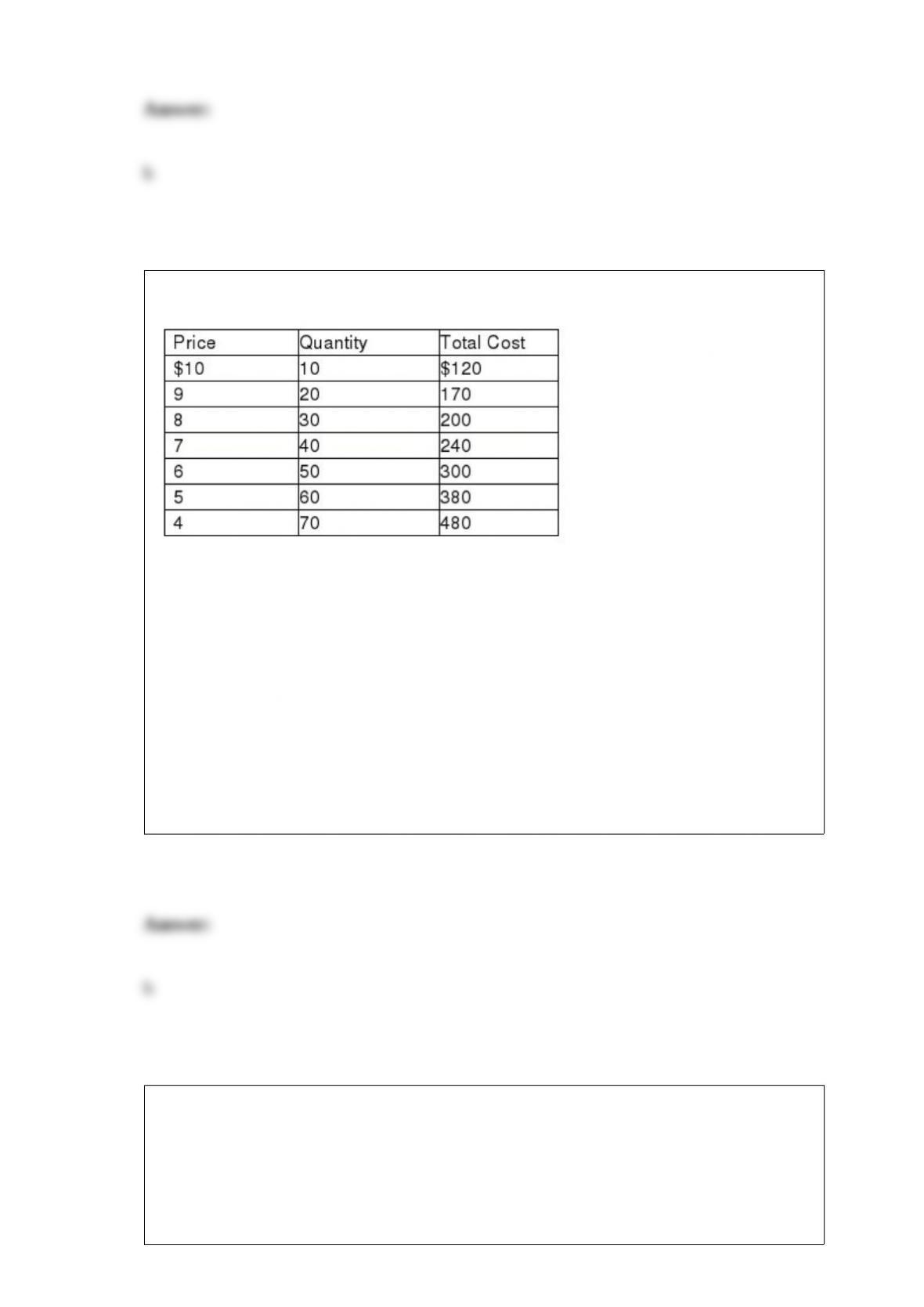
Exhibit 25-7
A monopolistic competitive firm earns a total profit of __________ when it produces
the profit maximizing level of output.
a. $12
b. $40
c. $20
d. $80
e. $200
If an industry consists of 20 firms holding equal market shares, the Herfindahl index is
a. 500.
b. 400.

c. 1,800.
d. 2,500.
e. This cannot be determined without further information.
Some economists refer to a monopsony as a
a. factor price taker.
b. factor buyer.
c. buyer’s monopoly.
d. single-price monopolist.
e. Economists don’t refer to a monopsony as anything other than a monopsony.
Situation 37-2
Dan and Ann live in the same community and both can participate in two activities,
producing and stealing.
If Dan’s MB/MC ratio for producing is currently greater than his MB/MC ratio for
stealing, then he will
a. steal more and produce less.
b. steal less and produce less.

c. produce more and steal more.
d. produce more and steal less.
Which of the following is not one of the four broad categories of resources?
a. labor
b. government
c. capital
d. entrepreneurship
e. land
Unit cost refers to
a. average variable cost.
b. average fixed cost.
c. marginal cost.
d. average total cost.
e. c or d