1) Scenario 18-3
Sam has two jobs, one for the winter and one for the summer. In the winter, he works as
a lift attendant at a ski resort where he earns $13 per hour. During the summer, he drives
a tour bus around the ski resort, earning $11 per hour.
Refer to Scenario 18-3. Assume that Sam has an upward-sloping labor supply curve. If
the opportunity cost of Sam’s leisure time increases, he will respond by working
a.more hours.
b.fewer hours.
c.an equal number of hours.
d.a number of hours that cannot be determined from the information. The labor demand
curve is needed to make this determination.
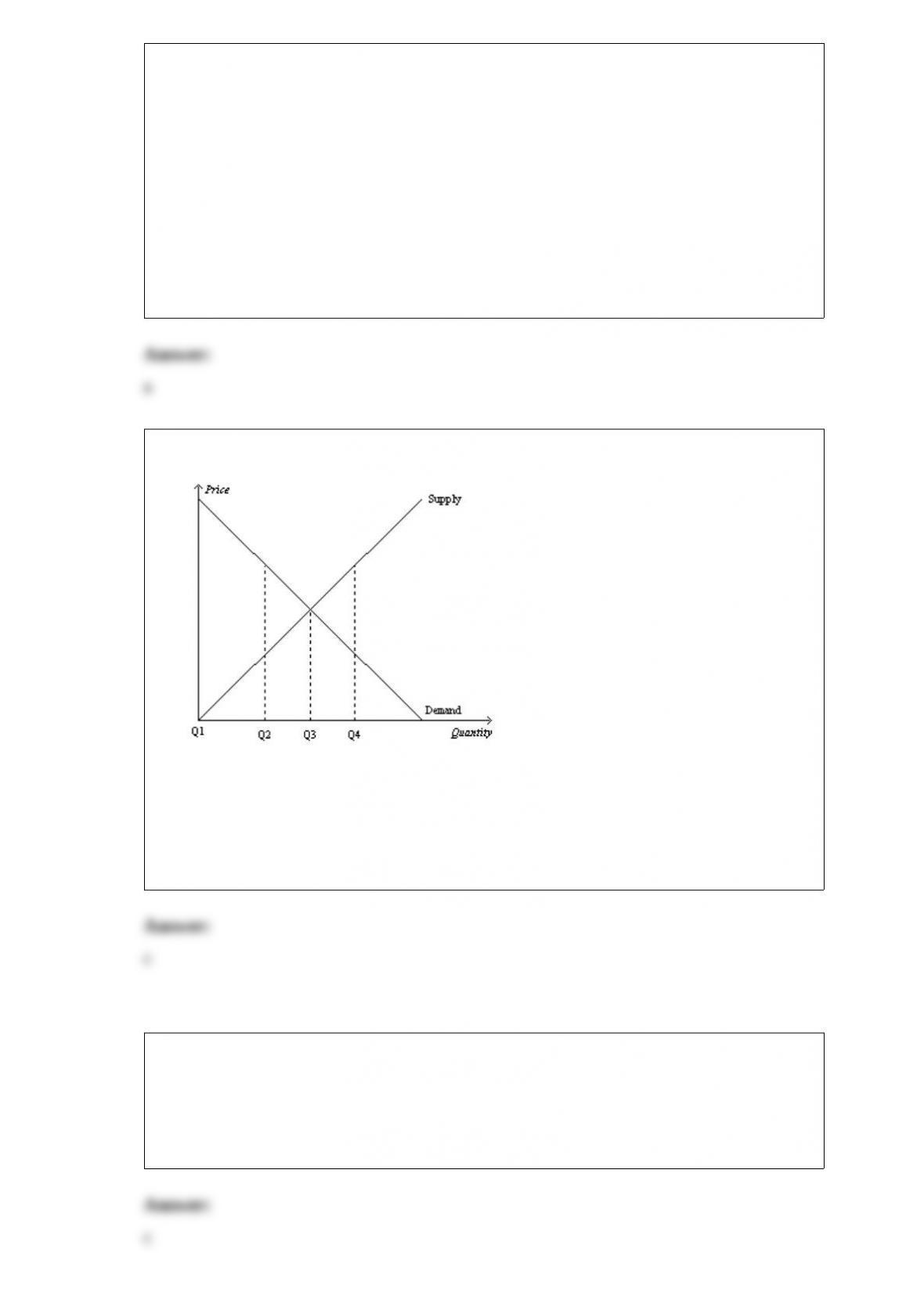
2) Figure 7-29
Refer to Figure 7-29. Which of the following statements is correct?
a.The market is in equilibrium at Q1.
b.At Q2, the cost to sellers exceeds the value to buyers.
c.At Q4, the value to buyers is less than the cost to sellers.
d.At Q3, the market is producing too much output.
3) When describing the opportunity cost of two producers, economists use the term
a.natural advantage.
b.trading advantage.
c.comparative advantage.
d.absolute advantage.
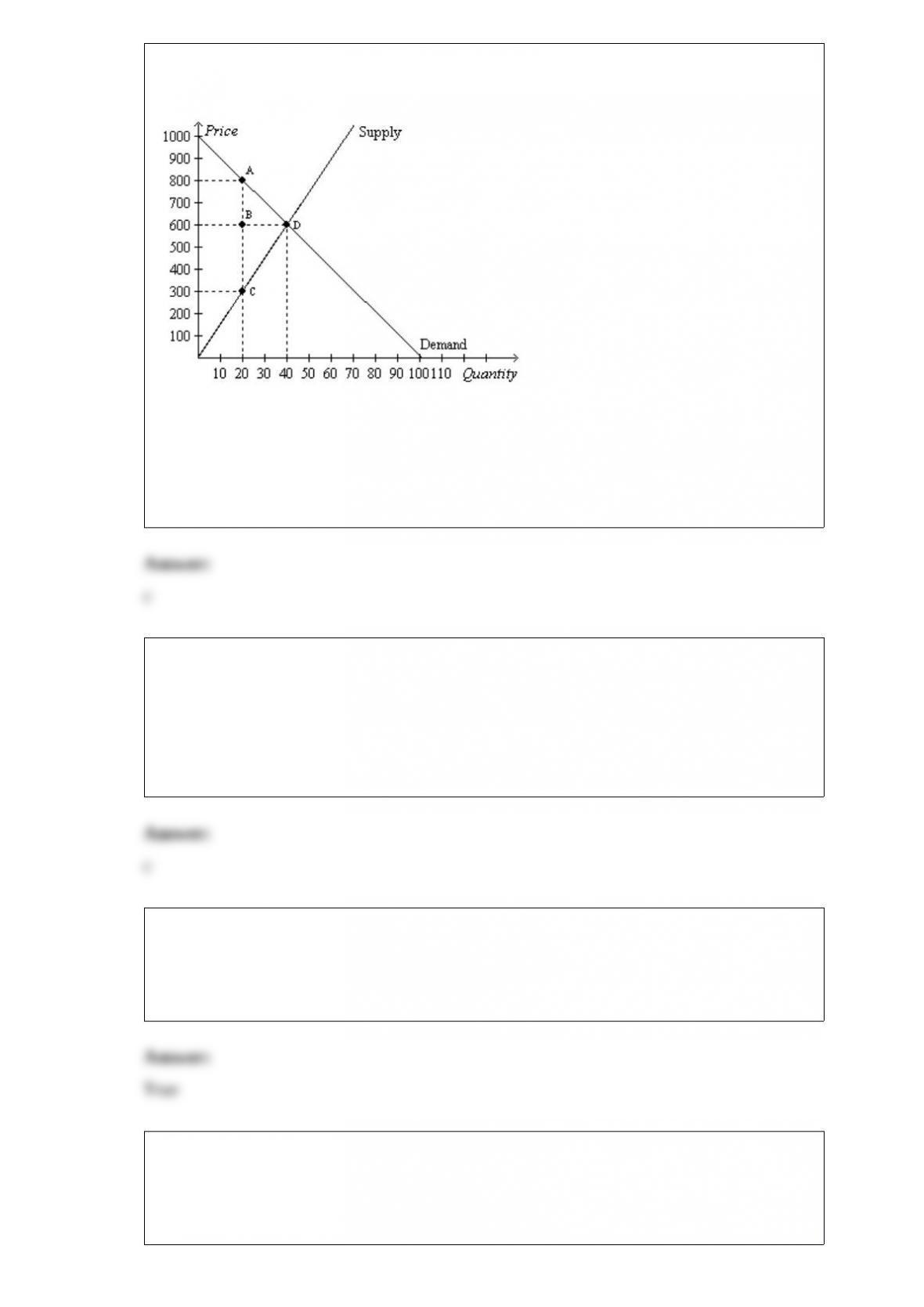
4) Figure 8-9
The vertical distance between points A and C represents a tax in the market.
The loss of consumer surplus as a result of the tax is
a. $2,000.
b. $4,000.
c. $6,000.
d. $8,000.
5) The 2011 U.S. distribution of income shows that the top 20 percent of families have
approximately what share of income?
a.20 percent
b.35 percent
c.50 percent
d.80 percent
6) In most countries today, many goods and services consumed are imported from
abroad, and many goods and services produced are exported to foreign customers.
a.True
b.False
7) When existing firms lose customers and profits due to entry of a new competitor, a
a.predatory-pricing externality occurs.
b.consumption externality occurs.
c.business-stealing externality occurs.
d.product-variety externality occurs.
8) Suppose that technological progress increases the productivity of teachers. Which of
the following accurately describes the labor market for teachers after the technological
change? Equilibrium wages will
a.rise, and the equilibrium quantity of teachers employed will fall.
b.rise, and the equilibrium quantity of teachers employed will rise.
c.fall, and the equilibrium quantity of teachers employed will fall.
d.fall, and the equilibrium quantity of teachers employed will rise.
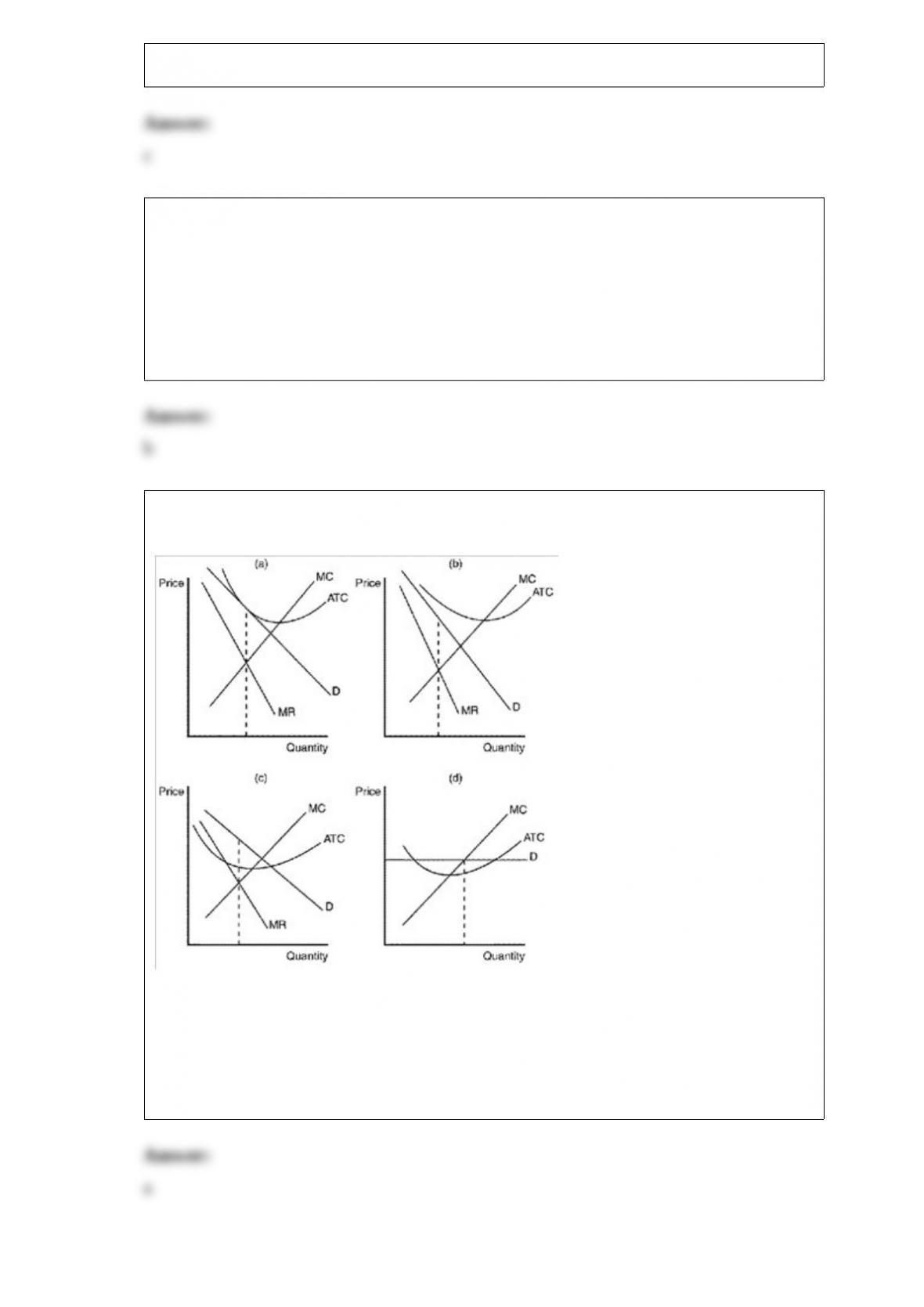
9) Figure 16-5
Which of the graphs depicts a short-run equilibrium that will not encourage either the
entry or exit of firms in a monopolistically competitive industry?
a.panel a
b.panel b
c.panel c
d.panel d
10) Consider a monopolistically competitive firm in a market in long-run equilibrium.
This firm is likely earning
a.a positive economic profit since it is charging a price above marginal cost.
b.no economic profit since it is charging a price equal to its marginal cost.
c.a positive economic profit since it is charging a price above its average total cost.
d.no economic profit since it is charging a price equal to it average total cost.
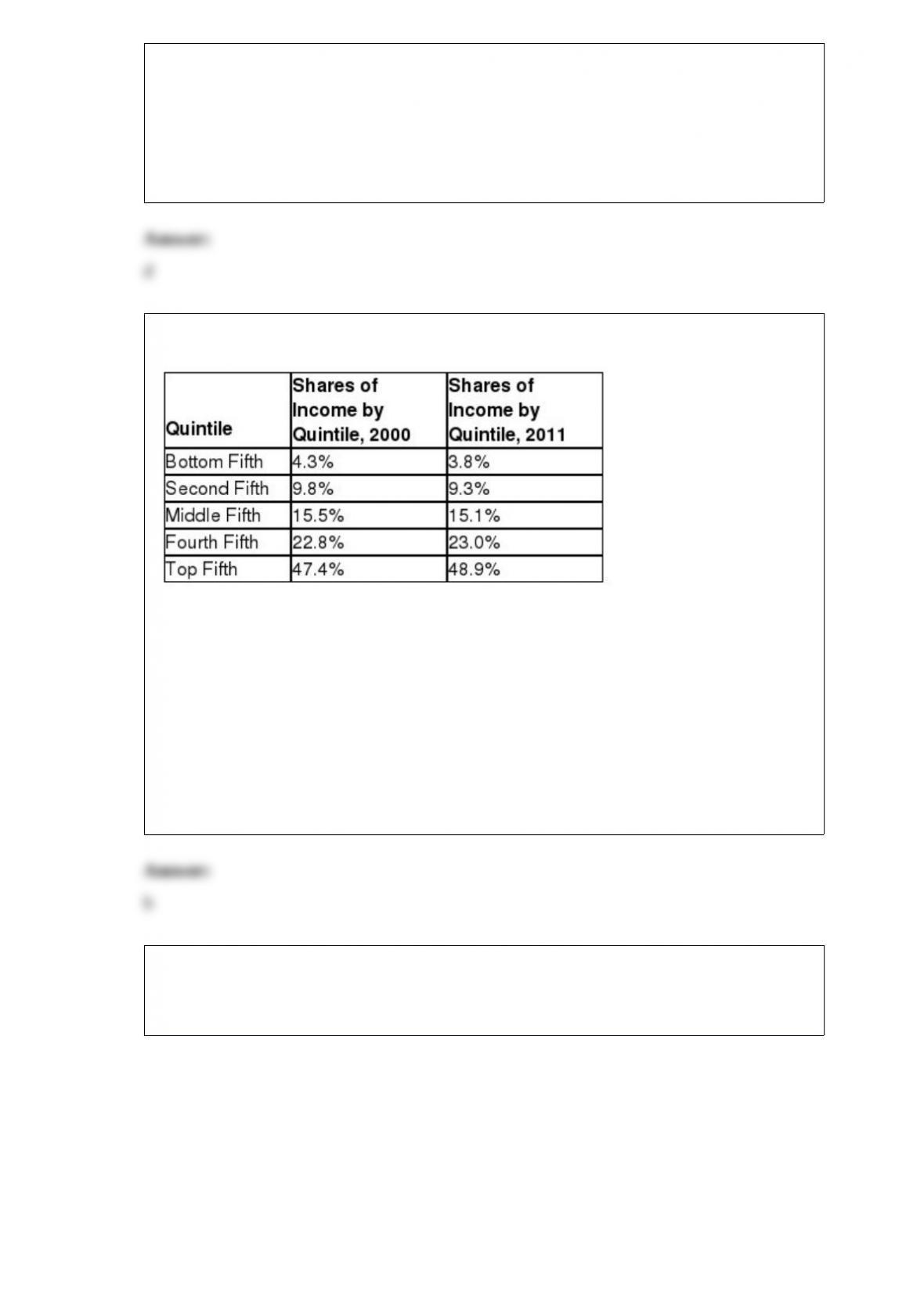
11) Table 20-8
Source: U.S. Bureau of Census
Refer to Table 20-8. Comparing data from 2000 and 2011, which of the following
statements is correct?
a.The bottom 40% of the population had a greater share of the income in 2011 than it
did in 2001
b.The top 40% of the population had a greater share of the income in 2011 than it did in
2001
c.The middle 60% of the population had a greater share of the income in 2011 than it
did in 2001
d.All of the above are correct
12) The production possibilities frontiers below show how much Bob and Betty can
each produce in 8 hours of time.
Bob’s Production Possibilities Frontier
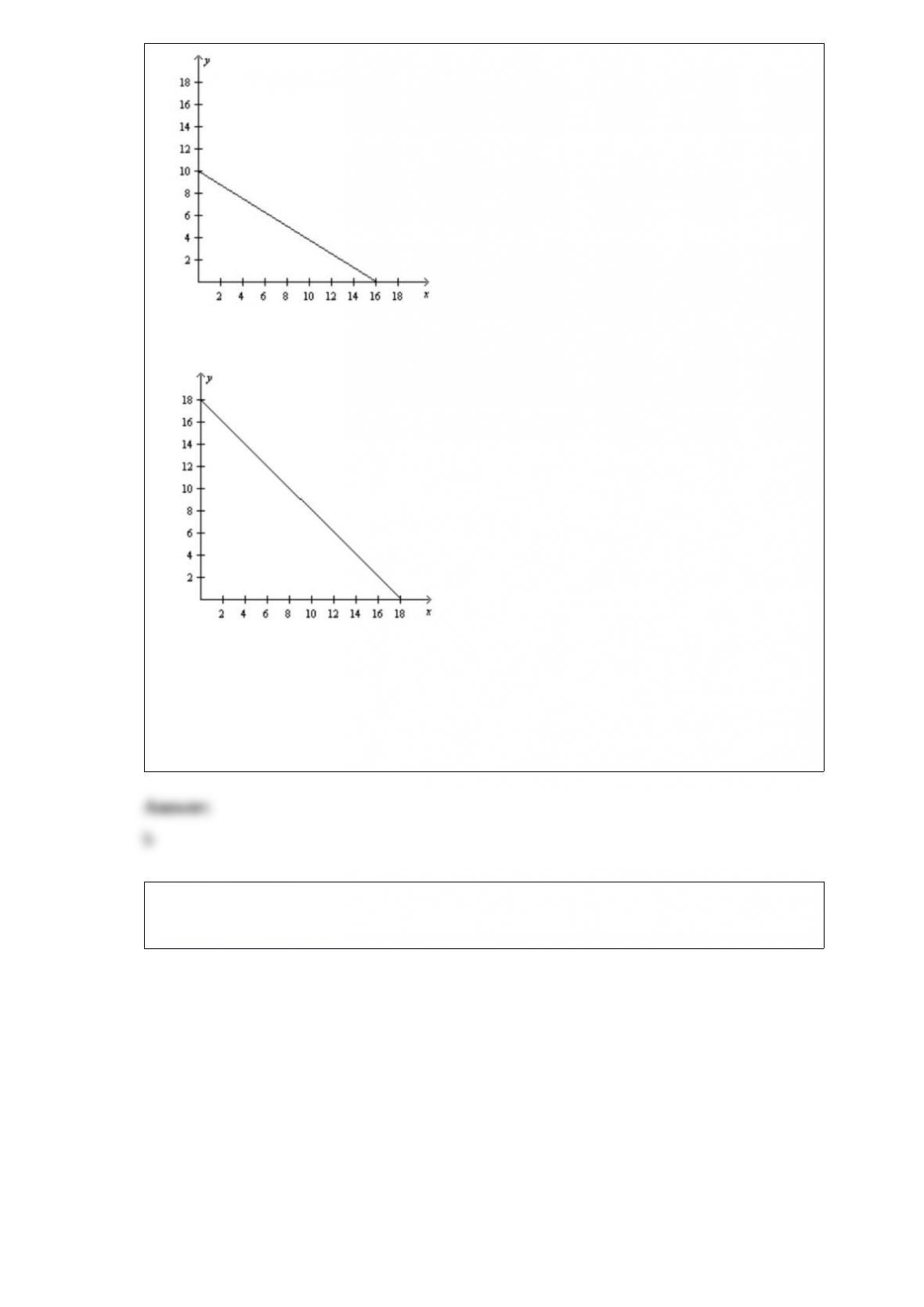
Betty’s Production Possibilities Frontier
Betty has
a.an absolute and comparative advantage producing good x.
b.an absolute but not a comparative advantage producing good x.
c.a comparative but not an absolute advantage producing good x.
d.neither a comparative nor an absolute advantage producing good x.
13) Figure 16-9
The figure is drawn for a monopolistically-competitive firm.
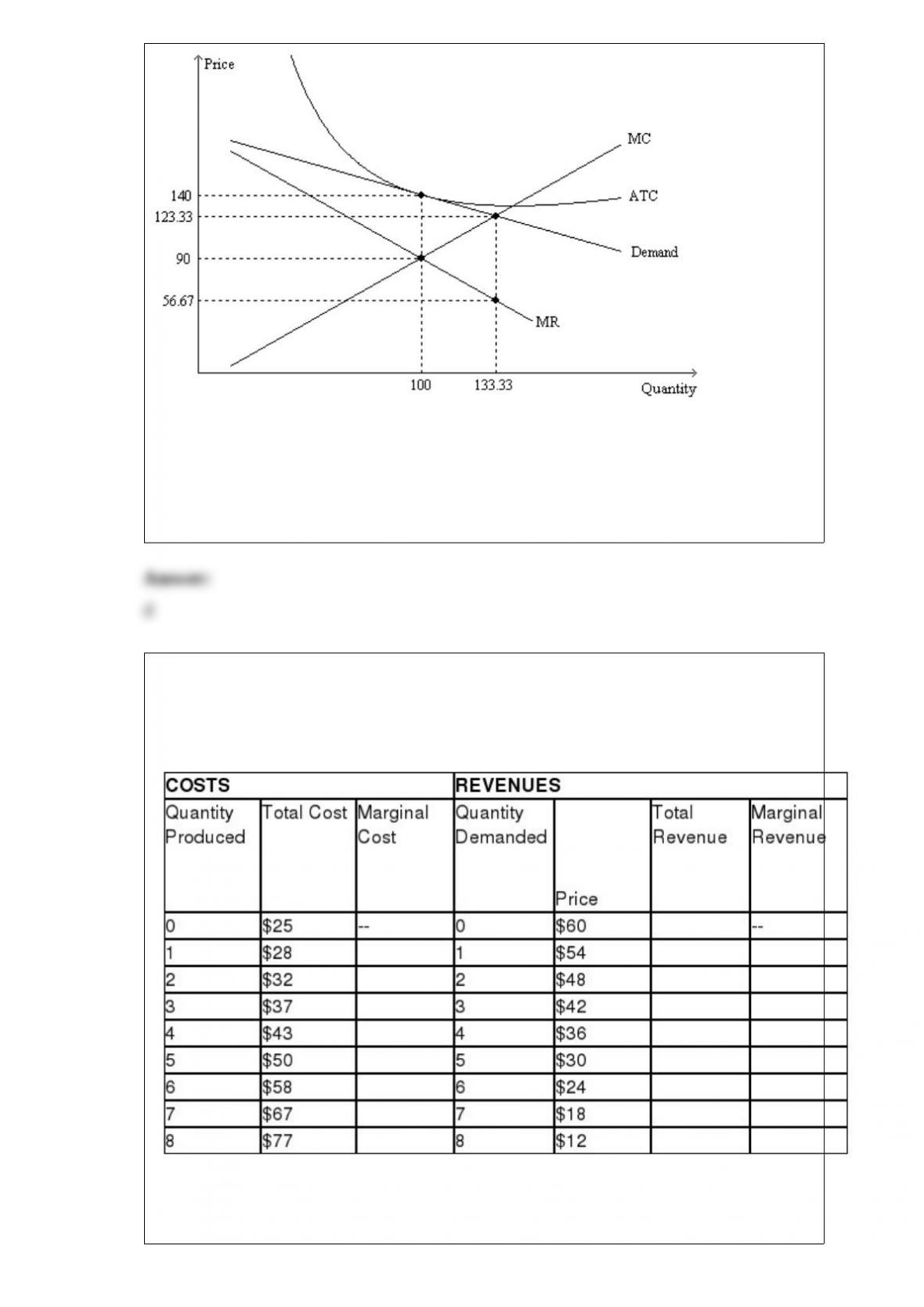
Efficient scale is reached
a.at 100 units.
b.between 100 and 133.33 units.
c.at 133.33 units.
d.beyond 133.33 units.
14) Table 16-6
Beatrice’s Birthday Cakes is one bakery among many in the market for birthday cakes.
The following table presents cost and revenue data for birthday cakes at Beatrice’s.
What is the profitmaximizing output for Beatrice’s Birthday Cakes?
a.3 cakes
b.4 cakes
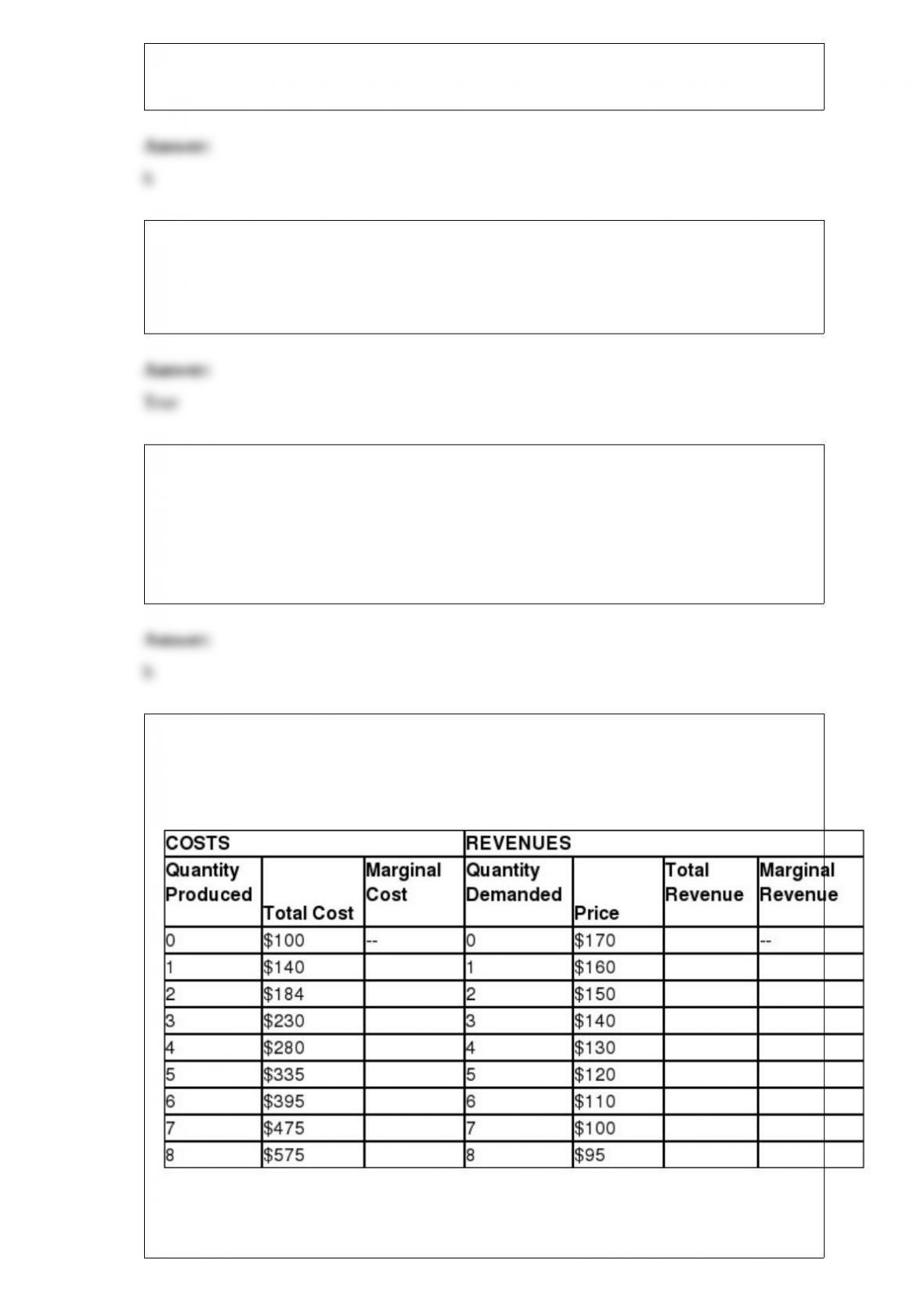
c.5 cakes
d.6 cakes
15) The “monopoly” in monopolistically competitive markets is most likely a result of
firms having some pricing power due to product differentiation.
a.True
b.False
16) Which of the following changes would not shift the supply curve for a good or
service?
a.a change in production technology
b.a change in the price of the good or service
c.a change in expectations about the future price of the good or service
d.a change in input prices
17) Table 15-21
Tommy’s Tie Company, a monopolist, has the following cost and revenue information.
Assume that Tommy’s is able to engage in perfect price discrimination.
What are Tommy’s Ties Company’s fixed costs?
a.$100
b.$150

c.$354
d.$654
18) As the size of a tax rises, the deadweight loss
a.rises, and tax revenue first rises, then falls.
b.rises as does tax revenue.
c.falls, and tax revenue first rises, then falls.
d.falls as does tax revenue.
19) Positive statements can be evaluated using data alone, but normative statements
cannot.
a.True
b.False