
1) A major difficulty with the argument that trade barriers are necessary because foreign
workers are paid low wages is that:
A.labor costs and product prices are not related.
B.there is no discernible relationship between wage rates and labor productivity.
C.wage rates and labor productivity are directly related.
D.wage rates and labor productivity are inversely related.
2) currently (2008) the marginal tax rates of the federal personal income tax:
a.are less than corresponding average tax rates.
b.rise from 5 to 50 percent.
c.fall from 20 to 10 percent.
d.rise from 10 to 35 percent.
3) Graphically, cost-push inflation is shown as a:
A.leftward shift of the AD curve.
B.rightward shift of the AS curve.
C.leftward shift of AS curve.
D.rightward shift of the AD curve.
4) Which pair of market structures provides firms with the greatest ability to finance
R&D out of retained earnings?
A.oligopolists and pure monopolists.
B.pure competitors and pure monopolists.
C.pure competitors and monopolistic competitors.
D.monopolistic competitors and pure monopolists.
5) Two of the implications of large U.S. trade deficits for the United States are:
A.decreased current consumption and decreased indebtedness to foreigners.
B.reduced budget deficits and decreased indebtedness to foreigners.
C.reduced current consumption and higher saving.
D.increased current consumption and increased indebtedness to foreigners.

6) which of the following activities is excluded from gdp, causing gdp to understate a
nation’s well-being?
a.the services of used-car dealers
b.the child-care services provided by stay-at-home parents
c.the construction of new houses
d.government expenditures on military equipment
7) if an economy produces its most wanted goods but uses outdated production
methods, it is:
a.achieving productive efficiency, but not allocative efficiency.
b.not achieving productive efficiency.
c.achieving both productive and allocative efficiency.
d.engaged in roundabout production.
8) Entrepreneurship:
A.can be carried out either by individuals or teams of individuals.
B.is no longer important in a world of large corporate R&D laboratories.
C.is, by definition, carried out by a single individual.
D.is relevant to pure competition but not to the other market structures.
9) As it relates to R&D, the expected-rate-of-return curve, r:
A.usually slopes upward.
B.shows the cost of financing various levels of R&D.
C.varies in location depending on the location of the interest-rate-cost-of-funds curve, i.
D.represents the marginal benefit element in the MB = MC decision framework.
10)
The demand for airline pilots results from the demand for air travel. This fact is an
example of:
A.resource substitutability.
B.rising marginal resource cost.
C.elasticity of resource demand.
D.the derived demand for labor.
11)
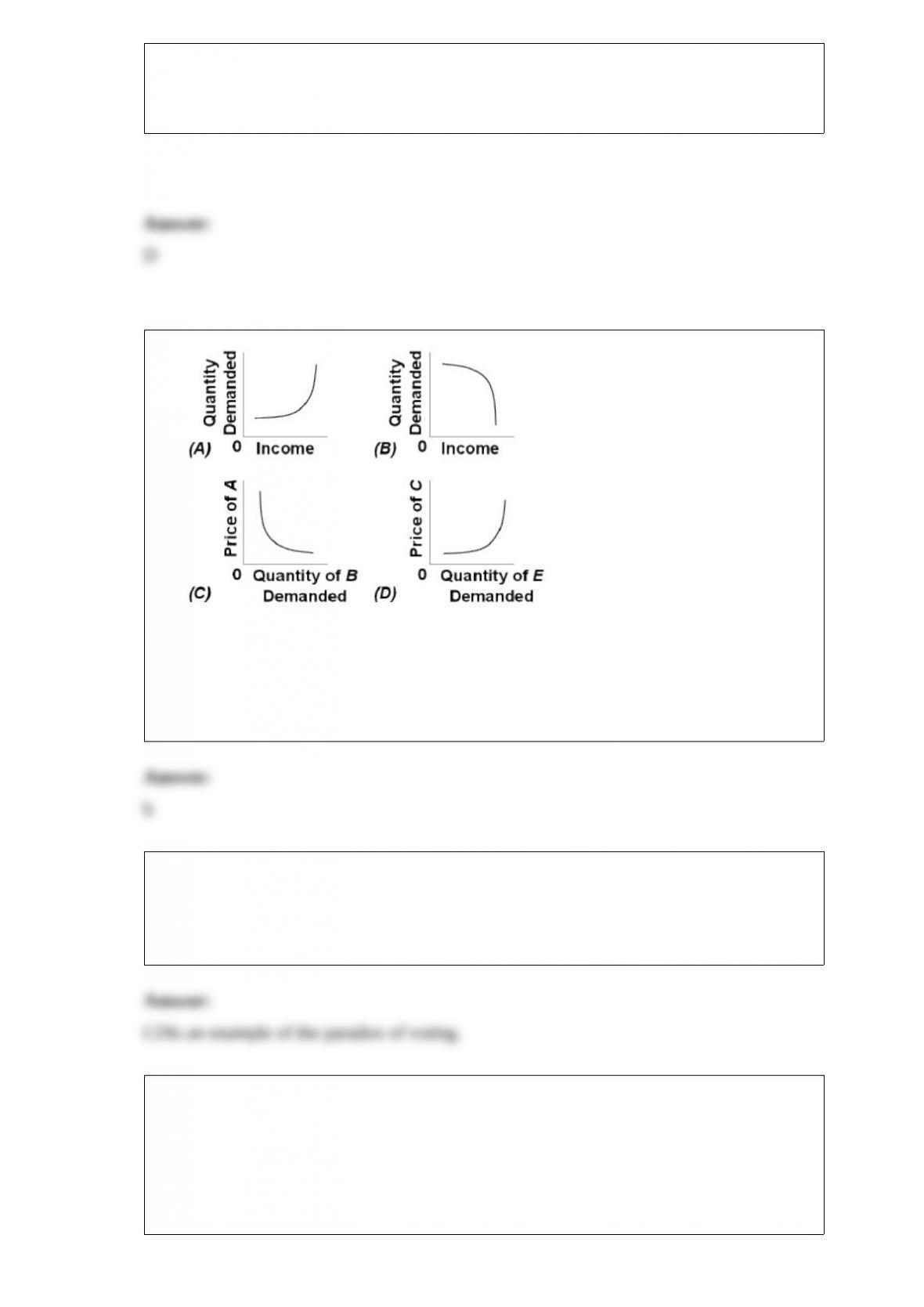
refer to the above diagrams. the case of an inferior good is represented by figure(s):
a.a only.
b.b only.
c.c.
d.d.
12) The political technique called logrolling:
A.always increases economic efficiency.
B.always decreases economic efficiency.
C.involves trading votes to secure favorable outcomes that otherwise would be rejected.
13) approximately half of the u.s. international trade is with:
a.the nations of eastern europe.
b.the developing countries of africa, asia, and latin america.
c.other industrialized nations, for example, canada, japan, and the countries of the
european union.
d.china.

14) The demand for land is:
A.perfectly inelastic because offering a different price will not affect how much land is
available for use.
B.downsloping because of diminishing returns.
C.upsloping because buyers want more land as its price rises.
D.perfectly elastic buyers can purchase as much as they want without influencing the
price.
15) nonexcludability is the idea that:
a.government actions cannot remedy market failure.
b.the presence of external costs and benefits produces a misallocation of resources.
c.individuals cannot receive benefits from a good without paying for it.
d.individuals who are unable or unwilling to pay for a good cannot be excluded from
the benefits provided by that product.
16) the law of supply:
a.reflects the amounts that producers will want to offer at each price in a series of
prices.
b.is reflected in a downsloping supply curve.
c.shows that the relationship between producer revenue and quantity supplied is
negative.
d.reflects the income and substitution effects of a price change.
17)
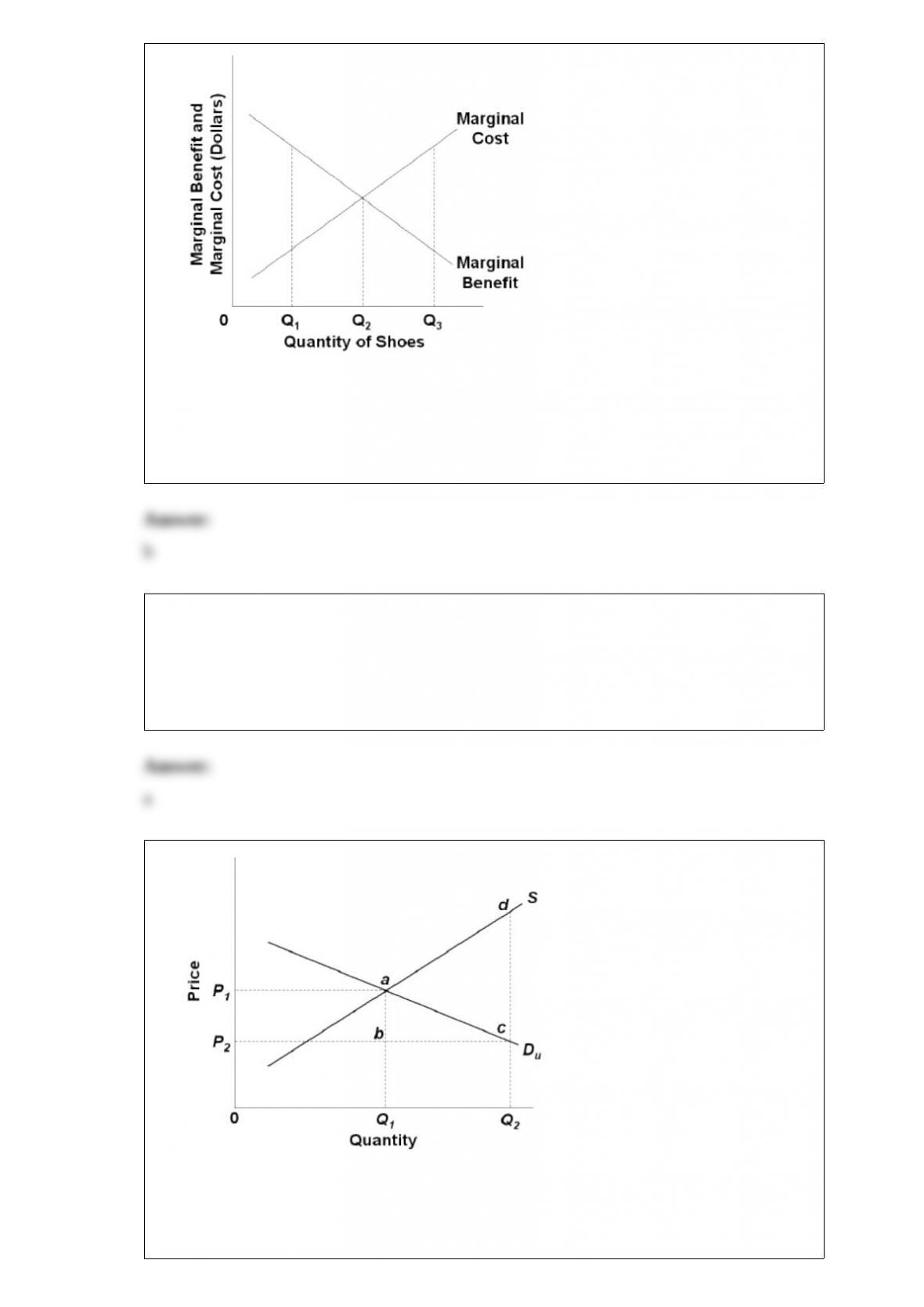
refer to the above diagram for athletic shoes. the optimal output of shoes is:
a.q1.
b.q2.
c.q3.
d.greater than q3.
18) a production possibilities curve illustrates:
a.scarcity.
b.market prices.
c.consumer preferences.
d.the distribution of income.
19)
refer to the above demand and supply diagram that relates to the health care market. if
suppliers provide whatever quantity of health care is demanded, health care insurance
causes:
a.resources to be underallocated to the health care industry.

b.resources to be overallocated to the health care industry.
c.health care to be underconsumed.
20) Which of the following arguments comes closest to constituting a legitimate
economic exception to the case for free trade?
A.the increase-domestic-employment argument
B.the cheap-foreign-labor argument
C.the diversification-for-stability argument
D.the infant-industry argument