1) The benefits-received principle of taxation supports the case for highly progressive
taxation.
2)
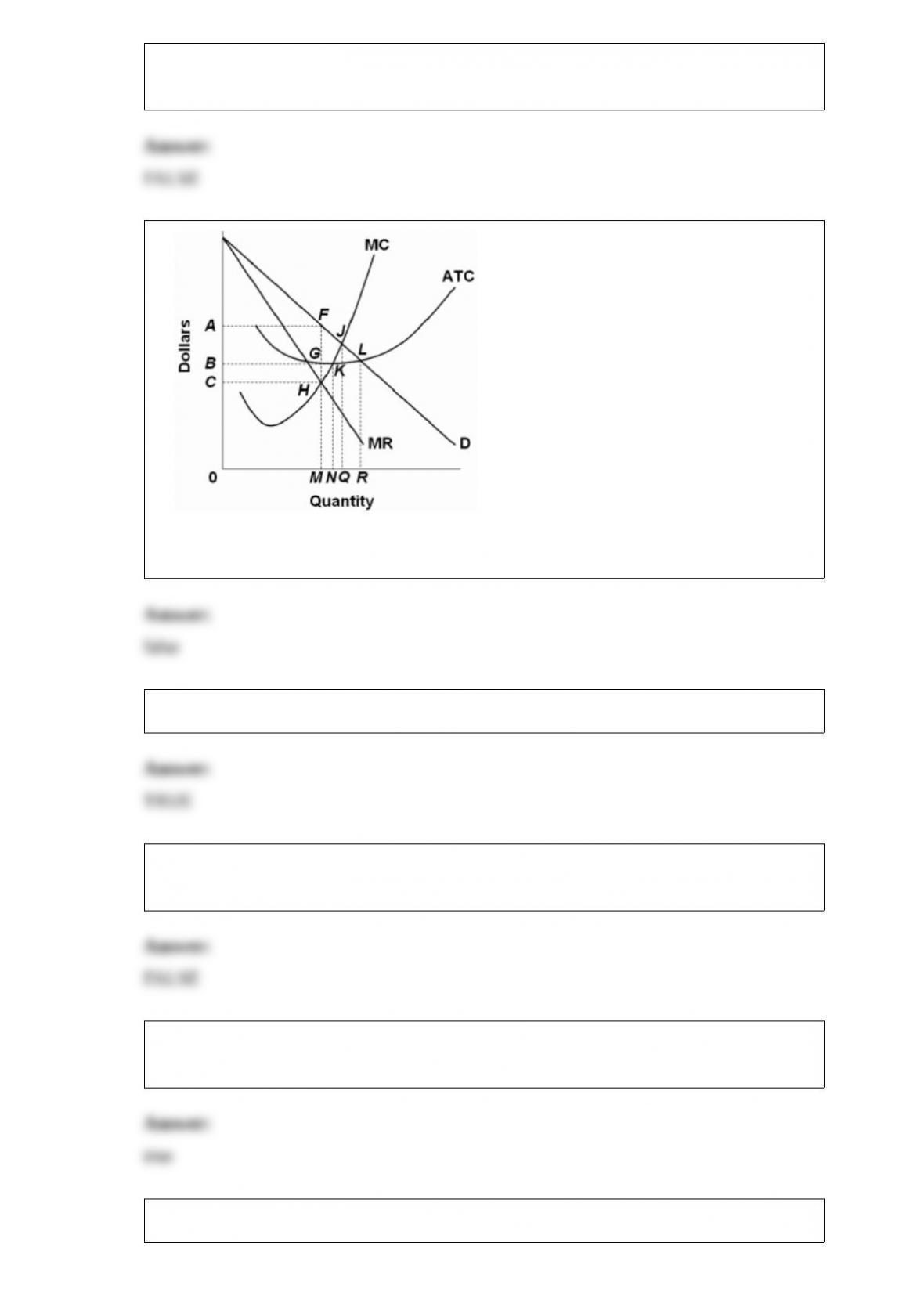
refer to the above diagram for a nondiscriminating monopolist. at output m total cost
will be 0chm.
3) Barriers to free trade impair efficiency in the international allocation of resources.
4) When the Fed auctions reserves through the term auction facility, the interest rate is
set by the rate offered by the highest bidder.
5) the term imperfect competition refers to every market structure besides pure
competition.
6) the economy of 1995-2007 was characterized by greater productivity growth and

greater economic growth than in the immediately preceding two decades.
7) assume a diagram in which a budget line is imposed on an indifference map. a
consumer will maximize her utility:
a.at any point where the budget line and an indifference curve intersect.
b.at either point where the budget line intersects the horizontal and vertical axes.
c.where the budget line is tangent to an indifference curve.
d.where the ratio of the two product prices equals the reciprocal of the consumer’s
income.
8) The median-voter model implies that a political office seeker will:
A.adopt more extreme views when seeking his or her party’s nomination than when
running against the other party’s opponent.
B.adopt less extreme views when seeking his or her party’s nomination than when
running against the other party’s opponent.
C.favor extensive government spending because demand curves for public goods are
added vertically rather than horizontally.
D.favor the private resolution of externality problems rather than governmental
intervention.
9) suppose 30 units of product a can be produced by employing just labor and capital in
the four ways shown below. assume the prices of labor and capital are $2 and $3
respectively.
refer to the above information. if the price of product a is $0.50, the firm will realize:
a.an economic profit of $4.
b.an economic profit of $2.
c.an economic profit of $6.
d.a loss of $3.

10)
In which of the above market situations will the efficiency loss of an excise tax be the
greatest?
A.4
B.3
C.1
D.2
11) In new classical economics, “a price-level surprise”:
A.has no effect on the economy.
B.causes a temporary change in real output.
C.causes a permanent change in real output.
D.can never occur since people correctly anticipate the future.
12) Graphically, the full-employment, low-inflation, rapid-growth economy of the last
half of the 1990s is depicted by a:
A.rightward shift of the aggregate demand curve along a fixed aggregate supply curve.
B.rightward shift of the aggregate supply curve along a fixed aggregate demand curve.
C.rightward shift of the aggregate demand curve and a rightward shift of the aggregate
supply curve.
D.leftward shift of the aggregate demand curve and a leftward shift of the aggregate
supply curve.
13) (last word) changes in stock market prices:
a.do not greatly impact the macroeconomy and used alone are not reliable predictors of

the future health of the economy.
b.greatly impact the macroeconomy but used alone are not reliable predictors of the
future health of the economy.
c.greatly impact the macroeconomy and used alone are reliable predictors of the future
health of the economy.
d.do not greatly impact the macroeconomy but used alone are reliable predictors of the
future health of the economy.
14) Appreciation of the Canadian dollar will:
A.intensify an existing disequilibrium in Canada’s balance of payments.
B.make Canada’s exports less expensive and its imports more expensive.
C.make Canada’s exports more expensive and its imports less expensive.
D.make Canada’s exports and imports both more expensive.
15) African-American worker Jackson earns $30,000 per year; white worker Johnson
earns $40,000 per year. On the basis of this information we can conclude that:
A.it is not clear whether discrimination is present in this situation.
B.there are no discriminatory forces at work in the labor market.
C.Jackson is being discriminated against, but the dollar amount is unclear.
D.Jackson is being discriminated against in the amount of $10,000 per year.
16) all of the following are sources of increasing returns and economies of scale except:
a.network effects.
b.the multiplier effect.
c.learning-by-doing.
d.simultaneous consumption.
17) according to dallas federal reserve economist w. michael cox, taken to its extreme,
the logic of “buying american” implies that:
a.we should buy everything from abroad.
b.people should only consume what they can produce themselves.
c.consumers should only buy goods from other states.
d.the best quality goods are found in the united states.
18) Which of the following describes the equilibrium condition in a purely competitive
labor market?
A.MRP = Wage Rate
B.MRP > Wage Rate
C.Wage Rate > MRC
D.Wage Rate < MRC
19)
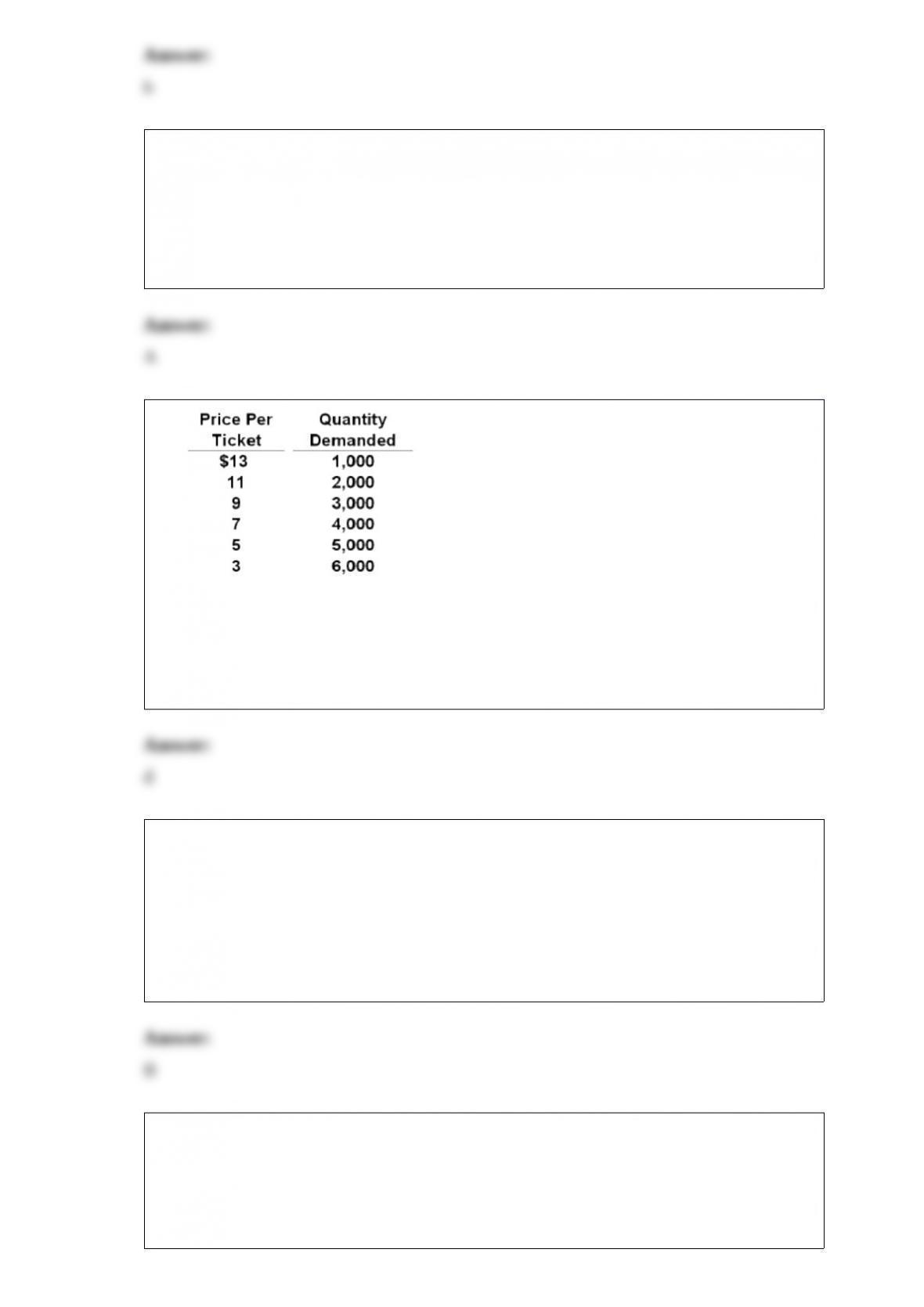
refer to the above information. over the $5-$3 price range, demand is:
a.perfectly elastic.
b.perfectly inelastic.
c.elastic.
d.inelastic.
20) In a private closed economy _____ investment is equal to saving at all levels of
GDP and equilibrium occurs only at that level of GDP where _____ investment is equal
to saving.
A.planned; actual
B.actual; planned
C.gross; net
D.net; gross
21) the nations of the euro zone have:
a.abandoned their national currencies and switched to a common currency.
b.abandoned their national currencies and switched to american dollars.
c.formed a single country called the union of european nations (uen).
d.recently admitted 10 new members.
22)
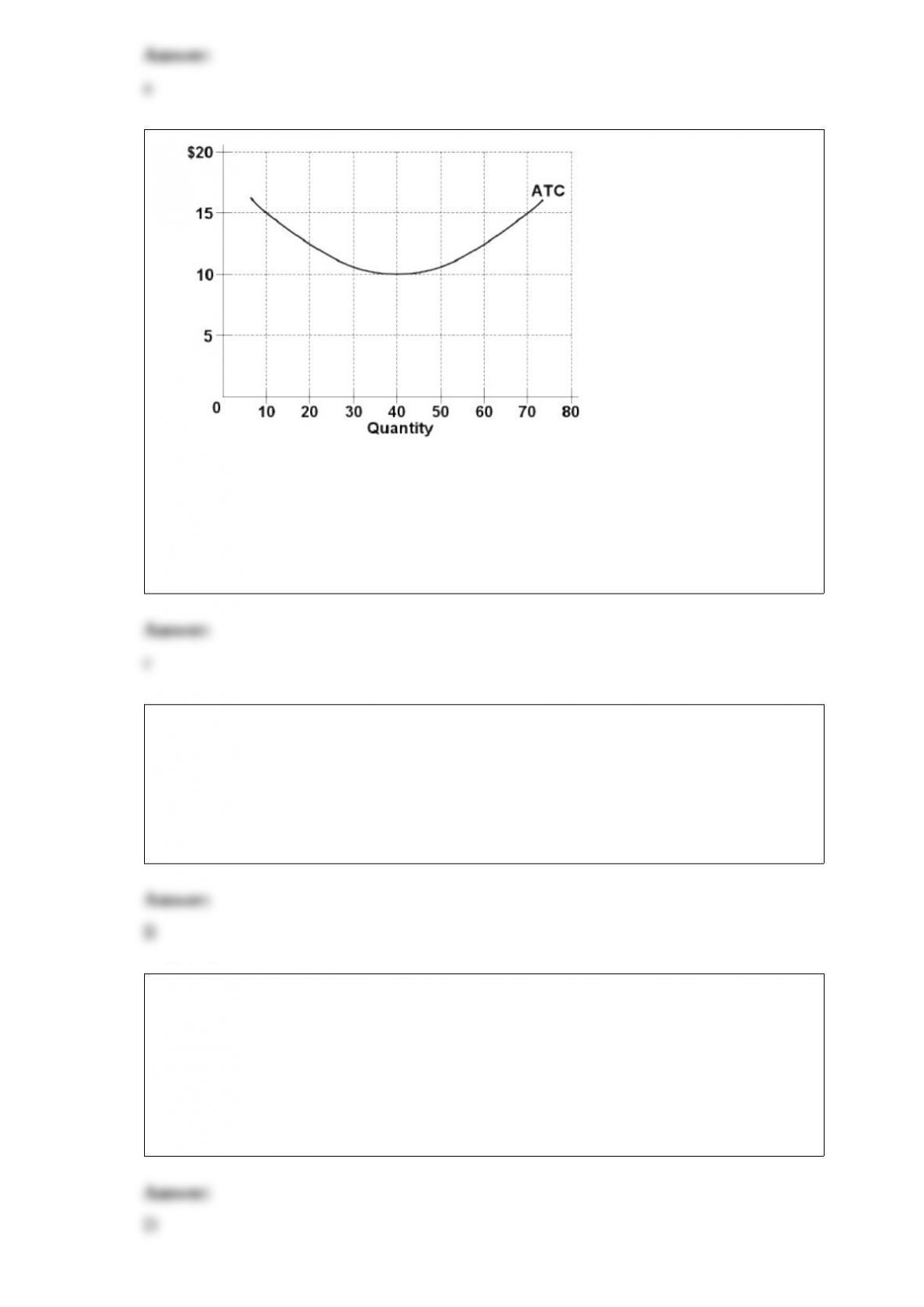
refer to the above diagram showing the average total cost curve for a purely competitive
firm. at the long-run equilibrium level of output, this firm’s total revenue:
a.is $10.
b.is $40.
c.is $400.
d.cannot be determined from the information provided.
23) Assuming a firm is selling its output in a purely competitive market, its resource
demand curve can be determined by:
A.multiplying total product by product price.
B.multiplying marginal product by product price.
C.dividing total revenue by marginal product.
D.comparing marginal product with various possible input prices.
24) Economic growth may hinge on whether individuals and institutions within a nation
want growth badly enough to change their traditional ways of doing things. This
statement refers to:
A.in-kind investment.
B.the capricious universe view.
C.human capital investment.
D.the will to develop.

25) for a purely competitive seller, price equals:
a.average revenue.
b.marginal revenue.
c.total revenue divided by output.
d.all of these.
26) Why do developing nations often have low labor productivity? Are the workers just
lazy?
27) What is the effect on the money supply when a commercial bank buys government
securities from the public?
28) If we as individuals would continue to spend more than we made, we would sooner
or later have to pay up or go bankrupt. Our government is in the same position or will
be unless we get serious about our liabilities and reduce expenditures enough to reduce
the deficits or increase revenues enough to pay our bills and have some left over to pay
the old bills. Evaluate this statement.
29) Evaluate the argument: Restricting imports from other nations will save U.S. jobs.
30) List six events that could cause a shift in the investment demand curve.
31) What are net benefits and how do they relate to natural resource economics?
32) Assume that a painter produces 20 paintings this year and 20 paintings next year.
What is the annual change in nominal GPD if the price of paintings rises from $1,000
this year to $1,500 next year? Can you conclude that the economy grew from this year
to next year based on your answer? Why?
33) What is the relationship between Social Security and the budget?
34) If a nations productivity grows by 3% rather than 1.5% over many years, what will
be the difference in the nations standard of living? Explain.
35) Give an example of the use of the time value of money in the study of natural
resource economics.