If decreased government borrowing drives down real interest rates in the United States,
a. private investment will tend to decline.
b. the dollar will depreciate leading to an increase in net exports.
c. an inflow of capital will cause the dollar to depreciate.
d. All of the above are true.
The tax reductions, increases in defense expenditures, and budget deficits of the 1980s
are characteristic of
a. expansionary fiscal policy.
b. the crowding-out effect.
c. restrictive fiscal policy.
d. the paradox of thrift.
Cartel agreements are difficult to maintain because individual members
a. can gain by raising their price above the price that is best for the cartel.
b. are often unable to police the price and output policies of other members.
c. can gain by secretly raising their price above the price that is best for the cartel.
d. can enforce price arrangements vigorously in court.

A form of economic organization that relies primarily on private ownership of
productive assets, freedom of exchange, and market prices to allocate goods and
resources is often called
a. national socialism.
b. the welfare state.
c. a corporate economy.
d. capitalism.
If a number of people suddenly deposit into their checking accounts a great deal of cash
previously kept in their pockets or at home, other things constant, their actions will
a. create excess reserves and place banks in a position to extend additional loans, which
will reduce the money supply.
b. create excess reserves and place banks in a position to extend additional loans, which
will expand the money supply.
c. lead to higher interest rates.
d. force the Fed to reduce its discount rate.

If the exchange rate value of one U.S. dollar changes from 120 Japanese yen to 140
yen,
a. the U.S. dollar has appreciated relative to the yen.
b. the Japanese yen has depreciated relative to the dollar.
c. the U.S. dollar has depreciated relative to the yen.
d. both a and b have occurred.
The National Industrial Recovery Act, passed in 1933, was an attempt to
a. break monopolies and cartels, and introduce competition into several different
industries.
b. fix prices, wages, and quotas for several industries in an effort to keep prices high.
c. lower corporate taxes and remove collusive behavior in an effort to keep U.S. firms
competitive with foreign manufacturers.
d. create a stable economic environment that would encourage investment and
expansion in the industrial sector of the economy.

The pure interest yield
a. reflects the expectation that the loan will be repaid with dollars of less purchasing
power.
b. is the real price one must pay for earlier availability.
c. reflects the probability of default.
d. is the real rate of return one could expect if the funds were invested in the
commodities market.
Which of the following is the strongest evidence of a shift toward a more expansionary
fiscal policy?
a. an increase in government spending as a share of the economy and an expansion in
the size of the budget deficit
b. a reduction in government spending as a share of the economy and a shift of the
budget toward a surplus
c. an increase in government spending as a share of the economy and a shift of the
budget toward a surplus
d. a reduction in government spending as a share of the economy and an expansion in
the size of the budget deficit
The random walk theory indicates that
a. investors can make money by purchasing stocks that are widely expected to earn
substantial profits in the future.
b. while changes in the prices of specific stocks are difficult to predict, experts are able
to forecast the future direction of broad stock market indexes with a high degree of
accuracy.
c. changes in stock prices are driven by surprise occurrences that are difficult for
anyone to predict accurately.
d. managed mutual funds will persistently outperform indexed funds.
If the demand for coffee makers increases,
a. the quantity demanded will decrease.
b. equilibrium price will increase and equilibrium quantity will decrease.
c. equilibrium price will decrease and equilibrium quantity will increase.
d. quantity supplied will increase.
e. quantity supplied will decrease.
Madison is a third-grade public school teacher who doesn’t own a car and uses public
transportation. According to public choice theory, which of the following four
politicians for a public office would Madison be most likely to vote for in the upcoming
election?
a. Politician A proposes increasing the property tax on personal automobiles and using
the money to increase teacher salaries by 10 percent.
b. Politician B proposes an across-the-board increase in state income tax rates and using
the money to increase the benefits paid to unemployed workers.
c. Politician C proposes increasing the property tax on personal automobiles and using
the money to increase the benefits paid to unemployed workers.
d. Politician D proposes an across-the-board increase in state income tax rates and using
the money to improve the highway system.
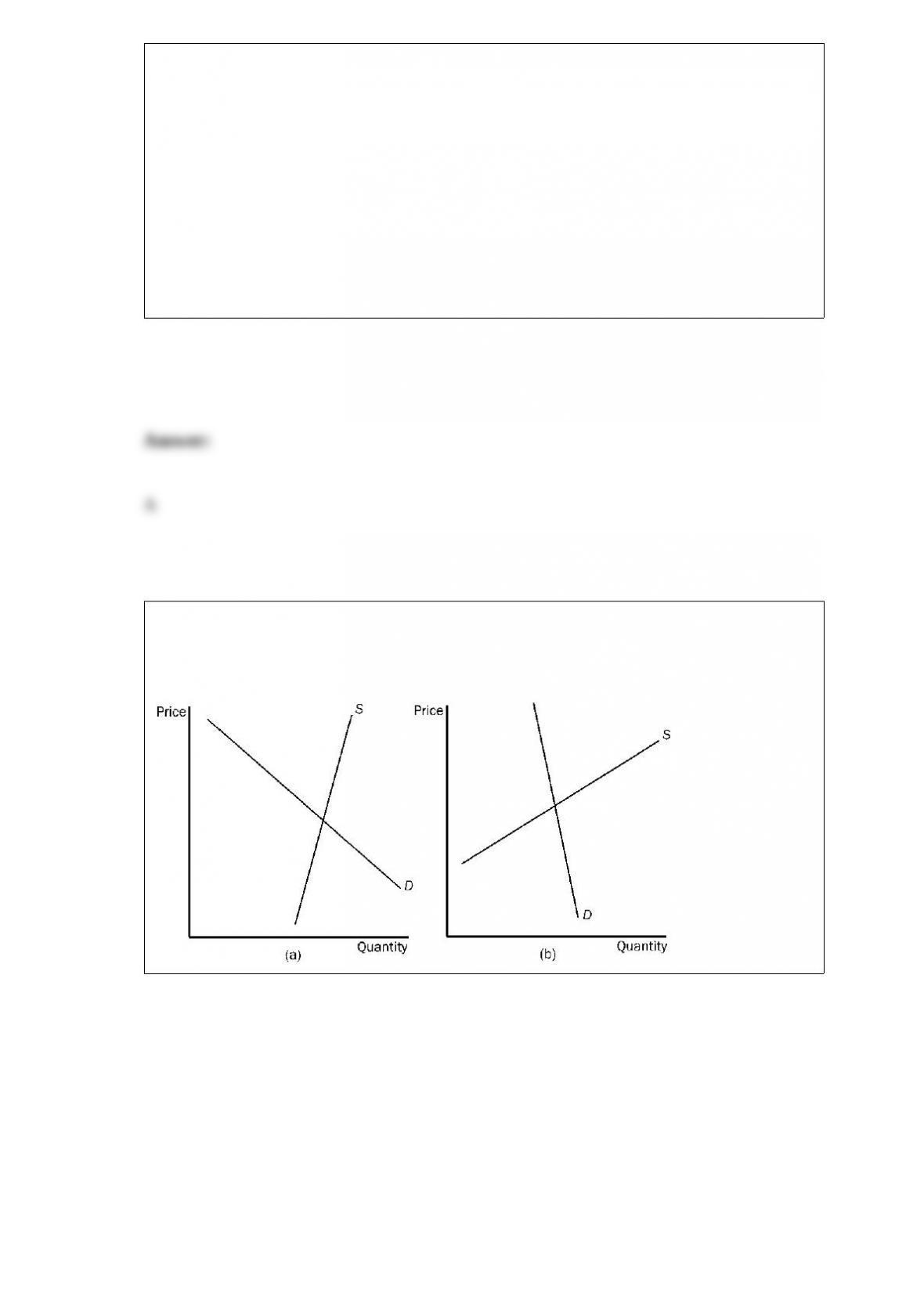
Figure 4-23
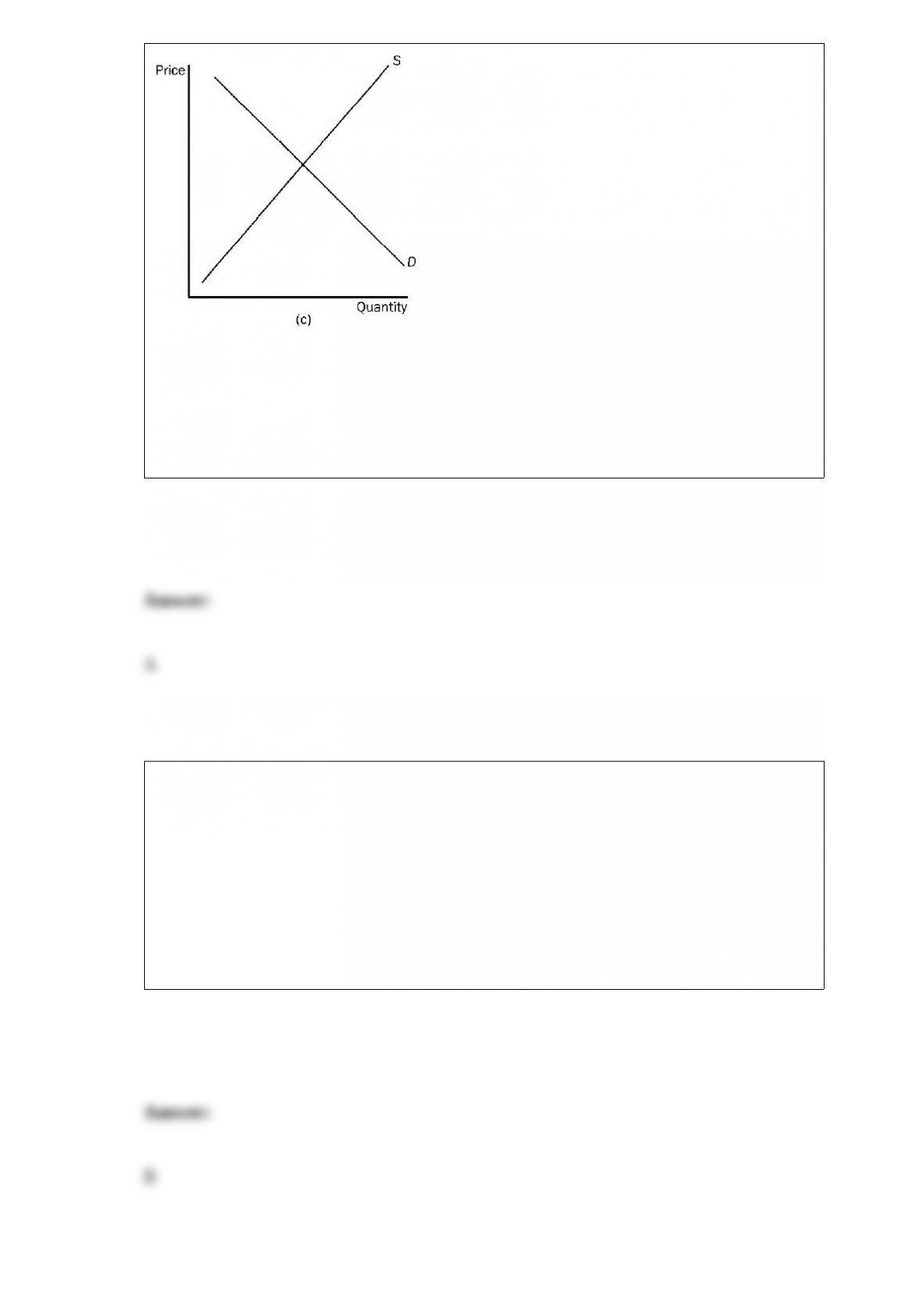
Refer to Figure 4-23. In which market will the majority of the tax burden fall on the
seller?
a. market (a)
b. market (b)
c. market (c)
d. All of the above are correct.
When an economy expands into an economic boom, automatic stabilizers will tend to
a. enlarge the budget deficit (or reduce the surplus).
b. reduce the budget deficit (or increase the surplus).
c. ensure that the budget will remain in balance.
d. reduce the supply of money and, thereby, retard aggregate demand.
Unanticipated restrictive monetary policy would tend to cause
a. real interest rates to rise.
b. the exchange rate value of the dollar to fall (the dollar to depreciate).
c. loans to become more available for small businesses.
d. asset prices to rise.
Economically speaking, tariffs are
a. a means to promote economic efficiency.
b. necessary to keep the industries of an economy healthy.
c. the same as import quotas.
d. obstacles that limit voluntary exchange.
Indicate whether the following transactions would be included in GDP. If they are
included, indicate which component (consumption, investment, government
consumption and gross investment, or net exports) of GDP would be affected.
a. A Czech student attending school in Florida takes a summer job as a lifeguard.
b. A New York company buys welding equipment from a St. Louis firm to help it build
jet fighters.
c. The IRS purchases a new computer from the GATS computer company (an
American-owned business producing and operating in Germany) that will allow it to
better detect income tax evasion.
When the effects of a more expansionary macroeconomic policy are quickly and
accurately anticipated, the policy will
a. increase inflation without reducing unemployment.
b. increase unemployment while exerting little impact on inflation.
c. decrease unemployment while exerting little impact on inflation.
d. fail to exert a significant impact on either unemployment or inflation.
If the U.S. imposed an import quota on sugar, then in the U.S.
a. exports and imports would rise.
b. exports and imports would fall.
c. exports would rise and imports would fall.
d. exports would fall and imports would rise.

A market will tend to be more competitive when
a. there are a small number of firms in the market.
b. similar products are available from alternative sellers.
c. entry barriers into the market are high.
d. governments require firms to meet strict regulatory standards.
Which of the following would be included in this year’s GDP?
a. the value of a used car, at its sale price
b. the value of a new domestic automobile, at its sale price
c. a sale of Microsoft stock from one individual to another
d. the face value of a life insurance policy paid to a woman at the death of her husband
Suppose Katie, Kendra, and Kristen each purchase a particular type of cell phone at a
price of $80. Katie’s willingness to pay was $100, Kendra’s willingness to pay was $95,
and Kristen’s willingness to pay was $80. Consumer surplus for the three individuals is

a. $15.
b. $20.
c. $35.
d. $80.
A decrease in a broad index of commodity prices suggests to the Fed that
a. money is plentiful, and the Fed should conduct restrictive policy.
b. money is plentiful, and the Fed should conduct expansionary policy.
c. deflation is a potential future danger, and the Fed should conduct expansionary
policy.
d. future prices will likely increase, and the Fed should conduct expansionary policy.
Hong Kong and Singapore both have relatively
a. high trade barriers and high rates of economic growth.
b. high trade barriers and low rates of economic growth.
c. low trade barriers and high rates of economic growth.
d. low trade barriers and low rates of economic growth.

The GDP deflator is designed to adjust nominal GDP for changes in
a. the level of transfer payments.
b. the quality of goods over time.
c. the costs of economic bads such as pollution and crime.
d. the general level of prices over time.
Which of the following is true?
a. if an investment project is going to be undertaken, someone must increase his current
consumption.
b. saving and investment must always be undertaken by different individuals.
c. if we invest more and use more of our resources to produce capital goods today,
fewer current resources will be available to produce consumption goods.
d. all of the above are correct.
Stock analysts often argue that lower interest rates are good for the stock market. Does

this argument make sense?
a. No; lower interest rates will tend to slow down the economy and this will be bad for
the stock market.
b. Yes; the lower rates of interest will increase the value of future income (and capital
gains) and stock prices will rise to reflect this factor.
c. No; the lower rates of interest will reduce the value of future income (and capital
gains) and this will cause stock prices to fall.
d. Yes; the lower interest rates will cause inflation and inflation is generally good for the
stock market.
Which of the following statements is false?
a. Political activities consistent with economic efficiency tend to emerge naturally from
the unconstrained democratic political process.
b. Constitutional rules establishing procedures and limiting the ability of the political
process to engage in redistributive activities can improve the economic efficiency of
government.
c. Rent-seeking activity tends to retard the economic prosperity of a nation because it
takes resources away from productive private sector activities.
d. Unconstrained democratic governments often enact special-interest programs that
waste resources and impair the standard of living of a country.

A local government operates a city recreation center with a pool and tennis courts. The
center is financed through $50 annual membership fees (required for members to use
it). This type of financing is an example of a
a. head tax.
b. excise fee.
c. user charge.
d. progressive tax.
Union membership will be more attractive from the worker’s viewpoint if
a. the demand for the union labor is highly inelastic.
b. the supply of union labor is highly elastic.
c. only a few of the firms in the industry are unionized.
d. the membership dues charged by the union are extremely high.
Which of the following is true regarding economic fluctuations in the United States?
a. Since World War II, economic ups and downs have been more moderate than before
the war.
b. Prior to World War II, real GDP annual increases of more than 5 percent were
unheard of.
c. Real GDP grew rapidly during the 1930s.
d. The 1920s was a period of prolonged economic stagnation and high unemployment.
The amount of U.S. exports purchased by the rest of the world is primarily determined
by
a. real disposable income in the United States
b. real disposable income in other nations
c. the real interest rate in other nations
d. the real interest rate in the United States
e. the government budget deficits in other nations
A person who argues that inflation “robs us of the purchasing power of our paychecks”
should also consider that inflation
a. increases the value of the dollar, making paychecks worth more.
b. will increase the size of paychecks as well as the prices of goods.
c. does not affect the value of the dollar, either in paychecks or in prices.
d. only affects the prices of things that we buy, not the prices of things that we sell.

Which of the following is true?
a. The U.S. current account deficit is a financial obligation of the federal government.
b. A nation cannot run a current account deficit over a long period.
c. A country with relatively poor (compared with other countries) domestic investment
opportunities and a high saving rate will tend to run a current account deficit.
d. A country with highly attractive (compared with other countries) domestic
investment opportunities and a low saving rate will tend to run a current account deficit.