1) for a progressive tax the:
a.average tax rate exceeds the marginal tax rate as income rises.
b.marginal tax rate declines as income increases.
c.average and marginal tax rates are equal.
d.marginal tax rate exceeds the average tax rate as income rises.
2)
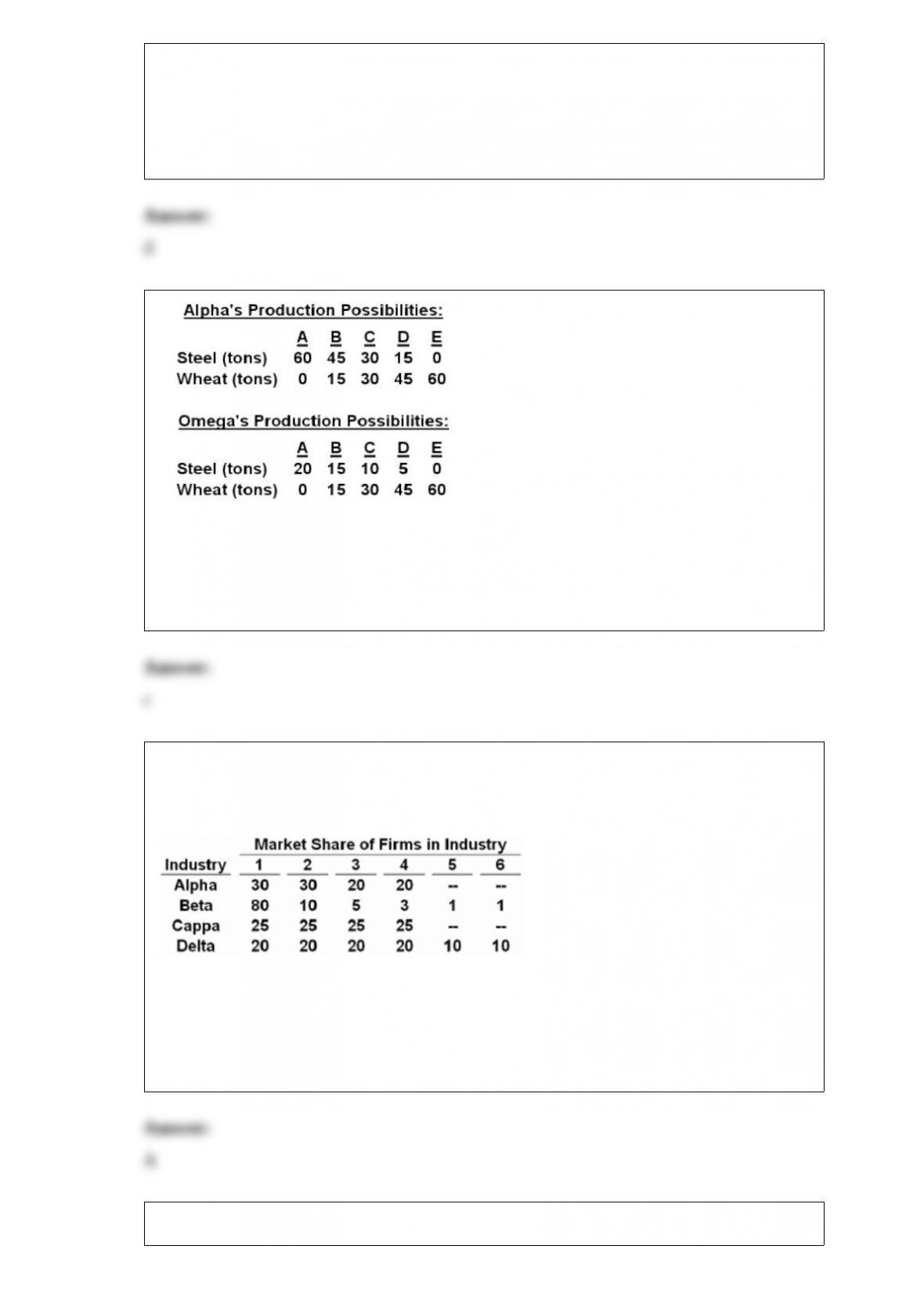
refer to the above data. alpha has a comparative advantage in producing:
a.neither steel nor wheat.
b.both steel and wheat.
c.steel.
d.wheat.
3) The following table shows market shares of firms in hypothetical industries. Assume
these are distinct industries with no buyer-seller relationships or competition among
them.
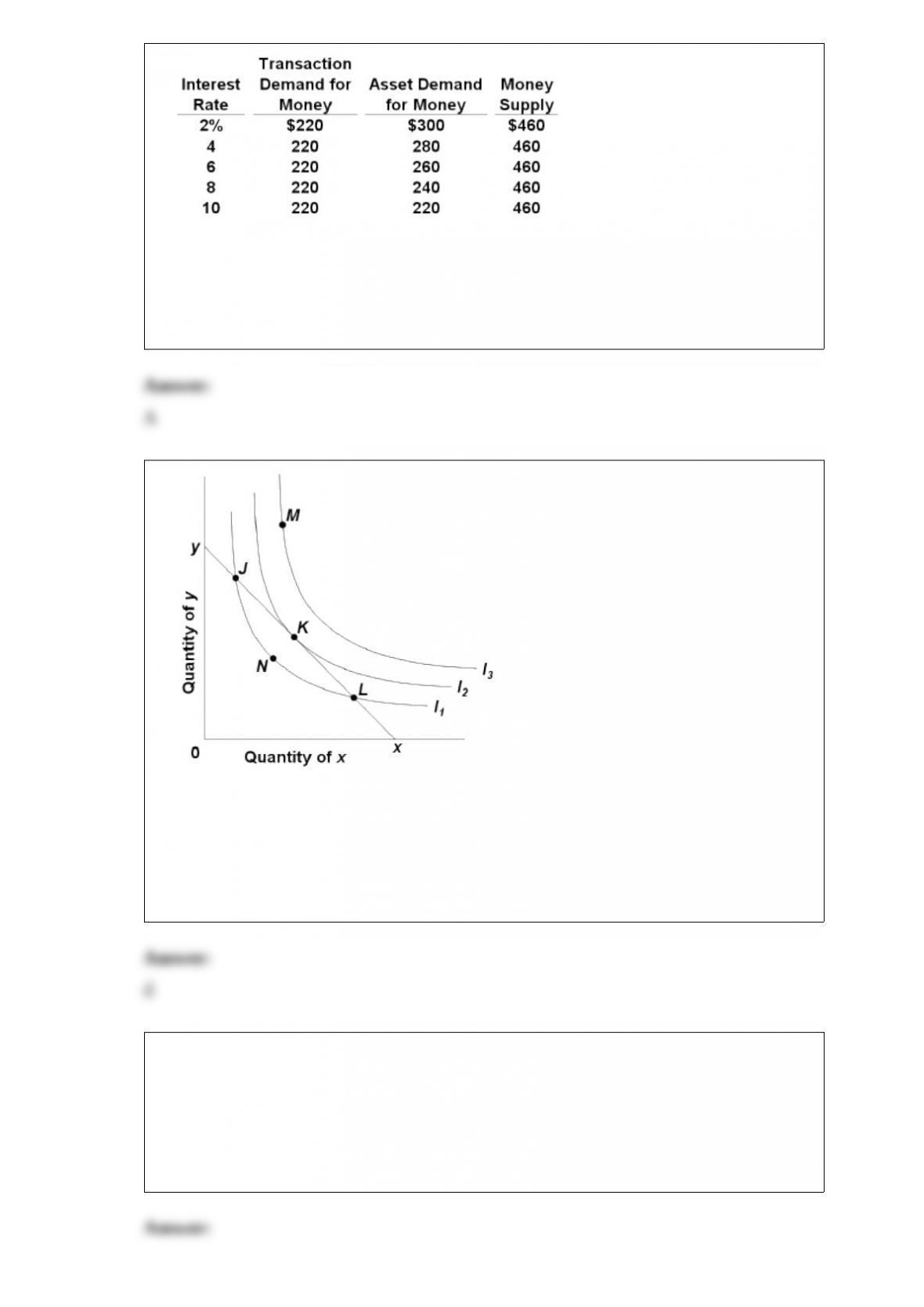
Refer to the above table. The Herfindahl index for Cappa is:
A.2,500.
B.100.
C.100,000.
D.5,000.
4) The introduction of mortgage-backed securities:

A.helped solve the mortgage debt crisis.
B.fully insulated banks from loan defaults.
C.created the fourth tool of monetary policy.
D.fueled the mortgage debt crisis by encouraging banks to issue riskier loans.
5) Suppose that government imposes a specific excise tax on product X of $2 per unit
and that the price elasticity of supply of X is unitary (coefficient = 1). If the incidence
of the tax is such that the producers of X pay $1.90 of the tax and the consumers pay
$.10, we can conclude that the:
A.supply of X is highly inelastic.
B.supply of X is highly elastic.
C.demand for X is highly inelastic.
D.demand for X is highly elastic.
6) The main focus of the vignette “Slicing the Pizza” is the:
A.equality-efficiency tradeoff.
B.principal-agent problem.
C.impact of market power on economic efficiency.
D.the highly unequal distribution of U.S. wealth.
7) The Lorenz curve portrays:
A.the functional distribution of income.
B.the ratio of labor to capitalist income.
C.the personal distribution of income.
D.income equality.
8)
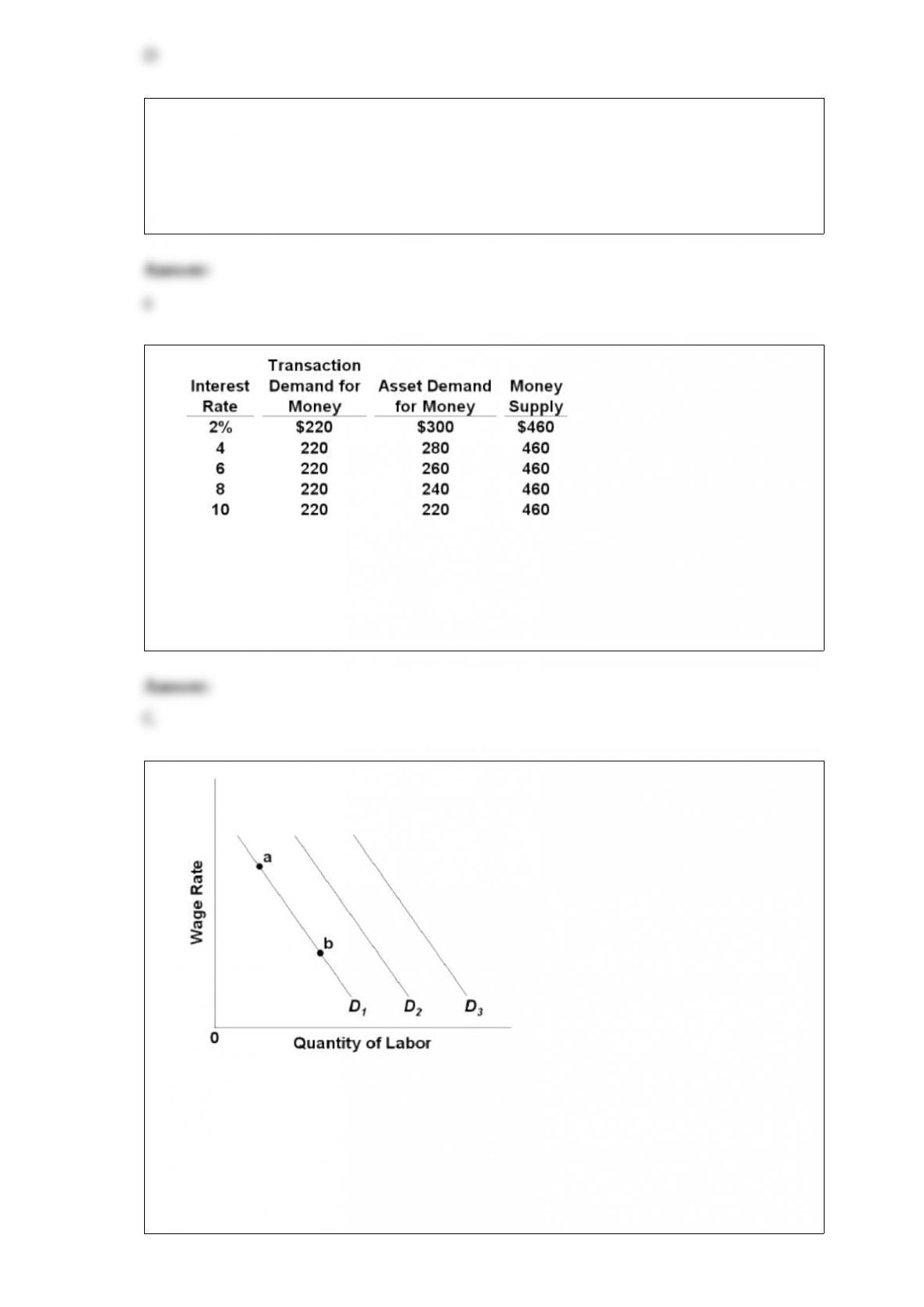
The transactions demand for money in the above market for money would graph as a:
A.vertical line.
B.horizontal line.
C.line sloping downward and to the right.
D.line sloping upward and to the right.
9)
refer to the above diagram where xy is the relevant budget line and i1, i2, and i3 are
indifference curves. if the consumer is initially at point l, he or she should:
a.strive for point n by obtaining a larger money income.
b.purchase more of x and less of y
c.remain at that point to maximize utility.
d.purchase more of y and less of x
10) The ideas of economist Arthur Laffer became the centerpiece for tax policy during
the:
A.Ford administration.
B.Clinton administration.
C.Nixon administration.
D.Reagan administration.
11) productive efficiency refers to:
a.the use of the least-cost method of production.
b.the production of the product-mix most wanted by society.
c.the full employment of all available resources.
d.production at some point inside of the production possibilities curve.
12)
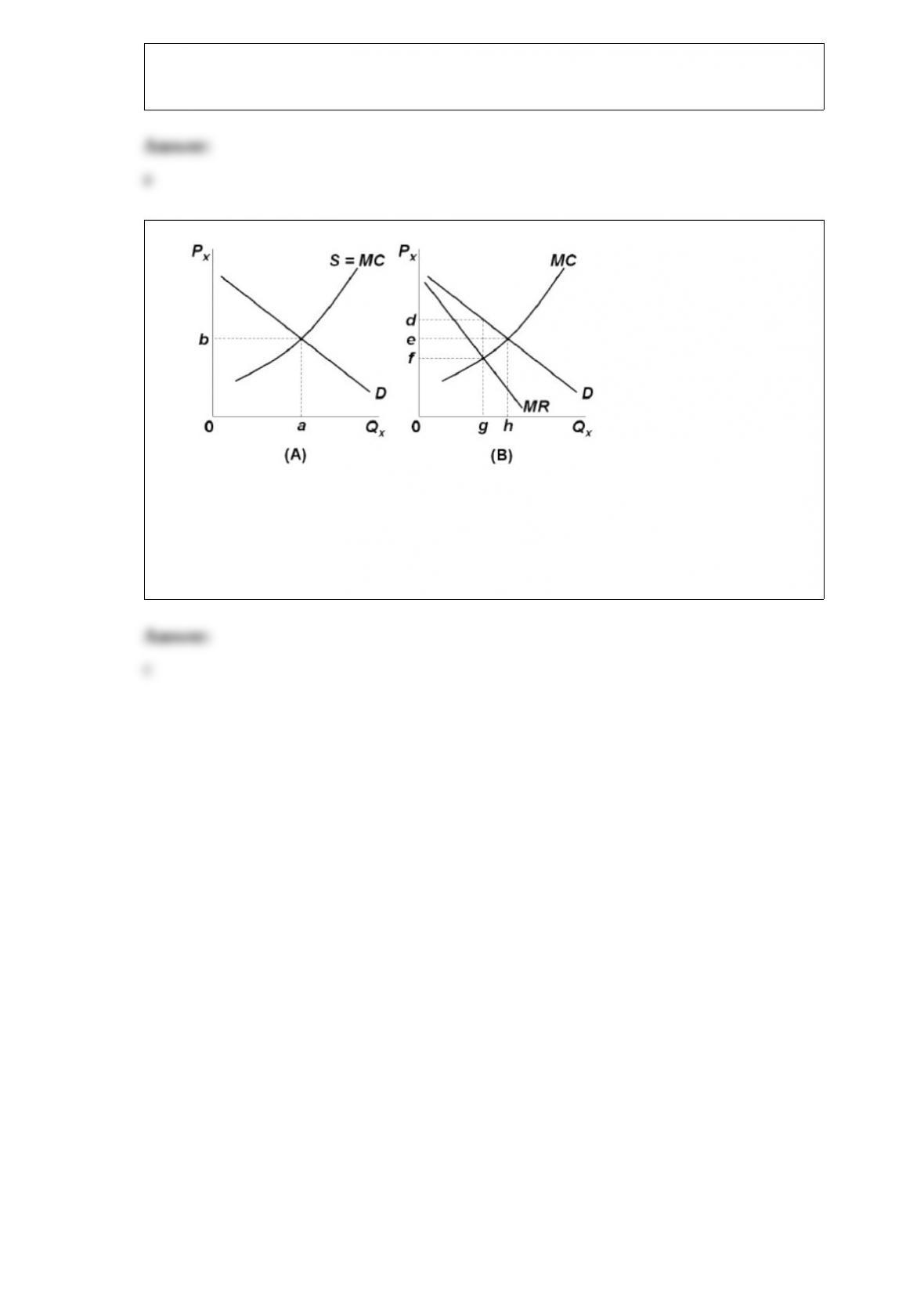
At equilibrium in the above market for money, the total amount of money demanded is:
A.$500.
B.$480.
C.$460.
D.$440.
13)
Refer to the above graph. A move from b to a along labor demand curve D1 would
result from:
A.a decrease in the price of a substitute resource, assuming that the substitution effect
exceeds the output effect.
B.an increase in the wage rate.
C.a decrease in the wage rate.
D.an increase in the demand for the product that this labor is helping to produce.

14) a supply curve that is a vertical straight line indicates that:
a.production costs for this product cannot be calculated.
b.the relationship between price and quantity supplied is inverse.
c.a change in price will have no effect on the quantity supplied.
d.an unlimited amount of the product will be supplied at a constant price.
15) For a new product to be profitable, it must:
A.enable customers to obtain greater total utility from their money income.
B.be less expensive than existing substitute products.
C.have greater marginal utility than existing substitute products.
D.embody process innovation.
16) assume initially that the price of x (measured on the horizontal axis) is $9 and the
price of y (measured on the vertical axis) is $4. if the price of x now declines to $6, the
budget line will:
a.be unaffected.
b.shift outward on the vertical axis.
c.shift inward on the horizontal axis.
d.shift outward on the horizontal axis.
17) To reduce the Federal funds rate, the Fed can:
A.buy government bonds from the public.
B.increase the discount rate.
C.increase the prime interest rate.
D.sell government bonds to commercial banks.
18) which of the following is most likely to be an implicit cost for company x?
a.depreciation charges on company-owned equipment
b.rental payments on ibm equipment
c.payments for raw materials purchased from company y
d.transportation costs paid to a nearby trucking firm
19)
refer to the above diagrams. with the industry structure represented by diagram:
a.(b) there will be allocative efficiency.
b.(a) economic profit can persist in the long run.
c.(b) output will be less than in diagram (a).
d.(b) output will be the same as in diagram (a).