
Which of the following statements is NOT true?
A) The trade-offs facing consumers and producers are based on prices.
B) All prices are determined by market interactions between buyers and sellers.
C) Prices serve an important role in microeconomics.
D) Only A and B above false.
E) Only B and C above are false.
If Px = Py, then when the consumer maximizes utility,
A) X must equal Y.
B) MU(X) must equal MU(Y).
C) MU(X) may equal MU(Y), but it is not necessarily so.
D) X and Y must be substitutes.
If all of the divisions in a vertically integrated firm are owned by the same company,
why is it possible that asymmetric information problems can lead to inefficient
outcomes in vertically integrated firms?
A) Divisions that produce parts for other divisions have effective monopoly power, so

the outcome for these division must be inefficient.
B) This outcome is no longer possible in the U.S. after passage of the Sarbanes-Oxley
law.
C) Vertically integrated firms are often subject to antitrust investigations, so managers
routinely limit the amount of information that flows between divisions.
D) Managers in some divisions may not have information about production capacities
or costs in related divisions.
Which of the following statements represents a key point about strategic decision
making?
A) Strategy is less important in nonconstant sum games than in constant sum games.
B) The payoffs in cooperative games will always be higher than in noncooperative
games.
C) It is essential to understand your opponent’s point of view and to deduce his or her
likely responses to your actions.
D) Optimal strategies in cooperative games always lead to economically efficient
outcomes.
Traditionally, the federal government provides disaster relief funds to flood victims so
that they can rebuild their homes after a major flood. However, the government has

recently denied requests to rebuild some homes that were situated in flood-prone areas.
This action represents an attempt to ________ the moral hazard problem associated
with building private homes in risky areas.
A) enhance
B) mitigate
C) legalize
D) support
The industry analysts have long recognized that there is a high degree of
complementarity between automobile tires and gasoline. A recent study done by an
automobile industry trade group estimated the following supply and demand functions:
QD
T = 5,250,000 – 12,500PT – 750,000PG
QS
T = -350,000 + 11,750PT
QD
G = 80,500,000 – 30,000,000PG – 2,500PT
QS
G = 35,000,000 + 15,000,000PG,
where OD
T and QS
T refer to quantities of tires demand and supplied each month
measured in sets of four, QD
G and QS
G refer to quantities of gasoline demanded and
supplied each month measured in gallons, PG is the price of gasoline per gallon, and PT
is the price per set of four tires.
a. Calculate the equilibrium price and quantity that will prevail in both the tire and
gasoline markets. (Hint: Recall that QD must equal QS in each market.)
b. Assume that a recession causes the demand curve for gasoline to shift leftward as
follows:
QD
G = 76,000,000 – 30,000,000PG – 2,500PT
Calculate the initial impact of this change in demand on the gasoline and tire markets.
(You need calculate only one change in P and Q for each market.)
c. Discuss the changes that will occur after the initial round to move each market back
to a stable equilibrium. Your answer to part (c) requires no calculations, but graphs
would help convey your understanding of the process.
QS
G = QS
G
Substitute into QS
T = -350,000 + 11,750(200)
QD
T = 4,575,000 – 12,500PT
The introduction of refrigerators into American homes:
A) decreased the magnitude of the short run own price elasticity of demand for raw
meat.
B) did not affect the short run own price elasticity of demand for raw meat.
C) increased the magnitude of the short run own price elasticity of demand for raw
meat.
D) decreased the magnitude of the short run own price elasticity of demand for smoked
meats.

Scenario 4.3:
The demand for erasers (Q) is given as follows:
Q = 240 – 4Pe + 2I + Pb + A
where Pe is the price of erasers
I is the level of income
Pb is the price of another good
A is the level of advertising
Suppose that Q = 240, Pe = 10, Pb = 10, and A = 2.Given the information in Scenario
4.3, what is the point price elasticity of demand?
A) -1/3
B) -1/6
C) -1/10
D) -1/24
E) -5/24

Ice cream can be frozen. In the short run the magnitude of the own price elasticity of
demand for ice cream:
A) is higher than in the long run.
B) is lower than in the short run.
C) is the same as in the long run.
D) does not depend on the fact that ice cream can be frozen.
Suppose the supply of farmland is infinitely inelastic and the demand for land is
downward sloping but inelastic at the current equilibrium. If the supply curve shifts
leftward (e.g., some farmland is permanently converted to other uses), what happens to
the aggregate economic rents in this market?
A) Decrease
B) Increase
C) Remain the same
D) We do not have enough information to answer this question.
Scenario 14.2:

A firm can hire labor at the minimum wage of $4.25 per hour. Assume that labor works
8 hours a day. The firm’s production function is as follows:
Number of Days Number of Units
of Labor of Output
0 0
1 8
2 15
3 21
4 26
5 30
Refer to Scenario 14.2. What is the average product of the 4th worker?
A) 4
B) 5
C) 6
D) 6.5
E) 7
Use the following statements to answer this question:
I. A network externality is a situation in which each individual’s demand depends on the
purchases of other buyers.
II. Network externalities are mainly positive effects resulting from the actions of others,
while ordinary externalities are mainly negative effects resulting from the actions of
others.
A) I and II are true.

B) I is true and II is false.
C) I is false and II is true.
D) I and II are false.
A manufacturer of digital music players uses a proprietary file format that is not used by
the other firms in the market. This action by the firm may be an example of using a
________ to reduce the number of firms in the market and to maintain a relatively
inelastic demand for its products.
A) natural monopoly
B) positive externality
C) subsidy
D) barrier to entry
The Acme Company is a perfect competitor in its input markets and its output market.
Its average product of labor is at its maximum and equals 30. The marginal revenue
product of labor is $300. The price of its output
A) is $0.10.
B) is $10.

C) is $9,000.
D) cannot be determined without more information.
Suppose the local market for legal services has an upward sloping supply curve, PL =
150 + 0.0001QL where PL is the price of legal services and QL is the number of hours
of legal services. If the equilibrium price of legal services is $250 per hour and the
average number of hours that a lawyer works per year is 2,500, what is the average
economic rent earned per lawyer in this market?
A) $10,000
B) $20,000
C) $50,000
D) $1,000,000
Coffee and donuts are complements in consumption. Suppose the economy expands so
that consumer income increases, and coffee is a normal good. What impact does this
change in the coffee market have on the donut market under a general equilibrium
analysis?
A) Donut demand shifts rightward and donut price and quantity increase

B) Donut demand shifts rightward, donut price increases, and donut quantity declines
C) Donut demand shifts leftward, donut price declines, and donut quantity increases
D) Donut demand shifts leftward and donut price and quantity decline
An upward sloping indifference curve defined over two goods violates which of the
following assumptions from the theory of consumer behavior?
A) transitivity.
B) preferences are complete.
C) more is preferred to less.
D) all of the above
E) none of the above
Consider the Battle of the Sexes game:
Suppose both players use maximin strategies for this game. Is there a clear equilibrium

outcome to the game in this case?
A) Yes, both players select wrestling
B) Yes, both players select opera
C) No, both players face the minimum payoff (0) under both actions.
D) We do not have enough information to answer this question.
Scenario 1:
Irrespective of the amount of cheese doodles and pretzels that Sam consumes, his
marginal rate of substitution of cheese doodles for pretzels is 2. Also, irrespective of the
amount of cheese doodles and pretzels that Sally consumes, her marginal rate of
substitution of cheese doodles for pretzels is 3.
Initially Sam and Sally are allocated 10 cheese doodles and 10 pretzels each. Which of
the following statements are TRUE?
A) The initial allocation is Pareto optimal as it is equitable.
B) The initial allocation is Pareto optimal as Sally and Sam have equal amounts of both
goods.
C) The allocation is not Pareto optimal. An allocation that gave Sam all of the cheese
doodles and Sally all of the pretzels would make both of them better off.
D) The allocation is not Pareto optimal. An allocation that gave Sam four of the cheese
doodles and sixteen of the pretzels (leaving Sally the rest) would make both of them
better off.
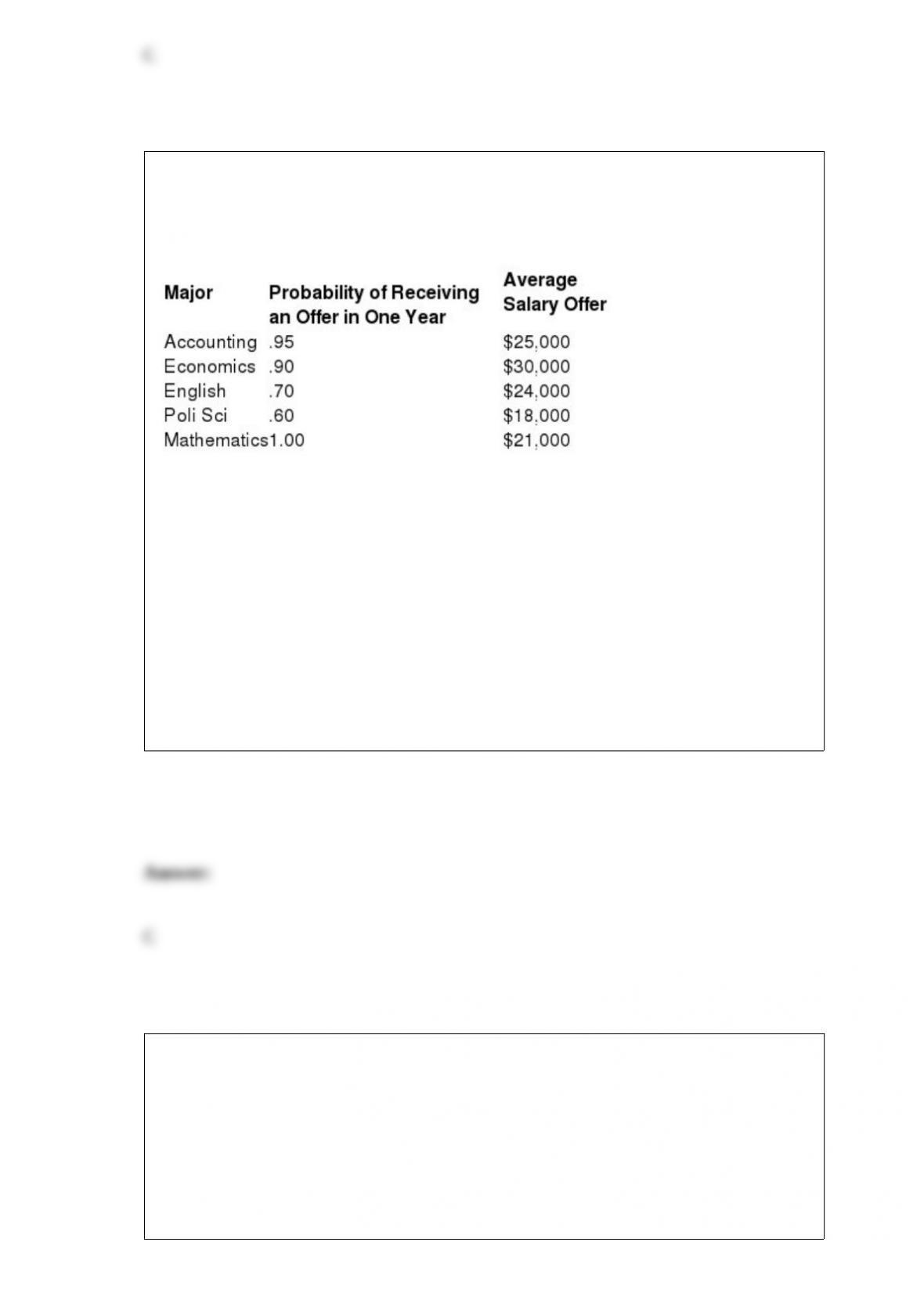
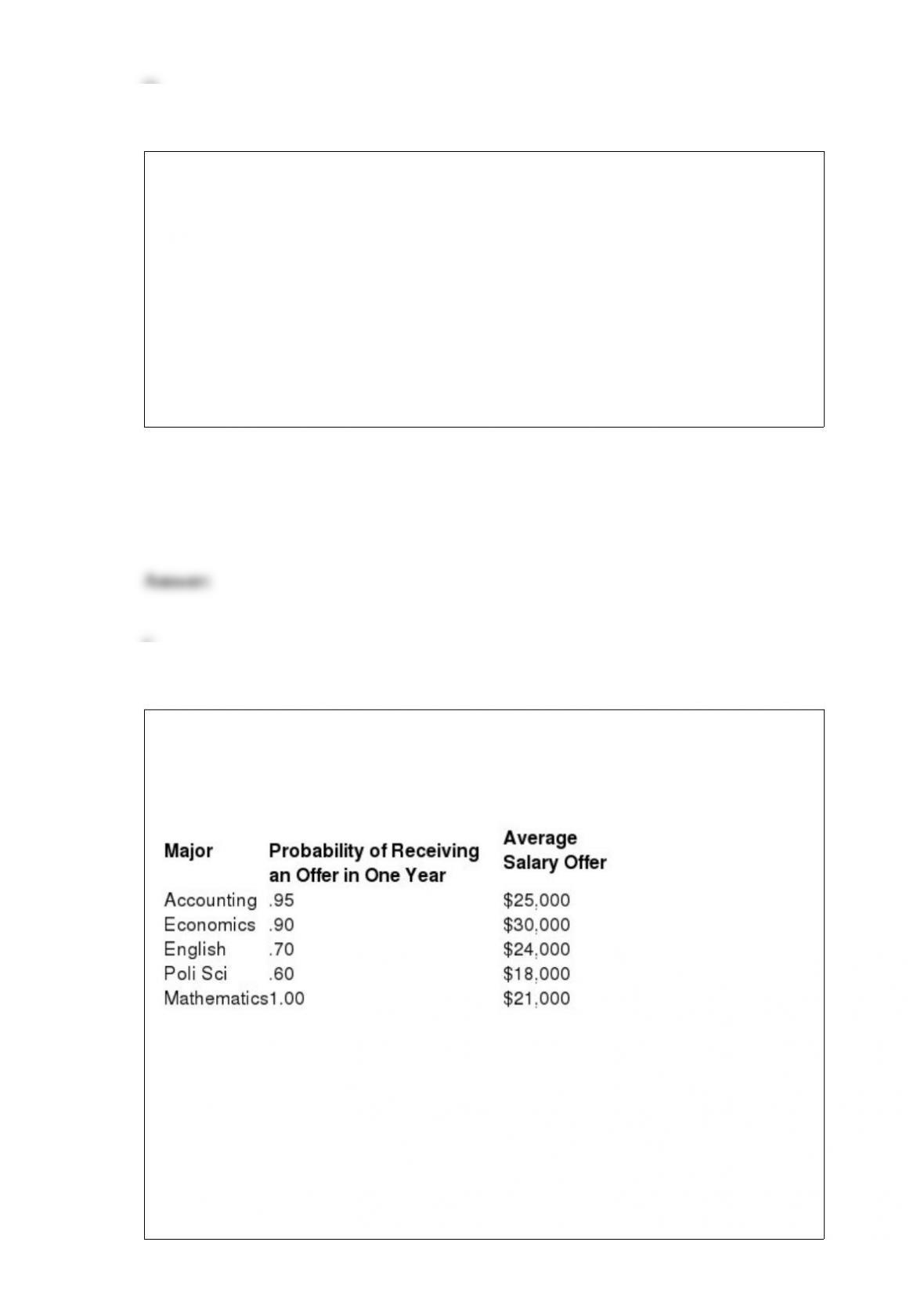
Consider the following information about job opportunities for new college graduates in
Megalopolis:
Table 5.1
Refer to Table 5.1. Ranked highest to lowest in expected income, the majors are
A) economics, accounting, English, mathematics, political science.
B) mathematics, English, political science, accounting, economics.
C) economics, accounting, mathematics, English, political science.
D) English, economics, mathematics, accounting, political science.
E) accounting, English, mathematics, political science, economics.
Suppose your utility from consuming X and Y is expressed as u(X,Y) = ln(XY) where
ln() is the natural logarithm operator. Given this information, which of the following
statements is NOT true?
A) The marginal utility of X may be positive or negative (depending on the quantity of
X and Y consumed).
B) The marginal utility of X does not depend on the quantity of Y consumed.
C) The marginal utility of Y does not depend on the quantity of X consumed.
D) all of these statements are not true
In the ________, each firm treats the output of its competitor as fixed and then decides
how much to produce.
A) Cournot model
B) model of monopolistic competition
C) Stackelberg model
D) kinked-demand model
E) none of the above
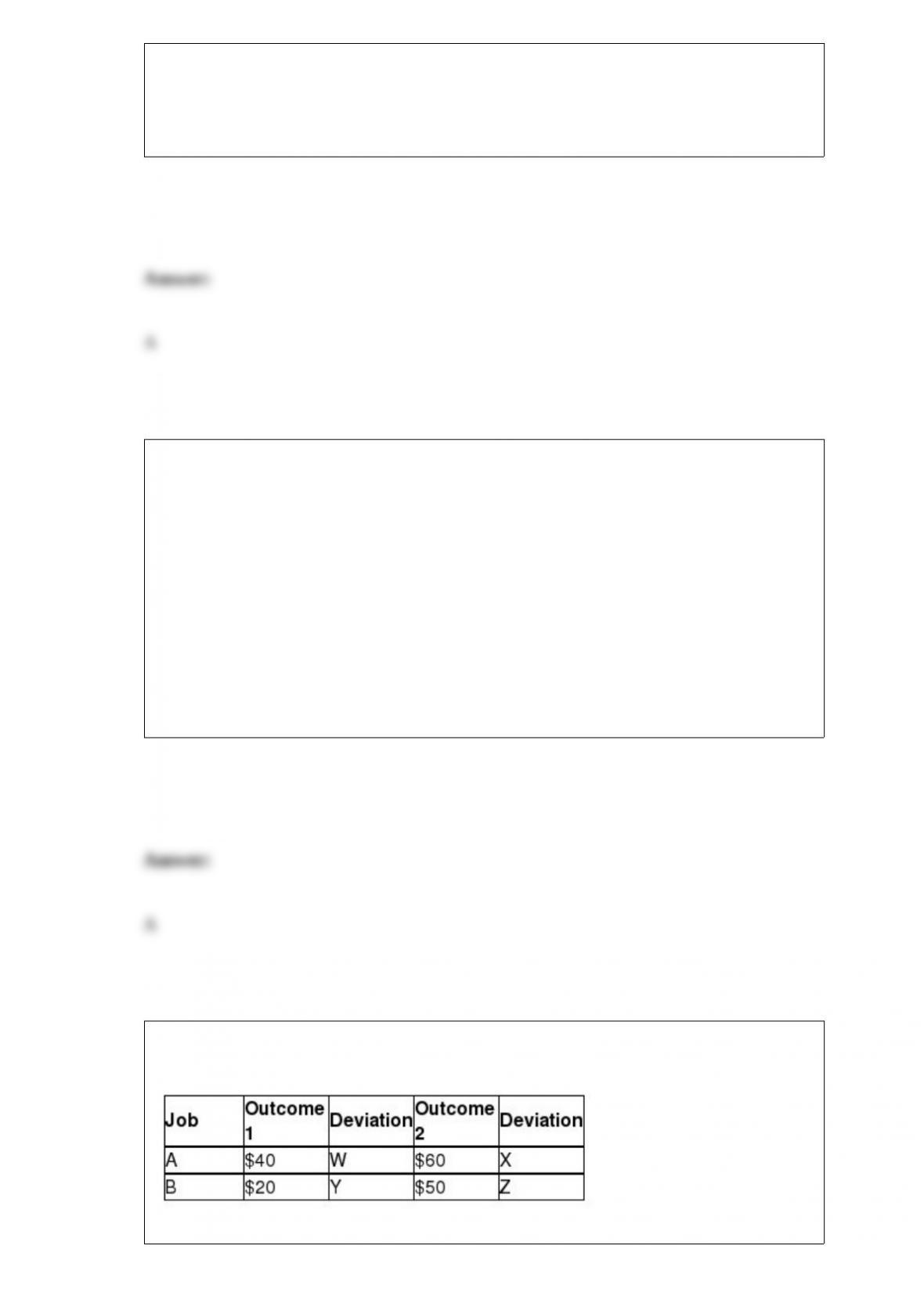
Table 5.4

Refer to Table 5.4. If at Job B the $20 outcome occurs with probability .2, and the $50
outcome occurs with probability .8, then the standard deviation of payoffs at Job B is
nearest which value?
A) $10
B) $12
C) $20
D) $35
E) $44
Along any downward sloping straight-line demand curve:
A) both the price elasticity and slope vary.
B) the price elasticity varies, but the slope is constant.
C) the slope varies, but the price elasticity is constant.
D) both the price elasticity and slope are constant.
Under perfect price discrimination, marginal profit at each level of output equal
A)0.
B) P – AC.
C) P – MC.
D) P – AR.
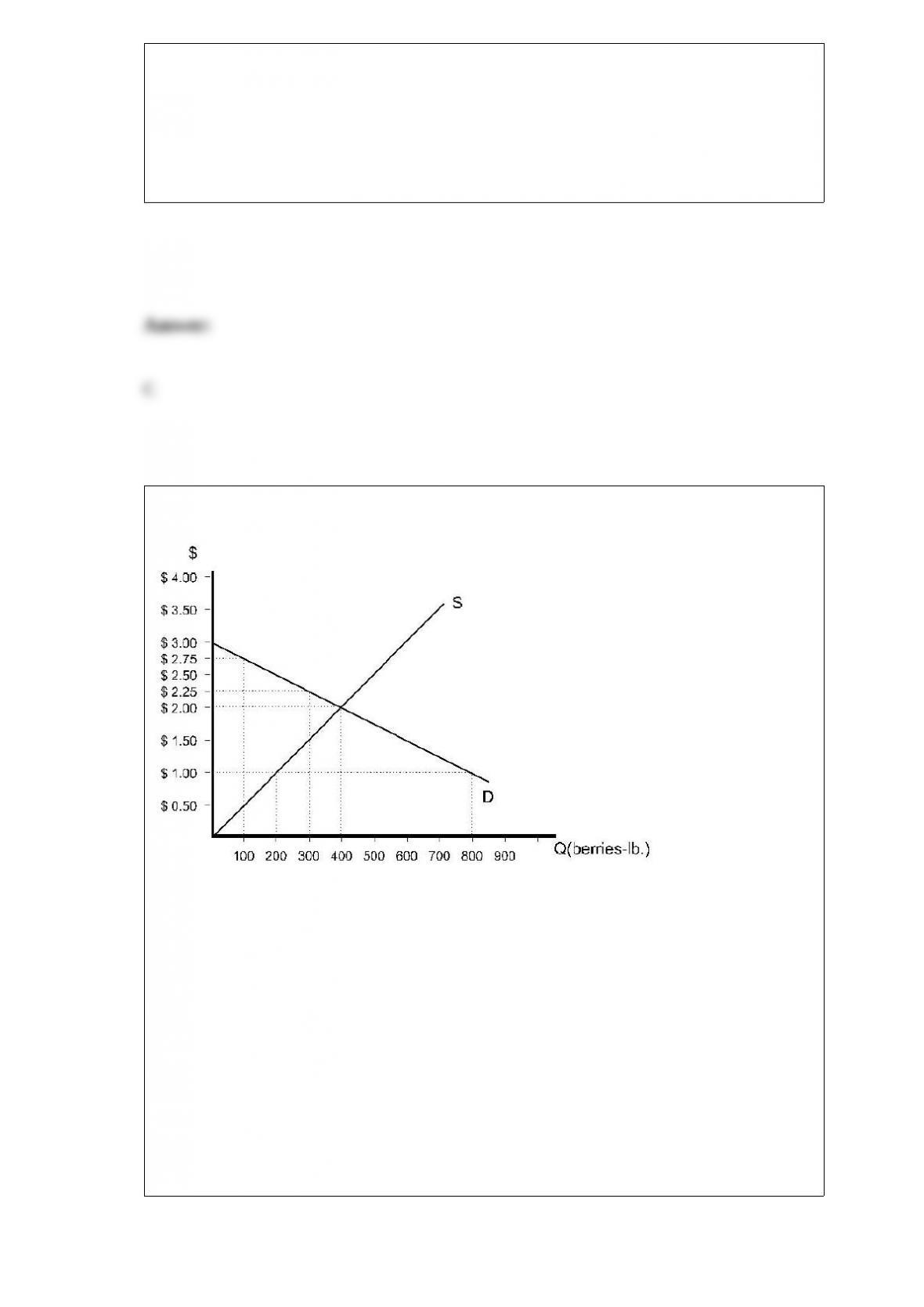
Figure 9.3
Refer to Figure 9.3. If the market is in equilibrium, the consumer surplus earned by the
buyer of the 100th unit is
A) $0.50.
B) $0.75.
C) $1.50.
D) $2.00.
E) $2.75.

Suppose a consumer only purchases food and clothing, and food is plotted along the
horizontal axis of the consumer’s indifference map. If the price of clothing increases and
the price of food and income do not change, then the budget line changes by rotating:
A) counter-clockwise about the fixed vertical axis intercept.
B) clockwise about the fixed vertical axis intercept.
C) counter-clockwise about the fixed horizontal axis intercept.
D) clockwise about the fixed horizontal axis intercept.
E) none of the above
In the Cournot duopoly model, each firm assumes that
A) rivals will match price cuts but will not match price increases.
B) rivals will match all reasonable price changes.
C) the price of its rival is fixed.
D) the output level of its rival is fixed.
When states make car insurance mandatory for all drivers, it
A) raises rates for everyone because it brings bad drivers into the pool.
B) raises rates for high-risk drivers.
C) may lower rates for all drivers to the extent that it keeps low-risk drivers in the pool.
D) prevents high-risk drivers from ‘selecting out,” to the detriment of low-risk drivers.
E) increases the amount of information available to insurers about the population.
Consider the following information about job opportunities for new college graduates in
Megalopolis:
Table 5.1
Refer to Table 5.1. A risk-neutral individual making a decision solely on the basis of the
above information would choose to major in
A) accounting.
B) economics.
C) English.

D) political science.
E) mathematics.