1) The compound interest formula states that if X dollars is invested today at an interest
rate i and allowed to grow for t years, it will become X(1 + i)(t) dollars in t years.
2) In the balance of payments statement, a current account deficit is always matched by
a capital and financial accounts surplus.
3) The multiplier measures the change in real GDP that results from a given change in
the price level.
4) In general for an excise tax on a product, given supply, the more elastic is the
demand for the product, the larger will be the portion of the tax shouldered by the
buyers.
5) Risk in financial economics refers mainly to the chance that an investment could lose
value.
6) In the long run equilibrium, a monopolist will earn zero economic profits.
7) Higher unemployment rates are linked with higher crime rates and higher rates of
physical and mental illness.
8) In a monopoly at equilibrium, price is greater than marginal cost.
9) The World Bank is the organization to which DVCs turn as a “last-resort” lending
agency for projects that private institutions will not fund.
10) The poverty rate in the U.S. increased significantly in the period 2007-2010.
11) When a producer cannot get all consumers of their product to pay for enjoying it,
such as in the case of a fireworks display, then we’d have a demand-side market failure.
12) The cyclically-adjusted surplus in the U.S. went from +1.2% of GDP in 2000 to
+0.6% of GDP in 2002. This suggests that the government during that period:
A.Cut taxes and increased spending
B.Increased taxes and cut spending
C.Wanted to rein in inflation
D.Did not change its discretionary fiscal policy
13) The government of Southland wants to improve resource allocation in the country.
Which of the following actions by the Southland government is most likely to
accomplish this?
A.Weakening enforcement of laws and contracts.
B.Promising to cover every risk of loss for private firms.
C.Coercing all firms to innovate and invest.
D.Taxing polluters and subsidizing firms that are creating significant positive
externalities.

14) Lee buys a bond for $10,000 and receives interest payments of $400 every six
months. The interest rate on the bond is approximately:
A.4 percent.
B.8 percent.
C.12.5 percent.
D.25 percent.
15) According to the research of Christina Romer and David Romer:
A.a tax reduction of 1 percent of GDP lowers real GDP by roughly 2 to 3 percent.
B.a tax increase of 1 percent of GDP lowers real GDP by roughly 2 to 3 percent.
C.a tax reduction of 2 to 3 percent raises real GDP by roughly 1 percent.
D.a tax increase of 2 to 3 percent lowers real GDP by roughly 1 percent.
16) Which characteristic would best be associated with pure competition?
A.Few sellers
B.Price takers
C.Nonprice competition
D.Product differentiation
17) Supporters of setting a cap on medical malpractice (or “pain and suffering”) awards
argue the following, except:
A.The caps will reduce medical malpractice premiums
B.They will help reduce health care costs
C.Patients should receive full compensation for losses, but should not be made wealthy
solely from the awards
D.The cap will improve the overall quality of the health care system
18) In a graph showing the market supply and demand for British pounds in terms of
U.S. dollars, the demand-for-pounds curve is downsloping because:
A.Fewer British pounds can be purchased if pounds become less expensive
B.Fewer U.S. dollars can be purchased if British pounds become less expensive
C.More U.S. dollars can be purchased if British pounds become more expensive
D.More British pounds can be purchased if pounds become less expensive
19) A major criticism of the marginal productivity theory of income distribution is that:
A.The demand for labor resources is price inelastic
B.Achieving equality in incomes will take time
C.Imperfectly competitive firms are only interested in profit maximization
D.Property resources like land are unevenly distributed which leads to income
inequality
20) The benefits to trading nations based on comparative advantage accrue from:
A.Specialization only
B.Specialization and trading
C.Trading only
D.Protection of domestic industries
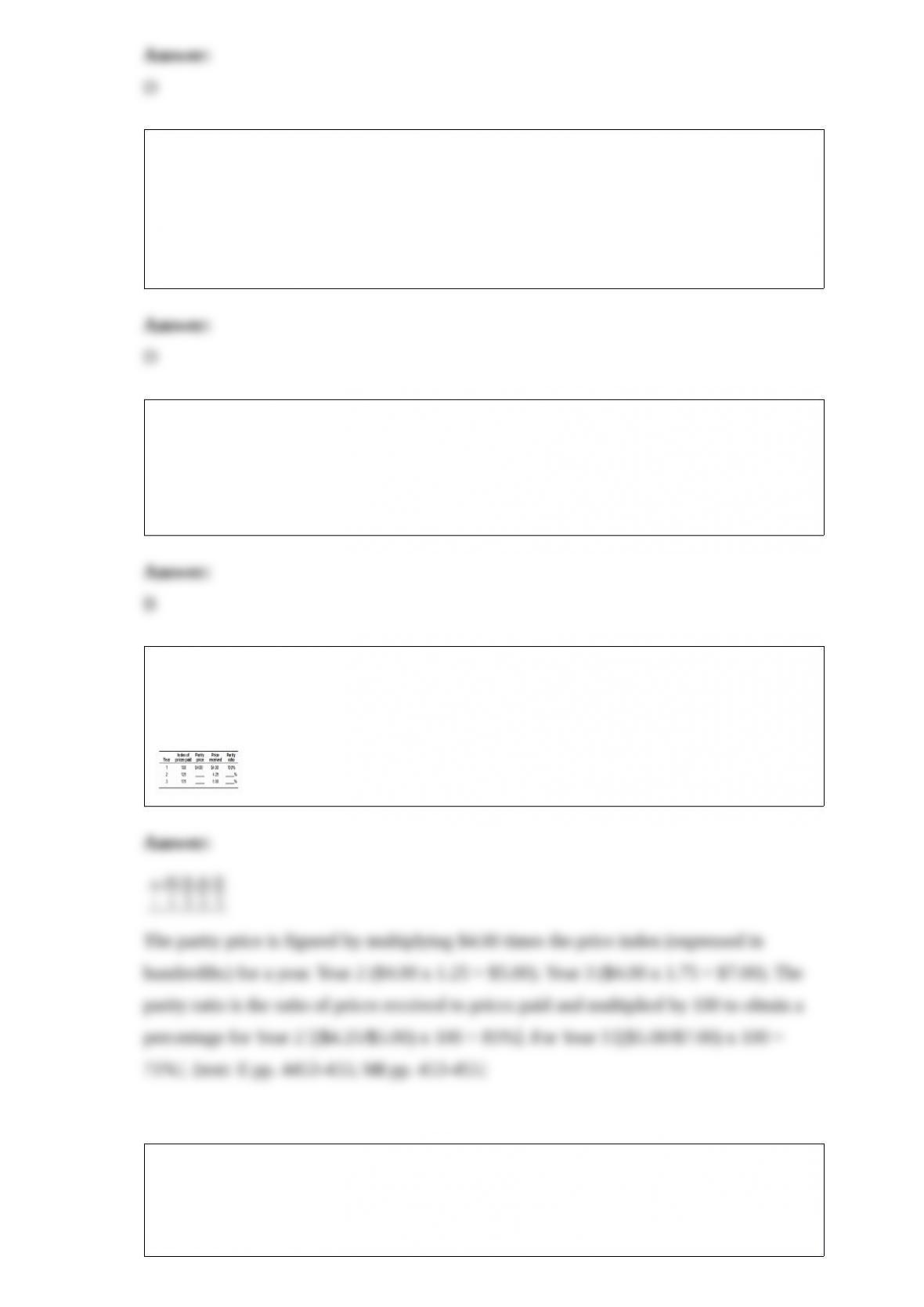
21) The following table gives the index of prices farmers paid in three different years.
The price farmers received in year 1, the base year, for a certain agricultural product
was $4.00 per bushel. Compute the parity price of the product in years 2 and 3 and enter
them in the table. Compute the parity ratio and enter it into the table.
22) Which of the following would tend to raise the value of the U.S. dollar in foreign
exchange markets?
A.A rise in U.S. interest rates
B.An easy monetary policy in the United States
C.A contractionary fiscal policy in the United States
D.An increase in the U.S. demand for foreign oil
23) If the stock of available capital in the economy is running too low, then the:
A.Investment schedule will shift upward
B.Investment schedule will shift downward
C.Consumption schedule will shift upward
D.Consumption schedule will shift downward
24) Government borrowing:
A.is the primary means of financing public expenditures.
B.provides a stimulus to government spending with no opportunity cost.
C.may crowd out private sector investment.
D.is prohibited by the U.S. constitution.
25) Investment happens when:
A.Current income is greater than current spending
B.Current consumption is greater than current output
C.Resources are devoted toward increasing current output
D.Resources are devoted toward increasing future output
26) The supply of loanable funds is an upward-sloping curve because the:
A.Higher the interest rate, the more households consume, and the more households save
B.Higher the interest rate, the less households consume, and the more households save
C.Lower the interest rate, the more households consume, and the more households save
D.Lower the interest rate, the less households consume, and the more households save
27) Discuss the decision a criminal must make before deciding whether or not to steal.
28) The owner of a health club asks you for advice about whether the company should
raise or lower the price of its membership this year based on the following information:
last year the club raised the price of its membership by 5% and the number of members
paying the same fee fell by 7%.
29) Use the Great Recession of 2007-2009 to describe the paradox of thrift.
30) Compare the long-run supply curve for a constant-cost industry, a decreasing-cost
industry, and an increasing-cost industry. Give an example with an explanation for each.
31) What has been the rationale made over the years to justify government subsidies for
agriculture?
32) Define and illustrate “noncompeting groups” and “compensating differences.”
33) Explain the principle of comparative advantage in nontechnical terms.
34) “The relative scarcity of resources makes the operation of any economy a matter of
choosing between alternatives.” Explain.