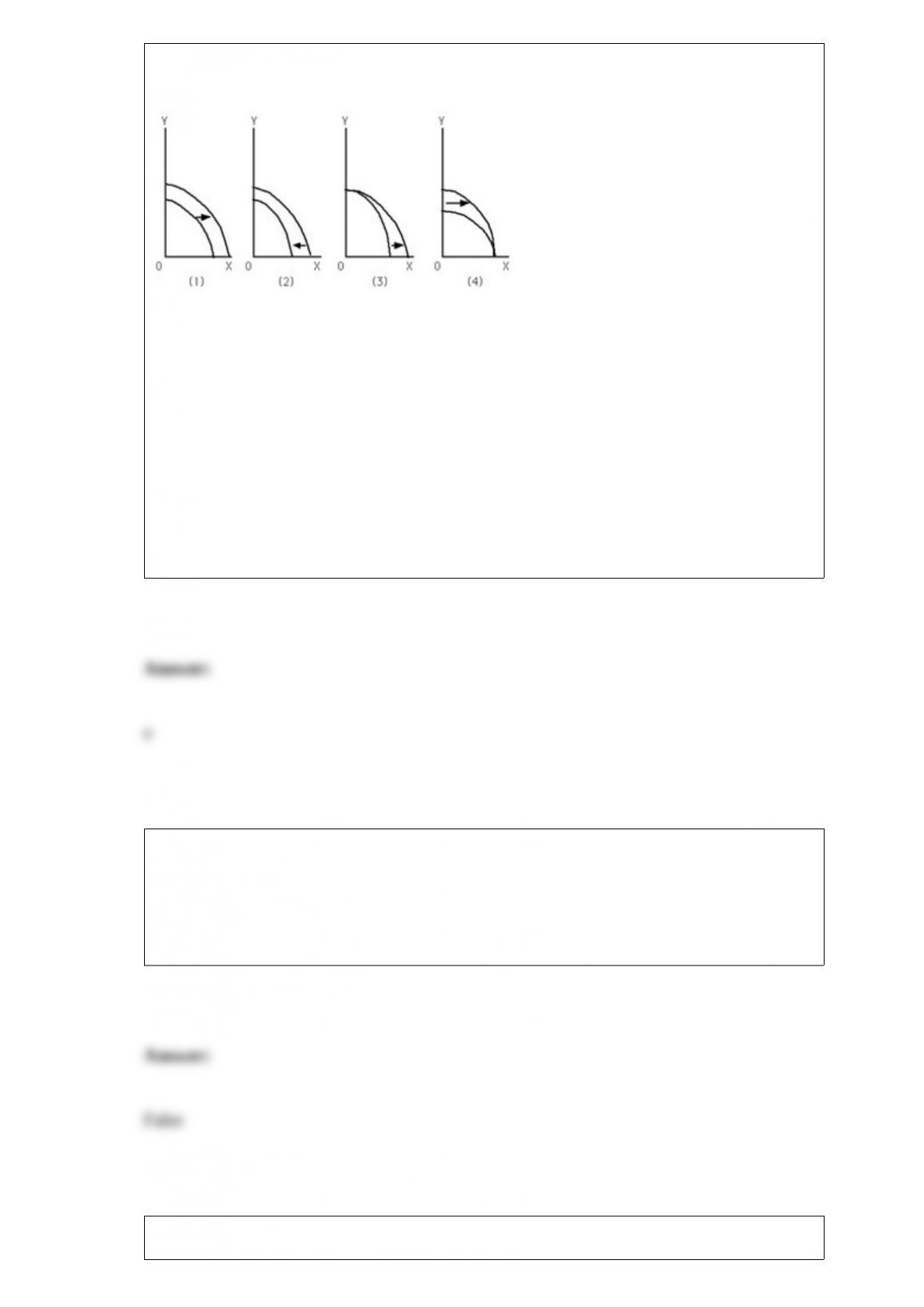
Exhibit 2-6
Which graph depicts society’s choice to produce more of good X and less of good Y?
a. (1)
b. (2)
c. (3)
d. (4)
e. none of the above
The higher the opportunity cost of doing something, the more likely it will be done.
a. True
b. False
Consider the following data: equilibrium price = $9, quantity of output produced =

1,000 units, average total cost = $7, and average variable cost $5. Given this, total
revenue is __________, total cost is __________, and total fixed cost is __________.
a. $6,000; $8,000; $1,000
b. $9,000; $7,000; $5,000
c. $10,000; $8,000; $3,000
d. $9,000; $7,000; $2,000
e. none of the above
Cross elasticity of demand measures the responsiveness of changes in the quantity
__________ of one good to changes in __________.
a. demanded; the price of the same good
b. demanded; income
c. demanded; the price of another good
d. supplied; the price of the same good
e. none of the above
Which of the following statements is false?

a. Externalities can sometimes be internalized through individual voluntary agreements.
b. It would be a relatively easy matter to establish property rights in the air.
c. Persuasion can be used in some cases to internalize externalities.
d. Taxes and subsidies are sometimes used as corrective devices for market failures.
If the nominal interest rate is 4 percent and expected inflation rate is 5 percent, the real
interest rate
a. is 1 percent.
b. is -1 percent.
c. is 9 percent.
d. cannot be calculated.
e. none of the above
If for a given individual, between a wage rate of $20 and $25 the
____________________ effect outweighs the ________________ effect, the
individual’s supply curve of labor curve between those two wages will be
_________________.
a. substitution; income; vertical
b. substitution; income; upward sloping

c. substitution; income; downward sloping
d. income; substitution; vertical
e. income; substitution; upward sloping
Average productivity of labor equals
a. the change in output divided by the change in labor.
b. output divided by the MPP of labor.
c. output divided by marginal cost.
d. output divided by the quantity of labor.
e. the quantity of labor divided by output.
If the price a buyer pays for a good is $50 and the maximum price she would be willing
and able to pay is $53, then ____________ is _______________.
a. producers’ surplus; $103
b. consumers’ surplus; $103
c. consumers’ surplus; $3
d. producers’ surplus; $3
e. consumers’ surplus; $40
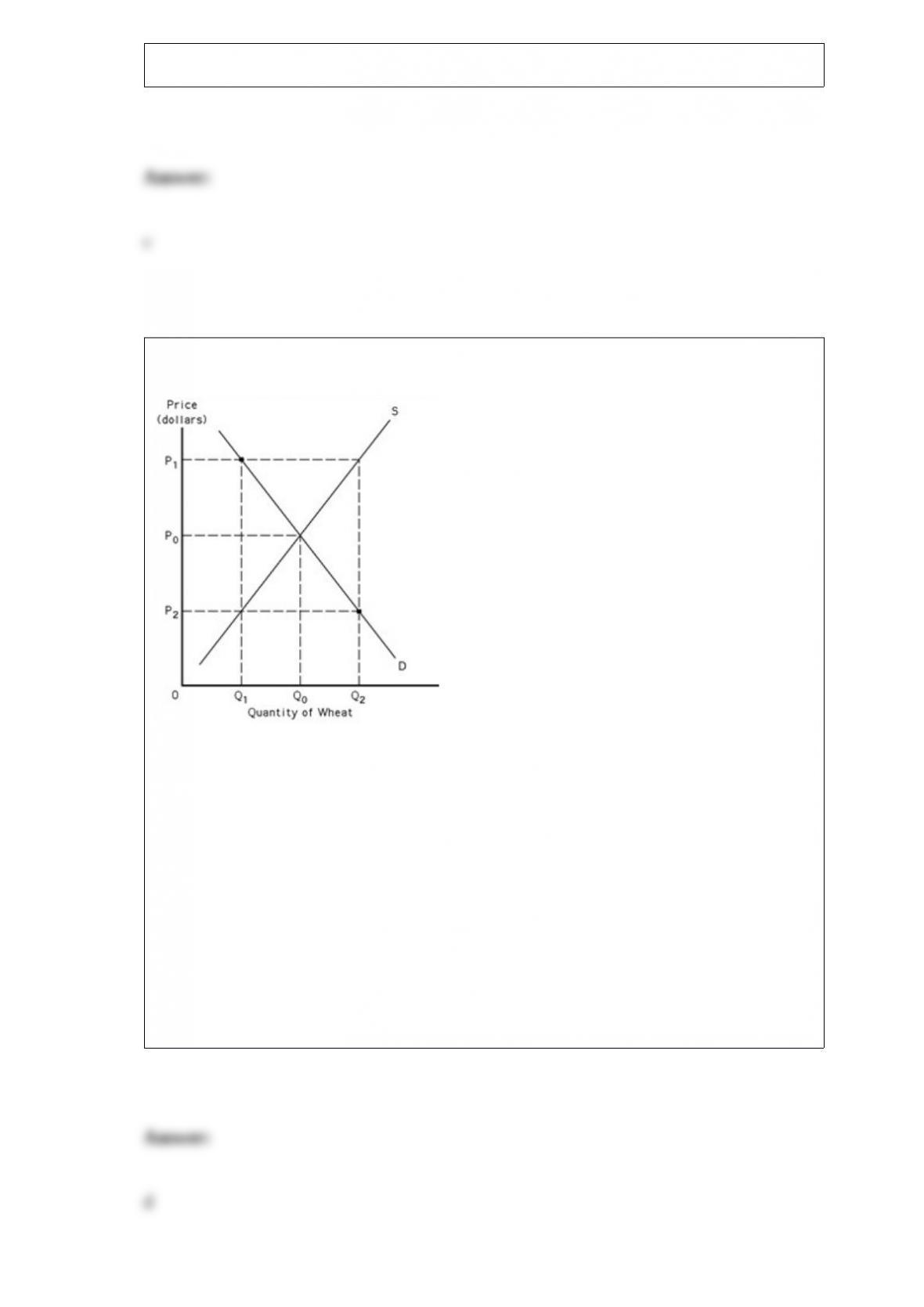
Exhibit 39-2
If P1 is a price support, the cost of the price support program to the government is
a. P1 x Q2.
b. P1 x (Q2 – Q0).
c. P1 x (Q0 – Q1).
d. P1 x (Q2 – Q1).
e. none of the above

In order for a price floor to have an impact on a market it must be set above the
equilibrium price.
a. True
b. False
If the price of good X falls and the demand for good X is inelastic, then the percentage
__________ in quantity demanded is __________ the percentage fall in price, and total
revenue __________.
a. fall; greater than; rises
b. rise; less than; rises
c. fall; equal to; remains constant
d. rise; less than; falls
e. fall; greater than; falls
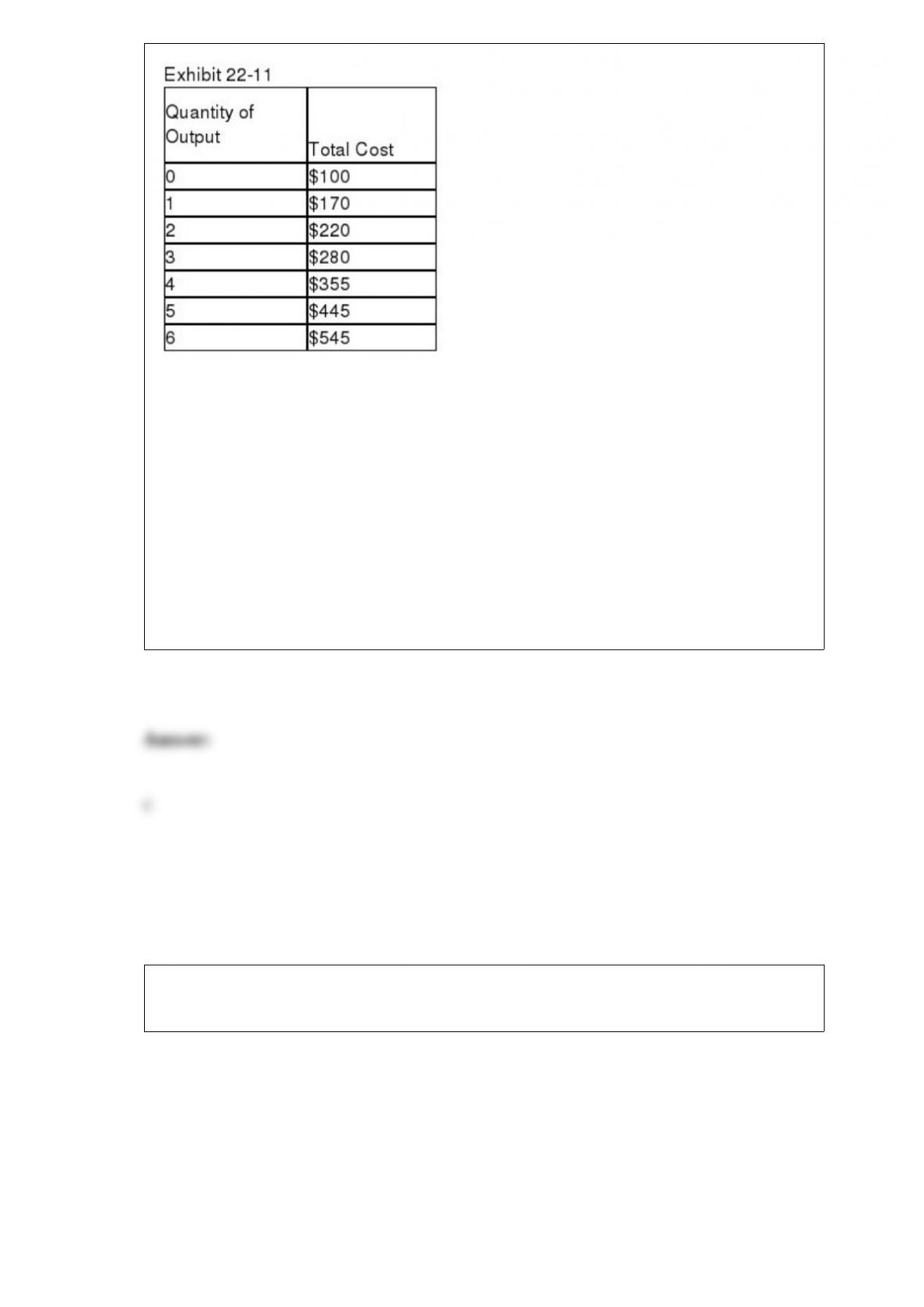
Total fixed cost is
a. $500.
b. $600.
c. $100.
d. $110.
e. There is not enough information provided to answer this question.
Exhibit 22-3
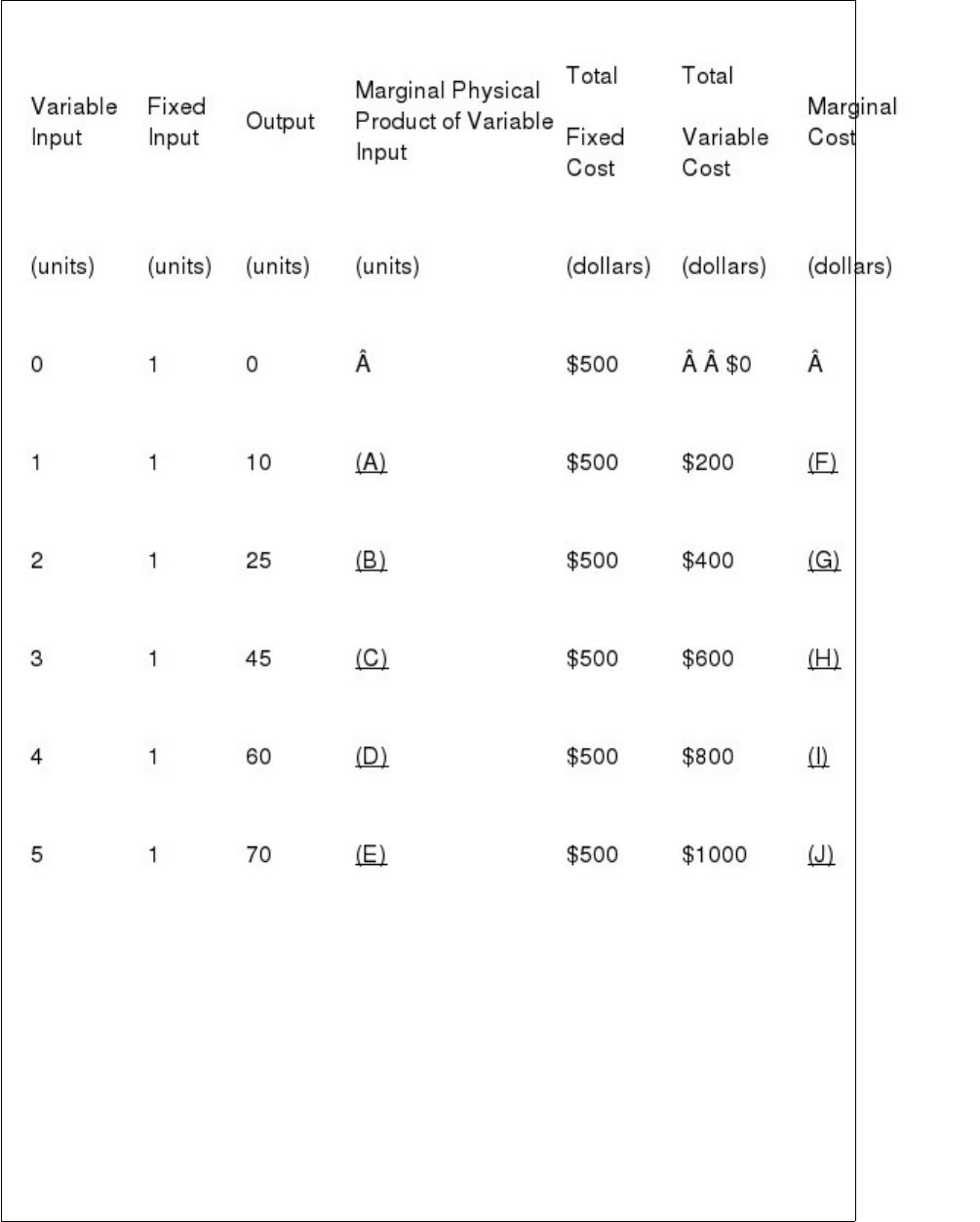
What is the average total cost of producing 45 units of output?
a. $25.11
b. $24.44
c. $21.11
d. $21.33

Assume the following conditions hold: (1) the demand for every type of labor is the
same, (2) there are no special nonpecuniary aspects to any job, (3) all labor is ultimately
homogeneous and can costlessly be trained for different types of employment, (4) all
labor is mobile at zero cost. Given these conditions,
a. wage rates will be the same in most labor markets.
b. the demand for labor will be less in some labor markets than in others.
c. wage rates will be the same in all labor markets.
d. wage rates will be the same in very few labor markets.
In 1973 and 1979, the U.S. federal government imposed price ceilings on gasoline
which resulted in surpluses of gasoline.
a. True
b. False
Variables X and Y are independent of each other. If we plot X on the horizontal axis and
Y on the vertical axis, the line that connects combinations of X and Y in a two-variable
diagram is
a. parallel to the horizontal axis.

b. downward-sloping (left to right).
c. parallel to the vertical axis.
d. upward-sloping (left to right).
e. a or c
Consider two points on the PPF: point A, at which there are 50 oranges and 100
apricots, and point B, at which there are 51 oranges and 98 apricots. If the economy is
currently at point B, the opportunity cost of moving to point A is
a. 2 apricots.
b. 1 orange.
c. 98 apricots.
d. 3 oranges.
What does it mean if a person makes a “decision at the margin”?
a. The person compares additional benefits and additional costs when deciding what to
do.
b. The person weighs the good against the bad and then decides what to do.
c. The person is more likely to say yes than to say no.
d. The person compares marginal benefits and total costs and then decides what to do.
e. The person makes a decision based on a condition.

The proponents of fixed exchange rates argue that flexible exchange rates
a. hamper international trade because of uncertainty over what the exchange rate will
be.
b. force a nation to use its domestic macroeconomic policies to maintain an exchange
rate.
c. lead to trade protectionism.
d. a and b
e. a, b, and c