1) An increase in quantity demanded
a.results in a movement downward and to the right along a demand curve.
b.results in a movement upward and to the left along a demand curve.
c.shifts the demand curve to the left.
d.shifts the demand curve to the right.
2) Abby, Bobbi, and Deborah each buy ice cream and paperback novels to enjoy on hot
summer days. Ice cream costs $5 per gallon, and paperback novels cost $8 each. Abby
has a budget of $80, Bobbi has a budget of $60, and Deborah has a budget of $40 to
spend on ice cream and paperback novels. Who can afford to purchase 4 gallons of ice
cream and 5 paperback novels?
a.Abby, Bobbi, and Deborah
b.Abby only
c.Abby and Bobbi, but not Deborah
d.None of the women can afford to purchase 4 gallons of ice cream and 5 paperback
novels.
3) Arturo’s Production Possibilities FrontierDina’s Production Possibilities
Frontier
c.value to buyers – amount paid by buyers + amount received by sellers – cost to sellers
d.value to buyers – cost to sellers
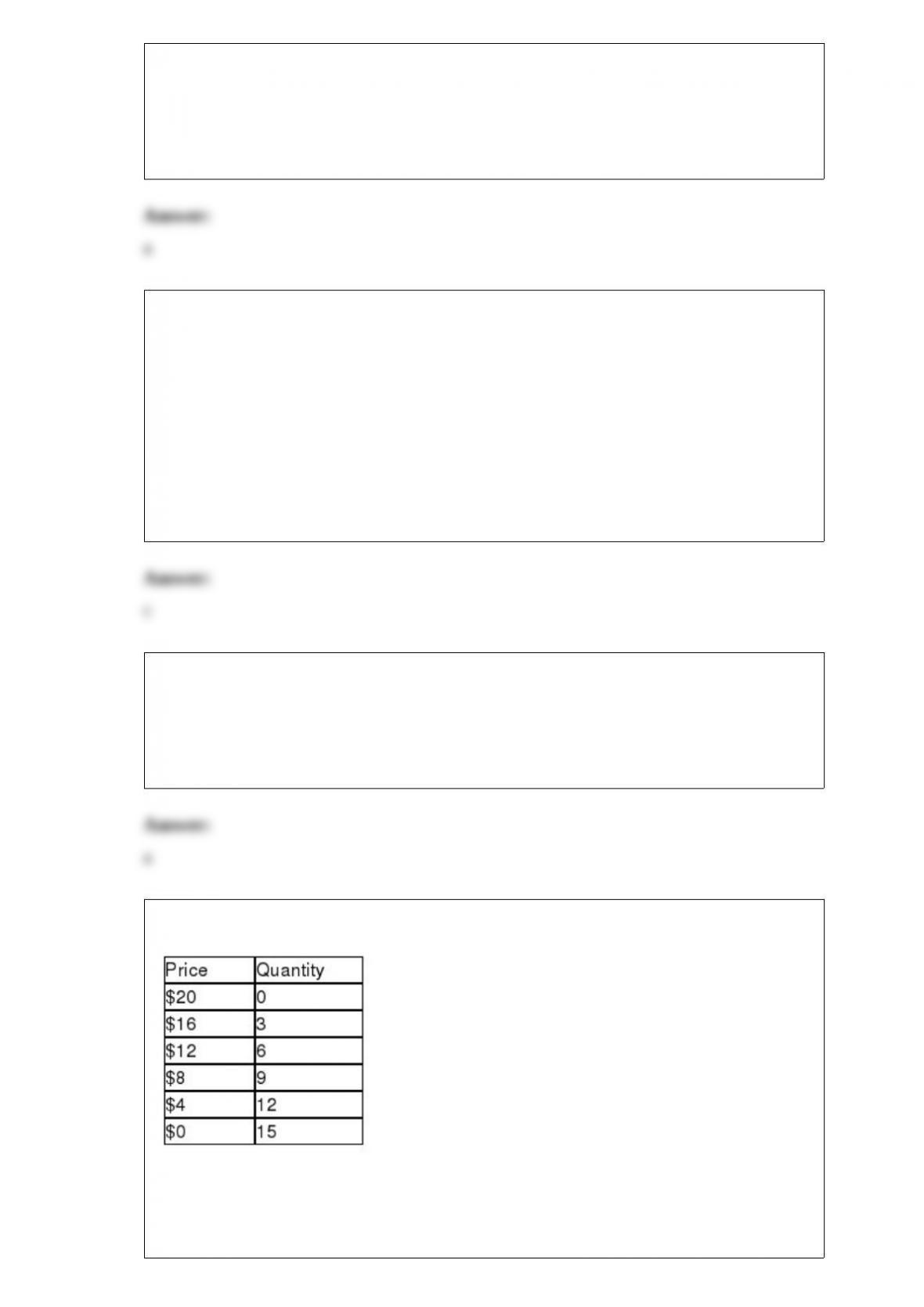
9) The following table shows the demand schedule for a particular good.
Using the midpoint method, when price falls from $8 to $4, the is a. 0.43
b.0.67
c.1
d.2.33

10) The theory of oligopoly provides another reason that free trade can benefit all
countries because
a.increased competition leads to larger deadweight losses.
b.as the number of firms within a given market increases, the price of the good
decreases.
c.as the number of firms within a given market increases, the profit of each firm
increases.
d.All of the above are correct.
11) Athos, Porthos,and Aramis each like to take fencing lessons. The price of a fencing
lesson is $10. Athos values a fencing lesson at $15, Porthos at $13, and Aramis at $11.
Suppose that if the government taxes fencing lessons at 50 cents each, the price rises to
$10.50. A consequence of the tax is that consumer surplus shrinks by
a.$1.50 and tax revenues increase by $1.50, so there is no deadweight loss.
b.$9.00 and tax revenues increase by $1.50, so there is a deadweight loss of $7.50.
c.$7.50 and tax revenues increase by $7.50, so there is no deadweight loss.
d.$7.50 and tax revenues increase by $1.50, so there is a deadweight loss of $6.
12) From the time of Benjamin Franklin to the present, the percentage of the average
American’s income that goes to pay taxes has
a.decreased from about 20 percent to about 10 percent.
b.remained constant at about 10 percent.
c.has risen from less than 2 percent to about 33.3 percent.
d.has risen from less than 5 percent to about 25 percent.
13) Economic models are most often composed of diagrams and equations.
a.True
b.False

14) An example of an opportunity cost that is also an implicit cost is
a.a lease payment.
b.the cost of raw materials.
c.the value of the business owner’s time.
d.All of the above are correct.
15) The for mobile phones
a.will be higher if there is an improvement in the production technology.
b.will be lower if consumers perceive mobile phones to be a necessity.
c.is computed as the percentage change in the price of mobile phones divided by the
percentage change in quantity of mobile phones.
d.All of the above are correct.
16) Average total cost and marginal cost express information that is already contained
in a firm’s total cost.
a.True
b.False