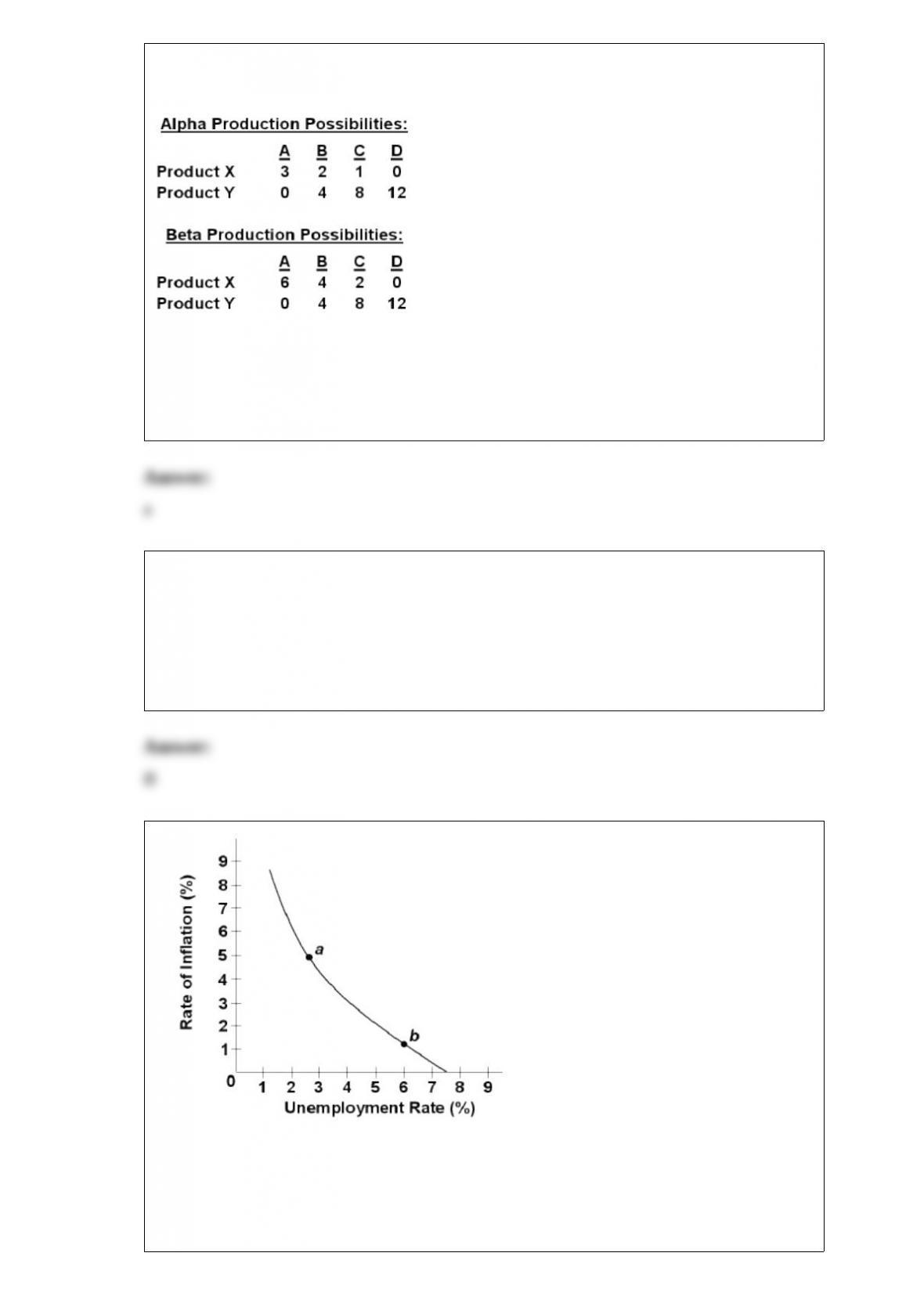
1) the following production possibilities tables for countries alpha and beta:
refer to the above tables. the domestic opportunity cost of one unit of x in beta is:
a.2 units of y
b.4 units of y
c.1 unit of y
d.3 units of y
2) If in a certain year the indices of prices received and paid by farmers were 115 and
142 respectively, the parity ratio (in percentage terms) would be:
A.123.
B.81.
C.69.
D.27.
3)
Refer to the above diagram for a specific economy. The shape of this curve suggests
that:
A.the price level rises at a diminishing rate as the level of aggregate demand increases.
B.full employment and price stability are compatible goals only when aggregate
demand is falling.
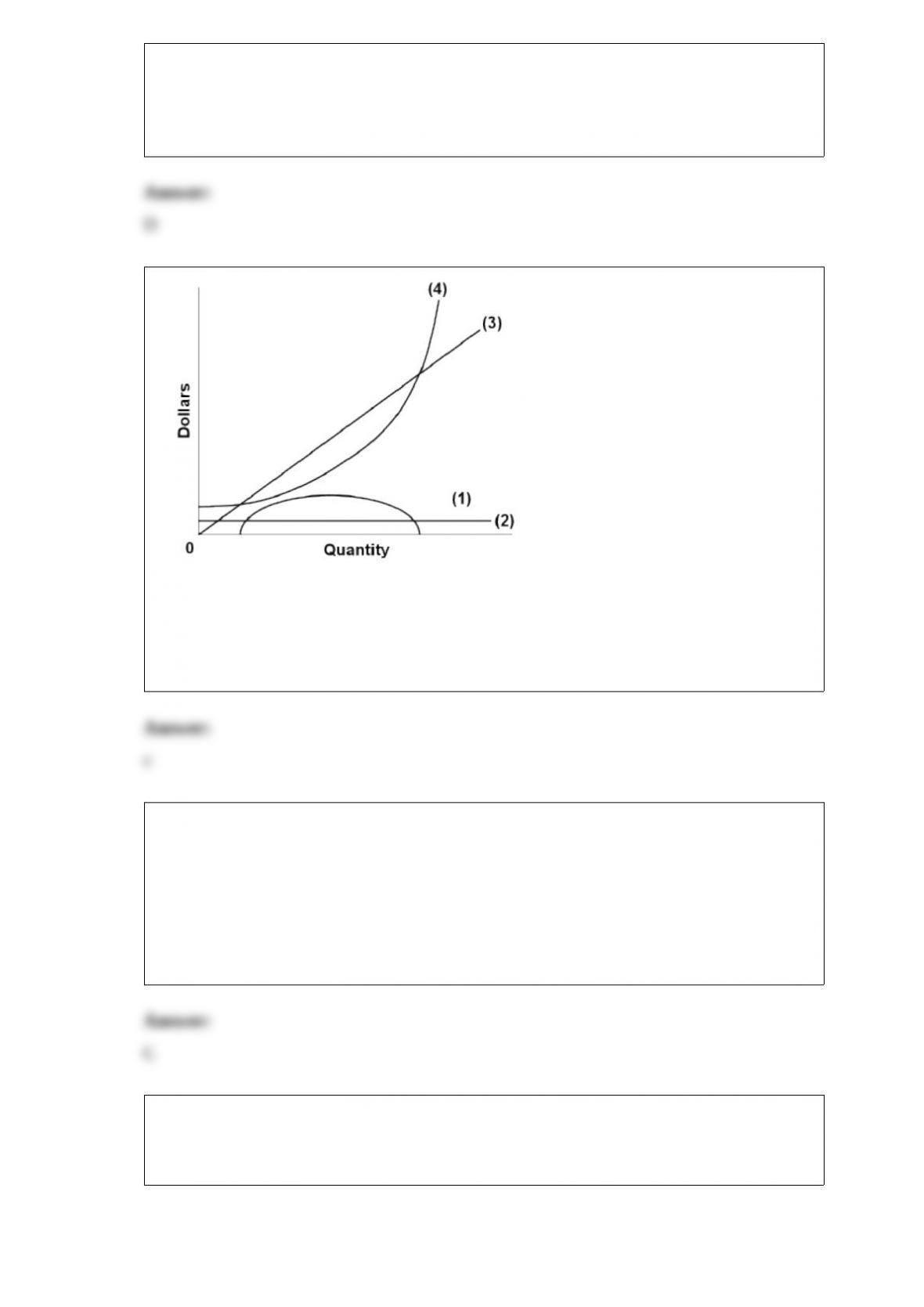
C.each successive unit of decline in the unemployment rate is accompanied by a
smaller increase in the rate of inflation.
D.each successive unit of decline in the unemployment rate is accompanied by a larger
increase in the rate of inflation.
4)
curve (2) in the above diagram is a purely competitive firm’s:
a.total cost curve.
b.total revenue curve.
c.marginal revenue curve.
d.total economic profit curve.
5) Assume Company X deposits $100,000 in cash in commercial Bank A. If no excess
reserves exist at the time this deposit is made and the reserve ratio is 20 percent, Bank A
can increase the money supply by a maximum of:
A.$50,000.
B.$180,000.
C.$80,000.
D.$500,000.
6) The following table shows the total costs and total benefits facing a city of five
different potential baseball stadiums of increasing size. All figures are in millions of
dollars.
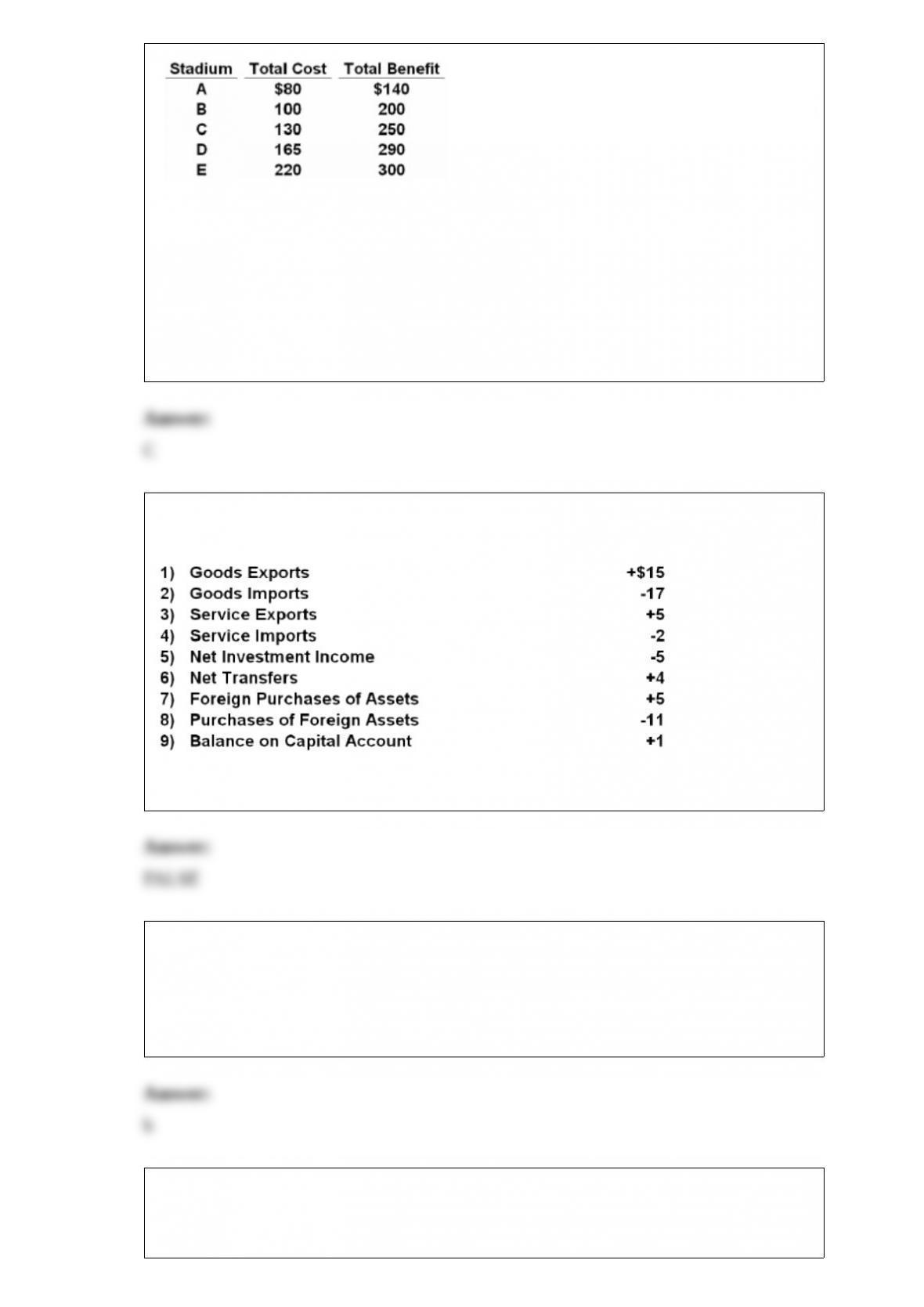
Refer to the above table. Suppose a five-person city council must decide via majority
voting which of these stadiums to build. Also suppose that each of the stadium sizes has
the support of one council member. According to the median voter model, the council
will ultimately vote in favor of stadium:
A.A
B.B
C.C
D.D
7) The following 2008 balance of payments statement for Transylvania. All figures are
in billions of dollars.
Refer to the above data. Transylvania had a $2 billion balance of trade (goods) surplus
in 2008.
8) the economic perspective entails:
a.irrational behavior by individuals and institutions.
b.a comparison of marginal benefits and marginal costs in decision making.
c.short-term but not long-term thinking.
d.rejection of the scientific method.
9) The level of aggregate expenditures in the private closed economy is determined by
the:
A.expenditures of consumers and businesses.
B.intersection of the saving schedule and the 45-degree line.
C.equality of the MPC and MPS.
D.intersection of the saving and consumption schedules.
10) Where there is natural monopoly, government is most likely to implement:
A.social regulation.
B.antitrust policy.
C.industrial regulation.
D.an externality containment policy.
11) Pa and Pb are the prices that individuals A and B are willing to pay for the last unit
of a public good, rather than do without it. These people are the only two members of
society.
Refer to the above data. Suppose government has already produced 4 units of this
public good. The amount individual B is willing voluntarily to pay for the 4th unit is:
A.$14.
B.$5.
C.$2.
D.$0.
12) the following cost data for a firm that is selling in a purely competitive market:
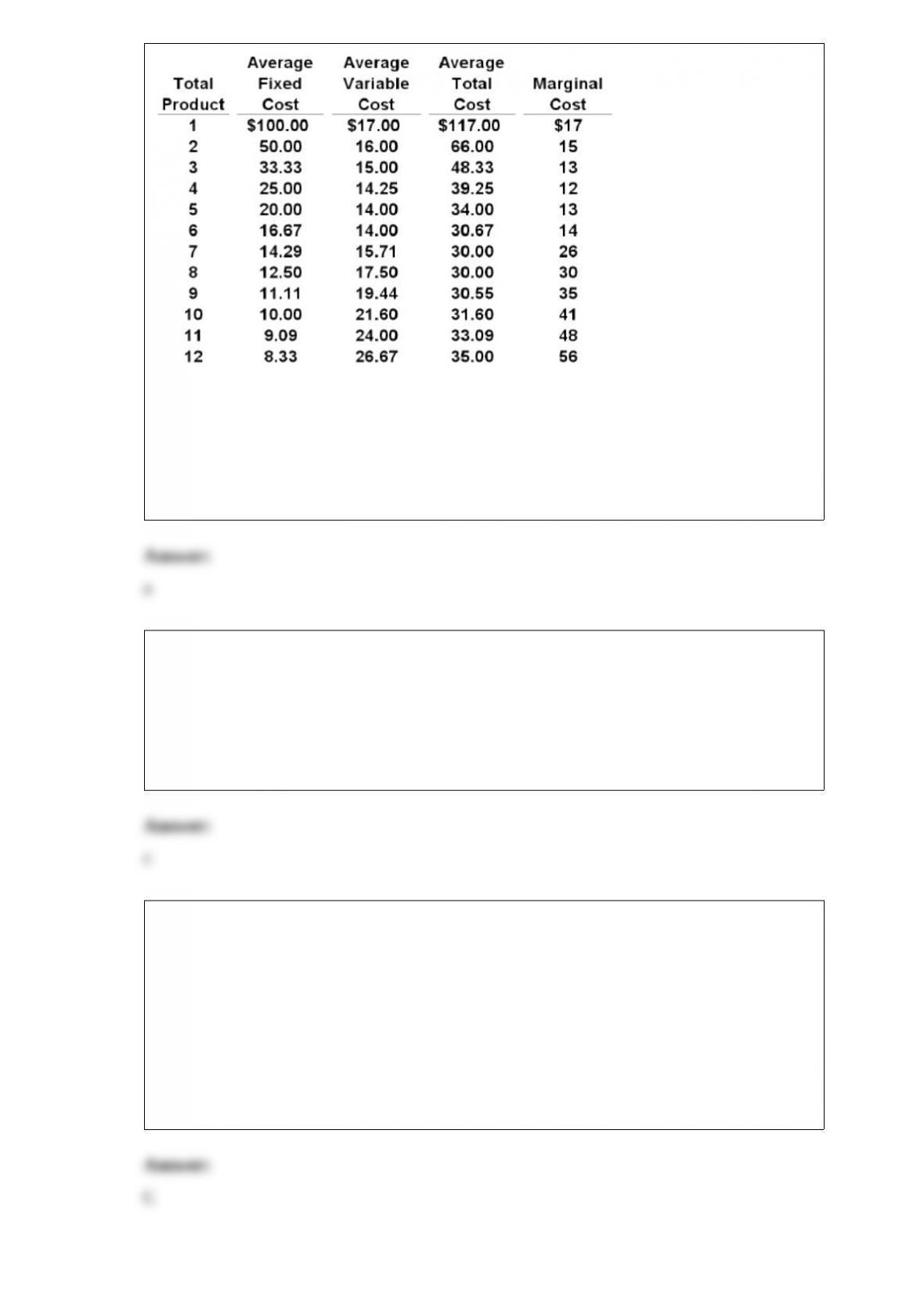
refer to the above data. if the market price for the firm’s product is $32, the competitive
firm will produce:
a.8 units at an economic profit of $16.
b.5 units at a loss of $10.
c.8 units at a loss equal to the firm’s total fixed cost.
d.7 units at an economic profit of $41.50.
13) which of the above diagrams illustrate(s) the effect of a governmental subsidy on
the market for aids research?
a.a only.
b.b only.
c.c only.
d.d only.
14) In the U.S. Steel case of 1920 the courts held that:
A.the structure of an industry is more important than its behavior in determining
violations of the antitrust laws.
B.any firm which faces substantial import competition is exempt from the antitrust
laws.
C.although U.S. Steel possessed monopoly power, it had not violated the Sherman Act
because it had not unreasonably used that power.
D.the fact that U.S. Steel possessed monopoly power was a violation of the Sherman
Act.
15) Why has one Presidential administration enforced the antitrust laws more or less
strictly than another?
16) What is the difference between economic investment and financial investment?
Give an example for each type of investment.
17) What are three significant generalizations supported by results from the extended
AD-AS model?
18) Whenever there is change in spending real GDP will change by a multiple of the
initial change in spending. Explain this multiplier effect.
19) Does velocity change in response to changes in the money supply according to
monetarists?
20) Inflation is a harsh and arbitrary form of taxation. Do you agree? If so, who pays
this tax?
21) Why are expectations important when discussing profits? What effects do these
profit expectations have on the economic system?