Bubba’s Hula Shack bar and bistro has begun giving customers who can show proof
that they arrived at the establishment by public transportation a 10 percent discount on
their total bill. All else equal, customers who arrive by public transportation to take
advantage of Bubba’s Hula Shack discount have a ________ for the services of the
establishment than customers who drive to the establishment.
A) higher price elasticity of demand
B) lower price elasticity of demand
C) higher price elasticity of supply
D) lower price elasticity of supply
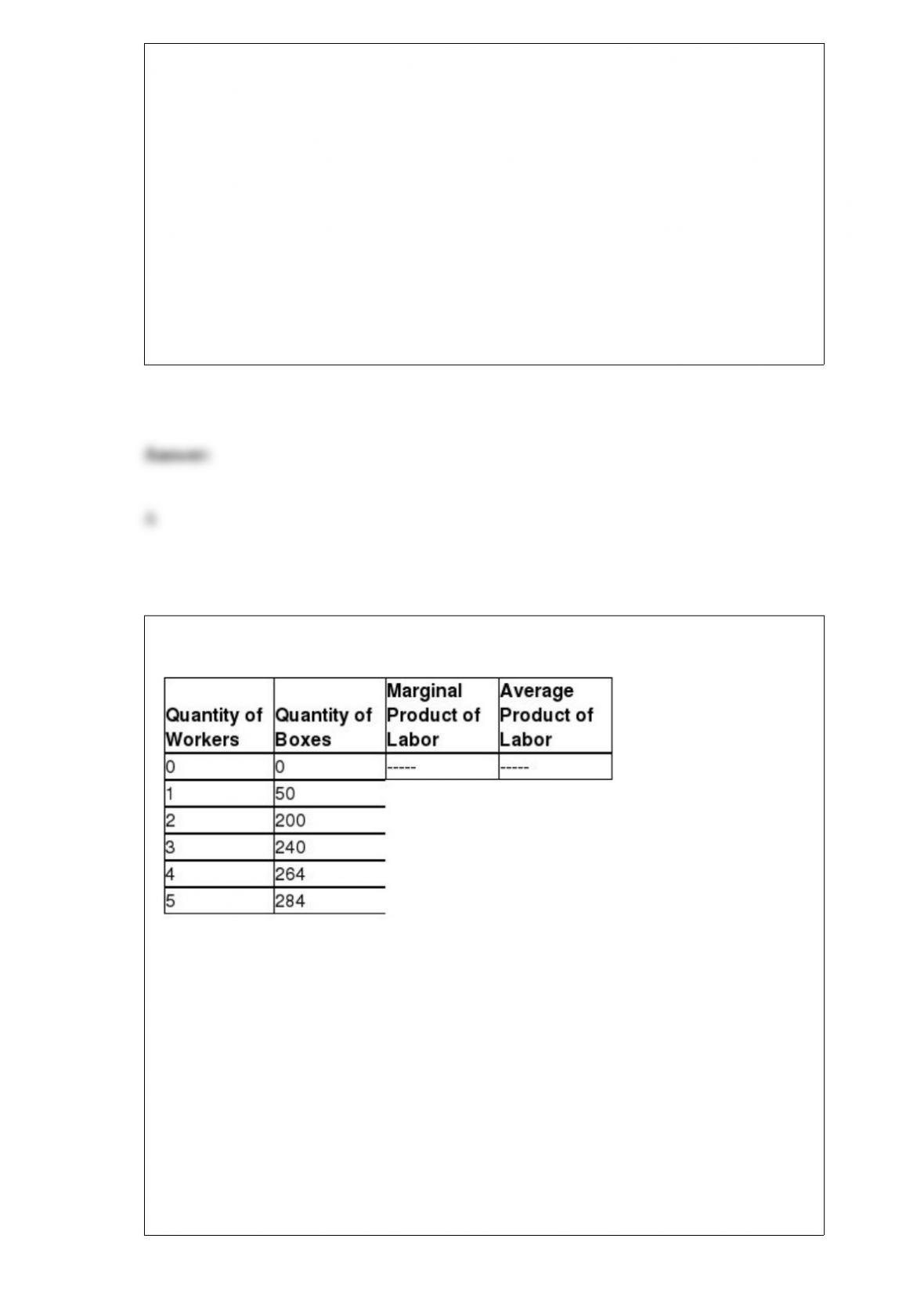
Table 11-3
The table above refers to the relationship between the quantity of workers employed
and the number of cardboard boxes produced per day by Manny’s House of Boxes. The
capital used to produce the boxes is fixed. The average product of labor will equal 60
boxes when Manny hires
A) the second worker.
B) the third worker.
C) the fourth worker.
D) the fifth worker.

Consider the following pairs of items:
a. shampoo and conditioner
b. iPhones and earbuds
c. a laptop computer and a desktop computer
d. beef and pork
e. air-travel and weed killer Which of the pairs listed will have a positive cross-price
elasticity?
A) a and b only
B) c and d only
C) e only
D) a, b, and c only
What is the profit-maximizing rule for a monopolistically competitive firm?
A) to produce a quantity that maximizes market share
B) to produce a quantity that maximizes total revenue
C) to produce a quantity such that marginal revenue equals marginal cost
D) to produce a quantity such that price equals marginal cost

At macroeconomic equilibrium,
A) total investment equals total inventories.
B) total spending equals total production.
C) total consumption equals total production.
D) total taxes equal total transfers.
If speculators believe a currency is undervalued, their trades in international exchange
markets will
A) increase the surplus of the currency at the existing fixed exchange rate.
B) decrease the surplus of the currency at the existing fixed exchange rate.
C) decrease the shortage of the currency at the existing fixed exchange rate.
D) increase the shortage of the currency at the existing fixed exchange rate.
If a natural monopoly regulatory commission sets a price where marginal cost is equal
to demand
A) the firm would earn monopoly profits.
B) economic efficiency would not be achieved.
C) the firm would incur a loss.
D) the firm would break even.
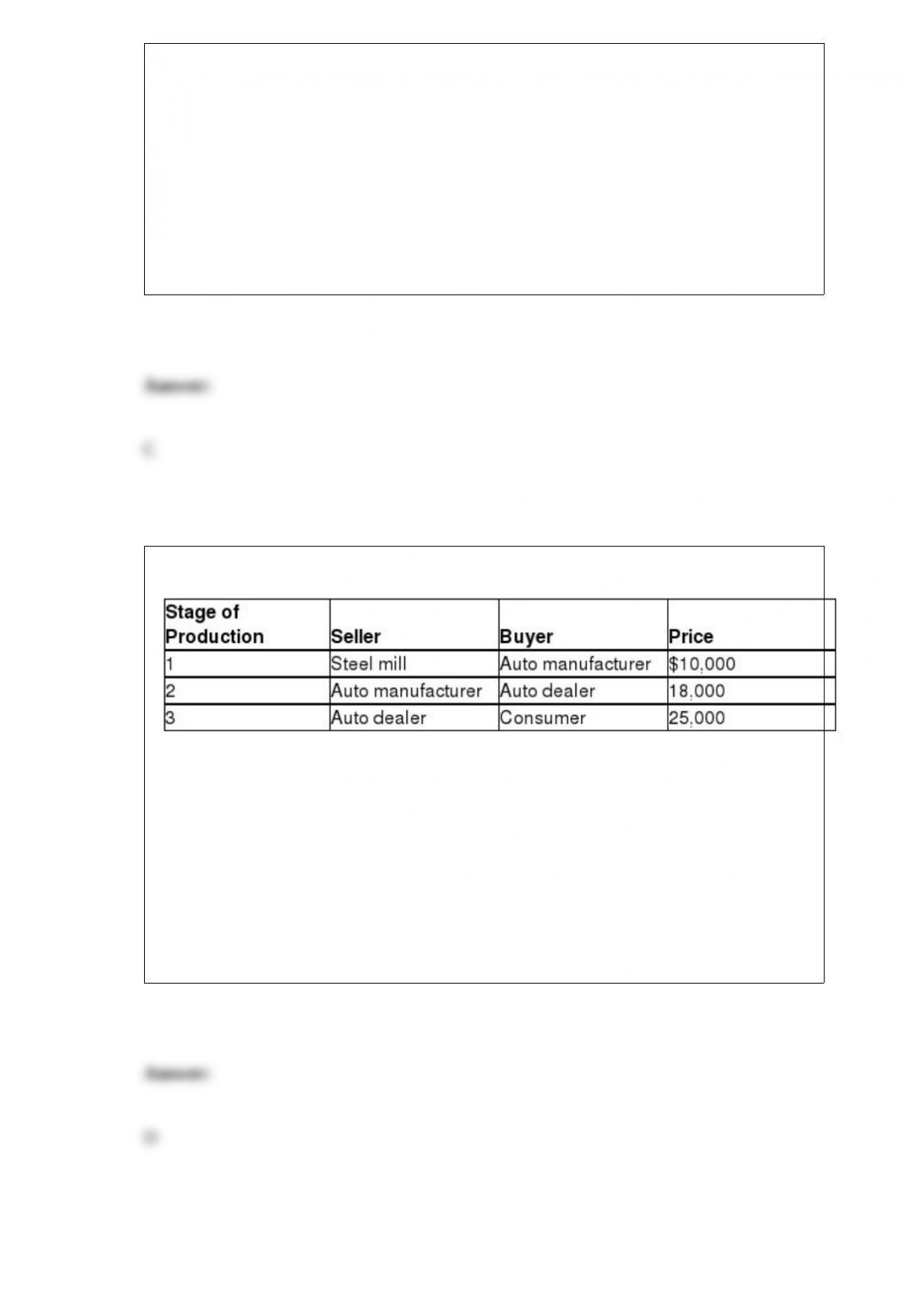
Table 8-5
Consider the table above showing three stages of production of an automobile. The
value of each automobile in gross domestic product equals
A) $7,000.
B) $15,000.
C) $18,000.
D) $25,000.

Equilibrium in the loanable funds market determines
A) the nominal interest rate.
B) the current interest rate.
C) the real interest rate.
D) the expected interest rate.
Studies have shown that drinking one glass of red wine per day may help prevent heart
disease. Assume this is true, and a fungal disease destroys a large portion of the grape
harvest of California vineyards. In the market for red wine, these two developments
would
A) increase demand and increase supply, resulting in an increase in the equilibrium
quantity and a decrease in the equilibrium price of red wine.
B) increase demand and decrease supply resulting in a decrease in both the equilibrium
quantity and the equilibrium price of red wine.
C) increase demand and decrease supply, resulting in an increase in the equilibrium
price and an uncertain effect on the equilibrium quantity of red wine.
D) increase demand and decrease supply, resulting in an increase in both the
equilibrium price and the equilibrium quantity of red wine.

Article Summary. According to the Office for National Statistics in the United
Kingdom, productivity in the UK in 2012 was well below the average of the G7
countries, only faring better than Japan. The G7 is a group of the seven most
industrialized countries, and includes Canada, France, Germany, Italy, Japan, the
United Kingdom, and the United States. Compared to the G7 average, the UK was
16% less productive per hour worked, and output was 19% worse when measured
on a per worker basis. The productivity gap was the largest for the UK since 1994.
Worker productivity has increased in all of the G7 nations except for the UK since
2007, where it has fallen by two percentage points. The most productive workers
were in the United States, where workers were 29 percentage points more
productive per hour worked than in the UK.
Source: “UK workers much less productive than others in the G7,” Guardian,
September 18, 2013.
Unlike in the UK, labor productivity in the other G7 nations has increased since 2007.
An increase in labor productivity
A) will increase the labor force participation rate.
B) allows the average consumer to increase consumption.
C) will create short-run, but not long-run, economic growth.
D) will increase output and decrease wages in the long run.
The demand curve for labor is also
A) the demand curve for the output produced with labor since the demand for labor is a
derived demand.
B) the marginal product of labor curve.
C) the marginal revenue product of labor curve.
D) the supply curve for the output labor is used to produce.

Which of the following statements describes economists’ attitudes regarding the
influence of social factors on the choices consumers make?
A) Economists formerly believed they were very important but now they believe they
are not important.
B) Economists believe social factors affect consumer choice in markets for public
goods but not in markets for private goods.
C) Liberal economists believe social factors are very important; conservative
economists do not believe social factors have any influence on consumers.
D) Economists traditionally believed they were unimportant, but many economists now
believe social factors are important.
Scenario 1-3 Suppose a t-shirt manufacturer currently sells 5,000 t-shirts per week and
makes a profit of $10,000 per week. A manager at the plant observes, “Although the last
400 t-shirts we produced and sold increased our revenue by $4,000 and our costs by
$4,800, we are still making an overall profit of $10,000 per week so I think we’re on the
right track. We are producing the optimal number of t-shirts.”
Using marginal analysis terminology, what is another economic term for the
incremental revenue received from the sale of the last 400 t-shirts?
A) gross earnings
B) marginal revenue
C) sales revenue
D) gross profit

What is accounting profit?
A) gross revenue minus explicit costs
B) gross revenue minus implicit costs
C) gross revenue minus explicit and implicit costs
D) the same as economic profit
Which of the following will shift the aggregate demand curve to the right, ceteris
paribus?
A) an increase in interest rates
B) a decrease in disposable income
C) a decrease in expected profits for firms
D) an increase in net exports
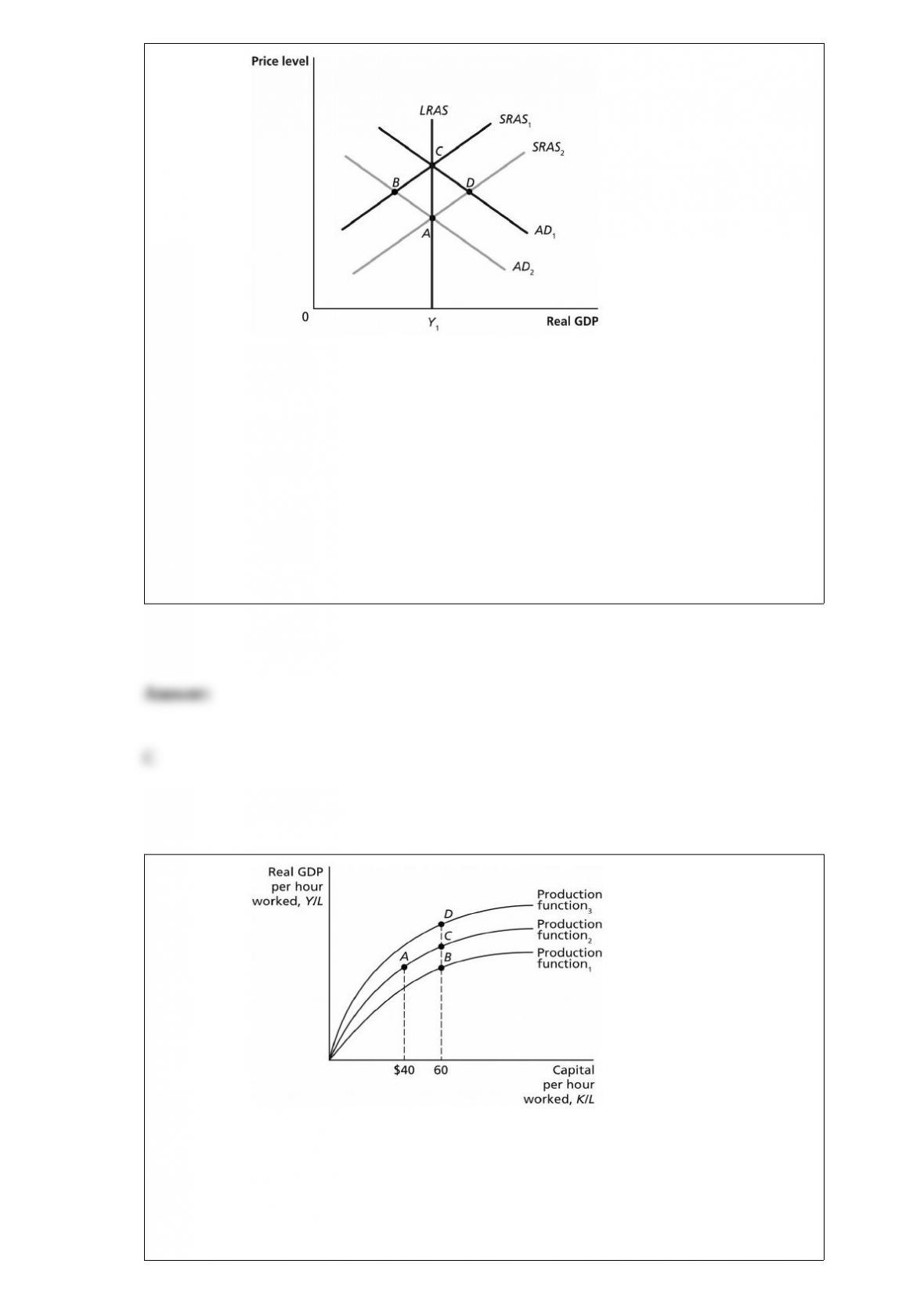
Figure 24-3
Suppose the economy is at point A. If government spending increases in the economy,
where will the eventual long-run equilibrium be?
A) A
B) B
C) C
D) D
Figure 22-1
Using the per-worker production function in the figure above, the largest changes in an
economy’s standard of living would be achieved by a movement from
A) A to B to C.

B) B to C to D.
C) C to B to A.
D) D to C to B.