
Which of the following accurately describes the impact of the rule of law on a country’s
economic growth rate?
A) Countries with a strong rule of law have faster economic growth.
B) Countries with a weak rule of law have faster economic growth.
C) Countries that enforce property rights through lawsuits have slower economic
growth.
D) Countries where favoritism and bribery are common have stronger rates of growth.
If GDP is currently $13 trillion and is growing at a rate of 2.3% per year, how long will
it take GDP to reach $26 trillion?
A) about 15 years
B) about 17 years
C) about 25 years
D) about 30 years
The public choice model
A) examines the degree of market power that the public exerts in a market economy.
B) examines the public’s role in appointing politicians and ensuring that elected officials
act in ways to reflect the public’s preferences.

C) applies economic analysis to government decision making.
D) applies economic analysis to the collective decision making of consumers.
When you purchase a new set of spurs you do so in the
A) resource market.
B) product market.
C) input market.
D) factor market.
Workers and firms both expect that prices will be 2.5% higher next year than they are
this year. As a result,
A) workers will be willing to take lower wages next year, but not lower than a 2.5
percent decrease.
B) the purchasing power of wages will rise if wages increase by 2.5%.
C) the short-run aggregate supply curve will shift to the left as wages increase.
D) aggregate demand will increase by 2.5%.
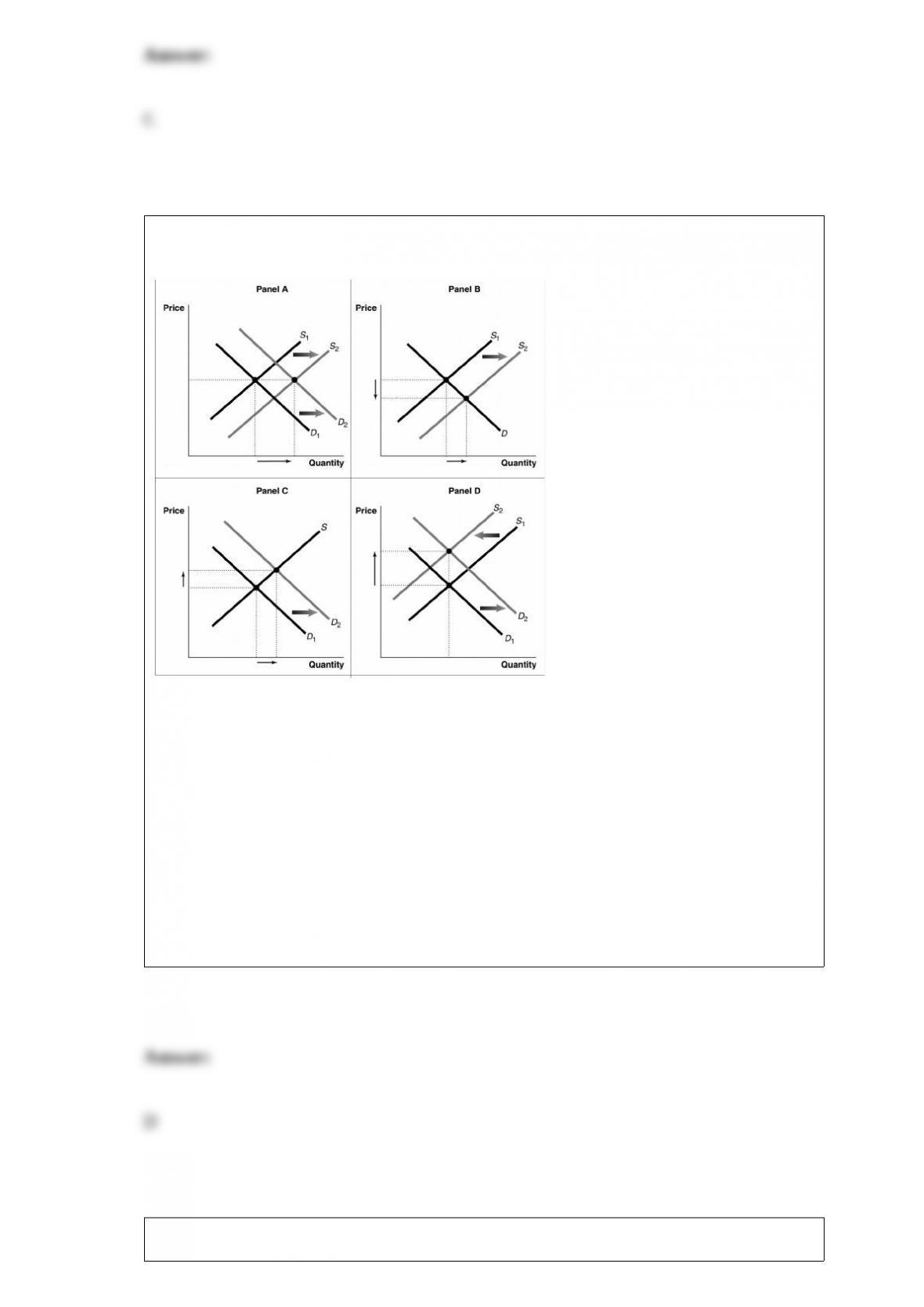
Figure 12-16
Which panel best represents the perfectly competitive organic produce market in which
some firms are experiencing short-run losses, and consumers are displaying an
increased preference for organic produce?
A) Panel A
B) Panel B
C) Panel C
D) Panel D
According to new growth theory,

A) physical capital is nonexcludable.
B) knowledge capital is excludable.
C) knowledge capital is subject to increasing returns.
D) knowledge capital is rival and excludable.
Assume that the demand curve for sunblock is linear and downward sloping. Which of
the following statements about the slope of the demand curve for sunblock and the price
elasticity of demand for sunblock are true?
A) The slope and the price elasticity of demand are constant at all points along the
demand curve for sunblock.
B) The slope is constant, but the price elasticity of demand is not constant at all points
along the demand curve for sunblock.
C) The slope is not constant, but the price elasticity of demand is constant at all points
along the demand curve for sunblock.
D) The slope of the demand curve for sunblock is constant and equal to zero; demand is
perfectly inelastic.
Who controls a partnership?
A) stockholders
B) bondholders

C) the owners
D) all of these
How will the exchange rate (foreign currency per dollar) respond to a decrease in the
relative rate of productivity growth in the United States in the long run?
A) Exchange rates will rise.
B) Exchange rates will fall.
C) Exchange rates will be unaffected by changes in the relative rate of productivity
growth in the United States, both in the short run and in the long run.
D) The exchange rate will be affected in the short run, but not in the long run.
A firm’s efforts to increase profit by price discrimination can be undermined by
A) arbitrage by buyers.
B) consumer ignorance.
C) differences in elasticity of demand.
D) seller market power.