
The relative concept of poverty is based on how far behind average income a particular
family gets.
a. True
b. False
If the supply curve of a commodity is upward sloping, and the producing country
begins to export more in a pure free trade system, the domestic price of the commodity
will
a. fall.
b. rise.
c. exceed the price in foreign countries.
d. be below the price in foreign countries.
Figure 16-2
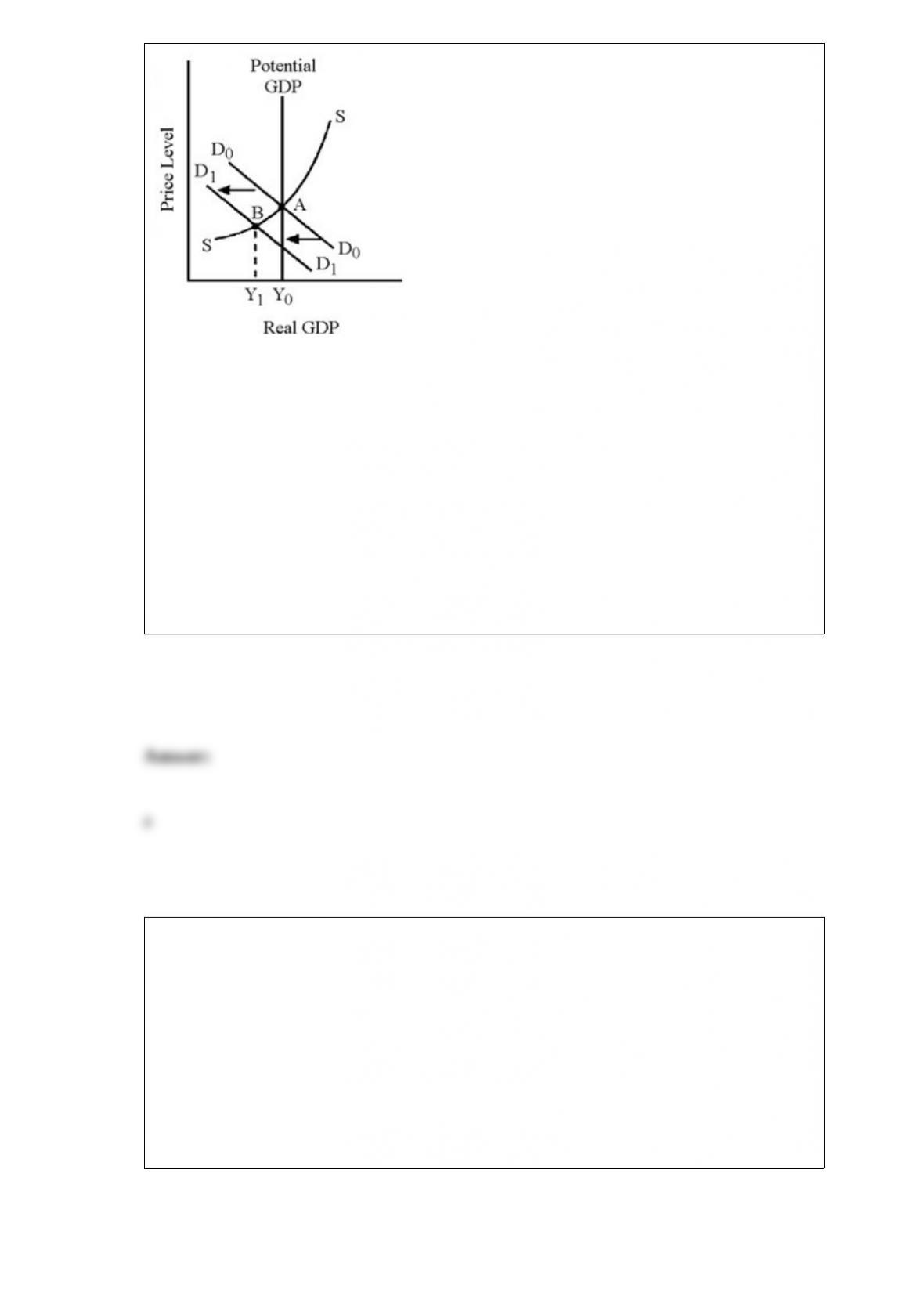
Suppose that Figure 16-2 shows the effects of reducing the budget deficit by raising
taxes. If authorities do not want real GDP to fall, monetary policy must
a. become sufficiently more expansionary to restore the aggregate demand curve to
D0D0.
b. contract aggregate demand to be consistent with deficit-reducing fiscal policy.
c. not lower interest rates and thwart the goal of a balanced budget.
d. become more contractionary to lower the interest rate and spur investment.
If a country is in a strong upward phase of the business cycle, one can expect that its
currency will
a. revalue.
b. devalue.
c. appreciate.
d. depreciate.

Imports from China represent ____ of total U.S. imports.
a. less than 20%
b. approximately 40%
c. approximately 60%
d. more than 80%
Demand-side inflation is normally accompanied by
a. falling real GDP, while supply-side inflation may be accompanied by rising real GDP.
b. falling real GDP; the same is true of supply-side inflation.
c. rising real GDP, while supply-side inflation may be accompanied by falling real GDP.
d. rising real GDP; the same is true of supply-side inflation.
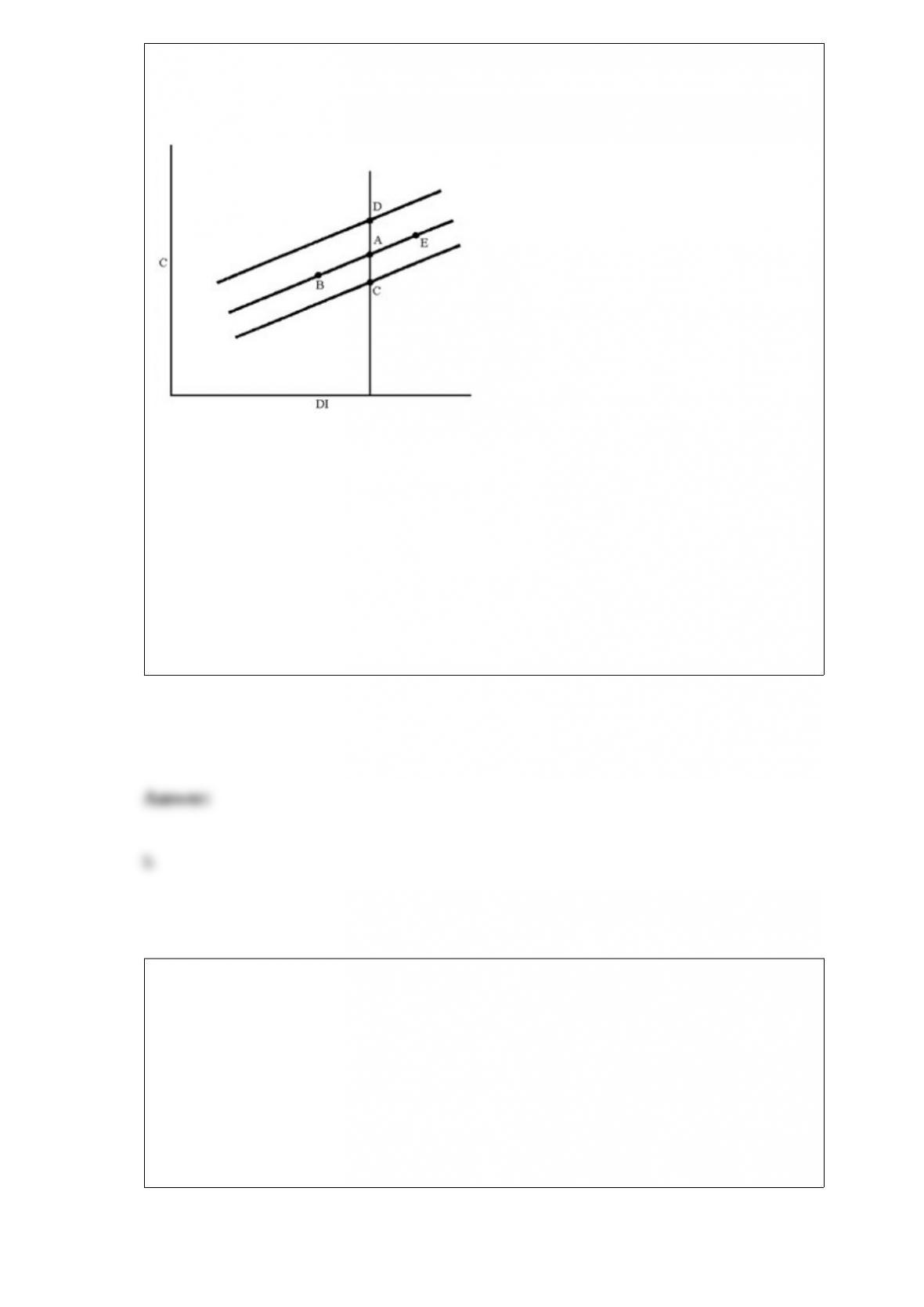
Figure 8-2
In Figure 8-2, which of the following moves can be explained by a decrease in the
prices of stock on the NASDAQ?
a. A to B
b. A to C
c. A to D
d. A to E
New stock issues are typically handled by
a. commercial banks.
b. insurance companies.
c. investment banks.
d. stock exchanges.

A recession will occur if an economy’s actual GDP ____ its potential GDP.
a. rises above
b. equals
c. falls below
d. grows faster than
Without government intervention, public goods would
a. be much less expensive.
b. not be provided.
c. be produced in much larger quantity.
d. be priced within the income ability of all individuals to purchase them.

What effect did the decrease in the value of the dollar have on the U.S. trade deficit in
the period from 2006 to 2009?
a. It decreased the trade deficit as Americans bought more U.S. capital goods.
b. It decreased the trade deficit as foreigners were attracted to the increased value of
U.S. products and Americans bought fewer imports.
c. It increased the trade deficit as U.S. investors bought more domestic financial assets.
d. It increased the trade deficit as Americans bought more imports and foreigners
bought fewer U.S. products.
In the past 100 years the U.S. economy has primarily experienced
a. deflation.
b. unemployment.
c. inflation.
d. depression.
The longer and more unpredictable that the policy lags are, the stronger the case for
active stabilization policy.
a. True

b. False
Government purchases have the same multiplier effect as business investment spending.
a. True
b. False
Specialization in production
a. raises productivity.
b. requires money.
c. stimulates exchange.
d. All of the above are correct.
During the 2007-2009 financial crisis, the U.S. government decided that Lehman
Brothers was not too big to fail and that AIG was too big to fail.
a. True
b. False
The personal income tax varies as GDP changes.
a. True
b. False
The Federal Reserve Bank was modeled after the European Central Bank.
a. True
b. False

The Social Security system works exactly like any private retirement trust system.
a. True
b. False
In an attempt to forecast enrollment, a major university hired an economist to give a
“head count.” One variable which she would probably emphasize more than any other
in trying to forecast this is
a. how interested people are in attending college.
b. the employment opportunities that college opens up.
c. survey results on public interest in education.
d. her instinct about what the public wants.
e. tuition (the price of attending).
The marginal utility of a unit of good Y to Jane is

a. the additional utility that Jane gets from consuming one more unit of Y.
b. defined in money terms as the minimum amount Jane is willing to pay for that
additional unit of Y.
c. defined in money terms as the maximum amount Jane is willing to pay for all the Y
she buys except that additional unit.
d. All of the above are correct.
In response to the “Great Depression 2.0” the Obama administration responded with
more tax cuts, increased federal spending, and aid to state and local governments.
a. True
b. False
Which of the following groups would have the lowest unemployment rates?
a. high-school dropouts
b. married men
c. nonwhite teenagers
d. nonwhite women

Input choices in the present are often affected by past decisions.
a. True
b. False
As a result of the recent financial crisis, some analysts believed that the MPC in the
U.S. declined. If this is true, the value of the multiplier is now
a. smaller.
b. larger.
c. the same.
d. magnified to a larger amount.

As GDP falls, automatic stabilizers run the federal budget in a deficit direction.
a. True
b. False
The monetary and fiscal stimulus response to the Great Recession resulted in an
immediate increase in real GDP.
a. True
b. False
Tax cuts associated with supply-side economics often lead to increased
a. federal budget surpluses.
b. federal budget deficits.
c. foreign trade surpluses.
d. government spending.
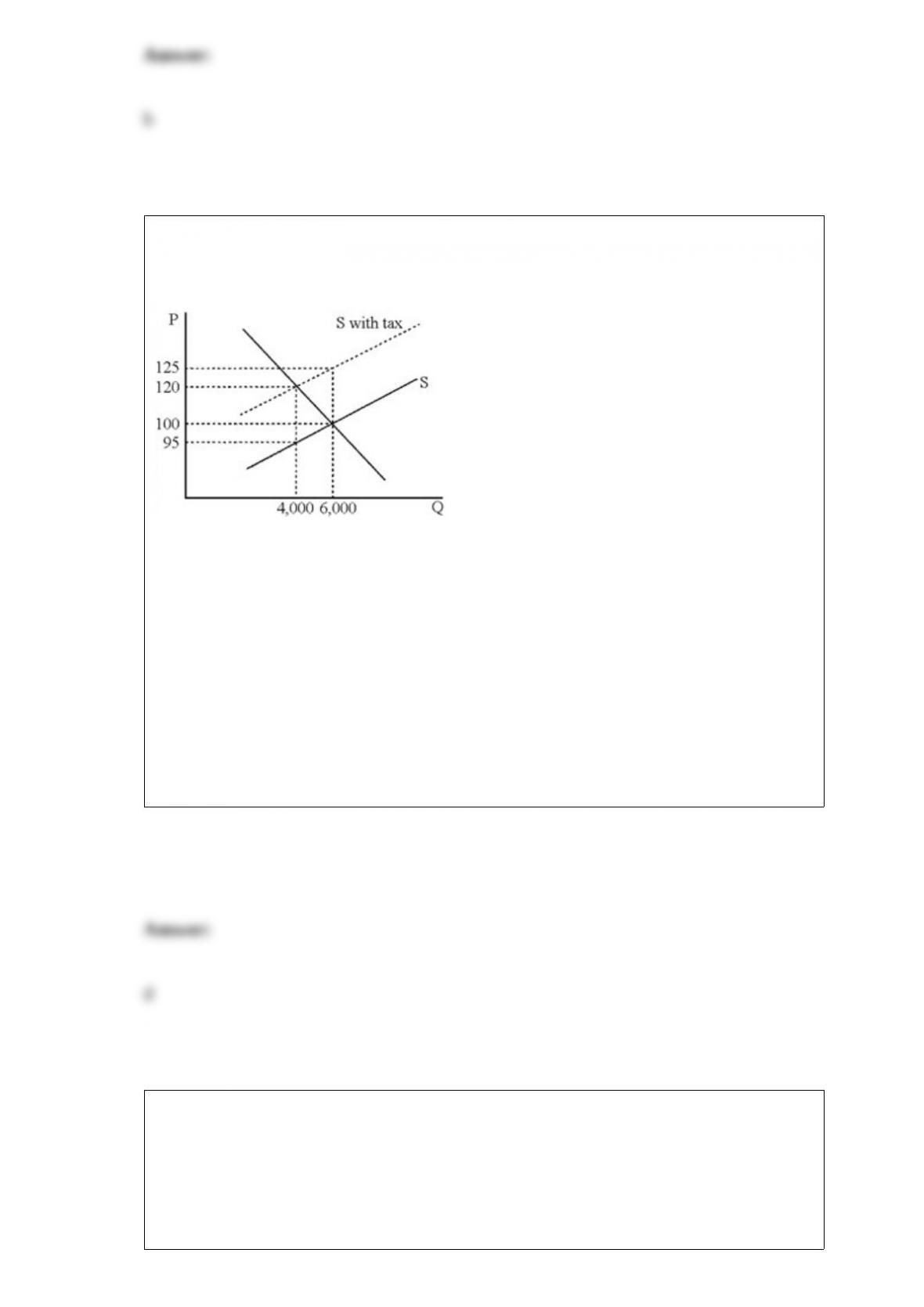
Figure 18-2
Figure 18-2 shows the widget market before and after an excise tax is imposed. What
percentage of the tax per widget is borne by consumers, considering the true economic
incidence of the tax?
a. 0 percent
b. 20 percent
c. 50 percent
d. 80 percent
A relatively high wage is predicted to be enjoyed by workers where
a. the population is large relative to industrial activity.
b. the jobs are disagreeable or dangerous.

c. the jobs are pleasant and satisfying.
d. demand is weak and supply is high.