
Which of the following is an imperfection of market economies?
a. They produce inexpensive services but expensive manufactured goods.
b. They place undue importance on the needs of future generations.
c. They cannot provide certain goods such as national defense.
d. They distribute income too unequally.
When price is above the equilibrium level, suppliers offer more than demanders wish to
buy.
a. True
b. False
The courts in some states have declared the financing of public schools by local
property taxes unconstitutional because
a. housing should never be the basis for taxation of any kind.
b. taxes on real estate generate too much tax revenue.
c. disparity in property values means some communities have more in tax revenues to
spend on education than do communities containing less valuable property.

d. the funds for public education should come from federal revenues, not from local
property taxes.
Which of the following is not a requirement for the existence of monopolistic
competition in a market?
a. numerous small sellers
b. full information about the market among buyers and sellers
c. product homogeneity
d. freedom of entry into the market
Frictional unemployment will typically be a short-term problem for someone between
jobs.
a. True
b. False

When constructing a basic macroeconomic model, several assumptions (not realistic,
but necessary to simplify the analysis) are made. Which of the following are assumed to
be constant?
a. the price level
b. the rate of interest
c. the foreign exchange rate
d. the level of government spending
e. All of the above are held constant.
It would be impossible to have an unlevered bank.
a. True
b. False
A failure of the pricing system has led to pollution.

a. True
b. False
Suppose that 19th-century politicians had succeeded in their attempt to impose a “single
tax”-a tax on suppliers of land (i.e., landlords). Most of the economic burden of the tax
would have been borne by
a. renters, because the demand for land is generally less elastic than its supply.
b. renters, because the demand for land is generally more elastic than its supply.
c. landlords, because the demand for land is generally less elastic than its supply.
d. landlords, because the demand for land is generally more elastic than its supply.
Figure 3-3
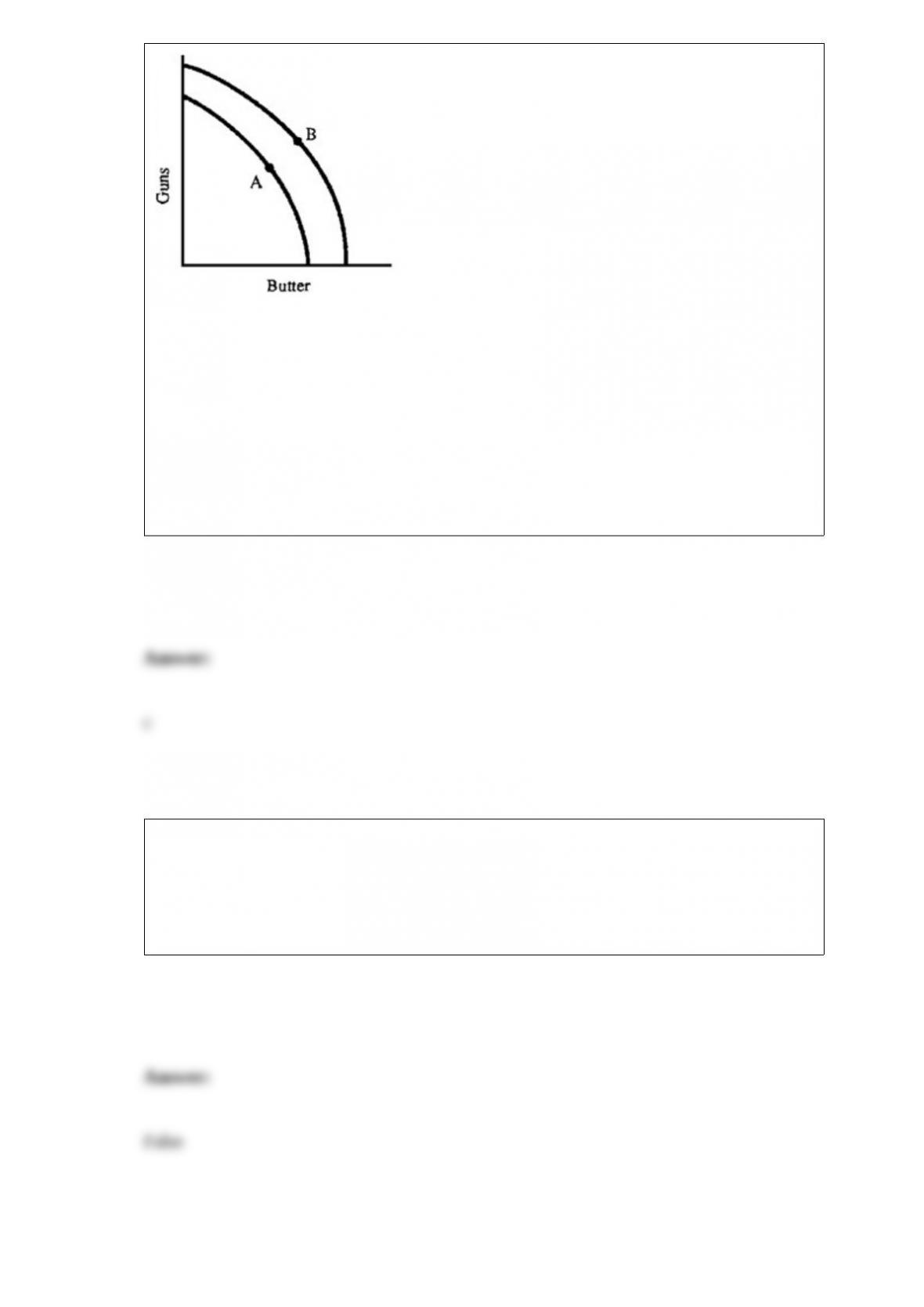
In Figure 3-3, a shift from A to B seems most consistent with which of the following?
a. Society decided to give guns lower priority.
b. There have been more technological advances in guns than in butter.
c. There is a massive immigration of labor.
d. There are unemployed resources in both guns and butter.
The U.S. Postal Service enjoys a monopoly position because of patent rights.
a. True
b. False

When the price of a good changes but the price of the only other good bought by a
consumer stays constant, his
a. budget line shifts.
b. indifference curves shift.
c. budget line changes slope.
d. indifference curves change slope.
Producers of computer software are plagued with the problem of “pirating”, that is,
many people copy software legally purchased by others. The industry estimates that for
each legal copy of a program, there are two pirated copies in use. The industry wants
strict laws for the enforcement of its “intellectual property rights,” but enforcement is
obviously very difficult. Economists call this problem
a. depletability.
b. externality.
c. durability.
d. nonexcludability.
Hutch Technology makes computer monitors, which sell for $100 each. What is the
opportunity cost of ten monitors?

a. $1,000.
b. the other goods that could be produced with the resources that produce the ten
monitors
c. the profits that Hutch earns when it sells the ten monitors
d. the profits that Hutch loses if it does not produce the monitors
e. All of the above are correct.
If the price of apples decreases by 2 percent and causes apple consumption to increase
by 4 percent, the price elasticity of demand is ____, indicating the demand is ____.
a. 2, elastic
b. 2, inelastic
c. 0.5, elastic
d. 0.5, inelastic
The demand by sterile couples for babies to adopt has grown rapidly, while the supply
has dwindled because of improved contraception, liberal abortion laws, and an increase
in the probability that unwed mothers will keep their children. It violates the law to sell
human beings at any age, but for every twenty legal adoptions there seemingly is one

baby sale at a price up to $50,000. The generic term economists apply to the market
produced by this type of shortage is
a. “black market.”
b. “white slave market.”
c. “the adoption market.”
d. “baby market.”
To correct the budget deficit for inflation, we should
a. multiply the budget deficit by the price deflator for GDP.
b. subtract interest payments from tax revenues.
c. divide the budget deficit by nominal GDP.
d. divide the budget deficit by the consumer price index.
The Japanese economy is stuck in a recessionary gap. The proper fiscal policy could
include a(n)
a. decrease in taxes.
b. increase in government purchases.

c. increase in transfer payments.
d. All of the above are correct.
Assume that consumption in the United States is $9,000 billion in 2009. If the MPC is
0.8 and disposable income increases by $1,000 billion in 2010, then the level of
consumption in 2010 will be
a. $10,000 billion.
b. $9,800 billion.
c. $9,000 billion.
d. $7,200 billion.
The term “stagflation” was invented in the 1970s to describe an economy experiencing
both
a. deflation and economic stagnation.
b. inflation and economic stagnation.
c. high inflation and high employment.
d. high inflation and high levels of economic growth.

In general, productivity levels are much higher in richer countries like the U.S.
a. True
b. False
Inventory reductions caused by strong demand are signals to retailers to order more
products.
a. True
b. False
Which of the following statements concerning efficiency is correct?
a. If a toll road is heavily used so that traffic movement is slowed, the price per vehicle

should be reduced since the road is generating more revenue.
b. Economists advocate high prices for abundant resources and low prices for scarce
resources.
c. If a toll road is heavily used and traffic movement is difficult, the price per vehicle
should be increased to shift some traffic to less-crowded roads.
d. None of the above is desirable in promoting efficient use of scarce road space.
From 2007 to 2008, the Federal Reserve System reduced interest rates, the price that
borrowers pay. As a result, economists expected that the supply of money would
a. increase.
b. decrease.
c. not change.
d. Uncertain-economic theory has no answer to this question.
The financing of investment spending is often made possible by
a. consumer spending.
b. money supply creation.

c. borrowing.
d. tax reductions.
Over the years, economists in universities and government agencies have developed a
number of fairly accurate techniques to assist them in predicting what the economy will
do.
a. True
b. False
Which of the following was not a lesson from the 2007-2009 financial crisis?
a. Financial regulations were too “light” prior to the crisis.
b. Excessive complexity made the financial system more fragile and dangerous.
c. Both monetary policy and fiscal policy are needed in order for the economy to
recover.
d. Regulatory failures were based primarily on poor job performance.

High prices redistribute wealth from consumers to firms.
a. True
b. False
In practice, turning horizontal and vertical equity into tax law
a. hasn’t been tried.
b. has been fairly easy.
c. is resisted by nearly all taxpayers.
d. has been extremely difficult.
If the Fed decides to keep interest rates low when there is a large budget deficit,
economists conclude that the Fed is
a. monetizing the debt.

b. neutralizing the effects of the deficit.
c. correcting the deficit for inflation.
d. resisting the effects of the deficit.
If marginal utility is a positive number:
a. the more you purchase, the more total utility you get
b. the more you purchase, the less total utility you get
c. utility is not affected by more purchases
d. none of these is correct