
A market supply curve shows
a. the total quantity supplied at all possible prices.
b. the average quantity supplied by producers at all possible prices.
c. how quantity supplied changes when consumer income changes.
d. suppliers’ responses, in terms of the amounts they will supply, to the demands of
buyers.
Which of the following illustrates how the investment accelerator works?
a. An increase in government expenditures increases aggregate spending so that
SnoozeBargain Co. decides to modernize its motels.
b. An increase in government expenditures increases the interest rate so that
SnoozeBargain Co. decides to modernize its motels.
c. An increase in government expenditures increases the interest rate so that the demand
for stocks and bonds issued by SnoozeBargain Co. rises.
d. An increase in government expenditures decreases the interest rate so that
SnoozeBargain Co. decides to modernize its motels.
Laws that restrict the smoking of cigarettes in public places are examples of
government intervention that is intended to reduce

a. efficiency.
b. equality.
c. externalities.
d. productivity.
A government budget deficit
a. increases both net capital outflow and net exports.
b. decreases both net capital outflow and net exports.
c. increases net capital outflow and decreases net exports.
d. decreases net capital outflow and increases net exports.
U.S. Department of Labor data show that minimum-wage workers tend to be
a. young and less educated.
b. young and more educated.
c. old and less educated.

d. old and more educated.
Suppose Ashley needs a dog sitter so that she can travel to her sister’s wedding. Ashley
values dog sitting for the weekend at $200. Cami is willing to dog sit for Ashley so long
as she receives at least $150. Ashley and Cami agree on a price of $175. Suppose the
government imposes a tax of $10 on dog sitting. The tax has made Ashley and Cami
worse off by a total of
a. $50.
b. $40.
c. $20.
d. $10.
When a country takes a multilateral approach to free trade, it
a. removes trade restrictions on its own.
b. reduces its trade restrictions while other countries do the same.
c. does not remove trade restrictions no matter what other countries do.
d. is willing to trade with multiple countries at once.
A firm may pay efficiency wages in an attempt to
a. reduce incentives to shirk.
b. reduce turnover.
c. attract a well-qualified pool of applicants.
d. All of the above are correct.
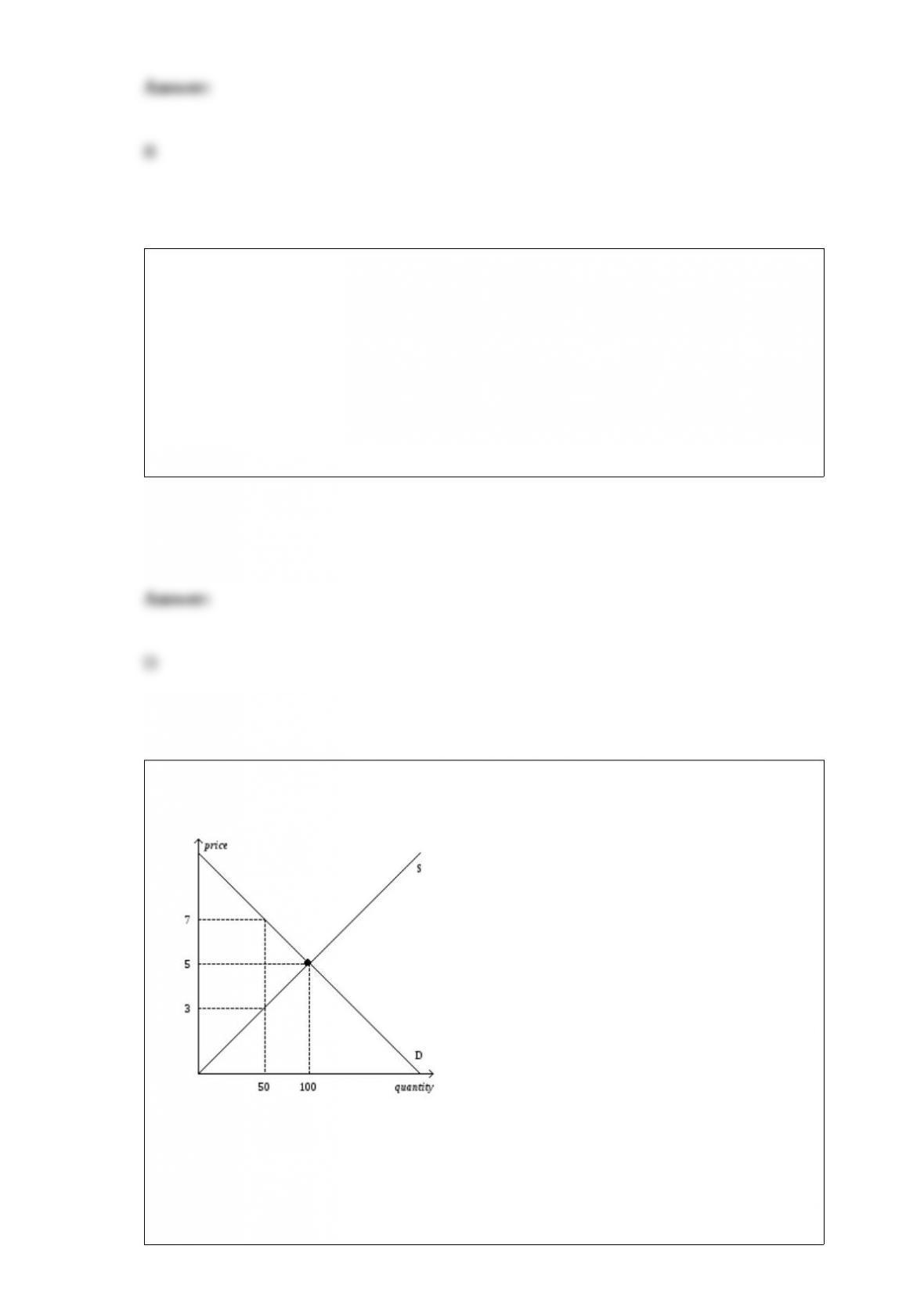
Figure 6-15
Refer to Figure 6-15. Suppose a tax of $2 per unit is imposed on this market. What will
be the new equilibrium quantity in this market?
a. less than 50 units

b. 50 units
c. between 50 units and 100 units
d. greater than 100 units
If a 10% decrease in price for a good results in a 20% increase in quantity demanded,
the price elasticity of demand is
a. 0.50.
b. 1.
c. 1.5.
d. 2.
Means-tested programs tend to favor
a. those with high income as would a consumption tax.
b. those with high income while a consumption tax would favor those with low income.
c. those with low income as would a consumption tax.
d. those with low income while a consumption tax would favor those with high income.

A favorable supply shock causes the price level to
a. rise. To counter this a central bank would increase the money supply.
b. rise. To counter this a central bank would decrease the money supply.
c. fall. To counter this a central bank would increase the money supply.
d. fall. To counter this a central bank would decrease the money supply.
An example of a perfectly competitive market would be the market for
a. electricity.
b. soybeans.
c. coffee shops.
d. restaurants.
The equipment and structures available to produce goods and services are called
a. physical capital.
b. human capital.
c. the production function.
d. technology.
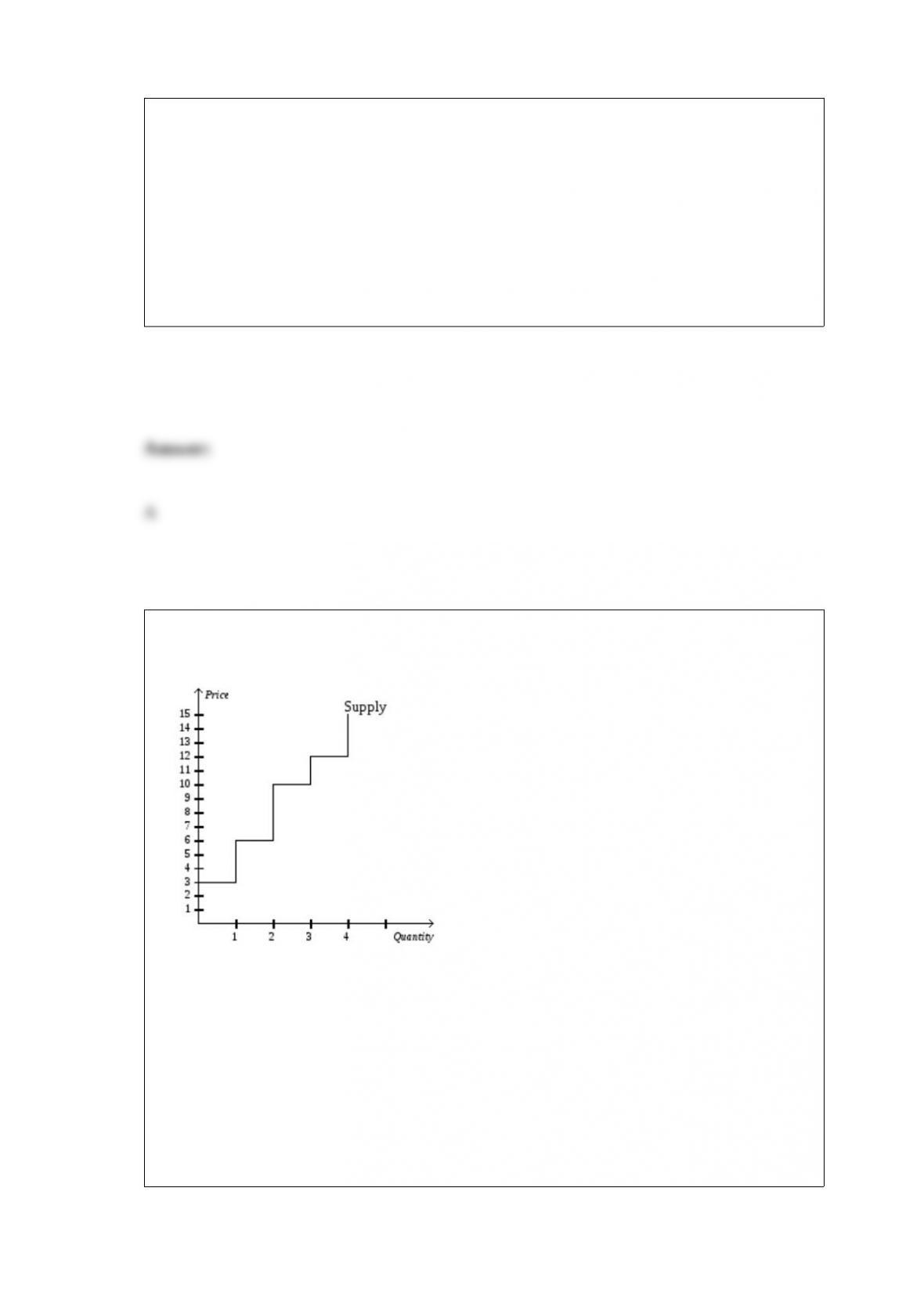
Figure 7-7
Refer to Figure 7-7. If the price of the good is $9.50, then producer surplus is
a. $2.50.
b. $6.50.
c. $8.00.
d. $10.00.
Which of the following is correct if there is a favorable supply shock?
a. the short-run aggregate supply curve and the short-run Phillips curve both shift right.
b. the short-run aggregate supply curve and the short-run Phillips curve both shift left.
c. the short-run aggregate supply curve shifts right and the short-run Phillips curve
shifts left.
d. the short-run aggregate supply curve shifts left and the short-run Phillips curve shifts
right.
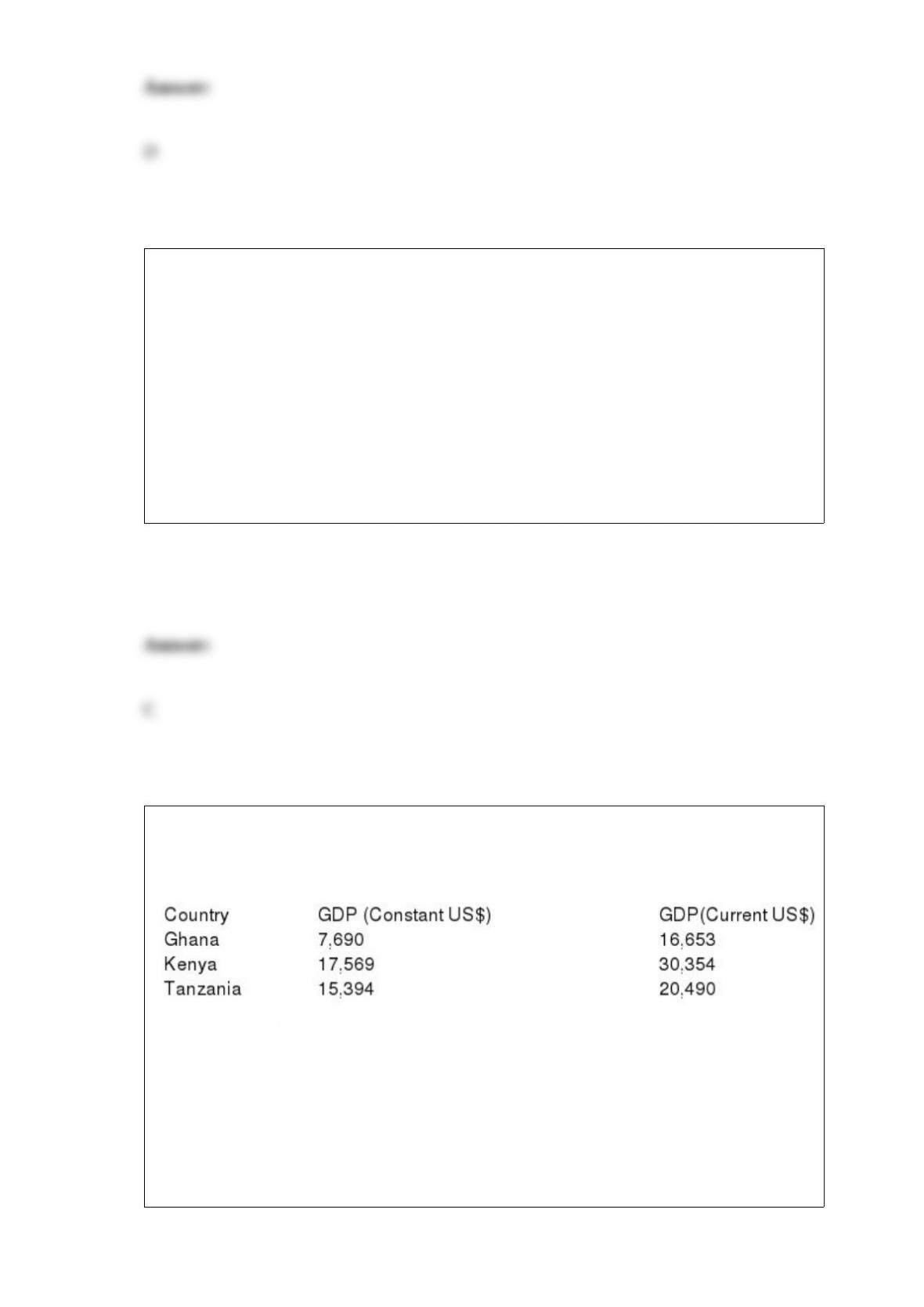
The information below for 2008 in millions was reported by the World Bank. On the
basis of this information, which list below contains the correct ordering of GDP per
person from highest to lowest?
a. Ghana, Kenya, Tanzania
b. Ghana, Tanzania, Kenya
c. Kenya, Tanzania, Ghana
d. Kenya, Ghana, Tanzania

In an imaginary economy, consumers buy only razors and cologne. The fixed basket
consists of 6 razors and 4 bottles of cologne. A razor cost $20 in 2009 and $25 in 2010.
A bottle of cologne cost $30 in 2009 and $40 in 2010. Using 2009 as the base year,
which of the following statements is correct?
a. For the typical consumer, the number of dollars spent on razors is equal to the
number of dollars spent on cologne in each of the two years.
b. The consumer price index is 310 in 2010.
c. The rate of inflation is 29.17% in 2010.
d. None of the above is correct.
In the 1990’s Ireland made unemployment benefits less generous. This change would
likely have
a. reduced structural unemployment and the natural rate of unemployment
b. reduced structural unemployment but not the natural rate of unemployment
c. reduced frictional unemployment and the natural rate of unemployment
d. reduced frictional unemployment but not the natural rate of unemployment

Over the past 70 years, the overall price level in the U.S. has experienced a(n)
a. 4-fold increase.
b. 8-fold increase.
c. 12-fold increase.
d. 16-fold increase.
Which of the following is correct? A tax burden
a. falls more heavily on the side of the market that is more elastic.
b. falls more heavily on the side of the market that is less elastic.
c. falls more heavily on the side of the market that is closest to unit elastic.
d. is distributed independently of the relative elasticities of supply and demand.
If the CPI was 104 in 1967 and is 390 today, then $10 in 1967 purchased the same

amount of goods and services as
a. $2.67 purchases today.
b. $37.50 purchases today.
c. $39.00 purchases today.
d. $104.00 purchases today.
At the Federal Reserve,
a. the nation’s monetary and fiscal policies are made by the Federal Open Market
Committee, which meets about every six weeks.
b. the nation’s monetary and fiscal policies are made by the Federal Open Market
Committee, which meets twice a year.
c. the nation’s monetary policy is made by the Federal Open Market Committee, which
meets about every six weeks.
d. the nation’s monetary policy is made by the Federal Open Market Committee, which
meets twice a year.
Which of the following is not correct about most economic models?
a. They are composed of equations and diagrams.

b. They contribute very little to economists’ understanding of the real world.
c. They omit many features of the real-world economy.
d. In constructing models, economists make assumptions.
U.S. exports are $400 billion, U.S. imports are $900 billion. Which of the following are
consistent with the level of net exports?
a. The U.S has a trade surplus. The U.S. purchases $800 of foreign assets and foreign
countries purchase $300 of U.S. assets.
b. The U.S. has a trade surplus. The U.S. purchases $300 of foreign assets and foreign
countries purchase $800 of U.S. assets.
c. The U.S has a trade deficit. The U.S. purchases $800 of foreign assets and foreign
countries purchase $300 of U.S. assets.
d. The U.S. has a trade deficit. The U.S. purchases $300 of foreign assets and foreign
countries purchase $800 of U.S. asset.
An increase in the price of cheese crackers from $2.25 to $2.45 per box causes suppliers
of cheese crackers to increase their quantity supplied from 125 boxes per minute to 145
boxes per minute. Using the midpoint method, supply is
a. elastic, and the price elasticity of supply is 1.74.

b. elastic, and the price elasticity of supply is 0.57.
c. inelastic, and the price elasticity of supply is 1.74.
d. inelastic, and the price elasticity of supply is 0.57.
Denmark is an importer of computer chips, taking the world price of $12 per chip as
given. Suppose Denmark imposes a $5 tariff on chips. Which of the following outcomes
is possible?
a. More Danish-produced chips are sold in Denmark.
b. More foreign-produced chips are sold in Denmark.
c. Danish consumers of chips become better off.
d. Total surplus in the Danish chip market increases.
Figure 8-15
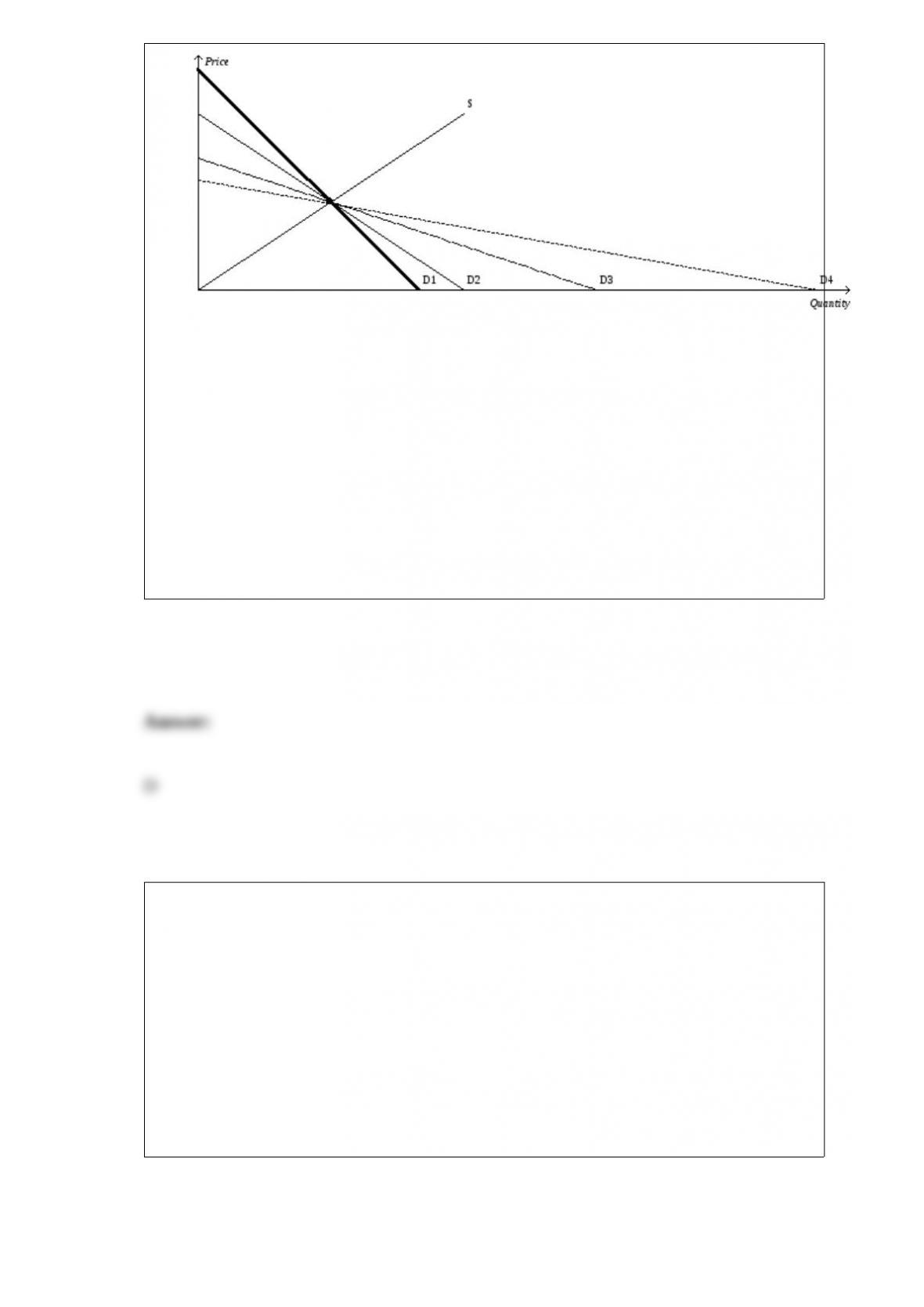
Refer to Figure 8-15. Suppose the government imposes a $1 tax in each of the four
markets represented by demand curves D1, D2, D3, and D4. The deadweight will be the
largest in the market represented by
a. D1.
b. D2.
c. D3.
d. D4.
An American retailer purchased 100 pairs of shoes from a company in Denmark in the
second quarter of 2010 but does not sell them to a consumer until the third quarter of
2010. In which quarter(s) is (are) the value of the shoes included in U.S. GDP?
a. the second and third quarters
b. the second quarter but not the third quarter
c. the third but not the second quarter
d. neither the second nor the third quarter

Which of the following is not an important question for economic policy raised by the
experience of the textile industry?
a. How does international trade affect consumer well-being?
b. Who gains and who loses from free trade among countries?
c. How do the gains from trade compare to the losses?
d. Which argument for restricting free trade is politically feasible?
Other things the same, when the price level rises more than expected, some firms will
have
a. higher than desired prices which increases their sales.
b. higher than desired prices which depresses their sales.
c. lower than desired prices which increases their sales.
d. lower than desired prices which depresses their sales.

An increase in the price of Irish whiskey imported into the United States will be
reflected in
a. both the U.S. GDP deflator and the U.S. CPI.
b. neither the U.S. GDP deflator nor the U.S. CPI.
c. the U.S. GDP deflator, but not the U.S. CPI.
d. the U.S. CPI, but not the U.S. GDP deflator.
The statistical discrepancy that regularly arises in national income accounting refers to
the slight difference between
a. personal income and personal disposable income.
b. estimates of GDP and actual GDP.
c. the income and expenditure approaches to the calculation of GDP.
d. the quarterly and annual approaches to the calculation of GDP.
If there is a shortage of loanable funds, then
a. the quantity demanded is greater than the quantity supplied and the interest rate will
rise.

b. the quantity demanded is greater than the quantity supplied and the interest rate will
fall.
c. the quantity supplied is greater than the quantity demanded and the interest rate will
rise.
d. the quantity supplied is greater than the quantity demanded and the interest rate will
fall.