1) If you received a 4% increase in your nominal wage and the price level increased by
6%, then your real wage has increased by 2%.
2) In the extraction of a nonrenewable resource such as coal, the mining firm faces
“user costs” which refer to the cost of digging out the coal, running the mine, and
transporting the coal.
3) Payments to holders of corporate bonds are known as dividends.
4) Gold backs the U.S. money supply.
5) A monopolist, being the sole seller in a market, is assured of positive economic
profits.
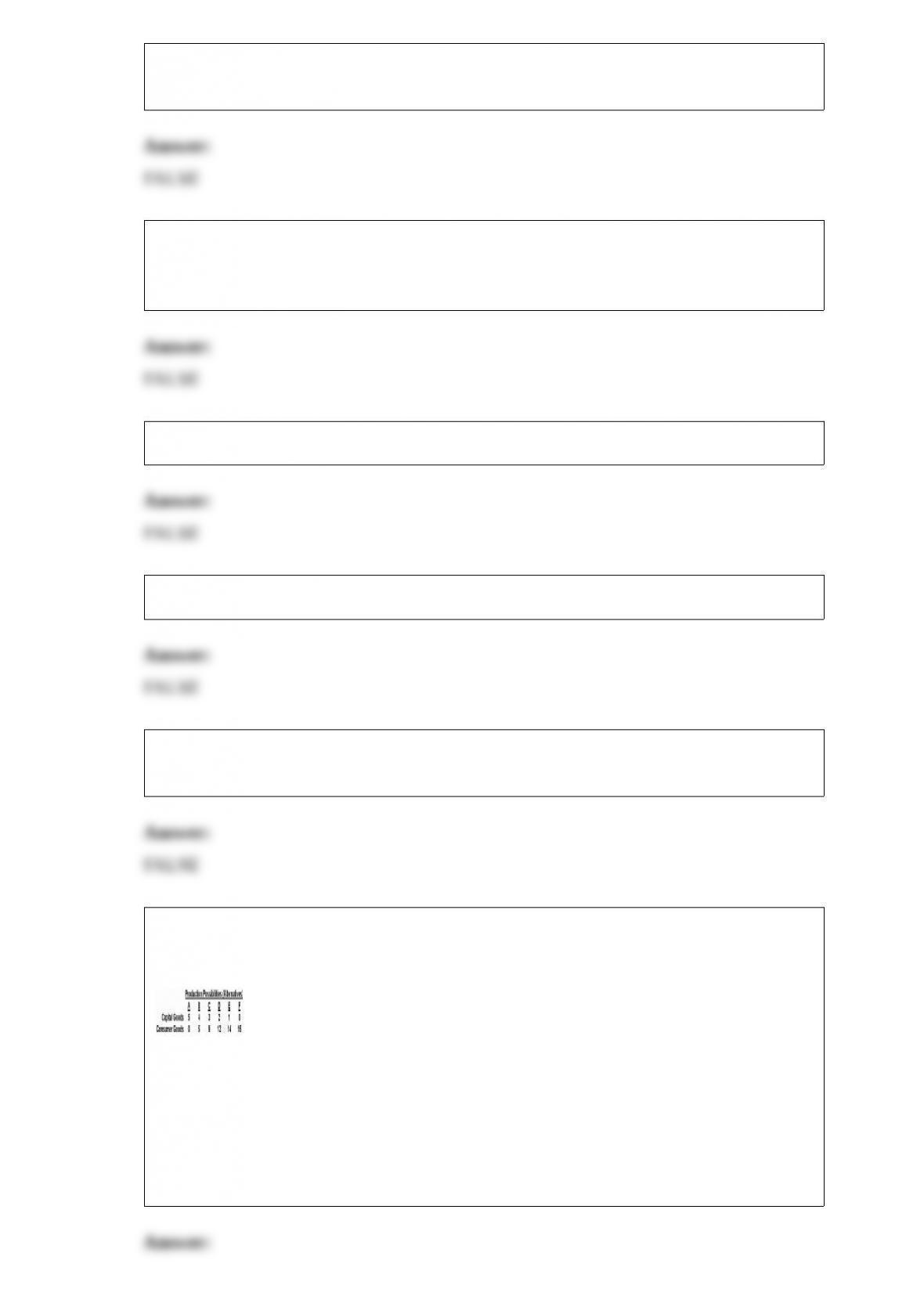
6) Answer the question on the basis of the data given in the following production
possibilities table:
Refer to the table. As compared to production alternative D, the choice of alternative C
would:
A.tend to generate a more rapid growth rate.
B.be unattainable.
C.entail unemployment.
D.tend to generate a slower growth rate.

7) The U.S. recession that occurred in 2008 and 2009 represented a case where:
A.government policy intervention effectively offset the negative demand shock and
minimized the effects on output and employment.
B.prices were somewhat flexible, so the impact of the demand shock was felt about the
same in terms of price and output changes.
C.prices were relatively flexible, minimizing the impact on total output and
employment.
D.prices were relatively sticky and most of the impact was on total output.
8) The process by which investors seek to profit by simultaneously selling an asset with
a lower rate of return and buying an otherwise identical asset with a higher rate of
return is known as:
A.hedging the market.
B.passive fund management.
C.arbitrage.
D.portfolio balancing.
9) Out-of-pocket costs of health care to consumers are mostly in the form of:
A.Premiums and copayments
B.Health taxes and premiums
C.Premiums and deductibles
D.Copayments and deductibles
10) The major beneficiaries from the elimination of a tariff on a product are the:
A.Foreign consumers of the product
B.Domestic producers of the product
C.Domestic consumers of the product
D.Domestic workers in industries producing the product
11) Monetary policy actions by the Fed are:

A.More effective in a restrictive direction than they are in an expansionary direction
B.More effective in an expansionary direction than they are in a restrictive direction
C.Equally effective in both expansionary and restrictive directions
D.Only effective when coupled with fiscal policy actions
12) The economy is in a recession. The government enacts a policy to increase spending
by $2 billion. The MPS is 0.2. What would be the full increase in real GDP from the
change in government spending assuming that the aggregate supply curve is horizontal
across the range of GDP being considered?
A.$6 billion
B.$8 billion
C.$10 billion
D.$16 billion
13) Given a Phillips Curve with stable and predictable inflation and unemployment rate
tradeoffs, it appears that:
A.An expansionary fiscal policy can shift the curve to the left
B.A tight money policy can shift the curve to the right
C.Manipulating aggregate demand through fiscal and monetary policies has the effect
of causing a movement along the curve
D.Manipulating aggregate demand through fiscal and monetary policies has the effect
of shifting the curve
14) U.S. workers will be attracted to otherwise undesirable work as long as:
A.The compensating wage differential is high enough
B.The compensating wage differential is low enough
C.There are not enough illegal immigrants to fill all of the available jobs
D.There are laws that restrict illegal immigrants from working in the U.S.
15) A nation’s real GDP was $250 billion in 2013 and $265 billion in 201 Its population
was 120 million in 2013 and 125 million in 201 What is its real GDP per capita in
2014?
A.$2,120 per person

B.$212 per person
C.$21,200 per person
D.$205 per person
16) The following data show the relationship between total costs and output in the short
run.
The firm’s marginal costs are equal to average total cost somewhere between units:
A.1 and 2
B.2 and 3
C.3 and 4
D.4 and 5
17) The legislation which prohibits the acquisition of assets of another company if the
transaction would significantly reduce competition, thereby closing a loophole in the
Clayton Act is the:
A.Sherman Act
B.Federal Trade Commission Act
C.Wheeler-Lea Act
D.Celler-Kefauver Act
18) A consumer had been consuming product X for some time. This period, she buys
fewer X in order to try some units of a new product Y. She finds that her marginal
utility of X is 20 (at a price of $10 per unit), while the marginal utility of Y is 36 (at a
price of $12). The utility-maximizing rule suggests that this consumer should:
A.Increase consumption of product X because of its lower price
B.Increase consumption of product X because it is an old reliable product
C.Increase consumption of product Y because it has a higher MU/P
D.Increase consumption of product Y because it has a higher MU
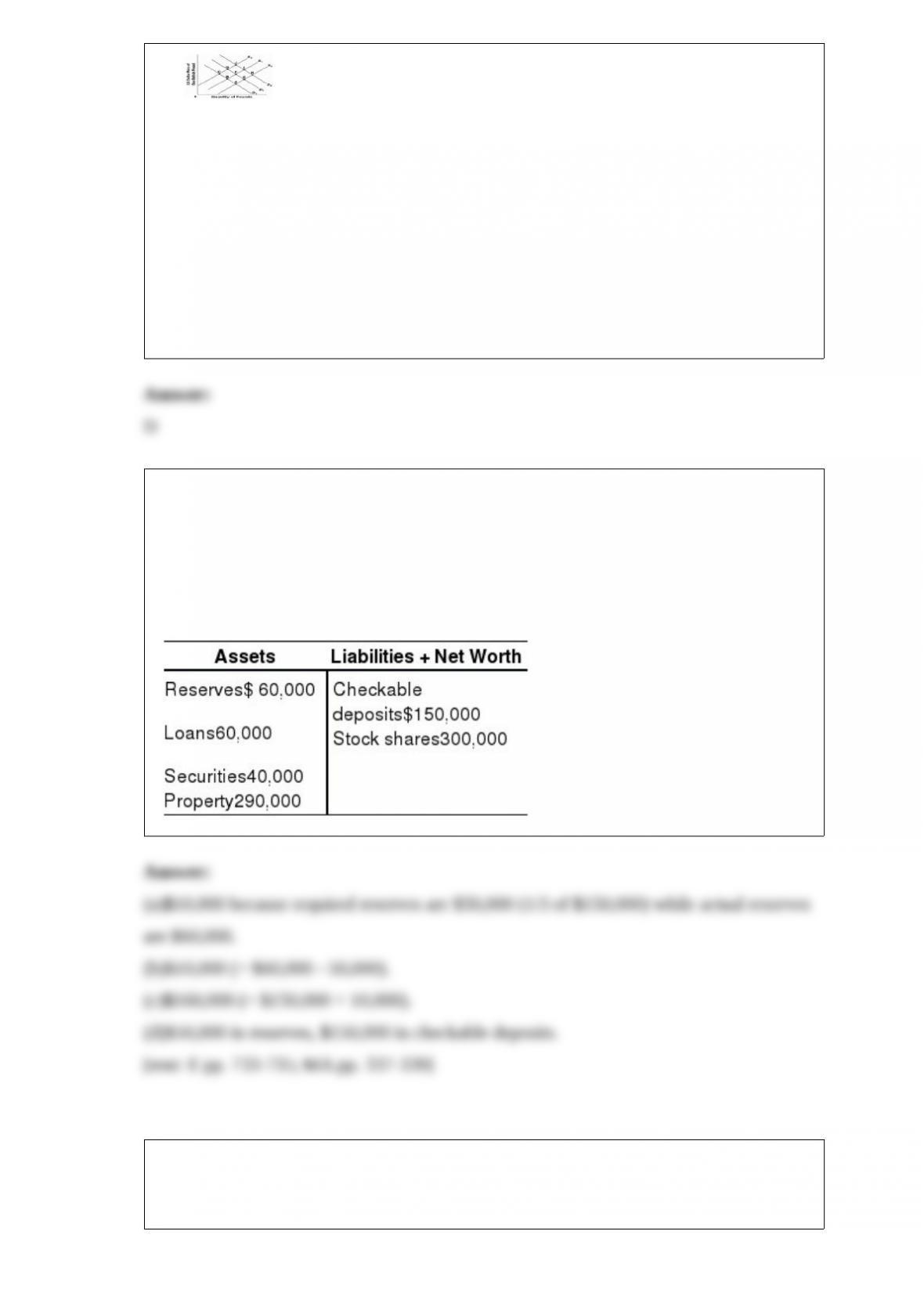
19)
Refer to the graph above, which shows the supply and demand for British pounds. D1
and S1 represent the initial demand and supply curves. If there is a huge increase in the
desire of U.S. buyers to consume UK products, and the British government starts
buying U.S. dollars in order to fix the exchange rate at the initial level, then the new
equilibrium will be at point:
A.F
B.J
C.C
D.H
20) Using the balance sheet below and assuming a required reserve ratio of 33%,
answer the following: (a) What is the amount of excess reserves? (b) This bank can
safely expand its loans by what amount? (c) By expanding its loans by this amount in
part (b), its checkable deposits would expand to what amount (if all loans were made to
checking account customers)? (d) If checks clear against the bank equal to the amount
loaned in (b), how much would remain in reserves and in checkable deposits?
21) The table below shows the total utility data for products X and Y. Assume that the
prices of X and Y are $3 and $4, respectively, and that consumer income is $18.

Refer to the above table. Which of the following price-quantity schedules would
represent the demand for X in the $2 and $3 price-range?
A.Option A
B.Option B
C.Option C
D.Option D
22) Indiana’s health care plan for state employees:
A.has reduced total spending on health care, but at the cost of employees forgoing
important preventative care procedures.
B.has reduced total spending on health care without people forgoing important
preventative care procedures.
C.has increased total spending on health care, but with the benefit of increasing the
overall health of state workers who now take greater advantage of preventative care
procedures.
D.has reduced health care spending for those who participate in the plan, but only a
small (less than 10 percent) percentage of state employees actually use the system.
23) Use the following diagrams for the U.S. economy to answer the following question.
Which of the diagrams best portrays the effects of declines in the prices of imported
resources?
A.A.
B.B.
C.C.
D.D.
24) Give three examples of how businesses or nonprofit institutions use elasticity of
demand to charge consumers different prices.
25) Does the Fed pay interest on required reserves and excess reserve balances held at
the Federal Reserve bank?
26) What are three basic sources of economic profit? Which ones are most beneficial
for society?
27) Explain what is meant by a command economy.
28) What perspective do economists use to evaluate the issue of the amount of pollution
control?
29) D.
30) What is minimum efficient scale? What insights would it give about the size of
firms in an industry?
31) The value of the vertical intercept is $150 and the slope is -25 in a linear equation
for price and quantity demanded. If price is $5.00, what is the quantity demanded? State
the linear equation and show how you found the answer.
32) Discuss the problems that can arise when a government experiences a chronic
budget deficit.
33) Explain the two models/theories of discrimination.