
If goods are not rationed according to price, if follows that
a. they won’t get rationed at all.
b. some non-price rationing device will be used to ration the goods.
c. first-come-first-served will necessarily be the rationing device used in the market.
d. there will be surpluses in the market.
e. none of the above
Starting with an exchange rate of $1 =¥110, and a price tag of ¥30,000 for a
Japanese good, what happens to the dollar price of the good if the yen appreciates by 6
percent?
a. the dollar price of the good rises from $272.73 to $289.09
b. the dollar price of the good falls from $272.73 to $256.37
c. the dollar price of the good rises from $330,000 to $349,800
d. the dollar price of the good falls from $330,000 to $310,200
e. the dollar price of the good rises falls from $2,700 to $2,560
If the government attempts to aid farmers by implementing a policy that results in a

leftward shift in the supply curve of agricultural products, the policy in question is most
likely
a. a price support.
b. an acreage allotment program.
c. a target price.
d. any of the above
A necessary condition for the economy to be self-regulating is that
a. wages must be relatively high.
b. the labor market must always be in equilibrium.
c. the interest rate must be above its equilibrium level.
d. wages must be flexible in both an upward and downward direction.
e. none of the above
Exhibit 8-4
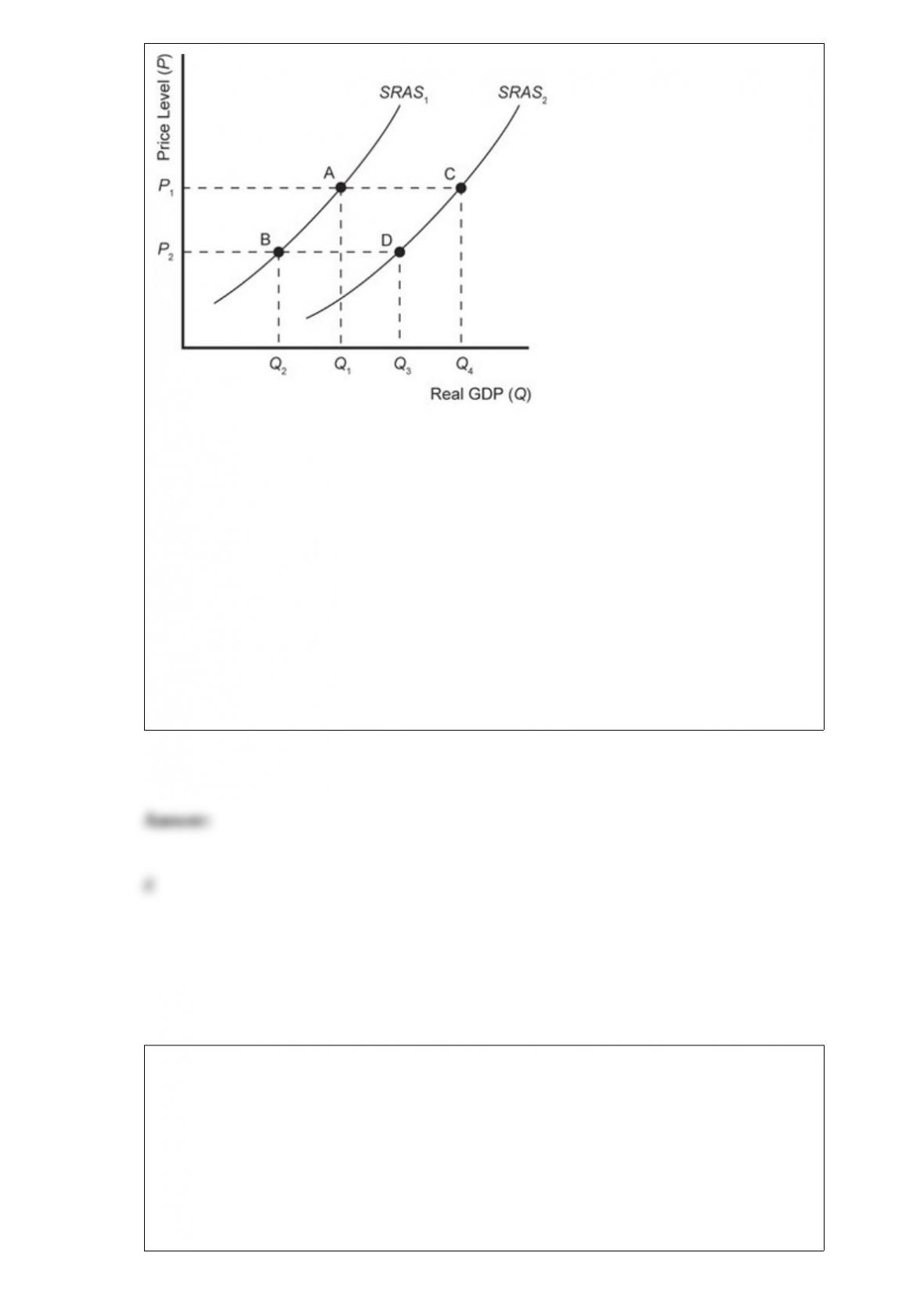
Which of the following could not have caused a shift in aggregate supply from SRAS1
to SRAS2?
a. an increase in productivity
b. a beneficial supply shock
c. a decrease in the price of a nonlabor input
d. a change in the price level
e. a decrease in wage rates
If an economy can increase its steady annual growth rate from 2 percent to 3 percent,
this reduces the time it takes for the economy to double in size by __________ years.
a. 5
b. 8
c. 12
d. 17
e. 20
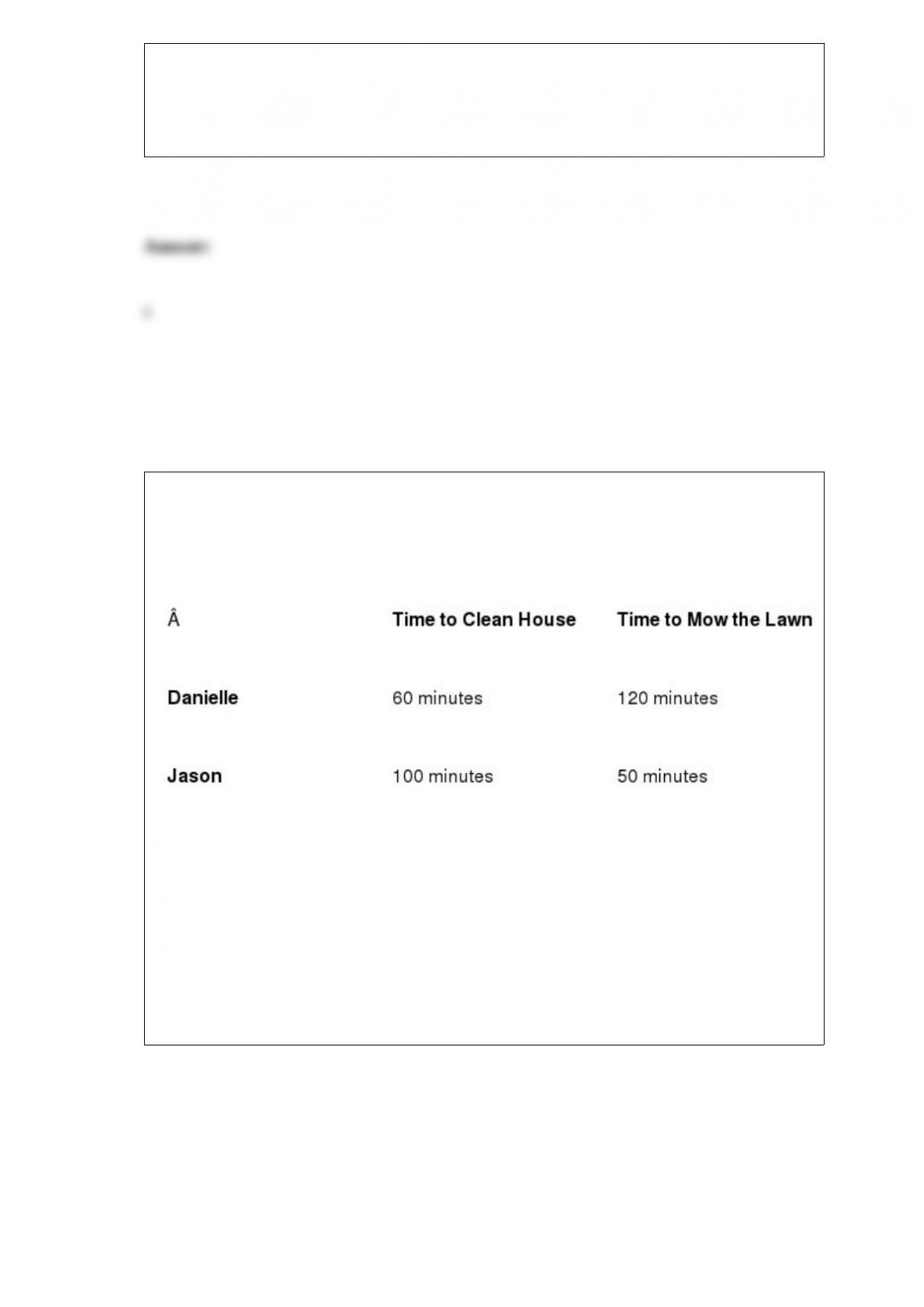
Exhibit 34-10
Jason’s opportunity cost of cleaning the house is
a. 0.50 mowed lawns.
b. 1.00 mowed lawns.
c. 2.00 mowed lawns.
d. 0.60 mowed lawns.
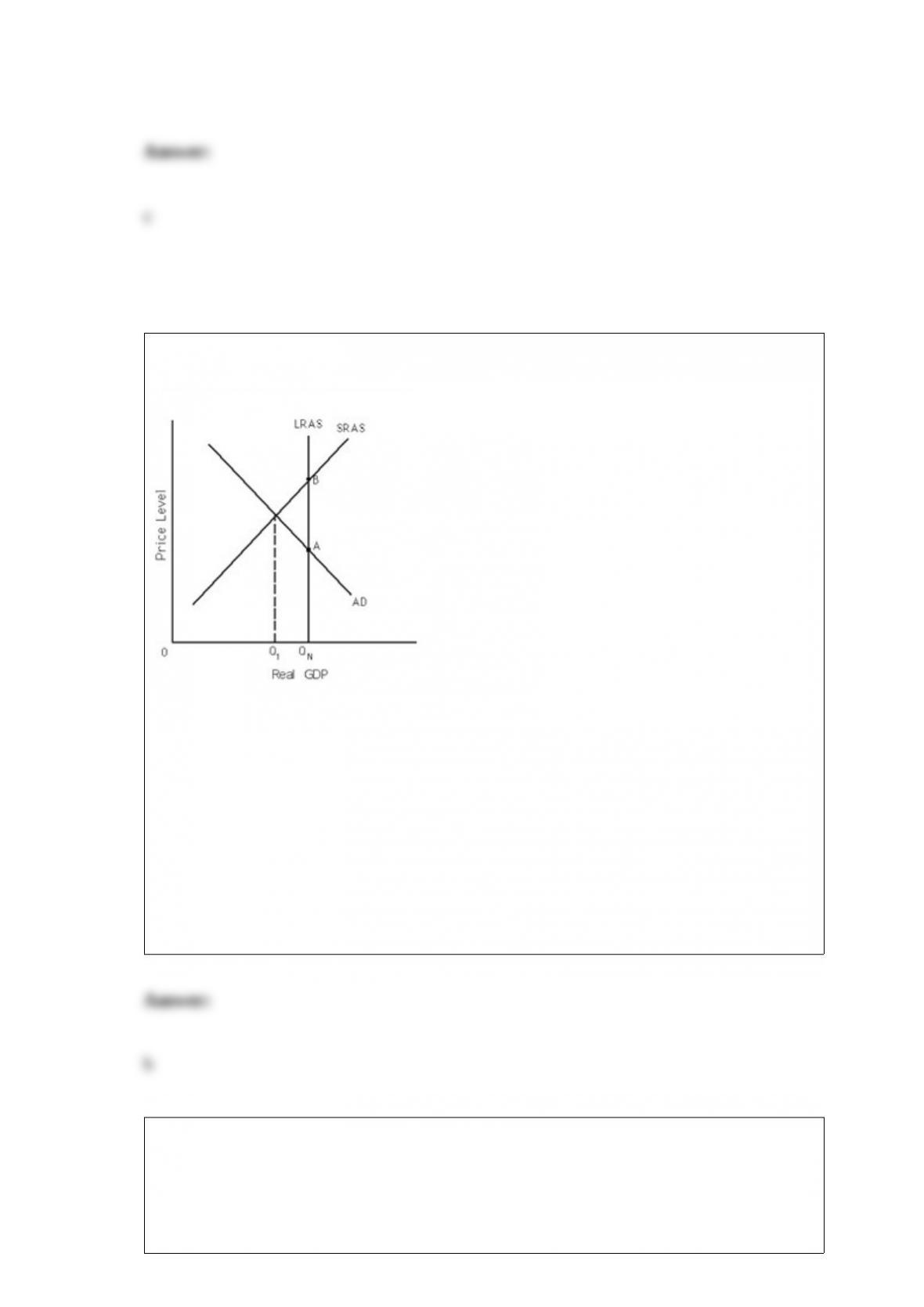
Exhibit 9-1
The economy is currently producing Q1. An economist who believes wages are flexible
in the downward direction would most likely argue that
a. it is likely the economy will soon move to point B.
b. it is likely the economy will soon move to point A.
c. it is not likely the economy will move to point A without government intervention.
d. Real GDP will soon take a downturn.
One measure of the inflation rate is the
a. sum of the CPIs of adjacent years.
b. percentage change in the CPI of adjacent years.

c. percentage change in the Real GDP of adjacent years.
d. GDP minus the Real GDP in a year.
Exhibit 39-3
If P3 is a price support, the amount sold on private markets is
a. Q1.
b. Q2.
c. Q3.
d. Q2 – Q3.
e. Q1 – Q3.
Exhibit 34-7

Assume that the current price of good X is $25 (which includes a $10 tariff on imports
of good X).The government collects tariff revenue on good X in the amount of
a. $100
b. $200
c. $250
d. $300
e. There is not enough information to answer this question.
Compared to barter, money __________ transaction costs, making transactions
__________ time-consuming.
a. increases; more
b. increases; less
c. reduces; more
d. reduces; less

Net exports must always be a positive amount.
a. True
b. False
Research by economists Autor, Dorn, and Hanson revealed that during the period 1990
to 2007, U.S. regions that faced more competition from Chinese imports had
_____________ unemployment rates and ______________ wages than U.S. regions
that faced less competition from Chinese imports.
a. lower; higher
b. higher; lower
c. lower; lower
d. higher; higher
In economics, a synonym for utility is
a. usefulness.
b. satisfaction.
c. sacrifice.
d. a service.

Exhibit 9-4
Assume the economy is self-regulating and currently is in long-run equilibrium with the
price level equal to P3. After an initial increase in U.S. exports, the economy will move
to long-run equilibrium by a shift from
a. AD3 to AD1.
b. SRAS1 to SRAS2.
c. SRAS2 to SRAS1.
d. AD3 to AD2.
e. none of the above
There is a technological improvement in the production of good X.As a result, the
_____________ curve for good X will shift ____________ resulting in a(n)
_____________ in the equilibrium price of X and a(n) ____________ in the
equilibrium quantity of X.
a. supply; rightward; decrease; increase.
b. demand; leftward; decrease; decrease
c. demand; rightward; increase; increase
d. supply; leftward; increase; decrease

e. supply; leftward; increase; increase