
You agree to lend $1,000 for one year at a nominal interest rate of 10%. You anticipate
that inflation will be 4% over that year. If inflation is instead 3% over that year, which
of the following is true?
A) The real interest rate you earn on your money is lower than you expected.
B) The purchasing power of the money that will be repaid to you will be lower than you
expected.
C) The person who borrowed the $1,000 will be worse off as a result of the
unanticipated decrease in inflation.
D) The real interest rate you earn on your money will be negative.
Which of the following is not an advantage to an insurance company of insuring a large
group of people for health insurance?
A) The characteristics of a large group are likely to reflect those of the entire
population.
B) It is easier to accurately predict the number of claims for a group than for an
individual.
C) When all group members pay the premium, the problem of moral hazard is reduced.
D) When all group members pay the premium, the problem of adverse selection is
reduced.
Economists refer to the conflict between the interests of shareholders and the interests
of top management as

A) a stock-equity problem.
B) a liability problem.
C) a principal-agent problem.
D) a financial intermediary problem.
You agree to lend $1,000 for one year at a nominal interest rate of 10%. You anticipate
that inflation will be 4% over that year. If inflation is instead 3% over that year, which
of the following is true?
A) The real interest rate you earn on your money is lower than you expected.
B) The purchasing power of the money that will be repaid to you will be lower than you
expected.
C) The person who borrowed the $1,000 will be worse off as a result of the
unanticipated decrease in inflation.
D) The real interest rate you earn on your money will be negative.
Based on the following information, what is the balance on the current account?
Exports of goods and services = $12 billion
Imports of goods and services= $14 billion
Net income on investments = -$4 billion

Net transfers = -$1 billion
Increase in foreign holdings of assets in the United States = $6 billion
Increase in U.S. holdings of assets in foreign countries = -$3 billion A) -$7 billion
B) -$3 billion
C) -$2 billion
D) $1 billion
Most economists believe that the best monetary policy target is
A) an interest rate.
B) the money supply.
C) total bank reserves.
D) the discount rate.
The division of labor and specialization explain
A) why, when the marginal product of labor increases, so does the average product of
labor.
B) why the average product of labor falls when firms use more capital or change the
layout of their businesses.

C) why the marginal product of labor rises as a firm hires its first units of labor.
D) why firms may find it profitable to use more workers when the marginal product of
labor is negative.
According to the quantity theory of money, the inflation rate equals
A) the money supply minus real output.
B) the growth rate of the money supply minus the growth rate of real output.
C) real output minus the money supply.
D) the growth rate of real output minus the growth rate of the money supply.
Deflation refers to
A) a decrease in the rate of inflation.
B) a falling price level.
C) Both A and B are correct.
D) None of the above is correct.
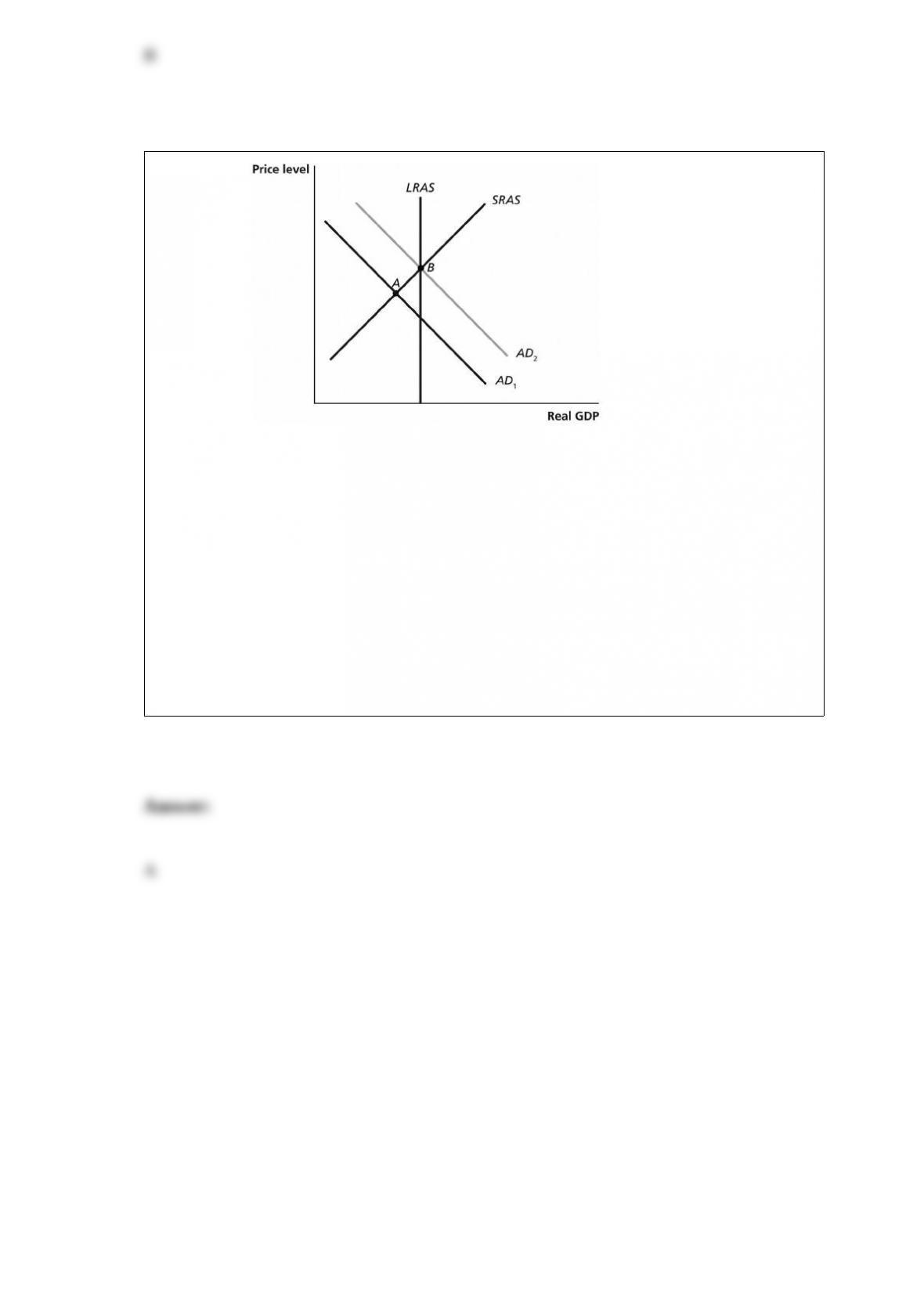
Figure 27-3
In the graph above, suppose the economy is initially at point A. The movement of the
economy to point B as shown in the graph illustrates the effect of which of the
following policy actions by the Congress and the president?
A) a decrease in income taxes
B) a decrease in interest rates
C) a decrease in government purchases
D) an increase in the money supply