
When competition is present and private ownership rights are clearly defined and
securely enforced,
a. production and trade are encouraged and plunder (taking from others) is discouraged.
b. people get ahead by helping others in exchange for income.
c. employers will have to provide prospective employees with at least as good a deal as
they could get elsewhere.
d. all of the above are correct.
At the most basic level, the distinguishing characteristic of government that makes it
different from private firms is its ability to
a. use coercive force against adults to modify their behavior or force them to pay for a
good or service.
b. direct resources in a manner that serves the public interest rather than the private
interest of individuals.
c. produce goods and services that people value.
d. escape the constraints imposed by scarcity.
Private investment as a share of the economy tends to be higher in countries

a. with low levels of economic freedom.
b. with high levels of economic freedom.
c. with economic freedom ratings near zero.
d. that have experienced a sharp reduction in economic freedom during the most recent
decade.
Within the framework of the Keynesian model, which of the following would most
likely occur if the federal government increased its spending and enlarged the size of
the budget deficit during a period of full employment?
a. The rate of inflation would decline.
b. The rate of inflation would rise.
c. A recession would develop.
d. Interest rates would fall.
If a college education did not increase worker productivity,
a. no one would go to college.
b. the earnings of workers with a college education would tend to be the same as for
workers without a college degree.

c. the earnings of workers with a college education would still be higher than for those
without a college degree.
d. the earnings of workers with a college education would be lower than for those
without a college degree.
Costs that a firm remaining in business will still incur even if it halts current production
are called
a. fixed costs.
b. variable costs.
c. implicit costs.
d. explicit costs.
Other things constant, if Americans suddenly decreased their desire for Mexican
tequila, the exchange rate value of the Mexican peso would
a. increase, which is an appreciation of the Mexican peso.
b. increase, which is a depreciation of the Mexican peso.
c. decrease, which is an appreciation of the Mexican peso.
d. decrease, which is a depreciation of the Mexican peso.

Which of the following is an example of political action that reflects the
shortsightedness effect?
a. budget surpluses
b. the promise of future benefits without providing for their funding
c. spending on roads and highways
d. spending on programs that transfer income from the rich to the poor
Which of the following is most likely to result in an increase in crony capitalism?
a. a reduction in entry barriers and an increase in the competitiveness of markets.
b. an increase in government spending and growth of government regulation
c. a reduction in the size of government
d. an increase in the share of the population voting in elections

Economic theory suggests that the standard of living of American workers would rise if
a. the minimum wage were doubled.
b. the knowledge and skills of workers improved.
c. older workers were forced to retire earlier, opening up jobs for younger workers.
d. technological setbacks lowered output per worker hour, increasing the number of
jobs.
Which of the following conditions would increase the likelihood of successful collusion
among American automobile producers?
a. vigorous enforcement of antitrust laws
b. strong quality competition that makes it difficult to monitor price cuts by rival firms
c. imposition of tariffs or quotas on imported automobiles
d. The market demand for automobiles fluctuates substantially.
Brand names such as “Coca Cola” or “Nike”
a. raise the cost of goods because they require advertising to make consumers aware of
the brand name and, therefore, generally increase the price of products to consumers
without producing any benefit to them.
b. generally convey little information about a product to consumers.

c. benefit consumers by assuring them of a known quality level when they buy a
product that they have little previous first-hand knowledge about.
d. provide the most value to consumers for goods that are repeat-purchase items.
As prices rise, people will buy fewer goods and services because
a. the interest rate has declined.
b. aggregate demand has increased.
c. the purchasing power of the fixed quantity of money has declined.
d. the income of households has increased.
Which of the following explains why managers of government agencies have little
incentive to achieve operational efficiency?
a. Public-sector managers need not fear bankruptcy when operational efficiency is not
achieved.
b. Public-sector managers seldom receive personal benefits if they find ways to improve
the efficiency of their operations.
c. Public-sector agencies typically do not face competition.
d. All of the above explain why government agencies have little incentive to be
efficient.

At a firm’s profit-maximizing level of output, its price is $200 and its short-run average
total cost is $225. The firm
a. has a profit of $25 per unit of output.
b. should shut down if its short-run average fixed cost is less than $25.
c. has a loss of $100 per unit of output.
d. should shut down if its short-run average variable cost exceeds $25.
The more elastic the supply of a product, the more likely it is that the burden of a tax
will
a. fall on sellers.
b. fall on buyers.
c. fall equally on both buyers and sellers.
d. be borne by the public sector, and not by market participants.
Use the figure below to answer the following question(s).
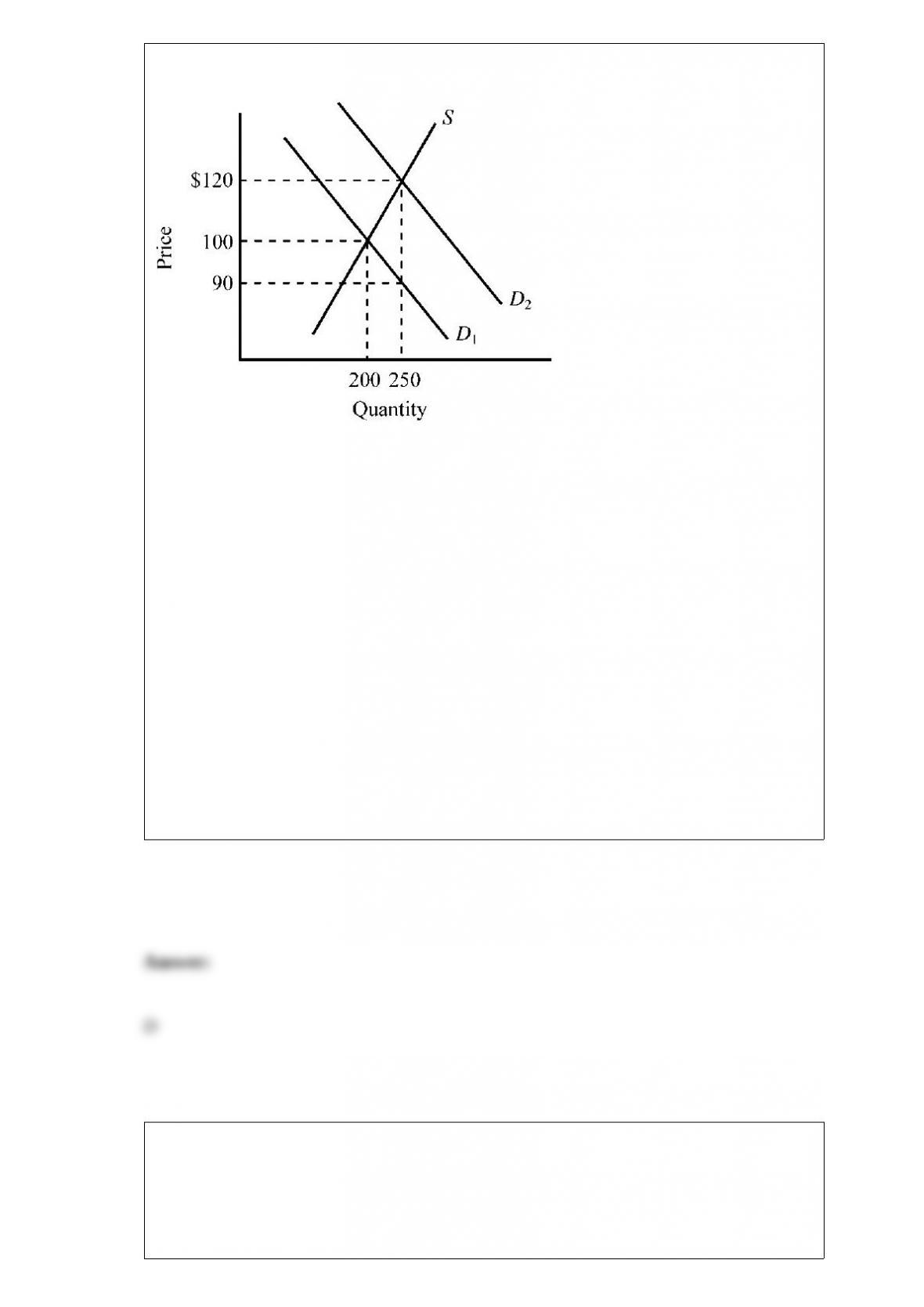
Figure 4-12
Refer to Figure 4-12. The supply curve S and the demand curve D1 indicate initial
conditions in the market for college textbooks. A new government program is
implemented that grants students a $30 per textbook subsidy on every textbook they
purchase, shifting the demand curve from D1 to D2. Which of the following is true for
this subsidy given the information provided in the exhibit?
a. The original average selling price of textbooks was $100, and after the subsidy it
rises to $120.
b. $90 represents the net price a buyer must pay for a textbook after taking into account
the subsidy payment.
c. Textbook buyers will receive an actual benefit of $10 from the subsidy, while
textbook sellers will receive an actual benefit of $20 from the subsidy.
d. All of the above are true.
Average fixed costs
a. will remain unchanged as output expands.
b. are defined as the change in total costs divided by the change in output.
c. will always increase as output increases.

d. will always decrease as output expands.
When barriers to entry are high, a monopolist (or cartel) will often be able to increase
their profits by
a. expanding their output so they can increase their price.
b. reducing their output so they can raise their price.
c. expanding their output so they can lower their price.
d. reducing their output so they can lower their price.
Marginal utility is the change in
a. total utility when an extra unit of output is produced.
b. total utility when an extra unit of output is consumed.
c. marginal utility when an extra unit of output is produced.
d. average utility when an extra unit of output is consumed.
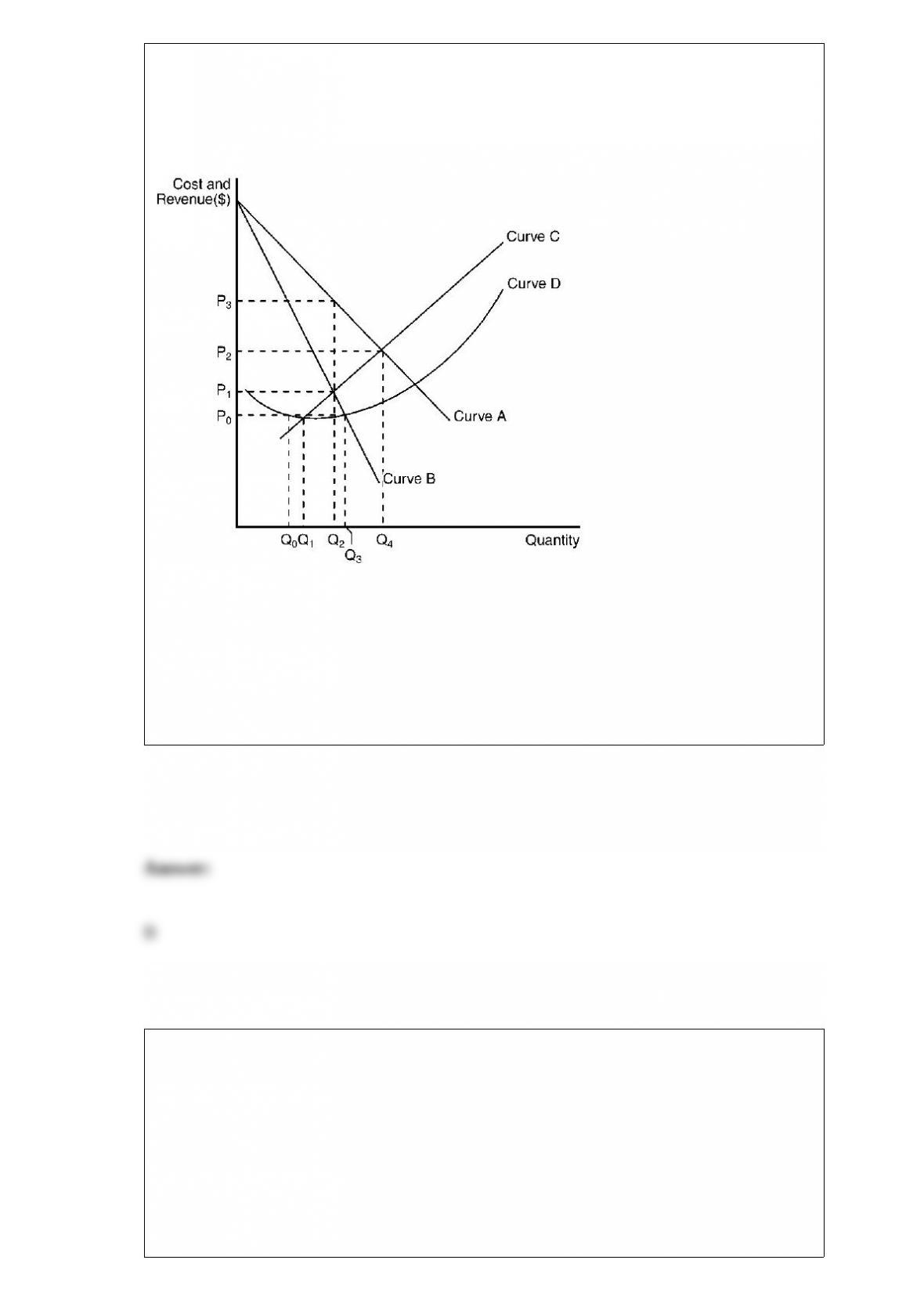
The figure below illustrates the cost and revenue structure for a monopoly firm.
Figure 11-17
Refer to Figure 11-17. If the monopoly firm wants to maximize its profit, it should
operate at a level of output equal to
a. Q1.
b. Q2.
c. Q3.
d. Q4.
If the interest rate is 9 percent, the net present value of $1,000 to be received one year
from now would be
a. $943.40.
b. $917.43.
c. $1,000.

d. $1,090.
When there are few unemployed resources, additional spending will tend to
a. flow directly to the unemployed resources, so that the multiplier can be maintained at
1/1-mpc.
b. increase the marginal propensity to consume, and thereby increase the size of the
multiplier.
c. increase the demand for resources and drive prices downward, increasing the size of
the multiplier.
d. bid resources away from other activities and drive prices upward, reducing the size of
the multiplier.
If a firm is making zero economic profit, it
a. will be forced to shutdown and leave the market.
b. will also generally be making zero accounting profit.
c. is doing as well as typical firms in other markets.
d. will not survive in the long run.

Potential GDP
a. is always less than actual GDP.
b. is identical to actual GDP.
c. measures inflation.
d. is the output an economy could produce at full employment.
The scientific evidence on the causes and consequences of global warming
a. is clear and indisputable.
b. is uncertain and variable.
c. indicates global warming should be stopped regardless of cost.
d. is of no importance to economists.

If a decrease in the demand for corn leads to economic losses for corn farmers,
a. some existing corn farmers will exit the industry.
b. the price of corn will remain low in the long run due to the economic losses.
c. the suppliers of corn will suffer long-run economic losses.
d. all of the above are correct.
Whenever firms can freely enter and exit a market,
a. firms can never earn a profit.
b. prices will be the same for all firms in the market.
c. products will be identical for all firms in the market.
d. profits and losses play an important role in determining the size of the industry.
At his current level of output, a monopolist has an MR of $10, an MC of $6, and an
economic profit of zero. If the market demand curve is downward sloping and his
marginal cost curve upward sloping, the monopolist
a. is producing his profit-maximizing level of output.
b. could increase his profit by increasing his output.
c. could increase his profit by increasing his price.
d. should exit the market if he has positive fixed cost.
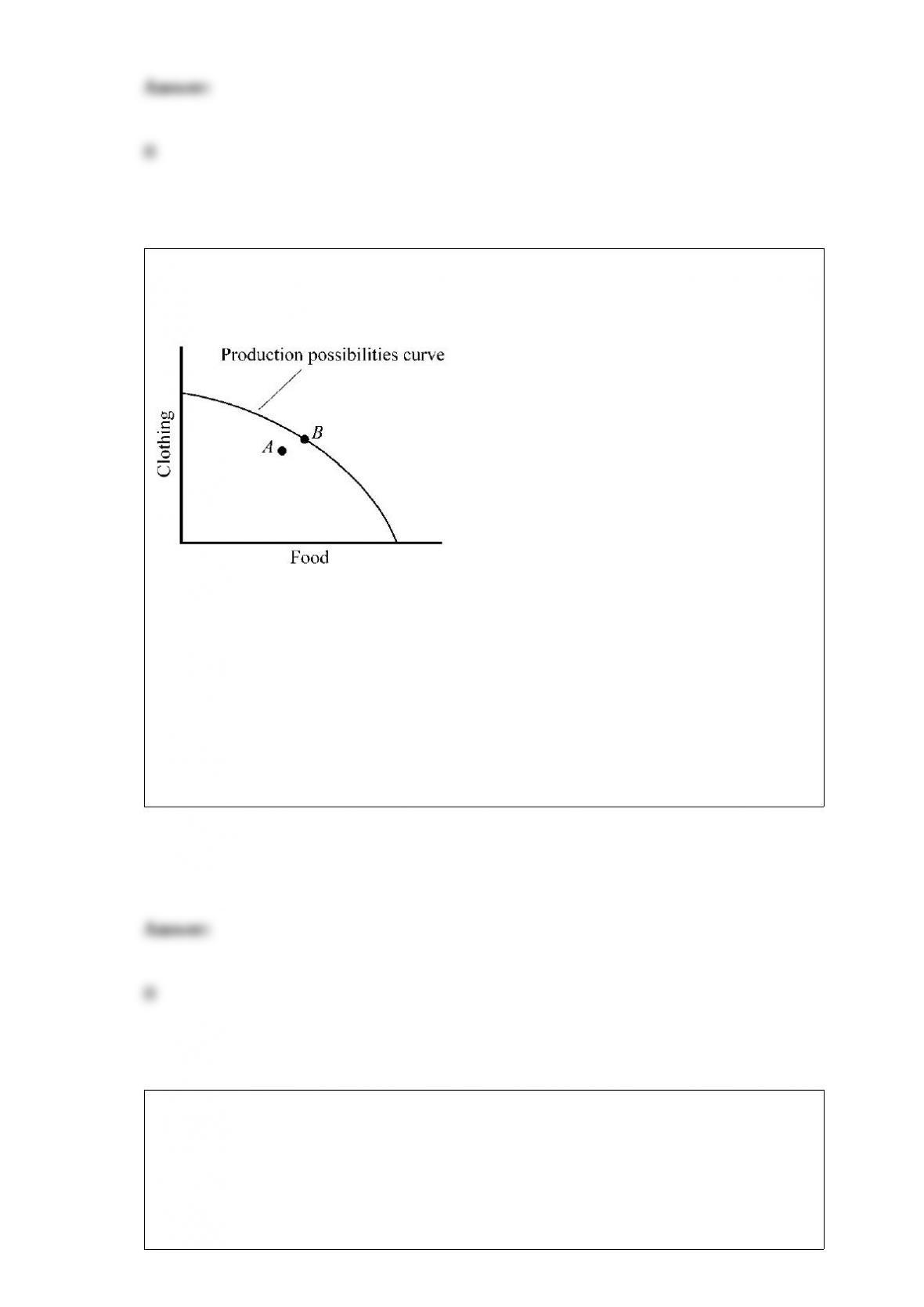
Figure 2-1
In Figure 2-1, point A is
a. unattainable.
b. inefficient.
c. efficient.
d. preferable to point B.
According to the Keynesian view, government spending will have its greatest impact
during a severe recession because
a. automatic stabilizers will shift the budget toward a surplus during a severe recession.
b. underemployed resources will be widespread and the crowding out of private

spending will be minimal.
c. budget deficits will reduce interest rates and thereby stimulate private investment.
d. increases in the government’s outstanding debt will lead to lower future taxes.
If the supply of a good is relatively elastic, this means that the quantity supplied of the
good is
a. not very sensitive to the price of the good.
b. highly sensitive to the price of the good.
c. unrelated to the price of the good.
d. none of the above.
The current Social Security System surplus of revenues relative to expenditures is used
to purchase
a. U.S. Treasury bonds.
b. bonds issued by domestic corporations.
c. U.S. stock.
d. U.S. and foreign stock.