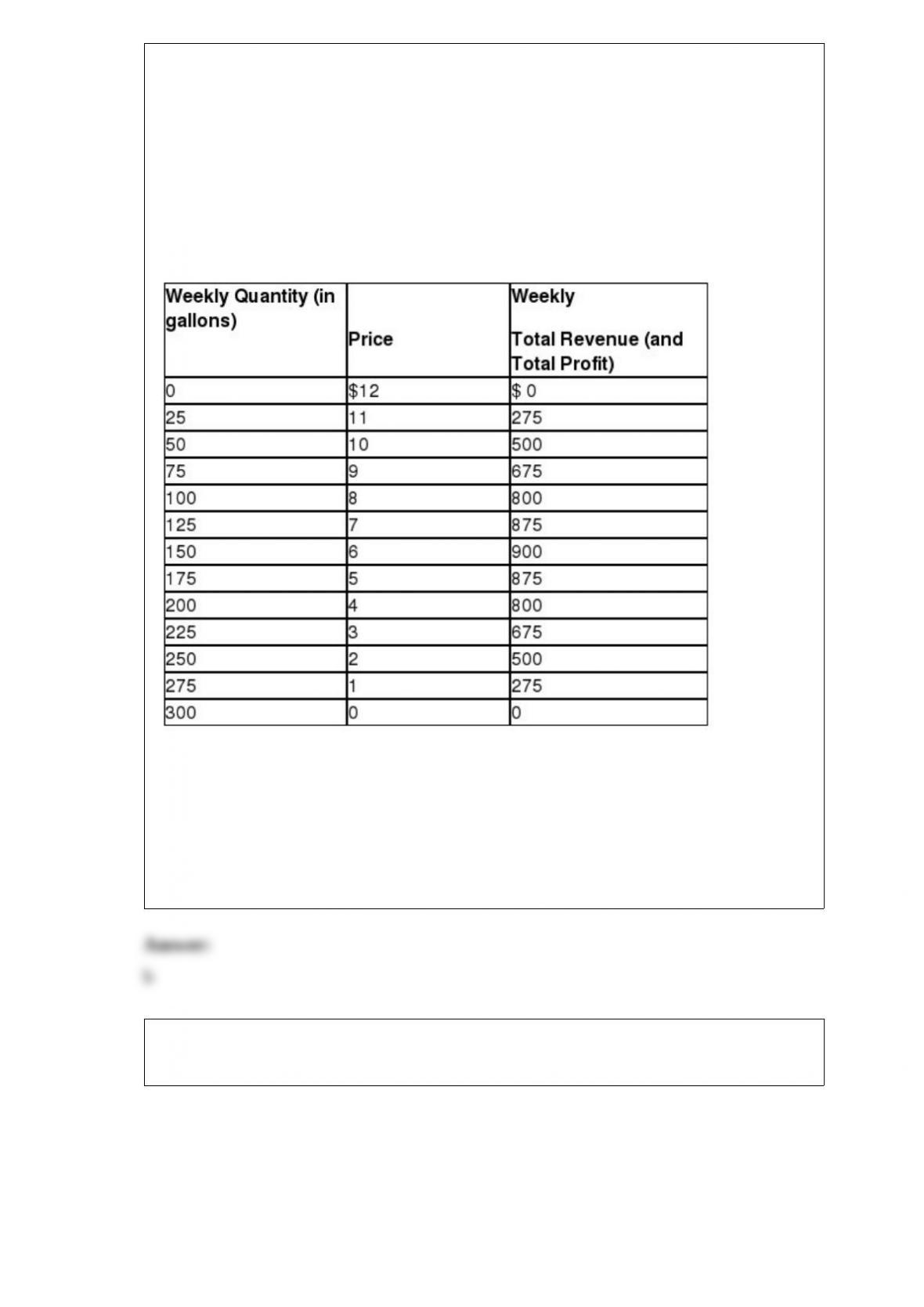
1) Table 17-6
Imagine a small town in which only two residents, Kunal and Naj, own wells that
produce safe drinking water. Each week Kunal and Naj work together to decide how
many gallons of water to pump, to bring the water to town, and to sell it at whatever
price the market will bear. Assume Kunal and Naj can pump as much water as they
want without cost so that the marginal cost of water equals zero.
The weekly town demand schedule and total revenue schedule for water are shown in
the table below.
Refer to Table 17-6. Suppose the town enacts new antitrust laws that prohibit Kunal
and Naj from operating as a monopolist. What will the new price of water be once the
Nash equilibrium is reached?
a.$3
b.$4
c.$5
d.$6
2) The table below reflects the levels of total utility received from income for each of
four members of a society.
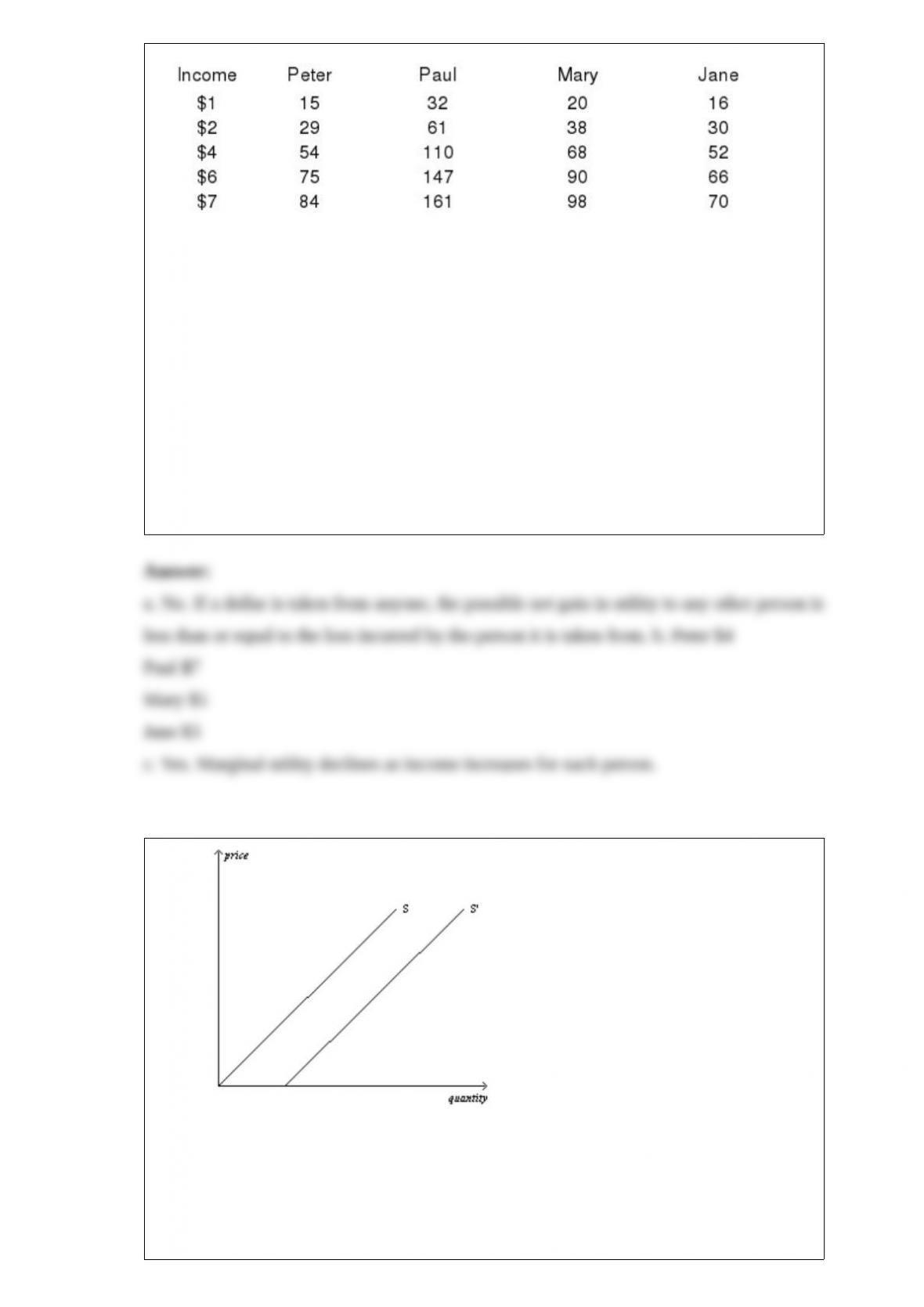
Assume that the society has the following income distribution:
Peter $3
Paul $7
a.Mary $5
Jane $3
Is it possible for the government to increase total aggregate utility by redistributing
income among members of society? Explain your answer. Assume that the government
has $19 to allocate among the four members of society.
b.(Assume that no one has any income to start with.) If the government is interested in
distributing income in a way that maximizes aggregate total utility, how should it
distribute the $19 of income?
c.Does the table above describe a situation characterized by diminishing marginal
utility? Explain your answer.
3)
The shift from S to S’ is called a(n)
a.decrease in supply.
b.decrease in quantity supplied.
c.increase in supply.
d.increase in quantity supplied.

4) In the circular-flow diagram, firms own the factors of production and use them to
produce goods and services.
a.True
b.False
5) Water pollution from pulp and paper mills harms plants, animals, and humans. This
is an example of
a.a market failure caused by an externality.
b.a market failure caused by market power.
c.a market failure caused by equality.
d.There is no market failure in this case.
6) Which of the following is not correct?
a.Antitrust laws may prevent mergers that would actually raise social welfare.
b.Public ownership is the most common public policy toward monopolies in the United
States.
c.Regulation is a common strategy for a natural monopoly.
d.Sometimes the best public policy toward a monopoly may be to do nothing.
7) When government receipts exceed total government spending during a fiscal year,
the difference is
a.a budget surplus.
b.a budget deficit.
c.the national debt.
d.automatically refunded.
8) A corporation has been steadily losing money on one of its product lines, plastic
flamingo lawn ornaments. The firm produces plastic flamingos in a factory that cost
$20 million to build 10 years ago. The firm is now considering an offer to buy that

factory for $15 million. Which of the following statements about the decision to sell or
not to sell is correct?
a.The firm should turn down the purchase offer because the factory cost more than $15
million to build.
b.The $20 million spent on the factory is a sunk cost; that cost should not affect the
decision.
c.The $20 million spent on the factory is an implicit cost, which should be included in
the decision.
d.The firm should sell the factory only if it can reduce its costs elsewhere by $5 million.
9) Suppose that a college professor is creating an exam in her university office. Which
of the following would be an example of a factor of production used by the professor?
(i)the professor’s time
(ii)a computer software program into which the professor types the exam questions
(iii)the physical space of the professors office where she works when creating the exam
(iv)the interest on the professor’s home mortgage
a.(i) only
b.(i) and (ii) only
c.(i), (ii), and (iii) only
d.(i), (ii), (iii), and (iv)
10) Consider a good to which a per-unit tax applies. The greater the price elasticities of
demand and supply for the good, the
a.smaller the deadweight loss from the tax.
b.greater the deadweight loss from the tax.
c.more efficient is the tax.
d.more equitable is the distribution of the tax burden between buyers and sellers.
11) The demand for computer programmers is inseparably tied to the supply of
computer software.
a.True
b.False
12) If the rich pay more in taxes than the poor, the tax system must be progressive.
a.True
b.False
13) Scenario 13-5
Suppose that Emily opens a restaurant. She receives a loan from a bank for $200,000.
She withdraws $100,000 from her personal savings account. The interest rate on the
loan is 6%, and the interest rate on her savings account is 2%.
Emily’s explicit cost of capital is
a. $2,000.
b. $4,000.
c. $12,000.
d. $14,000.
14) The term “compensating differential” refers to
a.the fact that workers who do similar work should be paid the same wage.
b.the fact that some workers live further from their jobs than do other workers.
c.a wage difference that is due to unionization of some firms but not others.
d.a wage difference that arises from nonmonetary characteristics of different jobs.
15) Arturo’s Production Possibilities FrontierDina’s Production Possibilities
Frontier
22) Why is cable TV reception regarded as a club good?
23) Scenario 9-3
Suppose domestic demand and domestic supply in a market are given by the following
equations:
Suppose the world price in this market is $8 per unit. If the country allows free trade,
how much are consumer surplus, producer surplus, and producer surplus with trade?
24) The regular pattern of income variation over a person’s life is called the .
25) Table 13-18
What is the total output of five workers?
26) List and briefly explain each of the four properties of indifference curves.
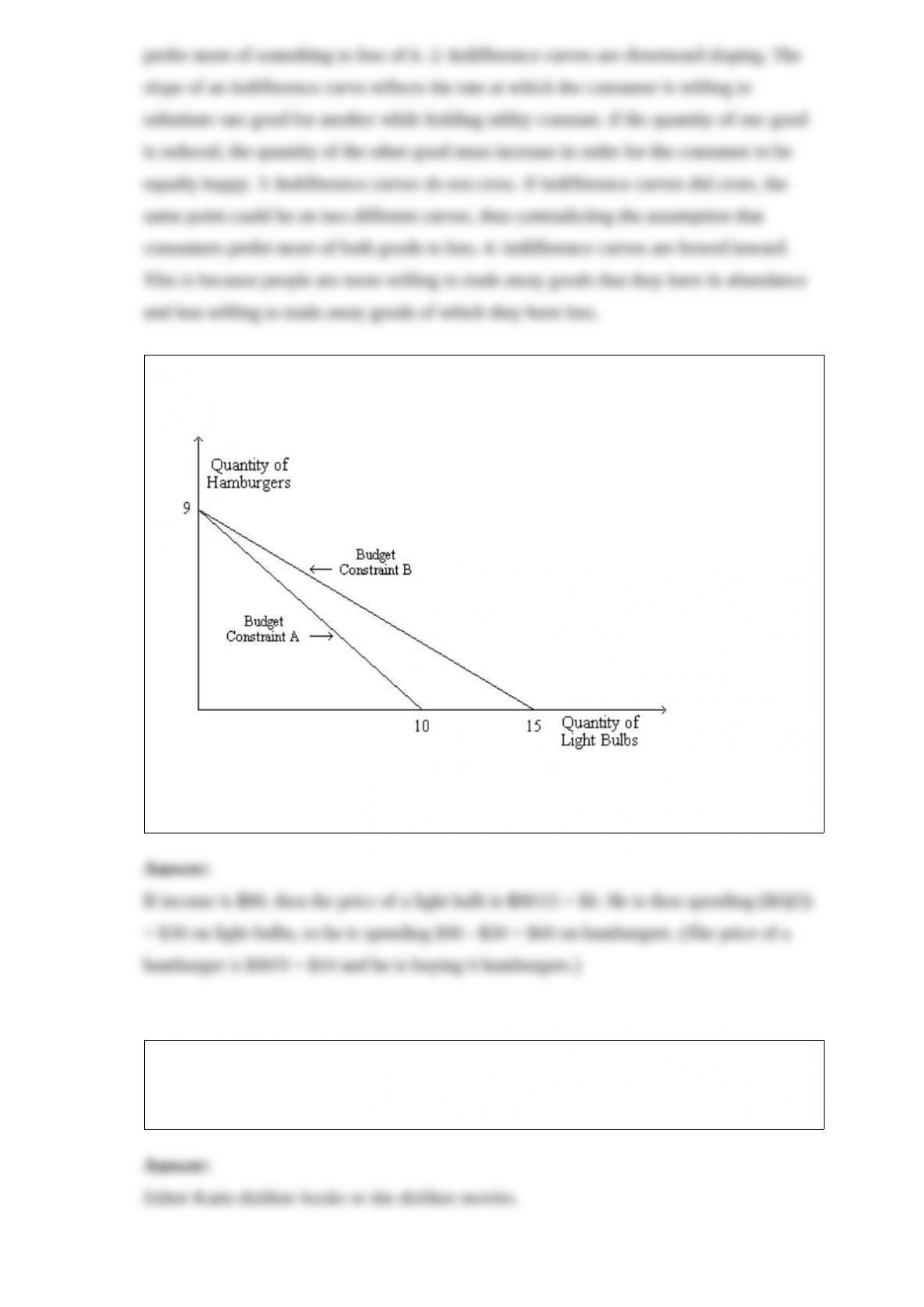
27) Figure 21-30
The graph shows two budget constraints for a consumer.
Refer to Figure 21-30. Suppose Budget Constraint B applies. If the consumer’s income
is $90 and if he is buying 5 light bulbs, then how much money is he spending on
hamburgers?
28) When we draw Katie’s indifference curves to represent her preferences for books
and movies, we find that her indifference curves are upward-sloping. What does this tell
us about Katie’s preferences?

29) When a new firm considers entering a market, it takes into account only the profit it
would make. What are the two external effects that occur in the market that the firm
does not consider?