
The demand for costume jewelry has been estimated to be Q = 100P“2E2, where E is
the price of real gem jewelry. Costume jewelry and real gem jewelry are:
a. substitute goods.
b. complement goods.
c. inferior goods.
d. normal goods.
e. unrelated goods.
Firms advertise in order to:
a. build brand loyalty.
b. appeal to the price-sensitive consumers.
c. increase the demand elasticities of their loyal customers.
d. shift the market supply curve to the left.
e. shift the market demand curve to the left.
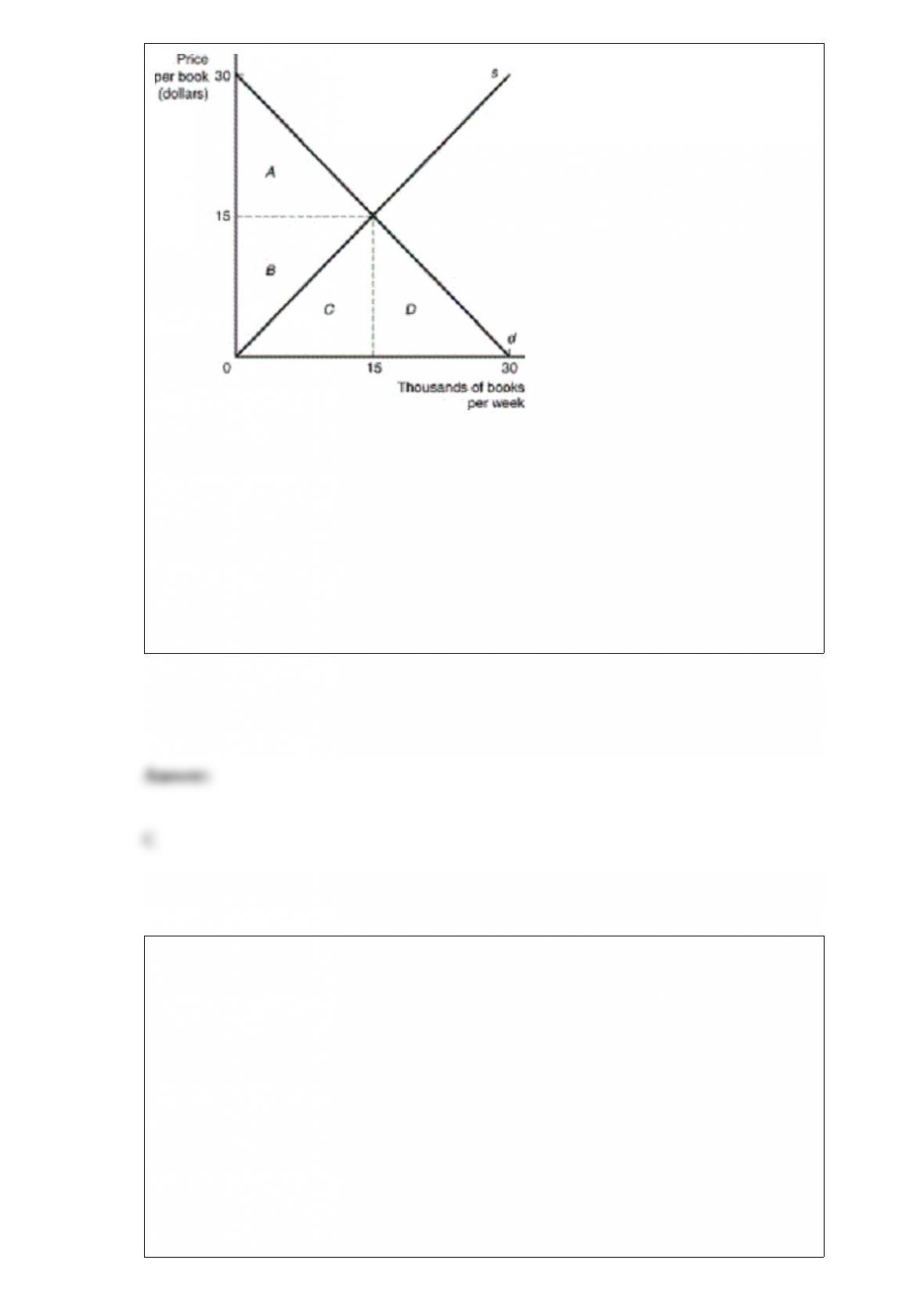
The following diagram represents the market for paperback books. In the market for
paperback books, producer surplus is:
a. $15.00.
b. $30.00.
c. $112.50.
d. $225.00.
e. None of the above.
Jane spends $210 per month on wine and beer. Her utility function is given by TU =
100WB, where W represents the number of bottles of wine that she buys and B
represents the number of cases of beer that she buys. If wine costs $10 per bottle and
beer costs $15 per case, she will maximize utility by buying:
a. 10.5 bottles of wine and 7 cases of beer.
b. 2 bottles of wine and 3 cases of beer.
c. equal amounts of wine and beer.
d. 10 bottles of wine and 13.33 cases of beer.

e. none of the above.
Tom spends all his monthly income on pretzels and potato chips. Currently, he is
maximizing his utility; the marginal utility of pretzels is 150, and the marginal utility of
potato chips is 125. If pretzels cost $6 per box, how much do potato chips cost?
a. $2.
b. $3.
c. $4.
d. $5.
e. $6.
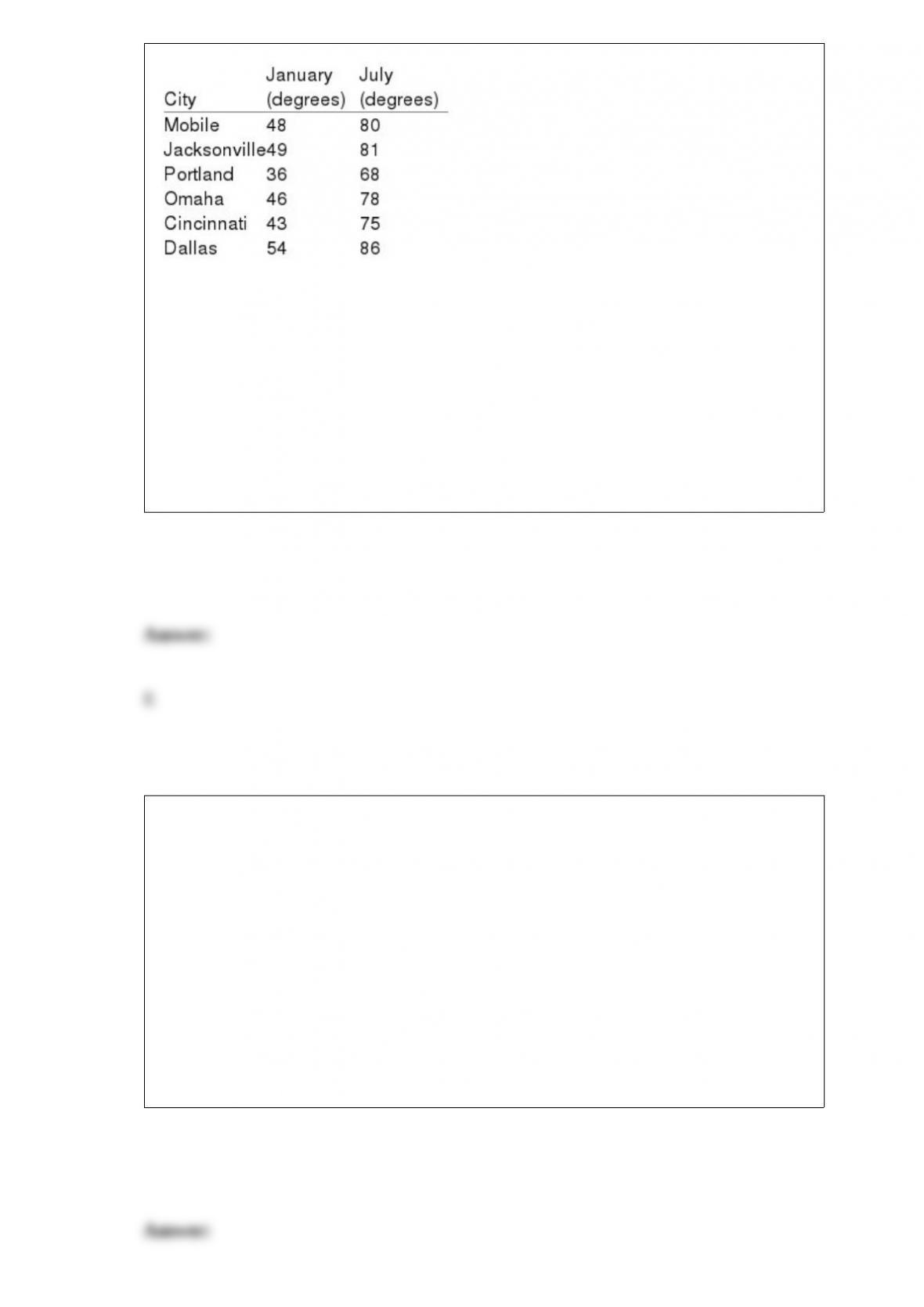
The daily mean temperatures in January and July by selected cities are given in the
following table. If the mean temperature in January is 1 degree higher in Tupelo than in
Tucumcari, what do you estimate the difference (Tupelo”Tucumcari) in mean
temperatures will be in July?
a. 1.25 degrees.
b. 2.0 degrees.
c. 0.40 degree.
d. 0.80 degree.
e. 1.0 degree.
If expected profit is R and variance s 2 = 0, then:
a. Ri = 0 for all i.
b. R ” Ri is a positive constant for all i.
c. R ” Ri is a negative constant for all i.
d. Ri = 0 for all i.
e. Ri = R for all i.
You”ve just won the $25 million lottery. You are going to receive a check for $1 million
today and at the end of every year for the next 24 years. If the interest rate is 10%, the
present value of your prize is:
a. $8,984,744.
b. $9,984,744.
c. $12,984,744.
d. $20,000,000.
e. $25,000,000.
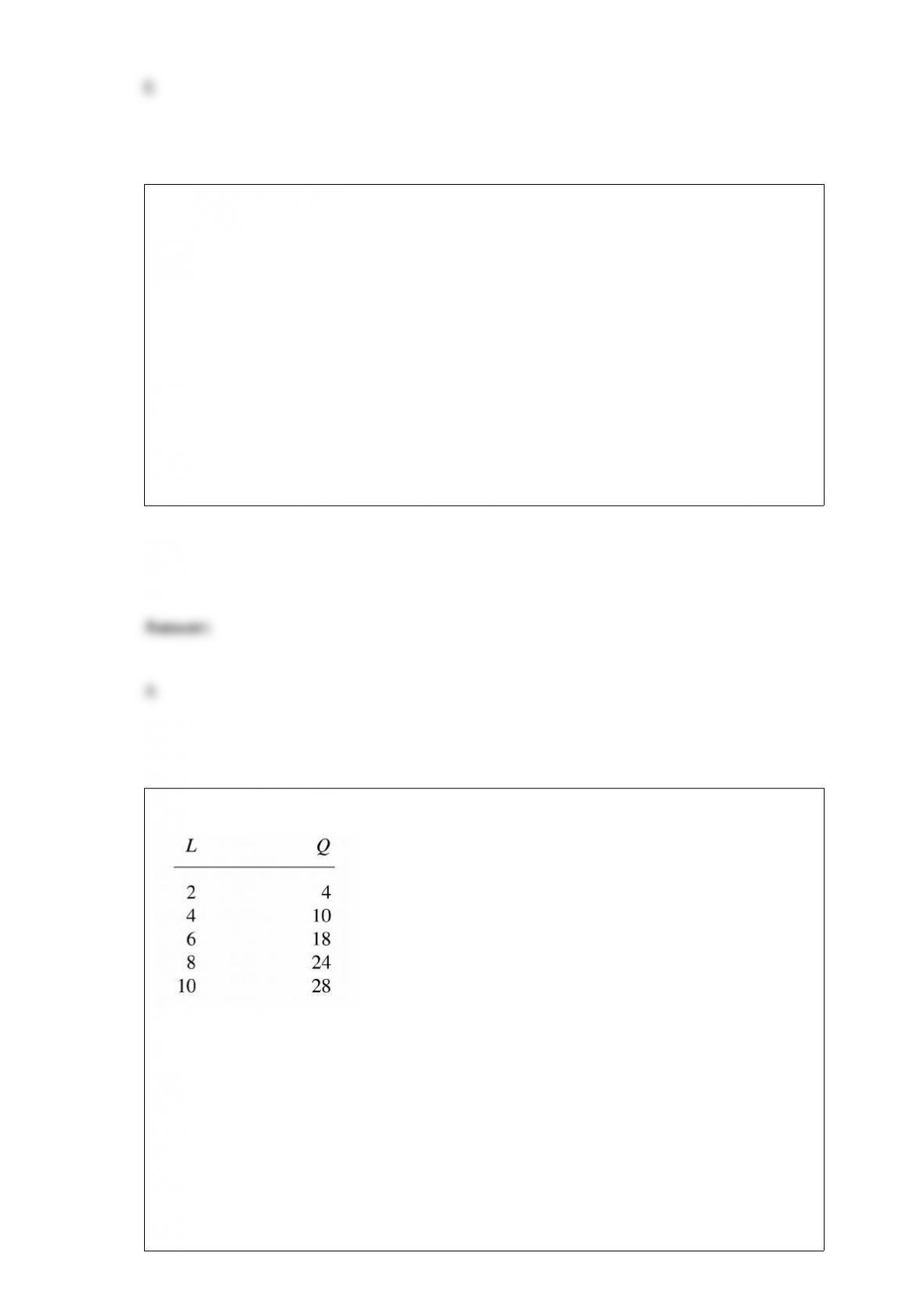
In the following table, the average product of labor at L = 6 is:
a. 8
b. 4
c. 6
d. 12
e. 3

Catalina Cable Company (CCC) faces a demand for basic cable service given by P =
160 ” Q. It has total costs (exclusive of the required rate of return on its invested
capital) of TC = 250 + Q2. If the commission that regulates CCC determines that $500
is sufficient to compensate equity holders for their invested capital, what are the
regulated price and output?
a. P = 85, Q = 75.
b. P = 75, Q = 85.
c. P = 65, Q = 95.
d. P = 55, Q = 105.
e. P = 45, Q = 115.
A constant-cost industry is one in which:
a. input prices do not change over time.
b. technology does not change over time.
c. input prices and technology do not change as firms enter or exit the industry.
d. input prices and technology do not change over time.
e. firms have reached the maturity phase of the industry’s life cycle.

Herodotus, the Greek historian, wrote that ancient Babylonians engaged in auctions in
which men purchased:
a. cattle.
b. horses.
c. grains of various sorts.
d. wives.
e. precious jewels.
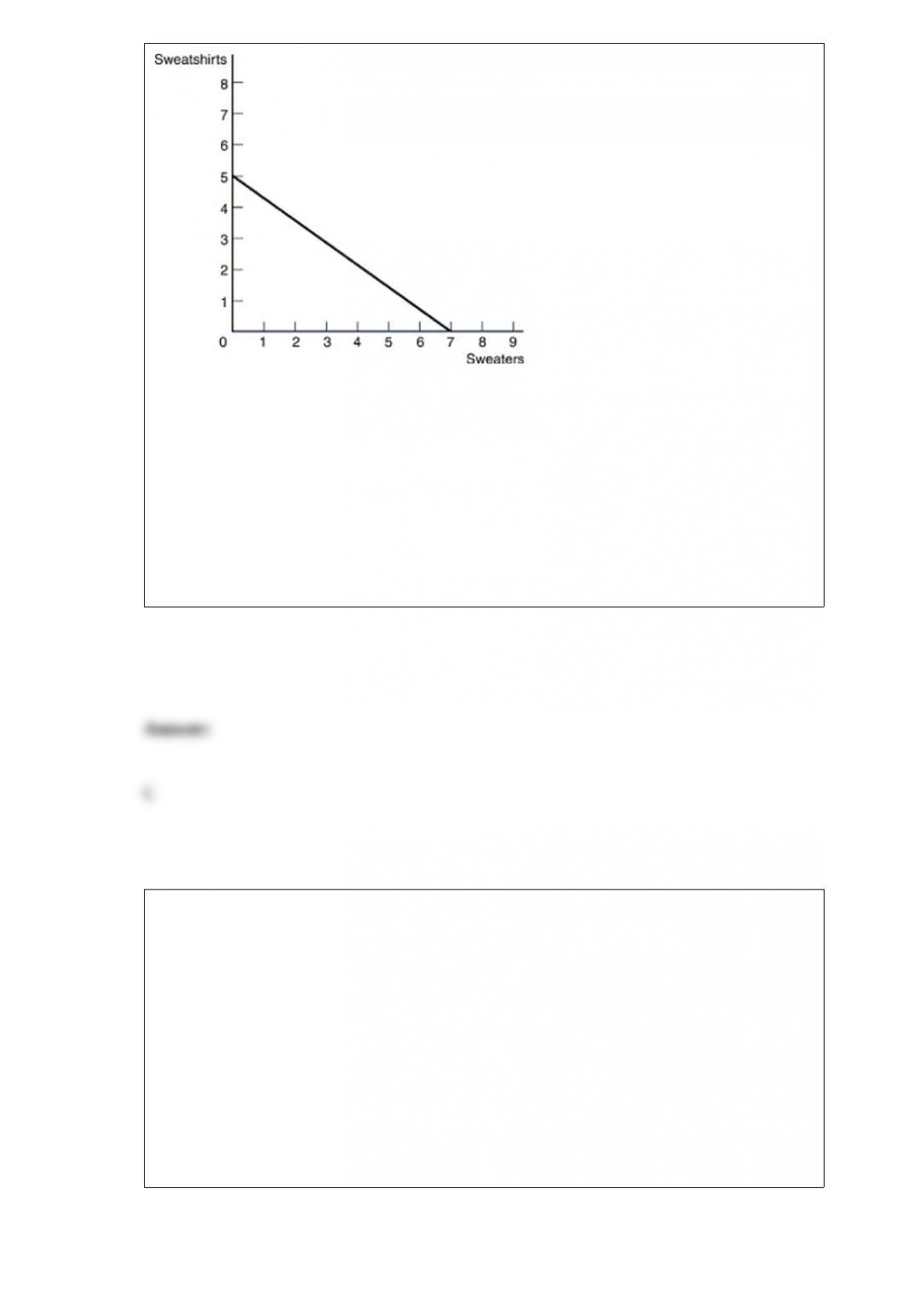
Consider the following budget constraint. Dennis spends all his money on sweaters and
sweatshirts. If the price of sweaters is $15, how much money does Dennis have in his
budget?
a. $7.
b. $75.
c. $105.
d. $178.
e. None of the above.
An indifference map can be used to find a demand curve for a consumer. Given an
initial equilibrium point, to find a demand curve for good X, change the:
a. consumer’s income and draw a new budget constraint.
b. price of Y and draw a new budget constraint.
c. consumer’s preferences.
d. price of X and draw a new budget constraint.
e. price of a substitute and draw a new budget constraint.

George is indifferent between $100 and a bet with a 0.6 chance of $50 and a 4 chance of
$200. If U(50) = a and U(200) = b, then U(100) = :
a. 0.4a + 0.6b.
b. 0.6a + 0.4b.
c. (a + b) / 2.
d. a + b.
e. 6a + 4b.
Betty is investing in the stock market. She is choosing among a variety of stocks; each
stock has an expected return and a level of risk attached. Betty likes higher returns and
she likes risk. If we were to draw indifference curves for Betty over risk and expected
return, they would be:
a. L-shaped.
b. linear.
c. upward-sloping.
d. downward-sloping.
e. vertical lines.

If ç is the elasticity of demand, a profit maximizer sets a markup price of:
a. MC[1/(1 + 1/h)].
b. MC[1/(1 ” 1/h)].
c. AC[1/(1 ” h)].
d. AC[1/(1 ” 1/h)].
e. 1/(1 ” h).
A monopsonist faces a market labor supply curve w = 20 + L, where w is the wage rate
and L is the number of workers employed. If the firm’s labor demand curve is w = 200 “
4L, what is the optimal wage rate and quantity of labor employed?
a. w = 50 and L = 30.
b. w = 56 and L = 36.
c. w = 80 and L = 30.
d. w = 104 and L = 32.
e. None of the above.

A decision fork with payoffs given for each branch is assigned a value based on:
a. the highest-payoff branch.
b. the lowest-payoff branch.
c. an average of the highest- and lowest-payoff branches.
d. an evenly weighted average of all payoff branches.
e. a probability weighted average of all payoff branches.
A budget constraint:
a. must be convex to the origin if consumers prefer more to less.
b. will be upward-sloping if consumers consider one good a “bad.”
c. must be downward-sloping if both goods have positive prices.
d. will be concave to the origin if the consumer’s budget is fixed.
e. will always have slope equal to “1.

Consumer surplus is defined as:
a. the quantities of a good or service that bring equal utility to the consumer.
b. the quantity of a good or service that is utility maximizing for the consumer.
c. the difference between what a consumer is willing to pay and what he or she actually
pays for a good or service.
d. the difference between the market price and the marginal cost of producing a good or
service.
e. none of the above.
Al’s Authentic Anklettes sells ankle bracelets. Their demand and costs are given by QD
= 100 ” P and TC = 100 + 10Q. The profit-maximizing level of output is:
a. 45 ankle bracelets.
b. 47.5 ankle bracelets.
c. 90 ankle bracelets.
d. 10 ankle bracelets.
e. no ankle bracelets.

The economic theory of the firm assumes that the primary objective of a firm’s owner or
owners is to:
a. behave in a socially conscientious manner.
b. maximize the firm’s profit.
c. maximize the firm’s total sales.
d. maximize the value of the firm.
e. All of these are primary objectives.
The socially optimal level of pollution control occurs where the marginal:
a. benefit of pollution control is zero.
b. cost of pollution is minimized.
c. cost of pollution control equals the marginal cost of pollution.
d. cost of pollution control is minimized.
e. cost of pollution control equals the marginal benefit of pollution.
A regression of the mean daily high temperature as a function of mean daily low
temperature across cities yielded High = 21 + Low, R2 = .98, and RMSE = 1.4. Interpret

these results.
a. The regression says that if a city’s average low temperature is 1 degree higher than
some other city’s, their average high temperatures are also likely to be 1 degree
different. The high R2 and low RMSE are inconsistent and suggest a serial correlation
problem.
b. The regression says that if a city’s average low temperature is 10 degrees higher than
some other city’s, their average high temperatures are also likely to be 10 degrees
different and that the average difference between average daily high temperatures and
average daily low temperatures is 21 degrees. The model explains 98% of the variation
in average daily high temperatures, and the standard error of the estimate is quite small.
c. The regression says that if a city’s average low temperature is 1 degree higher than
some other city’s, their average high temperatures are also likely to be 1 degree
different. The high R2 and low RMSE are inconsistent and suggest a multicollinearity
problem.
d. The regression says that if a city’s average low temperature is 10 degrees higher than
some other city’s, their average high temperatures are also likely to be 10 degrees
different and that the average difference between average daily high temperatures and
average daily low temperatures is 12 degrees. The regression explains all the variation
in average daily high temperatures.
e. None of the above.
If a payoff is equally likely to be $1, $2, $3, $4, or $5, the coefficient of variation is:
a. 0
b. 21/2/3.
c. 2/3.
d. 2
e. 10/3.

Bolan’s Fabric Shop sells discount material. Its demand and cost functions are QD = 40
” 2P and TC = 0.5Q2. Its profit-maximizing price is:
a. P = $5.
b. P = $10.
c. P = $15.
d. P = $20.
e. P = $0.
In the model of perfect competition, there:
a. are many firms producing differentiated products.
b. are a few firms producing undifferentiated products.
c. are a few firms producing differentiated products.
d. are many firms producing undifferentiated products.
e. is one firm producing a highly differentiated product.

Women are often charged more than men for haircuts performed by the same haircutter.
This is not considered price discrimination because:
a. women receive more consumer surplus from haircuts than men receive.
b. haircutters claim to spend more time on women’s hair, raising the cost of the haircut
to the firm.
c. firms make up the extra cost to consumers by giving women free samples of
products.
d. men receive more consumer surplus from haircuts than women receive.
e. women have a lower price elasticity of demand for haircuts.
Loco Pony Adventures rents clowns and ponies for children’s birthday parties. If the
annual total cost of furnishing entertainment is given by TC = 0.5Q2 + 25Q + 1,000, the
average variable cost of catering to 30 birthday parties is:
a. $25.00.
b. $25.50.
c. $26.50.
d. $30.00.
e. $40.00.