
Previously a creditor nation, in the 1980s the U.S. became a debtor nation.
a. True
b. False
The reason that higher interest rates reduce aggregate demand in an open economy with
capital flows is that investment
a. increases generated by higher interest rates are offset by net export decreases.
b. decreases generated by higher interest rates are coupled with net export decreases.
c. decreases generated by higher interest rates are offset by net export increases.
d. increases generated by higher interest rates are coupled with net export increases.
Business people often use “hunches” and intuition to make decisions regarding what to
produce.
a. True
b. False

The trade deficit is the mirror image ofrequired capital inflows.
a. True
b. False
The optimal time for the implementation of contractionary fiscal policy would be
a. before inflation accelerated.
b. after inflation accelerated.
c. after unemployment increased.
d. after the price level had risen significantly.
The political party that is in power determines the position and shape of the production
possibilities frontier that constrains the choices of the economy.
a. True

b. False
If a “liberal” wanted to decrease aggregate demand, which of the following would she
tend to favor?
a. An increase in government spending, because it will increase the size of the public
sector.
b. A decrease in government spending, because it keeps the public sector small.
c. An increase in transfer payments, because it has a larger multiplier than tax changes.
d. An increase in taxes, because it makes the public sector larger.
The difference in values between money today and money in the future is lower when
the rate of interest is higher.
a. True
b. False

On a graph with consumption on the vertical axis and disposable income on the
horizontal axis, the slope of the line is
a. greater than one.
b. equal to one.
c. less than one.
d. undefined.
As we approached the end of the millennium, many economic crackpots advised
citizens to hold large quantities of cash in anticipation of Y2K disasters. What effect
would this have had on velocity if many people had been foolish enough to follow this
advice?
a. It would have decreased.
b. It would have increased.
c. It would have remained constant.
d. Velocity is unrelated to cash balances.
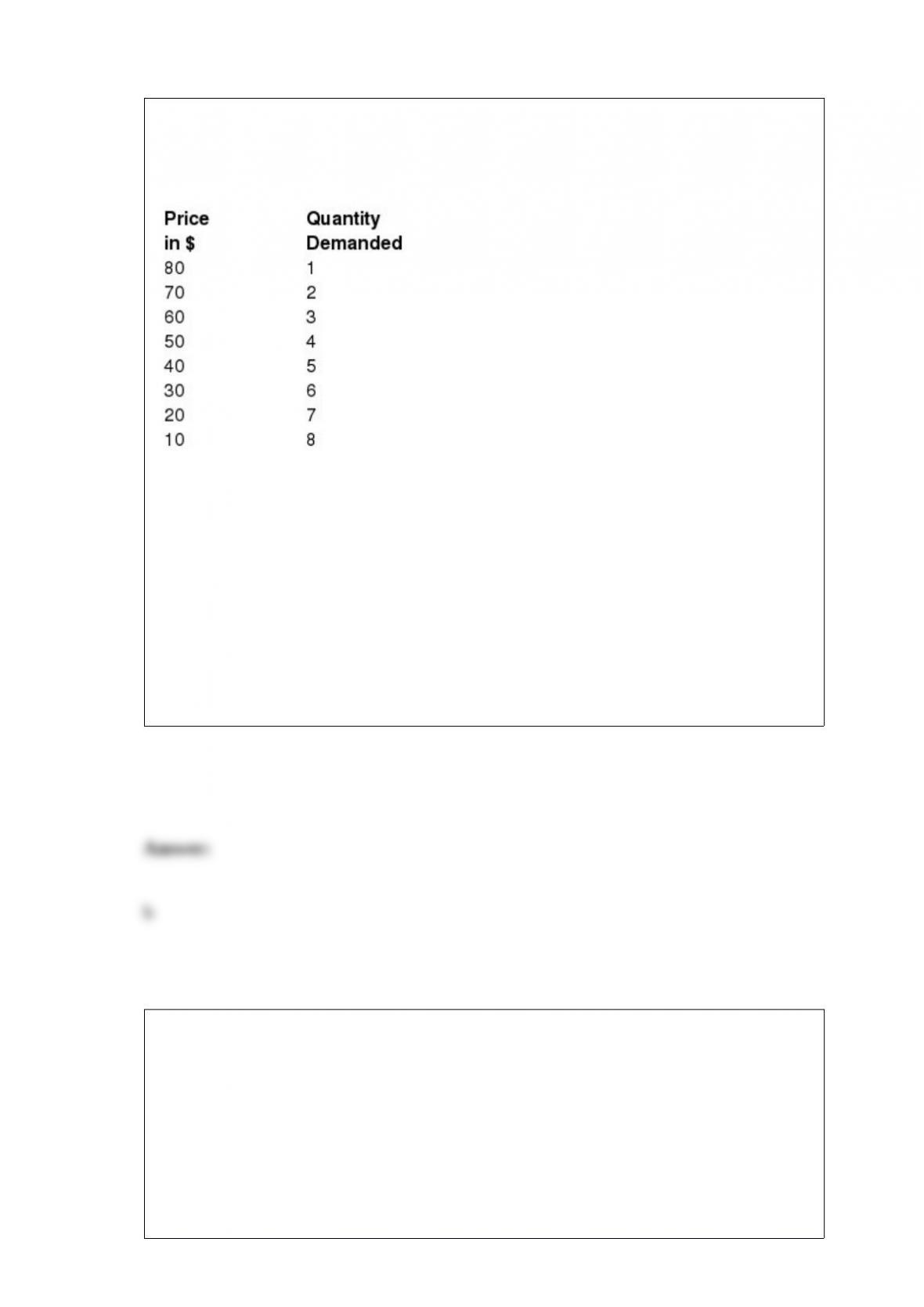
Table 5-4
Table 5-4 shows the demand schedule for concert tickets for a particular consumer.
What will be this consumer’s surplus if the price of tickets is $50?
a. $200
b. $60
c. $260
d. $210
Sales maximization may be a goal of a firm if
a. firms are managed by irrational persons.
b. the firm has no way to measure profitability.
c. the firm is privately held, and there is no separation between ownership and control.
d. managerial bonuses are based on sales revenue instead of profitability.

Market power allows firms to raise prices significantly above the competitive level.
a. True
b. False
Suppose that in a free market 2,000 patients purchase an operation to receive an
artificial heart at a price of $500,000 per operation. Without the heart, each patient will
die. The government decides this price is too high and imposes a maximum price of
$200,000. Everything else equal,
a. more patients will now die.
b. fewer patients will now die.
c. more patients will now die only if the demand curve is vertical.
d. more patients will now die only if the demand curve is horizontal.

The U.S. government uses export subsidies extensively to stimulate exports.
a. True
b. False
Unregulated markets will tend to
a. rapidly deplete any natural resource.
b. naturally conserve any depletable natural resource by pushing up its price every year
by a constant dollar amount.
c. naturally conserve a depletable resource by pushing up its price at a constant rate
every year.
d. deplete a resource unless new supplies are found.
Workforce quality can be improved by
a. years of education.
b. on-the-job training.
c. workplace learning.

d. all of the above.
An individual’s demand schedule
a. provides information about what quantity a consumer is willing and able to buy at
each price.
b. tells a buyer how many other buyers will try to purchase an item.
c. is a schedule that regulates monthly sales of scarce goods and services.
d. is of no use without its accompanying supply schedule.
Individuals face scarcity; whole societies do not.
a. True
b. False
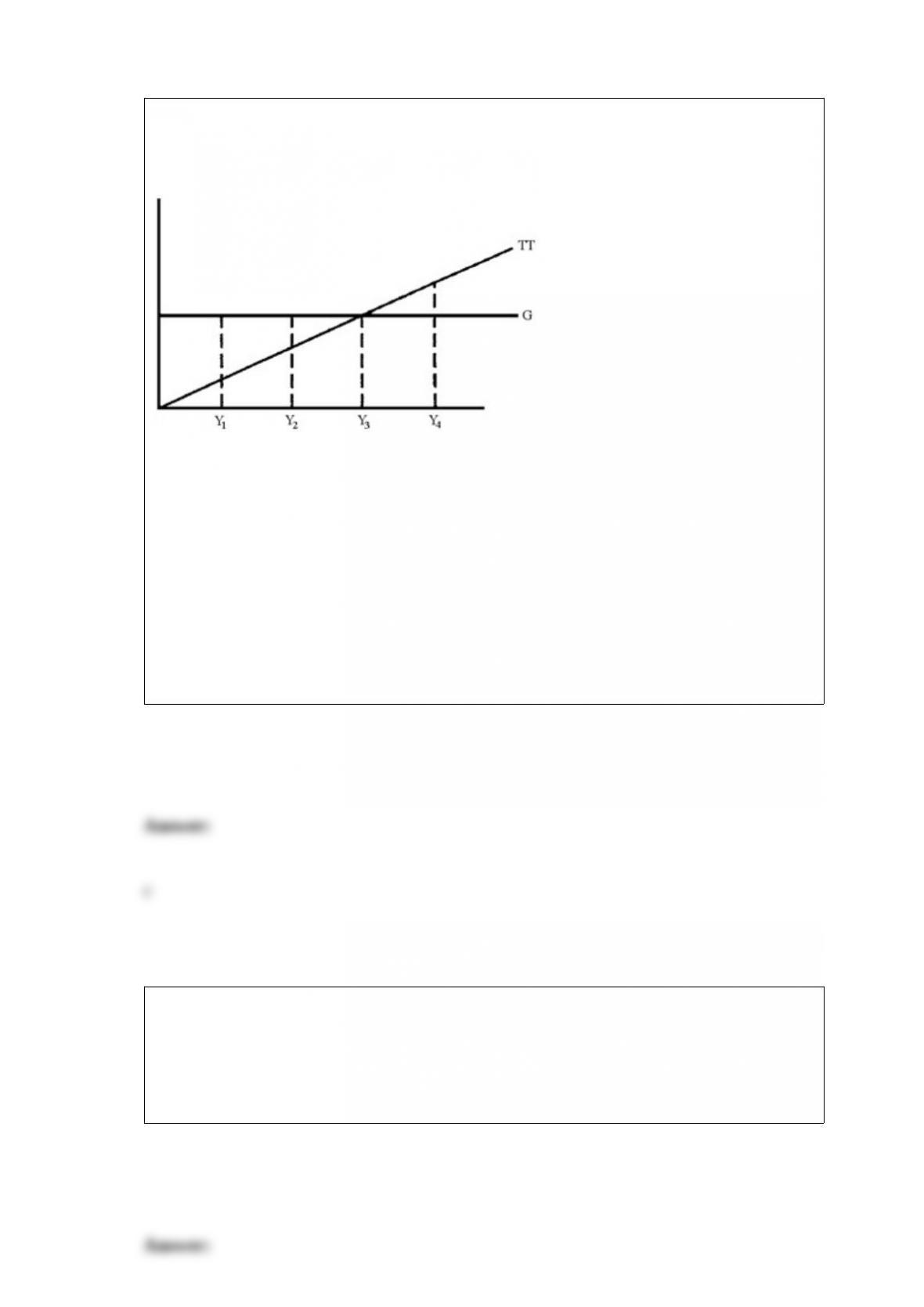
Figure 16-1
In Figure 16-1, there are four levels of income. G is government expenditures and TT is
taxes less transfers. Y3 is the full-employment level of income. At Y3
a. there is an official deficit but a structural budget balance.
b. there is a structural deficit but an official budget surplus.
c. the official and structural deficit are in balance.
d. both the official and structural budgets show a deficit.
In scientific language, a theory is an untested assertion of alleged fact.
a. True
b. False

Elasticity of demand is likely to be higher for less-expensive goods, other things being
equal.
a. True
b. False
In the winter of 2001-2002, Argentina’s overvalued currency reflected a(n)
a. balance of payments surplus.
b. balance of payments deficit.
c. surplus of exports over imports.
d. excess demand for Thai currency.
Fixed exchange rates are fixed by
a. international speculators who manipulate the world’s currencies.

b. international demand and supply.
c. national governments.
d. All of the above are correct.
If both a buyer and a seller have the same information, they are said to have symmetric
information.
a. True
b. False
If money wages increase, the most likely result is a(n)
a. increase in aggregate supply.
b. decrease in aggregate supply.
c. steeper aggregate supply curve.
d. flatter aggregate supply curve.

Horizontal equity is the concept that
a. equally situated individuals should be taxed equally.
b. persons with the same income should be taxed equally.
c. equal property value should be taxed equally.
d. persons living in the same neighborhood should be taxed equally.
Carefully define the following terms and explain their importance to the study of
economics.
a. specialization
b. absolute advantage
c. comparative advantage
d. quota
e. trade adjustment assistance
The most extensive indexing in the United States is in
a. interest payments on bonds or savings accounts.
b. government transfer payments, including Social Security benefits.
c. government contracts for military goods.
d. escalator clauses in wage and salary contracts.

Currently, the U.S. net national debt is almost 60 percent of GDP, but this percentage is
smaller than that of many fiscally healthy countries.
a. True
b. False
The price for labor is the wage rate. What happens to the demand for labor if wages
increase?
a. It increases.
b. It decreases.
c. It does not change.
d. Uncertain-economic theory has no answer to this question.
The price system takes into account consumer preferences in the distribution of goods
and services.
a. True

b. False
Profit is maximized at the output at which marginal revenue exceeds marginal cost by
the greatest margin.
a. True
b. False