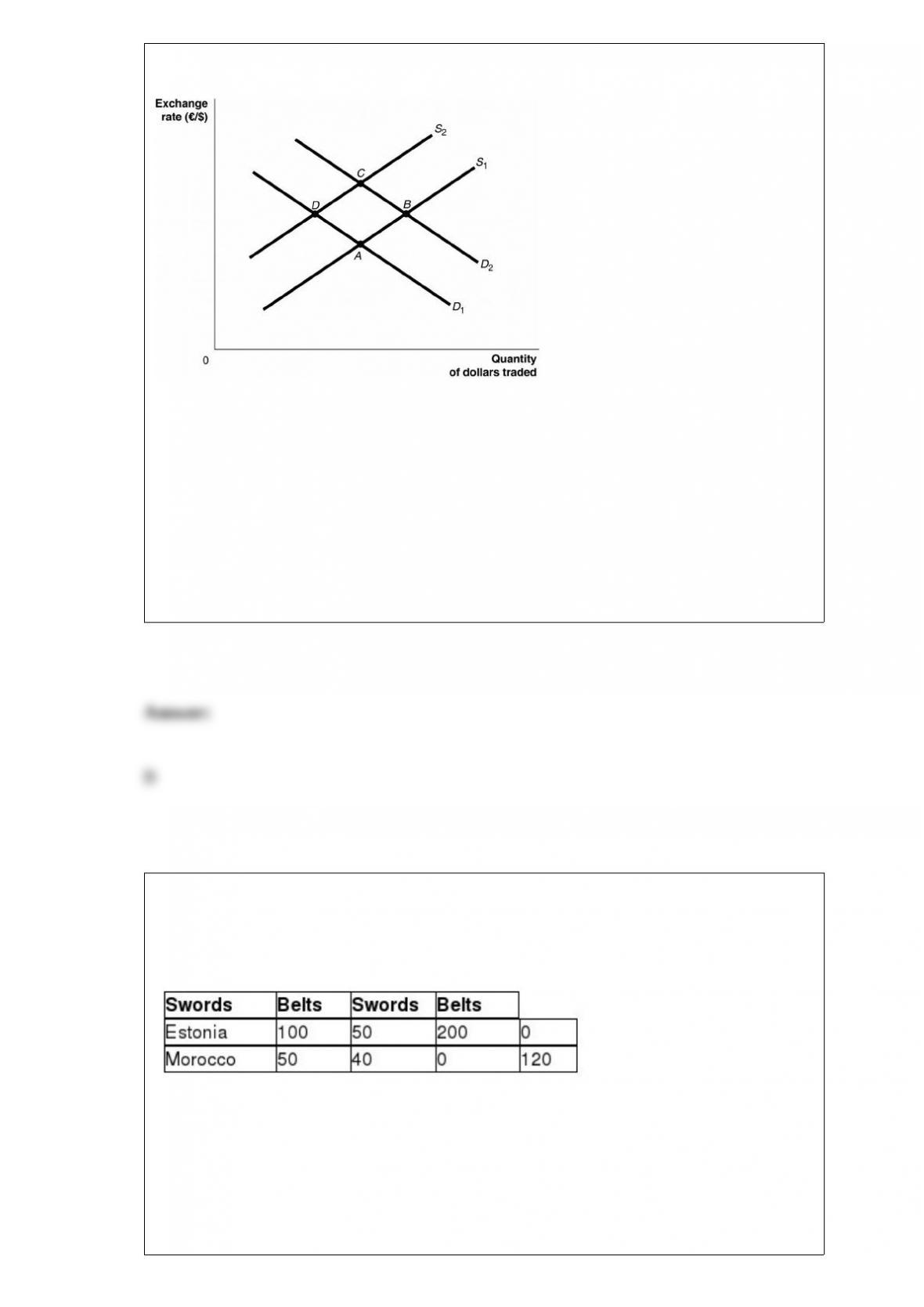
Figure 18-1
Refer to Figure 18-1. Europe experiences an economic boom. Assuming all else
remains constant, this would be represented as a movement from
A) D to A.
B) D to C.
C) C to B.
D) B to A.
Table 7-6
Production and
Consumption Production
Without Trade With Trade
Estonia and Morocco can produce both swords and belts. Table 7-6 shows the
production and consumption quantities without trade, and the production numbers with
trade.
Refer to Table 7-6. Prior to trade, what was the opportunity cost to produce 1 belt in
Morocco?

A) 1/2 of a sword
B) 4/5 of a sword
C) 1.25 swords
D) 2 swords
During the Great Depression, economists first began studying the relationship between
A) changes in GDP and changes in interest rates.
B) changes in aggregate expenditures and changes in GDP.
C) changes in nominal GDP and changes in real GDP.
D) changes in stock prices and changes in price controls.
The Taylor rule predicted a federal funds rate which was ________ that set when Paul
Volcker was chairman of the Fed, and a rate which was ________ that set when Arthur
Burns chaired the Fed.
A) greater than; equal to
B) greater than; less than
C) less than; equal to
D) less than; greater than
Some economists have argued that certain characteristics of the delivery of health care
justify government intervention. One of these characteristics is
A) health care is a public good.
B) health care is nonrivalrous and nonexcludable.
C) health care generates negative externalities.
D) health care generates positive externalities.
In 2008, Zimbabwe ran out of locally produced Coca Cola and local Coke bottlers were
not able to import the concentrated syrup needed to make Coke from the United States
because they could not obtain U.S. dollars. A small amount of Coke was imported from
South Africa, but a single bottle sold for around 15 billion Zimbabwean dollars.
Zimbabwe was experiencing rapid increases in the price level, which is known as
A) stagflation.
B) deflation.
C) inflation.
D) hyperinflation.
Economists believe the most persuasive argument for protectionism is to
A) save jobs.
B) protect high wages.
C) protect national security.
D) protect infant industries.
Table 11-4
Refer to Table 11-4. In the table above, which countries are consistent with the
predictions of the economic growth model?
A) Botswana and Thailand
B) Japan and Guatemala
C) only Japan
D) all four countries
What type of business is the easiest to set up?
A) sole proprietorship
B) partnership
C) corporation
D) There is no difference in the ease of establishment.
The Bretton Woods system of fixed exchange rates was set up in
A) the 1890s.
B) the 1920s.
C) the 1940s.
D) the 1970s.
If the average productivity of Indian firms is rising more quickly than the average
productivity of American firms, which of the following would you expect to see?
(India’s currency is the rupee.)

A) a decrease in the value of the rupee relative to the dollar
B) an increase in the prices of Indian products
C) an increase in the quantity demanded of Indian products relative to American
products
D) All of the above are correct.
Inflation targeting is a framework for carrying out monetary policy whereby
A) the central bank adopts a rigid target for inflation and ignores declines in output.
B) the central bank commits to achieving a publicly announced level of inflation.
C) the central bank commits to achieving a target level of inflation which is never
announced publicly.
D) the central bank commits to a monetary growth rule.
The primary purpose of patents and copyrights is to
A) provide owners with large profit forever.
B) protect firms from being taken advantage of by competing firms.
C) protect domestic firms from foreign competition.
D) encourage the expenditure of funds on research and development to create new
products.

During a recession, spending on ________ tends to fall more dramatically than
spending on ________.
A) necessities; luxuries
B) durable goods; nondurable goods
C) nondurable goods; durable goods
D) food; cars
The largest government-run health care system in the world, with 1.7 million
employees, is the National Health Service (NHS) in the United Kingdom. The NHS
receives its funding primarily from
A) tariffs.
B) the World Health Organization.
C) income taxes.
D) private businesses.
Scenario 14-2
Imagine that Kristy deposits $10,000 of currency into her checking account deposit at
Bank A and that the required reserve ratio is 20%.
Refer to Scenario 14-2. As a result of Kristy’s deposit, Bank A’s reserves immediately
increase by
A) $2,000.
B) $8,000.
C) $10,000.
D) $50,000.
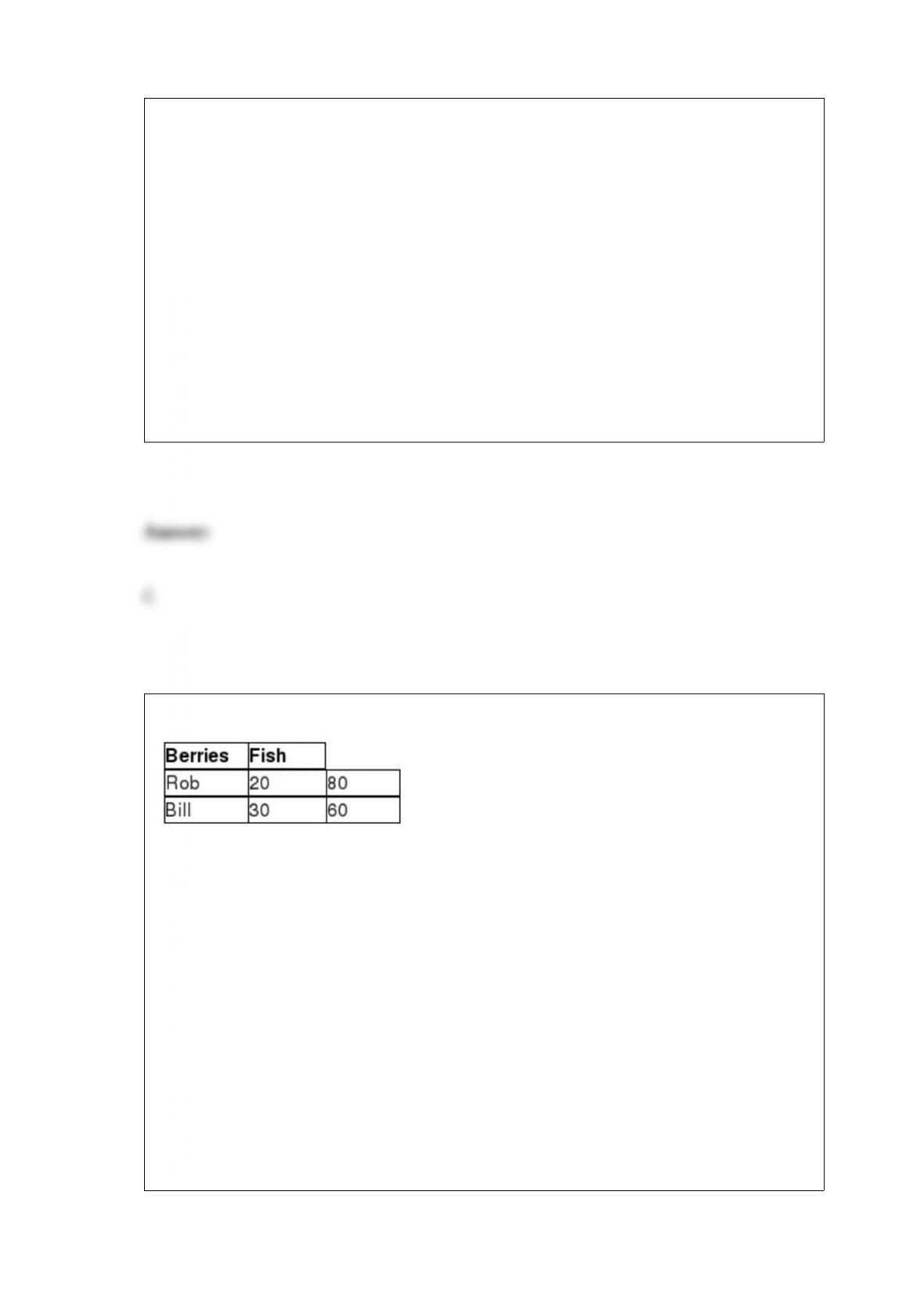
Table 7-1
Rob Crusoe and Bill Friday spent their week-long vacation on a desert island where
they had to find and make their own food. Rob and Bill spent one day each fishing and
picking berries. The table lists the pounds of output Rob and Bill produced.
Refer to Table 7-1. Use the table above to select the statement that accurately interprets
the data in the table.
A) Bill has a greater opportunity cost than Rob for picking berries.
B) Bill’s opportunity cost for catching fish is less than Rob’s.
C) Rob has a greater opportunity cost than Bill for picking berries.
D) Bill’s opportunity cost for picking berries and catching fish are both greater than
Rob’s.

In an open economy, the government purchases multiplier will be
A) larger as the marginal propensity to import decreases.
B) smaller as the marginal propensity to import decreases.
C) smaller as the marginal propensity to tax decreases.
D) larger as the marginal propensity to consume decreases.