
1) If the amount of money in circulation is $180 billion and the value of the economy’s
total output is $540 billion, then the:
A.circulation period of money must be one-fourth of a year.
B.velocity of money is 4
C.average price per final good sold is $3.
D.velocity of money is 3
2) behavioral economists use the concept of time inconsistency to explain why:
a.younger workers save more for retirement than older workers.
b.humans have an instinct for variety.
c.students would be willing to pay to delay the final exam the day before the exam, but
not earlier in the term.
d.people like to eat brightly colored m&ms.
3) purposeful behavior suggests that:
a.everyone will make identical choices.
b.resource availability exceeds economic wants.
c.individuals will make different choices because of different desired outcomes.
d.an individual’s economic goals cannot involve tradeoffs.
4) The sales tax is a regressive tax because the:
A.percentage of income paid as taxes falls as income rises.
B.administrative costs associated with the collection of the tax are relatively high.
C.percentage of income paid as taxes is constant as income rises.
D.tax tends to reduce the total volume of consumption expenditures.
5) effectively removing all illegal immigrants from u.s. labor markets would:
a.reduce wages in the united states.
b.increase employment of domestic-born workers, but by a lesser amount than the
number of jobs lost by illegal workers.
c.increase employment of domestic-born workers at a rate of one-for-one with the jobs
lost by illegal workers.
d.increase employment of domestic-born workers by an amount greater than the

number of jobs lost by illegal workers.
6) Other things equal, an increase in input prices will:
A.reduce aggregate supply and reduce real output.
B.increase the interest rate and lower the international value of the dollar.
C.increase aggregate supply and increase the price level.
D.increase net exports, increase investment, and reduce aggregate demand.
7) Productivity increases in agriculture have:
A.increased the demand for foodstuffs.
B.been negligible since the Second World War.
C.increased the incomes of farm households above the national average.
D.lowered farm prices.
8) The equilibrium interest rate:
A.affects both the size of total output and its composition.
B.falls when the demand for loanable funds increases.
C.determines the composition of R&D spending but not its total amount.
D.increases when the expected rate of return on R&D spending falls.
9) which of the following conditions is not required for price discrimination?
a.buyer with different elasticities must be physically separate from each other.
b.the good or service cannot be resold by original buyers.
c.the seller must be able to segment the market, that is, to distinguish buyers with
different elasticities of demand.
d.the seller must possess some degree of monopoly power.
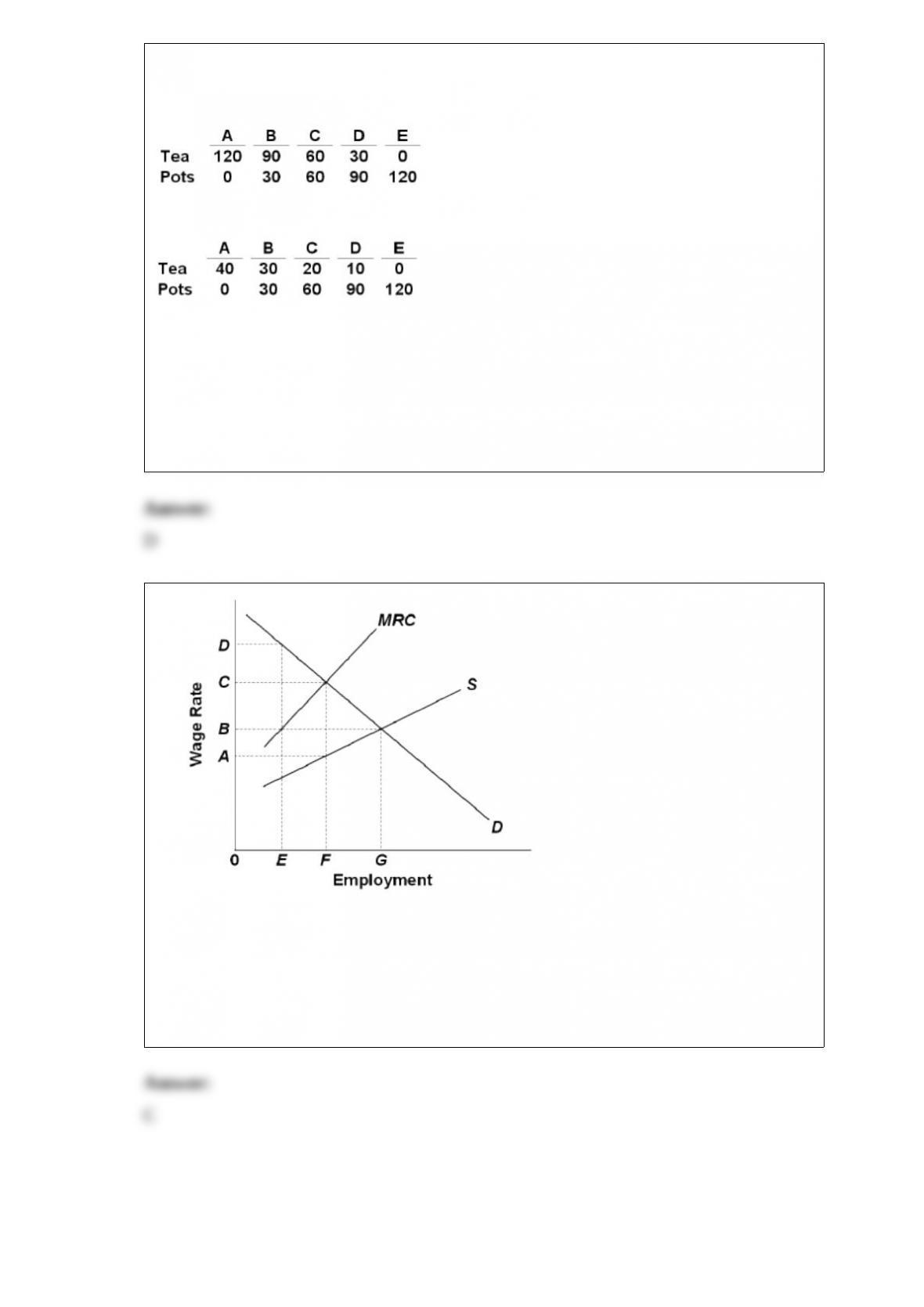
10) The following production possibilities data for Gamma and Sigma. All data are in
tons.
Gamma production possibilities:
Sigma production possibilities:
Refer to the above data. Assume that before specialization and trade Gamma and Sigma
both chose production possibility “C.” Now if each specializes according to
comparative advantage, the gains from specialization and trade will be:
A.40 tons of pots.
B.20 tons of tea and 20 tons of pots.
C.20 tons of tea.
D.40 tons of tea.
11)
Refer to the above diagram. If this labor market is purely competitive, the wage rate and
level of employment respectively will be:
A.D and E.
B.C and E.
C.B and G.
D.B and F.