
The term “tragedy of the commons” is used to describe
a. overpricing of computer software by Microsoft.
b. an increase in rents when air quality in a community improves.
c. the difficulty in obtaining honest evaluations of public goods.
d. the elimination of social gains due to the overuse of property without a well-defined
owner.
An economic problem with using subsidies or price ceilings to move a monopoly
toward the competitive equilibrium is that
a. it may increase monopoly profits.
b. it may decrease monopoly profits.
c. policy makers may not be able to determine what the competitive equilibrium is.
d. policy makers always need to be lobbied before taking any actions.
A copper mining firm has discovered that there is gold mixed in with its copper ore.
Since the marginal cost of mining the gold is negligible, they are willing to sell it at the
current market price of $500 an ounce. If the rate of interest is 5%, the firm should
expect the price next year

a. to rise to $505.
b. to rise to $525.
c. to rise to over $525.
d. to remain constant.
Suppose that the price of labor, the only variable input needed to produce cotton,
increases from $100 day to $120 day. The effect on costs will be
a. a parallel shift in the total cost curve.
b. a parallel shift in the fixed cost curve.
c. a parallel shift in the marginal cost curve.
d. a shift in total cost by different amounts for different quantities.
Tax Problem. Consider a perfectly competitive market were demand is Q = 100 – P and
Supply isQ = P – 10.
If the government imposes a $10 per unit consumption tax, then how much consumer
surplus will there be after the tax.
a. 600.

b. 800.
c. 1000.
d. 1600.
Cournot Problem. Consider Cournot Duopolists that produce homogeneous goods.
These firms each have constant marginal costs of $10. The market for these firms’
product has demand Q = 100 – P.
In the Nash Equilibrium, each firm will receive producer surplus of
a. $300
b. $450
c. $600
d. $900
Suppose that because of inflation, the absolute price of a gallon of milk increases by
20% and the absolute price of a gallon of gasoline increases by 10%. In this situation,
the price of milk relative to the price of gasoline
a. falls.

b. rises.
c. remains the same.
d. changes unpredictably.
The purpose of a Clarke tax is to
a. give people an incentive to truthfully reveal their preferences for a public good.
b. raise enough revenue to pay for a public good.
c. give producers an incentive to supply nonrivalrous public goods in socially efficient
quantities.
d. prevent the dissipation of rents that would occur with a nonexcludable public good.
In the theory of monopoly, which of the following is an exogenous variable?
a. The technology available to the monopoly.
b. The price charged by the monopoly.
c. The level of output produced by the monopoly.
d. The profit earned by the monopoly.
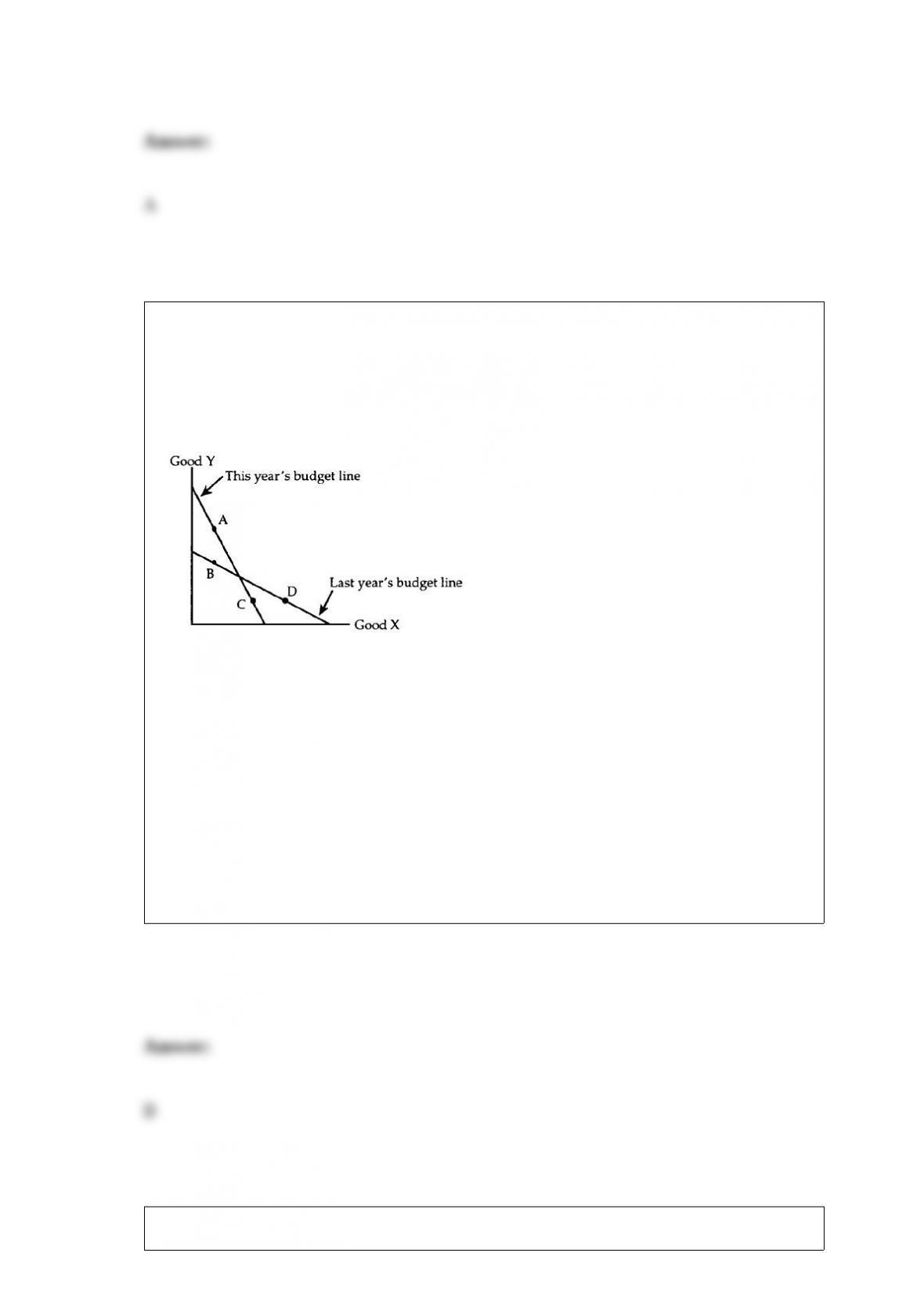
Budget Lines
The following questions refer to the following diagram, which shows the budget lines
faced by a consumer last year and this year.
If the consumer purchased basket B last year and purchases basket C this year, we can
conclude that
a. the consumer is not behaving optimally.
b. the consumer’s tastes changed between this year and last year.
c. the consumer’s indifference curves cannot be convex.
d. the law of demand does not hold for this consumer.
There are two states of the world. The person receives $100 in state one which occurs

with probability 0.6. If the person is rational and their expected return is $60, then in
state two the person must receive
a. $20
b. $25
c. $50
d. $100
In the Fable of the Bees, it was found that contrary to popular belief among economists,
but consistent with the Coase Theorem
a. apple growers would pay bee keepers for pollination services.
b. bee keepers would pay orchard owners for access to their flowering trees.
c. apple growers and bee keepers would reimburse each other for increasing output.
d. the transactions costs of negotiating prevented any agreements from being reached
between orchard owners and bee keepers.
Economists find that models based on the assumption of rational behavior are robust,
because a world in which everyone is rational would function quite similarly to a world
in which there are no

a. unexploited profit opportunities.
b. constraints due to scarcity.
c. inefficient markets.
d. barriers to free trade.
A monopoly will set price
a. at the highest price along its demand curve.
b. equal to the value at which marginal cost intersects the demand curve.
c. so that it can sell the quantity at which marginal revenue is equal to marginal cost.
d. so that it can sell the quantity at which marginal revenue is equal to zero.
In laboratory experiments, how do animals respond to economic stimuli?
a. The animals’ behaviors are consistent with economic theory.
b. The animals’ responses are random and unpredictable.
c. The results indicate that the animals’ tastes must be constantly changing.
d. The animals do not respond at all to subtle variations in “prices” and “incomes.”
When speculators begin to sell futures contracts, suppliers will
a. try to sell more in the spot market.
b. store more of their crop to sell in the future.
c. not have any incentive to change their plans.
d. earn larger profits.
Which statement is true regarding a market in equilibrium
a. There is a shortage of the good.
b. There is a surplus of the good.
c. Neither demanders or suppliers are satisfied.
d. Both demanders and suppliers are satisfied.

If demand rises and supply falls, which of the following must be true?
a. The equilibrium price will rise.
b. The equilibrium price will fall.
c. The equilibrium price will not change.
d. The change in the equilibrium price is indeterminate.
Ultimately, short-run supply curves are upward sloping because of
a. the irrelevance of fixed costs to the firm’s decision making.
b. the factor-price effect.
c. diminishing marginal returns to the variable inputs.
d. the equality of demand and marginal revenue for competitive firms.
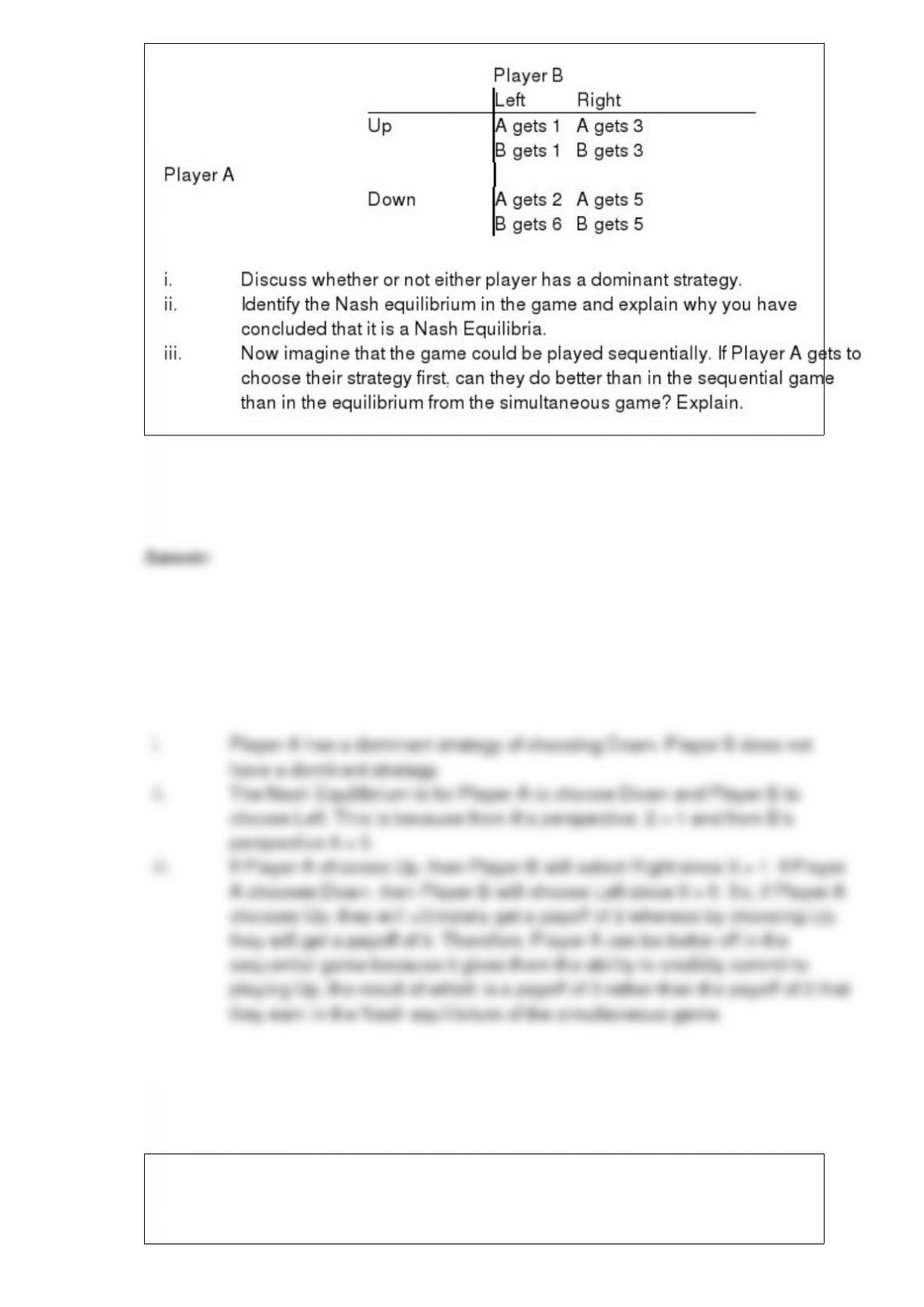
Consider the simultaneous choice game represented by the matrix below where Player
A chooses either Up or Down and Player B chooses either Left or Right.
Which of the following best summarizes the essence of the Invisible Hand Theorem?
a. Competitive markets guarantee that any shortages or surpluses existing in an

economy will be quickly eliminated.
b. Of all the possible economic systems, competitive markets are the most
philosophically compatible with democracy and freedom.
c. Within competitive markets, people who selfishly pursue their own interests end up
achieving a socially desirable outcome.
d. The social gain created by competitive markets is second only to what a hypothetical
benevolent dictator could achieve.
The Benham study suggests that professional societies may prefer to restrict advertising
by their members because
a. the costs of advertising would unnecessarily add to the price of their product.
b. with advertising, it would be harder for new members to compete with established
members.
c. limiting information for consumers makes it easier for their members to charge
higher prices.
d. advertising lowers the status of the profession in the public’s eyes.
Which of the following would shift the supply curve for coffee to the right?
a. An innovation in agricultural techniques that allows growers to produce coffee less

expensively.
b. A late frost in Brazil that destroys 75% of its coffee bean crop.
c. An increase in the wages paid to coffee bean pickers.
d. A rise in the popularity of espresso, cappuccino, and other exotic coffee drinks.
A sunk cost is one that
a. does not vary with the level of output.
b. increases as the firm’s production increases.
c. measures the value of the firm’s self-owned resources.
d. can no longer be avoided.
A farmer with $1000 worth of crops in the field faces a .10 probability that a hail storm
will destroy the value of her crop before she can harvest it. If she is risk averse, the
most she would be willing to pay to insure against this loss is
a. $0.
b. $10.
c. $100.
d. $900.
An employer is liable for torts committed by his employees under the
a. principle of general average.
b. doctrine of respondent superior.
c. Good Samaritan Rule.
d. contributory negligence standard.
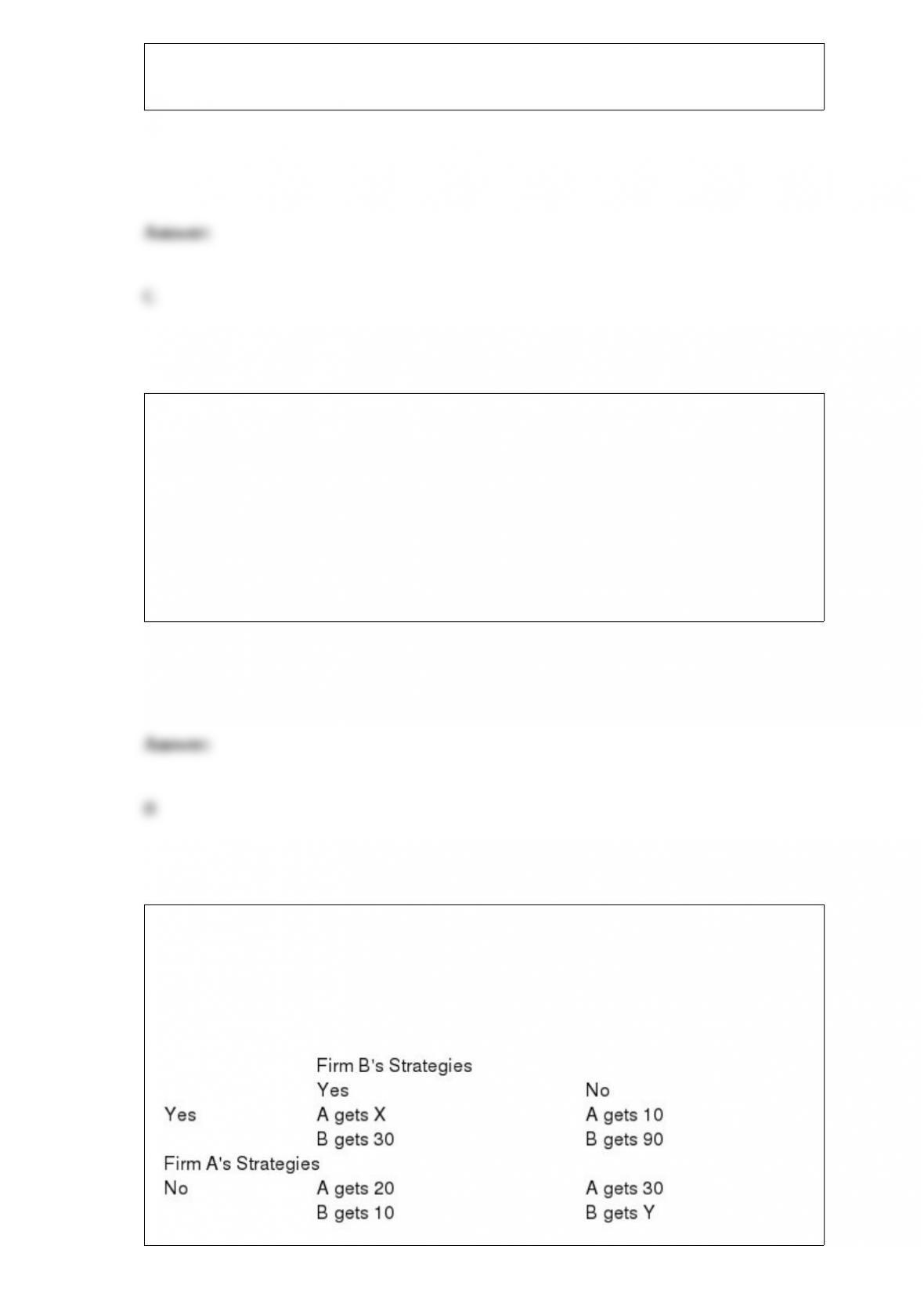
Game Matrix V
The following questions refer to the game matrix below. Each firm has a choice of
saying Yes or NO. The profits each gets depend upon which it chooses.

Which of the following values of X and Y result in there being no pure strategy Nash
Equilibrium?
a. X = 21, Y = 9.
b. X = 19, Y = 11.
c. X = 31, Y = 11.
d. There will always be at least one pure strategy Nash Equilibrium in this game.
Your company is considering a project that costs $1000 up front. It generates a revenue
stream of $250 a year for four years. The present value of this project is approximately
a. $0.00
b. $790.46
c. $-209.54
d. It cannot be determined with the information given.
Edgeworth Box Economy
The accompanying diagram shows an Edgeworth box economy. The initial endowment
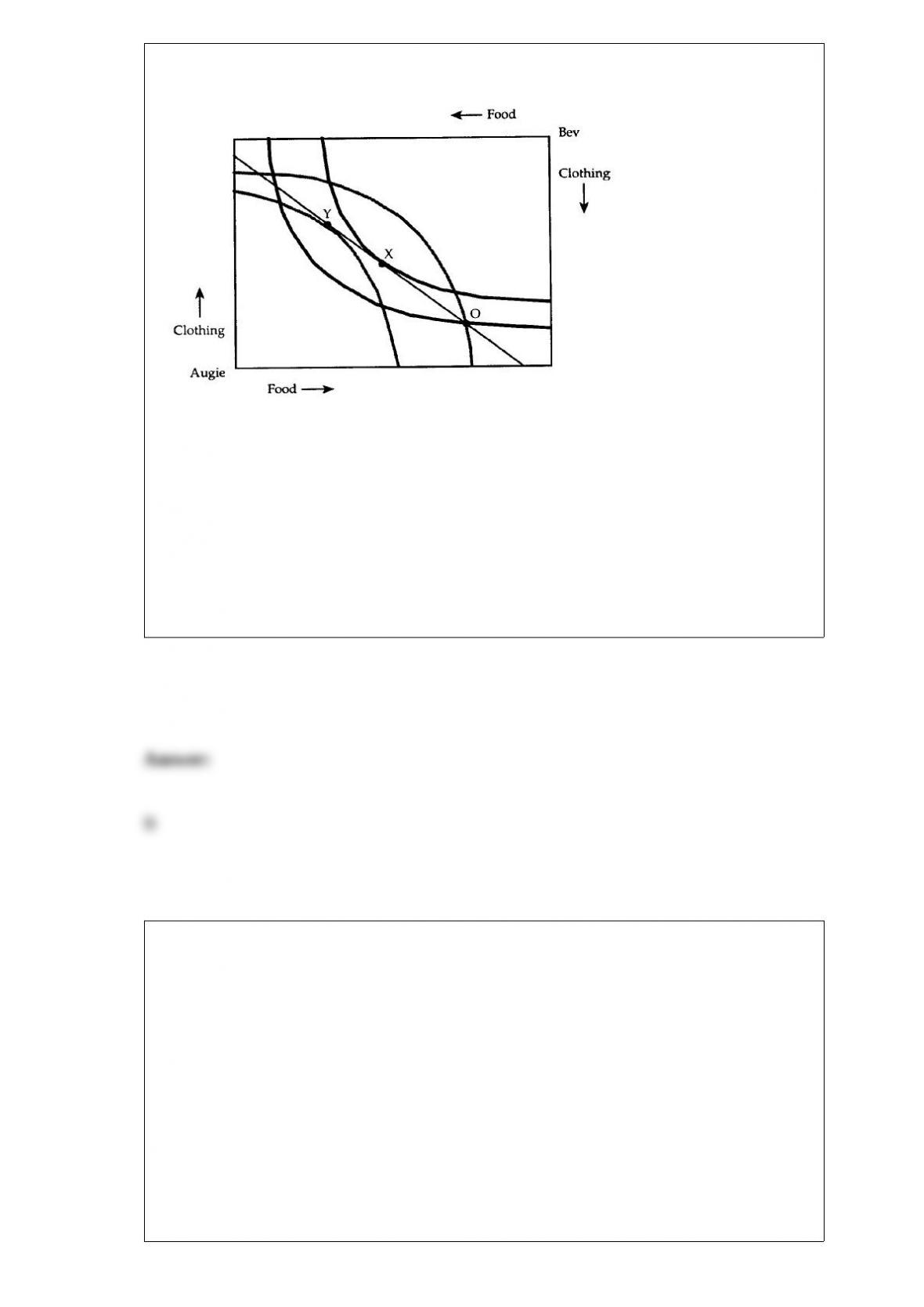
is point O. At current relative prices, Augie chooses point X and Bev chooses point Y.
Based on the situation shown in the diagram, we can conclude that
a. Augie and Bev have reached a competitive equilibrium.
b. the relative price of food must rise to clear the market.
c. both point X and point Y must lie on the contract curve.
d. there is a shortage of clothing and a surplus of food.
Pollutants
The following questions refer to the situation below. A chemical plant’s production adds
pollutants to a stream which irrigates a farm’s crops. The pollutants damage the farm’s
crops, increasing the firm’s costs by $800 per month. The crop damage may be
eliminated in two ways: the chemical plant can install a new filtering system costing
$300 per month, or the farm can install a new irrigation system costing $600 per month.
Suppose transactions costs preclude the possibility of private bargaining between the
chemical plant and the farm. Which liability rule will not result in an efficient outcome?
a. The chemical plant bears all liability for the crop damage.
b. The farm bears all of the costs of the crop damage.
c. The chemical plant bears 50% of the liability, while the farm bears the other 50% of
the crop damages.
d. The Coase Theorem guarantees that any assignment of liability will result in an
efficient outcome.
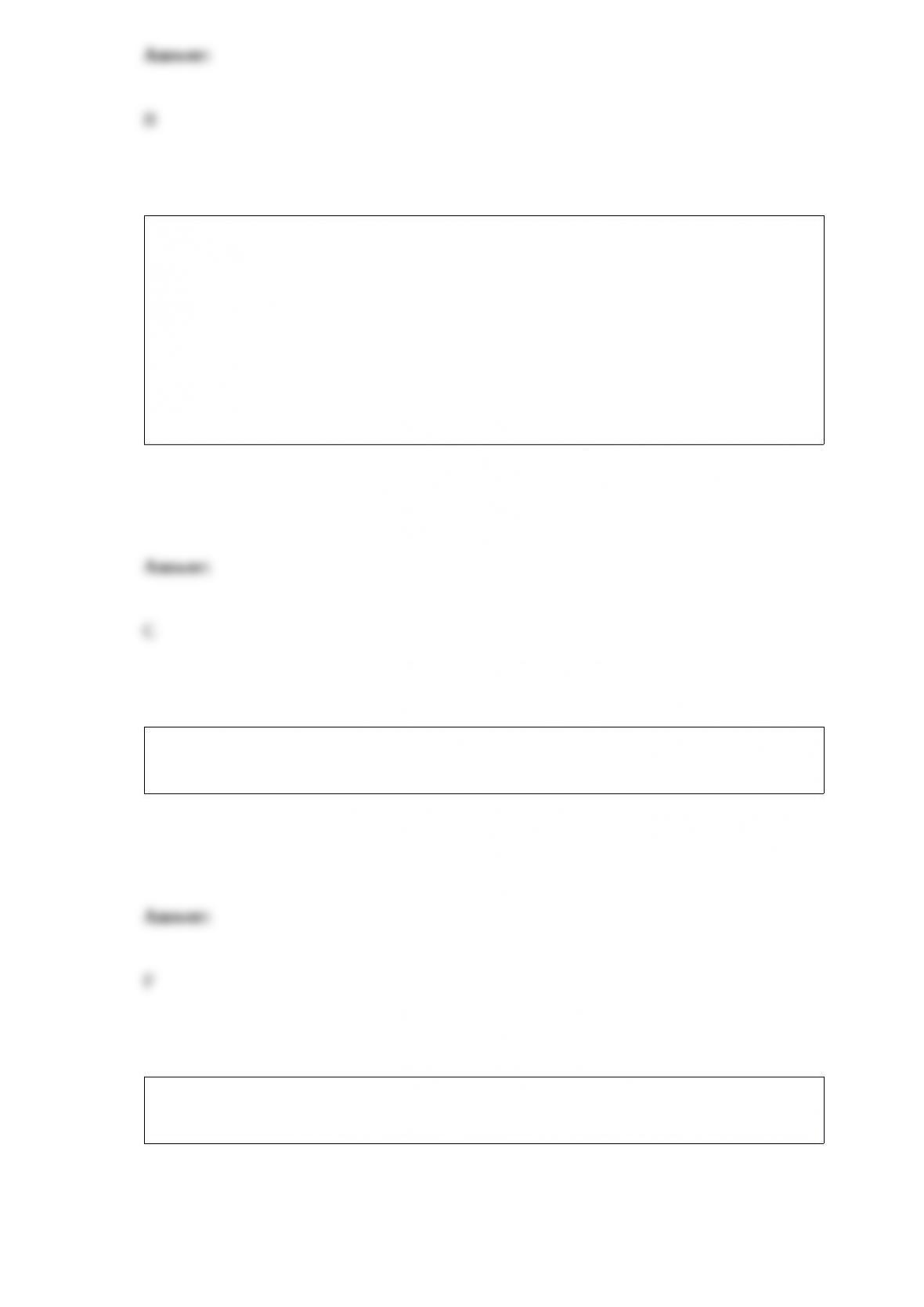
Demand and Total Cost of Production
The following questions refer to the following tables which show the demand for a
firm’s product and the firm’s total cost of production.
According to the equimarginal principle, how many units should the firm produce in
order to maximize its profit?
a. 2 units.
b. 3 units.
c. 4 units.
d. 5 units.
Under competition, the price of a resource reveals
a. information about the past, but not future, uses of a resource.
b. the most valuable way to use the resource.
c. how much the resource is worth in the most valuable of its alternative uses.
d. the value of the labor needed to fully exploit the resource.
The Good Samaritan Rule dictates that if a person witnesses a crime, they must assist
the person against whom the crime is being committed.
When a sales tax of 50¢ per carton is imposed on cigarettes, the demand curve for
cigarettes shifts down by precisely 50¢ per carton.
Suppose the demand curve for a good is given by the equation Q = 100 – P and the
supply curve is given by the equation Q = 0.25P, where P represents the price of the
good (measured in dollars per unit) and Q represents the quantity of the good (measured
in units per week).
(i) Find the equilibrium price and quantity for this market.
(ii) Suppose quantity demanded for the good rises by 10 units at every possible price
while at the same time quantity supplied falls by 5 units at every possible price (with
the exception that quantity supplied can not drop below zero units at any price). Find
the new equilibrium price and quantity in this market.
(iii) Given the change in demand, how large would the fall in supply need to be (given
the same 10 unit rise in demand) in order for the price to decrease instead of increasing
as in part (ii)?
A person argues that if the prison sentences for all crimes were doubled, this would
worsen the problem of overcrowded prisons, all other things being equal. Use the
concept of demand to explain why this argument is incorrect.
The Battle of the Sexes game has two Nash equilibria, neither of which is Pareto
optimal.
Because people work more efficiently in periods of high productivity, they tend to work
fewer hours because it does not take as long to complete assignments.
A comic book company pays an annual licensing fee of $10,000 for the rights to an
artist’s character. Which would have the bigger effect on the readers of that character’s
comic: an increase in printing costs or an increase in the artist’s licensing fee? Explain.
In the moral hazard problem, people incur additional risks as a result of being insured.
When Ricardian equivalence holds, government borrowing leads to higher interest
rates.
Output is held fixed along an isocost.
What can be said about the market price when a good is in surplus (i.e., when the
quantity supplied exceeds the quantity demanded)? How will demanders and suppliers
respond to a surplus, and what will happen to the market price?
To an economist, a cost is a forgone opportunity.
If the price and quantity exchanged of a good simultaneously rise, then the law of
demand has been violated.
The Axelrod study shows that “Tit-for-Tat” is a successful strategy for playing a
repeated Prisoners’ Dilemma game.
An inferior good is one for which the substitution effect is relatively large.
A speculative bubble is characterized by systematic undervaluing of stocks.
The use of signals in an economy is both individually rational and socially efficient.
While the model of supply and demand has been around for a long time, it has survived
more because it mimics reality than because it actually predicts something.
The shape of the firm’s long-run average cost curve is determined by returns to scale.
Increased use of machinery hurts workers by lowering the demand for their labor.