
Table 9-1
Linda and Sandy own The Preppy Puppy, a dog grooming business. Table 9-1 lists the
number of dogs Linda and Sandy can each bathe and groom in one week. Select the
statement that accurately interprets the data in the table.
A) Linda has an absolute advantage in dog bathing and Sandy has an absolute
advantage in dog grooming.
B) Sandy has an absolute advantage in dog bathing and Linda has an absolute
advantage in dog grooming.
C) Sandy has an absolute advantage in dog bathing and dog grooming.
D) Linda has an absolute advantage in dog bathing and dog grooming.
The Jeans Store sells 7 pairs of jeans per day when it charges $100 per pair. It sells 8
pairs of jeans per day at a price of $90 per pair. The marginal revenue of the eighth pair
of jeans is
A) $20.
B) $90.
C) $100.
D) $700.
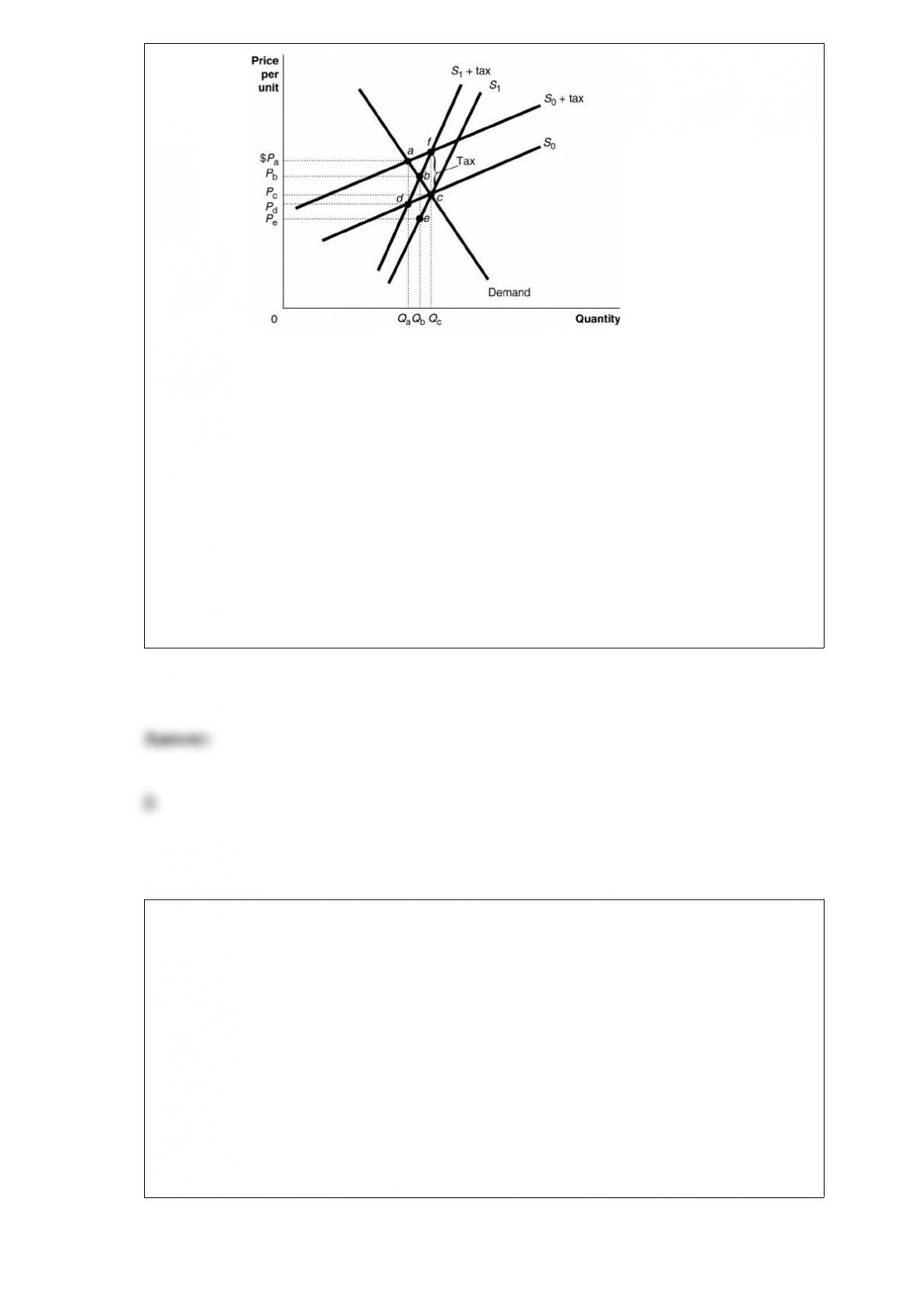
Figure 18-2 Figure 18-2 shows a
demand curve and two sets of supply curves, one set more elastic than the other.
If the government imposes an excise tax of $1.00 on every unit sold, the government’s
revenue from the tax is represented by the area
A) (PaPcQa) if the supply curve is S0 and (PPcQ) if the supply curve is S1.
B) (PaPdQa) if the supply curve is S0 and (PPeQ) if the supply curve is S1.
C) (PaPeQa) under either supply curve.
D) (PPeQ) under either supply curve.
The free rider problem refers to a situation in which
A) people consume a pure public good without payment, even though the good may not
be produced if no one chooses to pay.
B) the marginal cost of allowing additional consumers to consume a public good is
zero.
C) high income individuals subsidize the production of goods, such as education, that
make society better off.
D) markets fail to allocate resources efficiently when benefits outweigh costs.

Adam Smith’s invisible hand refers to
A) the government’s unobtrusive role in ensuring that the economy functions efficiently.
B) property ownership laws and the rule of the court system.
C) the process by which individuals acting in their own self-interest bring about a
market outcome that benefits society as a whole.
D) the laws of nature that influence economics decisions.
Today, ________ of Goodyear’s tire sales are in the North America.
A) only 11 percent
B) less than 40 percent
C) 65 percent
D) more than 80 percent
The money demand curve has a negative slope because

A) lower interest rates cause households and firms to switch from money to financial
assets.
B) lower interest rates cause households and firms to switch from financial assets to
money.
C) lower interest rates cause households and firms to switch from money to stocks.
D) lower interest rates cause households and firms to switch from money to bonds.
If you want to know the present value of $10,000 received in one year, and the interest
rate is 4 percent, what formula can you use?
A) Present value equals $10,000 times 0.04.
B) Present value equals $10,000 divided by 1.04
C) Present value equals 1.04 divided by $10,000.
D) Present value equals $10,000 times 1.04.
Table 21-2

Using the table above, what is the approximate growth rate of real GDP from 2011 to
2012?
A) 1%
B) 2%
C) 3%
D) 4%
A monopolistically competitive firm that is earning profits will, in the long run,
experience all of the following except
A) new rivals entering the market.
B) a decrease in demand for its product.
C) demand for the firm’s product becomes more elastic.
D) a decrease in the number of rival products.

A cooperative equilibrium results when firms
A) choose the best strategy regardless of what other players do.
B) choose the strategy that maximizes the total game payoff.
C) choose the strategy that minimizes the payoff to other players.
D) choose a strategy by random chance.
If you own a $1,000 face value bond with one year remaining to maturity and a five
percent coupon rate and new bonds are paying 12 percent, what is the most you can get
for your old bond?
A) $1,120
B) $1,000
C) $937.50
D) impossible to determine without additional information
Many economists ________ protectionism because it ________ consumers and
________ jobs in domestic industries that use protected products.
A) support; benefits; creates
B) criticize; causes losses to; eliminates
C) support; lowers prices for; raises wages for
D) criticize; unfairly rewards; relocates
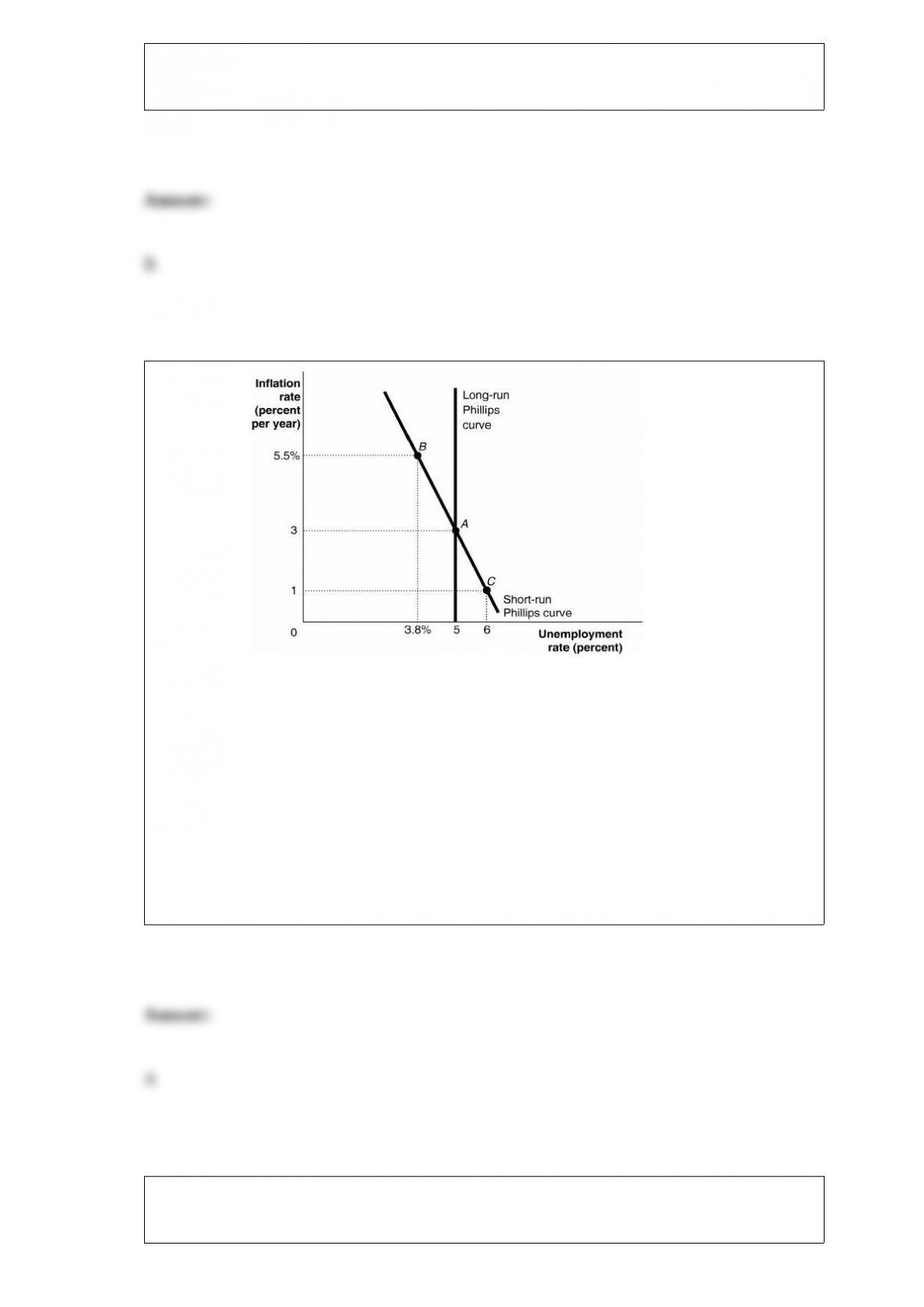
Figure 17-2
Suppose the economy is at point C. If the Fed decreases the money supply so that
inflation falls, the economy will ________ in the long run, holding all else constant.
A) eventually move to point A
B) eventually move to point B
C) stay at point C
D) move to point A and then back to point B
A firm in a market economy must do all of the following to succeed except

A) produce the goods and services that consumers want at a lower cost than consumers
themselves can produce.
B) organize the factors of production into a functioning, efficient unit.
C) have access to sufficient funds.
D) be organized as a corporation.
According to the Australian Wool Innovation, severe drought conditions in Australia
contributed to the lowest level of wool production in 50 years. This record low
production has driven up prices sharply in Australian wool markets. Meanwhile, the
price of raw cotton increased significantly for the first time in many years.
a. Illustrate this observation with one demand and supply graph for the market for
Australian wool and another demand and supply graph for raw cotton.
b. Make sure that your graphs clearly show (1) the initial equilibrium before the
decrease in the supply of Australian wool and (2) the final equilibrium.
c. Use arrows to indicate any shifts in the demand and supply curves for each market.
d. Label your graphs fully and write an explanation of your work.
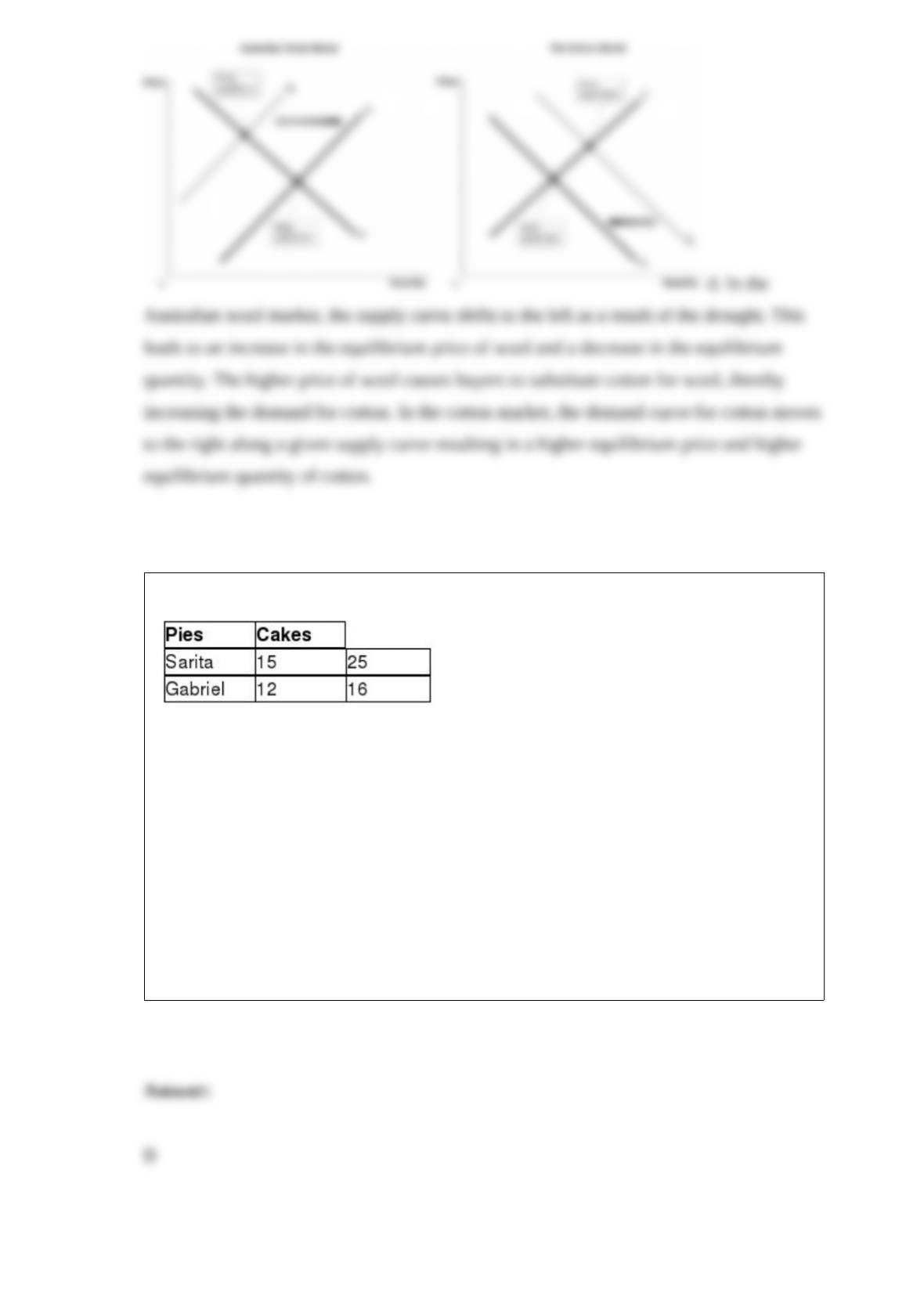
Table 9-2
Sarita and Gabriel own S&G Bakery. Table 9-2 lists the number of pies and cakes Sarita
and Gabriel can each bake in one day. Select the statement that accurately interprets the
data in the table.
A) Sarita has a greater opportunity cost than Gabriel for baking cakes.
B) Sarita’s opportunity cost for baking cakes is less than Gabriel’s.
C) Gabriel has a greater opportunity cost than Sarita for baking pies.
D) Gabriel’s opportunity cost for baking cakes and baking pies are both greater than
Sarita’s.