1) Which of the following statements is consistent with evidence?
A.It is widely accepted that central planning will accelerate a DVCs growth rate.
B.It is generally agreed that a laissez-faire policy for government will maximize
economic growth.
C.The effectiveness of government policies in enhancing growth has varied from
country to country.
D.Government intervention in DVC economies has universally hampered economic
growth.
2)
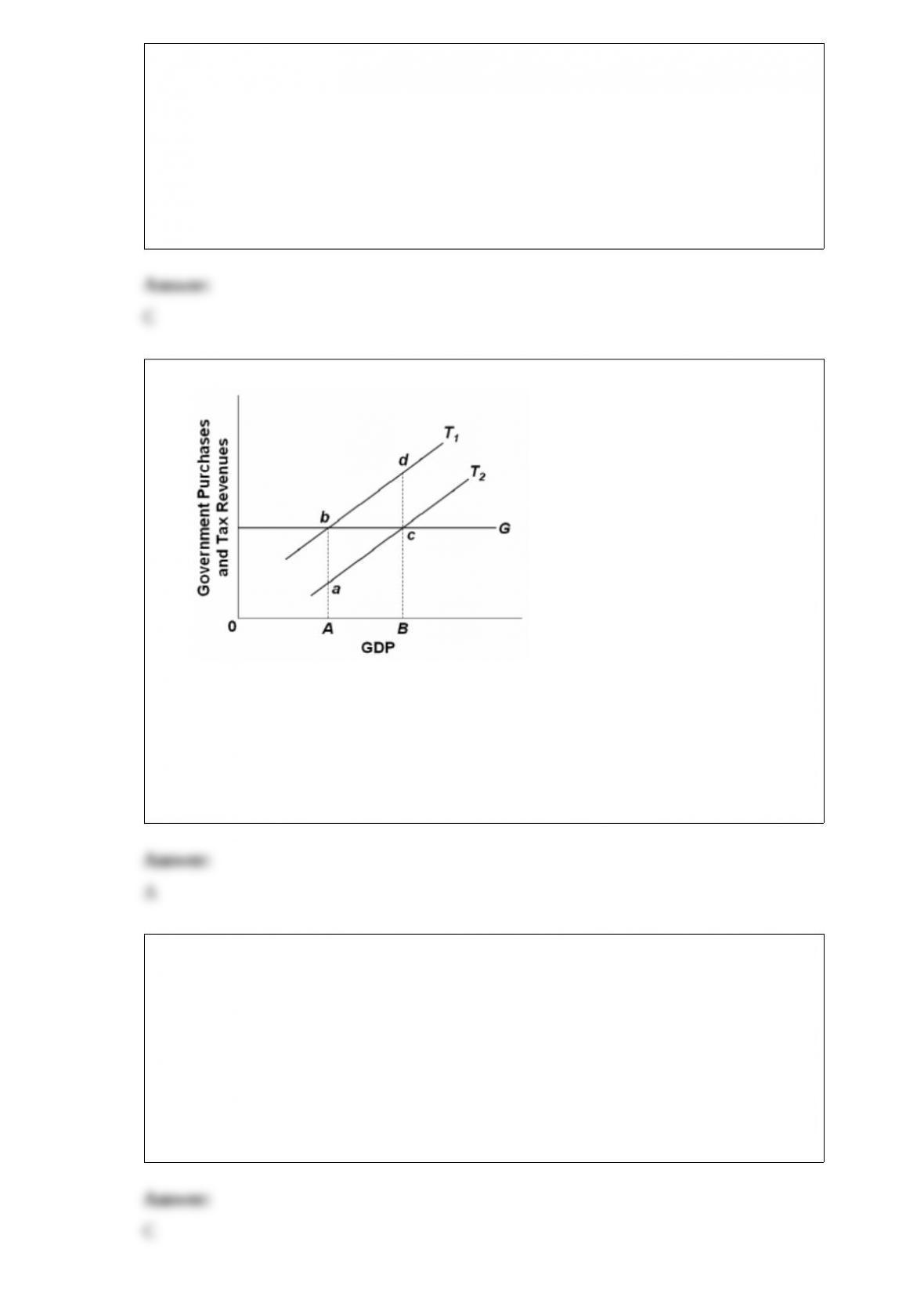
Refer to the above diagram. Assume that G and T1 are the relevant curves, the economy
is currently at A, and the full-employment GDP is B. This economy has a(n):
A.standardized budget surplus.
B.standardized budget deficit.
C.actual budget deficit.
D.actual budget surplus.
3) A farmer who has fixed amounts of land and capital finds that total product is 24 for
the first worker hired; 32 when two workers are hired; 37 when three are hired; and 40
when four are hired. The farmer’s product sells for $3 per unit and the wage rate is $13
per worker.
Refer to the above information. What is the farmer’s profit-maximizing output?
A.20
B.32
C.37
D.40
4) data from the registrar’s office at gigantic state university indicate that over the past
twenty years tuition and enrollment have both increased. from this information we can
conclude that:
a.higher education is an exception to the law of demand.
b.the supply of education provided by gsu has also increased over the twenty-year
period.
c.school-age population, incomes, and preferences for education have changed over the
twenty-year period.
d.gsu’s supply curve of education is downsloping.
5)
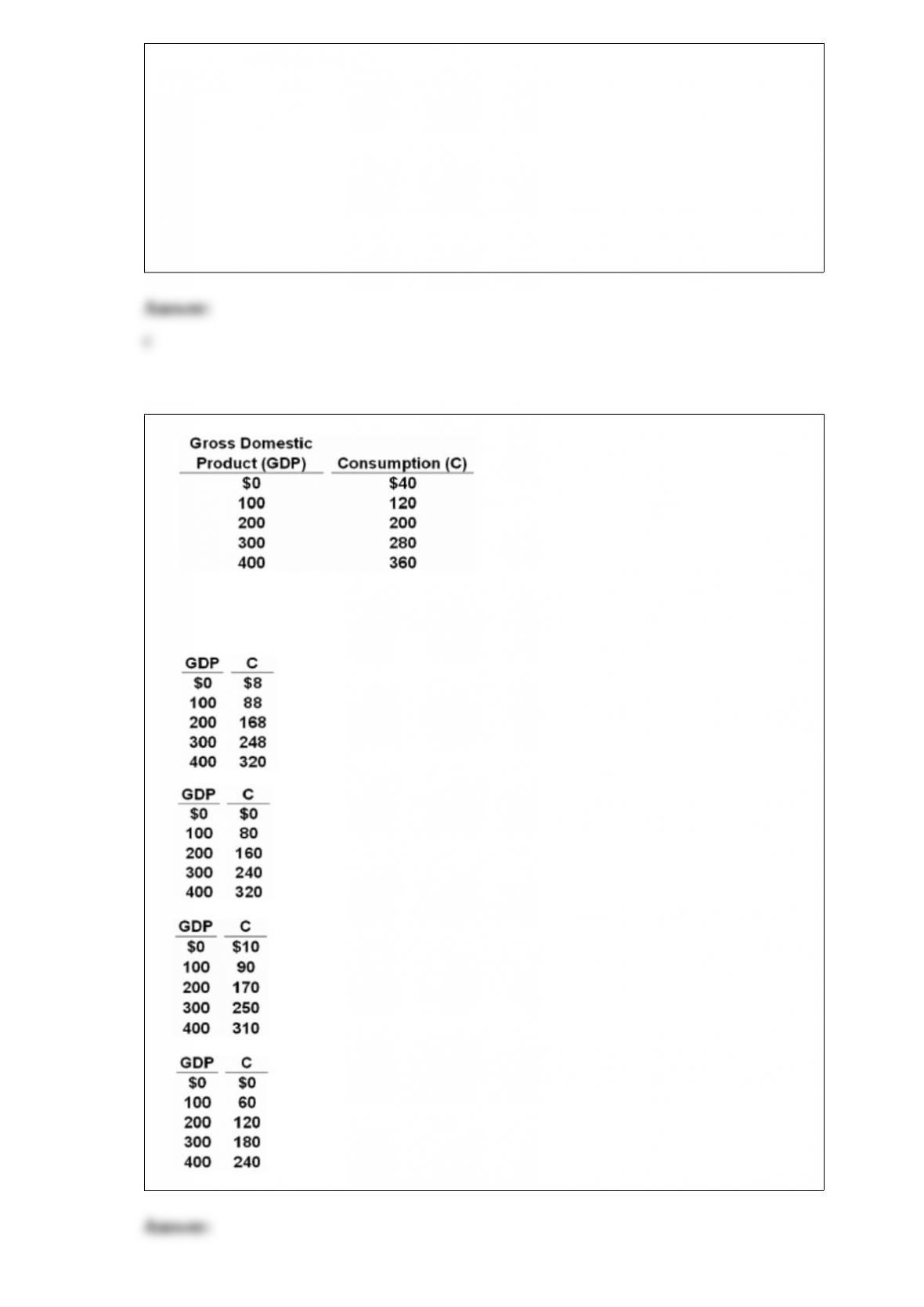
Refer to the above data. If a lump-sum tax (the same tax amount at each level of GDP)
of $40 is now imposed in this economy, the consumption schedule will be:
A.
B.
C.
D.

6) Refer to the above graph. Other things equal, a decrease in the price of a substitute
resource would cause a(n):
A.move from a to b on D1.
B.shift from D2 to D3 assuming the output effect exceeds the substitution effect.
C.shift from D3 to D2 assuming the output effect exceeds the substitution effect.
D.move from b to a on D1.
7) the two basic markets shown by the simple circular flow model are:
a.capital goods and consumer goods.
b.free and controlled.
c.product and resource.
d.household and business.
8) the largest goods exports of the united states (in dollar volume) are:
a.chemicals, agricultural products, consumer durables, and semiconductors.
b.petroleum, automobiles, clothing, and household appliances.
c.iron and steel, clothing, beef, and sugar.
d.aircraft, glassware, television sets, and furniture.
9) Dumping of goods abroad:
A.constitutes a general case for permanent tariffs.
B.may be part of a firm’s price discrimination strategy.
C.may be part of a nation’s strategy to rectify its trade deficit.
D.drives up prices of the dumped goods.
10) Monetarists say that the relationship between the amount of money which
households and businesses want to hold and the level of national output and income:
A.has decreased historically because of increased accessibility to credit.
B.rises during recession and falls during periods of full employment.
C.falls during recession and rises during periods of full employment.
D.is relatively stable.
11)
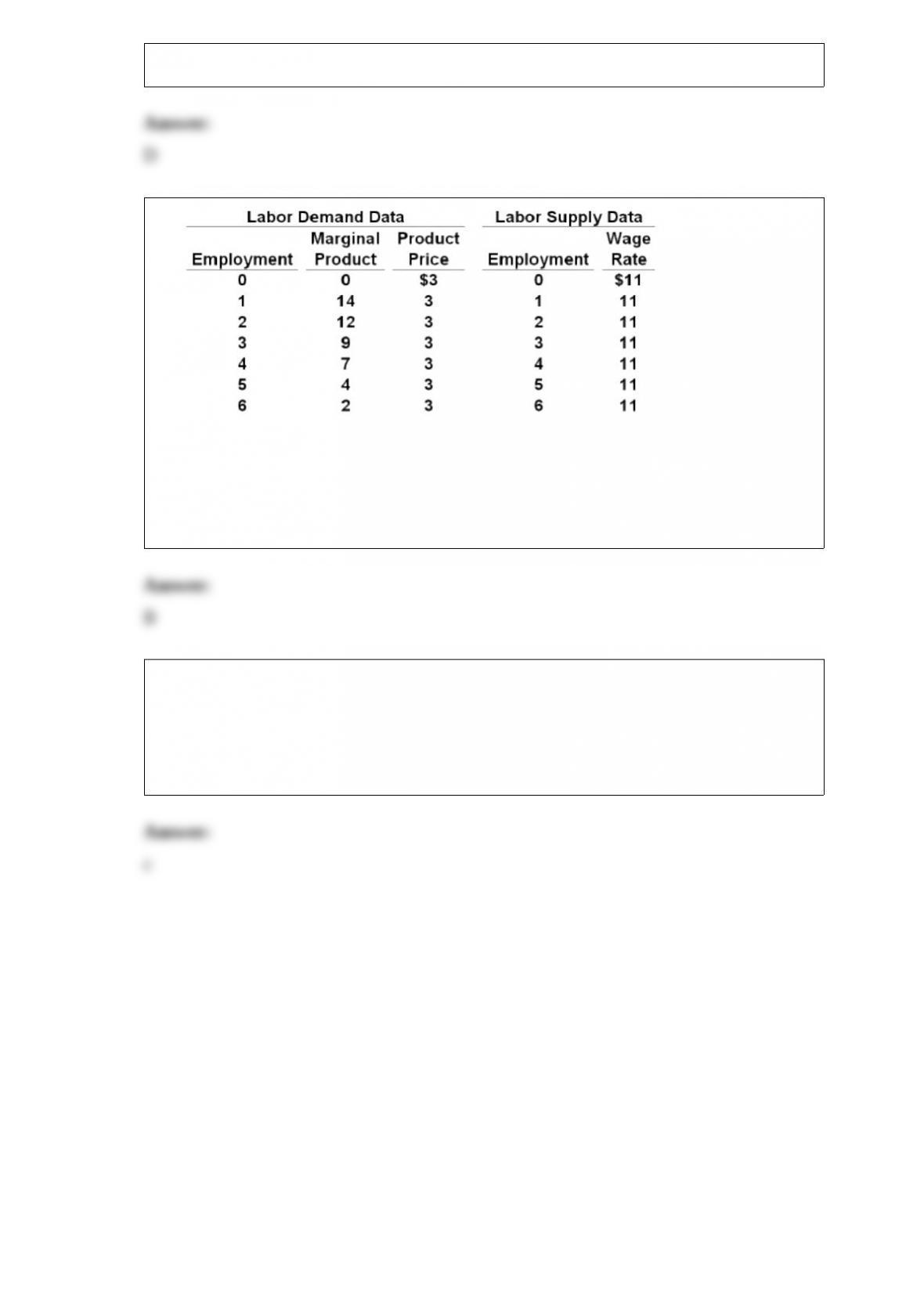
Refer to the above data. The firm is hiring labor:
A.at a wage rate that exceeds labor’s MRP.
B.under purely competitive conditions.
C.in an imperfectly competitive market.
D.as a monopsonist.
12) allocative efficiency involves determining:
a.which output-mix will result in the most rapid rate of economic growth.
b.which production possibilities curve reflects the lowest opportunity costs.
c.the mix of output that will maximize society’s satisfaction.
d.the optimal rate of technological progress.