1) President Gerald Ford referred to inflation as
a.a blight on our nation’s economy.
b.a necessary evil to combat high unemployment.
c.public enemy number one.
d.a fly in the ointment.
2) The price elasticity of supply measures how responsive
a.equilibrium price is to equilibrium quantity.
b.sellers are to a change in buyers’ income.
c.sellers are to a change in price.
d.consumers are to the number of substitutes.
3) Which of the following statements is correct?
a.The market for capital is unlike the market for labor because the rental price of capital
is unaffected by the marginal product of capital, whereas the price of labor is affected
by the marginal product of labor.
b.The market for capital is unlike the market for labor because the purchase price of
capital is unaffected by the marginal product of capital, whereas the price of labor is
affected by the marginal product of labor.
c.The market for capital is like the market for labor because the rental price of capital is
affected by the marginal product of capital, and the price of labor is affected by the
marginal product of labor.
d.Both a and b are correct.
4) The substitution effect of a wage decrease in the work-leisure model results in the
worker choosing to
a.work less than before.
b.work more than before.
c.possibly work more or less than before.
d.work more with a higher level of consumption.
5) Which of the following statements is correct?
a.Buyers always want to pay less and sellers always want to be paid more.
b.Buyers always want to pay less and sellers always want to be paid less.
c.Buyers always want to pay more and sellers always want to be paid more.
d.Buyers always want to pay more and sellers always want to be paid less.
6) A bagel shop sells fresh baked bagels from 5 a.m. until 7 p.m. every day. The shop
does not sell day-old bagels, so all unsold bagels are thrown away at 7 p.m. each day.
The cost of making and selling a dozen bagels is $1.00; there are no costs associated
with throwing bagels away. If the manager has 8 dozen bagels left at 6:30 p.m. on a
particular day, which of the following alternatives is most attractive?
a.Lower the price of the remaining bagels, even if the price falls below $1.00 per dozen.
b.Lower the price of the remaining bagels, but under no circumstances should the price
fall below $1.00 per dozen.
c.Throw the bagels away and produce 8 fewer dozen bagels tomorrow.
d.Starting tomorrow, lower the price on all bagels so they will all be sold earlier in the
day.
7) Which of the following is likely to have the most price inelastic demand?
a.latt©s
b.filet mignon
c.Grey Goose® vodka
d.milk
8) The opportunity cost of leisure is impossible to measure because we cannot measure
leisure time in dollars.
a.True
b.False
9) The most common explanation for Social Security payments accounting for a larger
share of federal government expenditures is
a.increases in life expectancy.
b.people becoming eligible for Social Security benefits at an earlier age.
c.increases in birth rates among teenagers and the poor.
d.falling payroll tax receipts.
10) Skip’s Sealcoating Service increased its total monthly revenue from $12,000 to
$13,500 when it raised the price of driveway repairs from $600 to $750. The for Skip’s
Sealcoating Service is
a. 0.11.
b. 0.47.
c. 1.12.
d. 2.11.
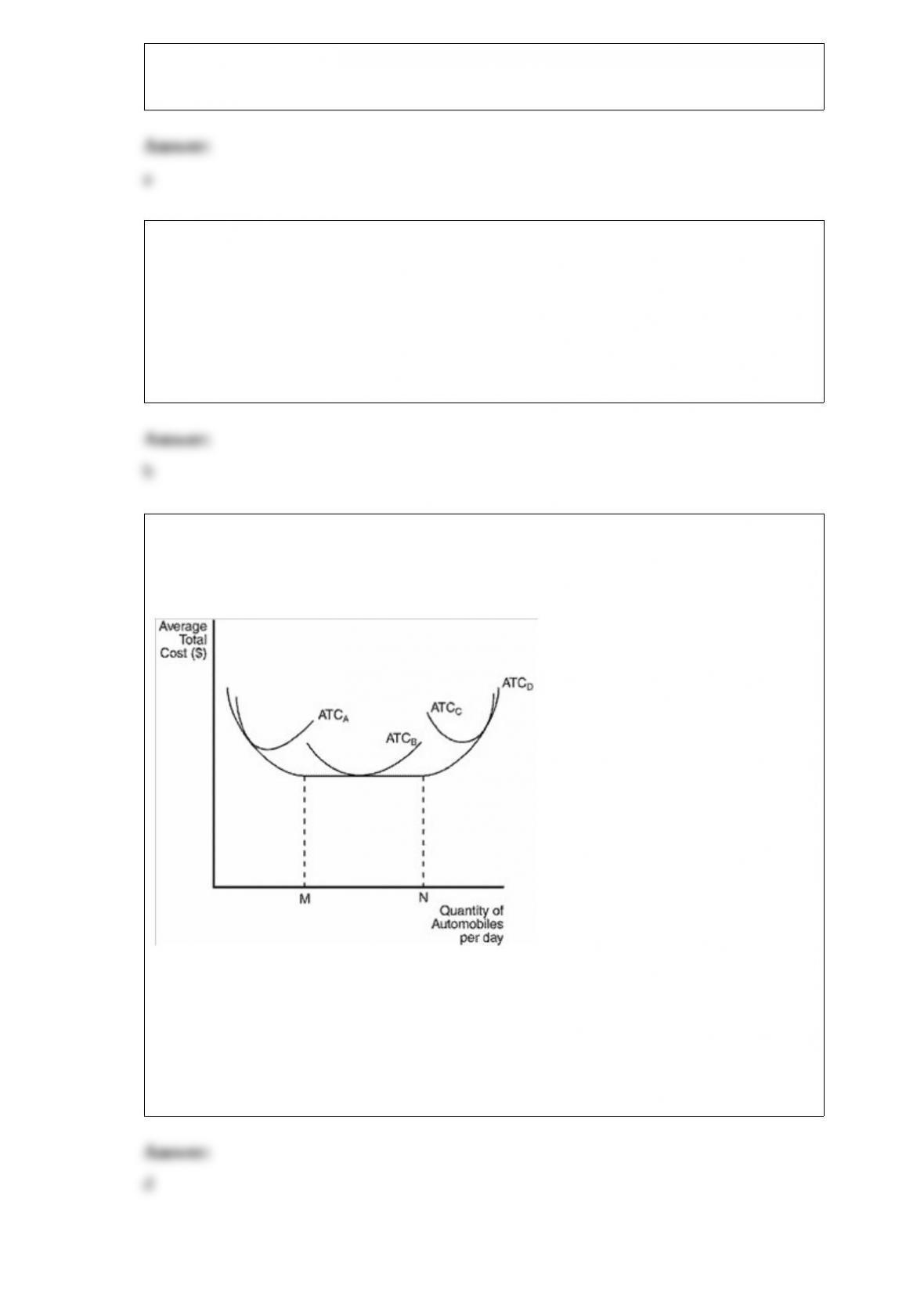
11) Figure 13-9
The figure below depicts average total cost functions for a firm that produces
automobiles.
In the long run, the firm can operate on which of the following average total cost
curves?
a.ATCA
b.ATCB
c.ATCC
d.All of the above are correct.