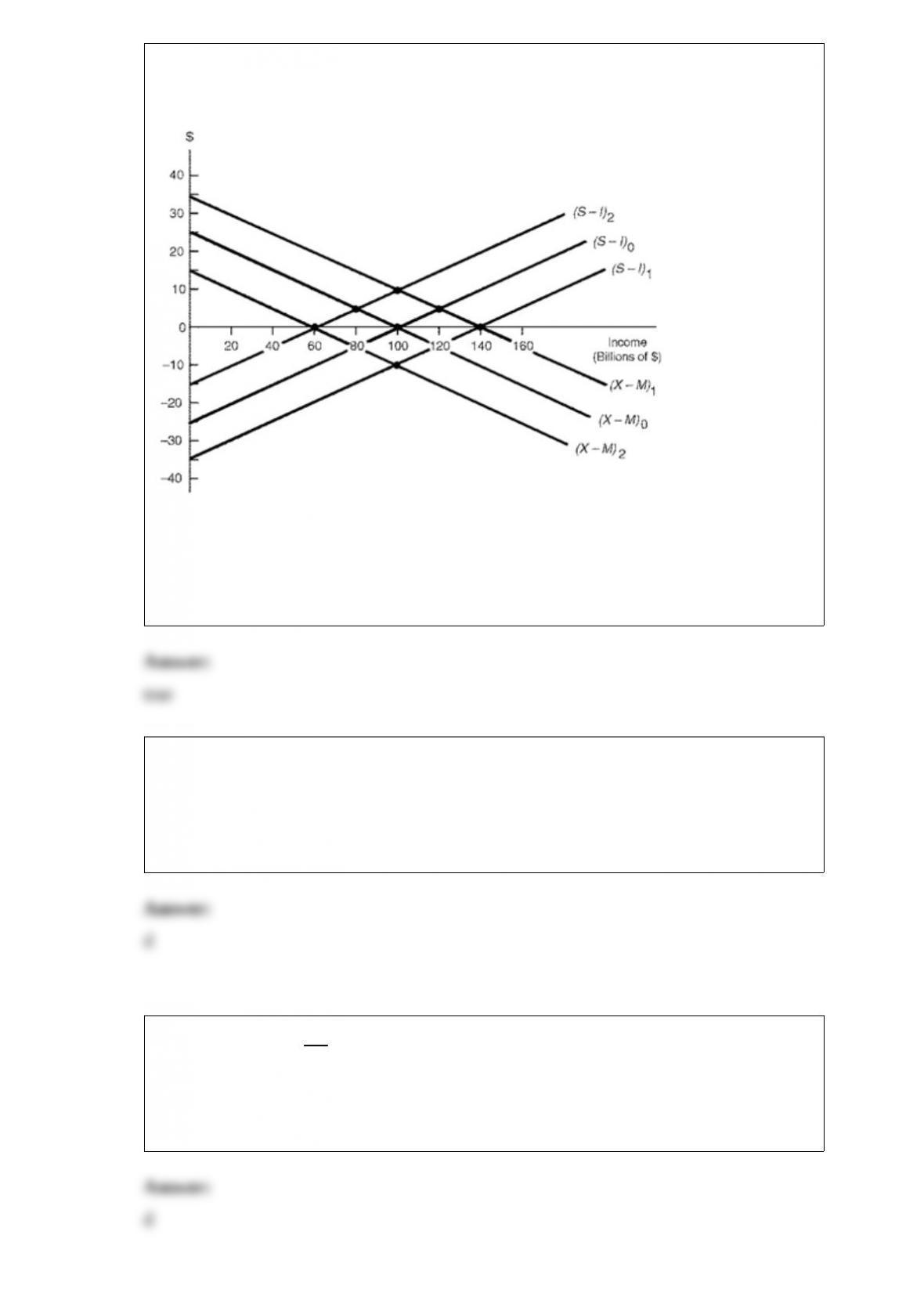
1) figure 13.4. canadian economy under a fixed exchange rate system
refer to figure 13.4. starting at equilibrium income $100 billion, where (s – i)0 intersects
(x – m)0, an autonomous decrease in canadian exports of $10 billion leads to a $20
decrease in income and a trade deficit of $5 billion.
a.true
b.false
2) the uruguay round of trade negotiations was primarily concerned with:
a.import tariffs
b.export tariffs
c.economic sanctions
d.nontariff trade barriers
3) which country is not a member of the european union?
a.spain
b.germany
c.france
d.iceland
4) if the japanese demand for computers is elastic and the canadian demand for
computers is inelastic, a profit-maximizing firm would charge a higher price to
canadian buyers than to japanese buyers.
a.true
b.false
5) throughout the post-world war ii era, the importance of tariffs as a trade barrier has:
a.increased
b.decreased
c.remained the same
d.none of the above
6) the demand for international reserves is negatively related to the level of world prices
and income.
a.true
b.false
7) tariffs and quotas on imports tend to involve larger sacrifices in national welfare than
would occur under domestic subsidies. this is because, unlike domestic subsidies,
import tariffs and quotas:
a.permit less efficient home production
b.distort choices for domestic consumers
c.result in higher tax rates for domestic residents
d.redistribute revenue from domestic producers to consumers
8) the product-life-cycle model contends that when a new product is introduced to the
home market, it generally requires low-skilled labor to produce it.
a.true
b.false
9) to maintain that south koreans are dumping their vcrs in the united states is to
maintain that:
a.koreans are selling vcrs in the united states below their production cost
b.koreans are selling vcrs in the united states above their production cost
c.the cost of manufacturing vcrs in korea is lower in korea than in the united states since
wages are lower in korea
d.the cost of manufacturing vcrs in korea is higher in korea than in the united states
since wages are higher in korea
10) when nations are of similar size, and have similar taste patterns, the gains from
trade
a.are shared equally between them
b.are impossible to determine
c.are too small, so that trading is not beneficial
d.are determined by the nation that has comparative advantage in the more essential
product
11) the purpose of a cartel is to support prices higher than would occur under more
competitive conditions, thus increasing the profits of cartel members.
a.true
b.false
12) relatively low wages in mexico make it impossible for u.s. manufacturers of
labor-intensive goods to compete against mexican manufacturers.
a.true
b.false
13) under a system of floating exchange rates, relatively high productivity and low
inflation rates in the united states result in:
a.an increase in the demand for foreign currency, a decrease in the supply of foreign
currency, and a depreciation in the dollar
b.an increase in the demand for foreign currency, an increase in the supply of foreign
currency, and an appreciation in the dollar
c.a decrease in the demand for foreign currency, a decrease in the supply of foreign
currency, and a depreciation in the dollar
d.a decrease in the demand for foreign currency, an increase in the supply of foreign
currency, and an appreciation in the dollar
14) the “goods and services” account of the balance of payments shows the monetary
value of international flows associated with transactions in goods, services, and
unilateral transfers.
a.true
b.false
15) the exchange rate is kept the same in all parts of the market by:
a.forward cover
b.hedging
c.exchange speculation
d.exchange arbitrage
16) a subsidy granted to import-competing producers results in a welfare loss to the
economy by an amount equal to the protective effect plus the consumption effect.
a.true
b.false

17) the principle of comparative advantage contends that a nation should specialize in
and export the good in which its absolute advantage is smallest or its absolute
disadvantage is greatest.
a.true
b.false