
1) the united states, japan, and the western european nations are the major international
traders in terms of overall volume.
2) if the demand for labor in a country receiving immigrants is inelastic, the
immigration will increase the total wages paid in that country.
3) It is impossible for a nation to have a comparative advantage in producing
everything.
4) if the demand for wheat is highly price inelastic, an extraordinarily large crop may
reduce farm incomes.
5) About 20 percent of the labor force is in agriculture.
6) during the past ten years the annual rate of inflation in the united states has averaged
less than 1 percent.
7) Bond prices and interest rates are directly or positively related.

8) the medicare prescription drug, improvement, and modernization act of 2003
established health savings accounts (hsas) for workers with limited or no health
insurance coverage.
9) According to the time-value of money concept, people prefer to receive a given sum
of money later rather than sooner.
10) Union workers have higher rates of job turnover than do nonunion workers.
11) Loans made to customers are a liability on a bank’s balance sheet.
12) when an economist says that the demand for a product has increased, this means
that:
a.consumers are now willing to purchase more of this product at each possible price.
b.the product has become particularly scarce for some reason.
c.product price has fallen and as a consequence consumers are buying a larger quantity
of the product.
d.the demand curve has shifted to the left.
13) if the aggregate income of households is $300 billion, consumption is $210 billion,
and personal taxes are $60 billion, then personal saving:
a.is $70 billion.
b.is $30 billion.
c.is $40 billion.
d.cannot be determined from the information given.

14) which of the following statements is true about productive and allocative
efficiency?
a.realizing allocative efficiency implies that productive efficiency has been realized.
b.productive efficiency can only occur if there is also allocative efficiency.
c.society can achieve either productive efficiency or allocative efficiency, but not both
simultaneously.
d.productive efficiency and allocative efficiency can only occur together; neither can
occur without the other.
15) Which of the following argument is not generally made to justify farm subsidies?
A.The “family farm” is an American institution that should be protected and nurtured.
B.Agribusiness firms need subsidies to achieve economies of scale.
C.Farmers sell their output in purely competitive markets, but must buy inputs from
imperfectly competitive firms.
D.Farmers cannot fully insure themselves against the risks unusual to farming, such as
floods, droughts, and pests.
16) the main purpose of hmos and ppos is to:
a.reduce health care costs for employers and their employees.
b.reduce medical malpractice suits.
c.enable groups of physicians to increase their fees.
d.direct patients to specialists rather than to more expensive primary-care physicians.
17) Suppose there is a decline in the demand for the product labor is producing.
Furthermore, the price of capital, which is complementary to labor, increases. Thus the
demand for labor:
A.will increase.
B.will decrease.
C.may either increase or decrease.
D.will not change.
18) the relationship between the marginal cost and the average total cost schedule is
such that:

a.the behavior of one schedule does not affect the other.
b.if atc exceeds mc, mc must be rising.
c.if mc is declining, atc may be either declining or rising.
d.if mc is declining, atc must also be declining.
19) an economic system:
a.requires a grouping of private markets linked to one another.
b.is a particular set of institutional arrangements and a coordinating mechanism used to
respond to the economizing problem.
c.requires some sort of centralized authority (such as government) to coordinate
economic activity.
d.is a plan or scheme that allows a firm to make money at some other firm’s expense.
20) if a corporation goes bankrupt, its stockholders will lose:
a.only the value of their stock.
b.the value of their stock plus any other business assets they may own.
c.the value of their stock plus any other personal assets they may own.
d.the value of their stock plus any other business and personal assets they may own.
21) for most nations, per capita spending on health care tends to:
a.remain constant as per capita income increases.
b.rise much faster than per capita income.
c.rise proportionately with per capita income.
d.fall as per capita income increases.
22) Which of the following are included and which are excluded in calculating this
years GDP? Explain in each instance.
(a)A monthly scholarship check received by an economics student
(b)The purchase of a new truck by a trucking company
(c)Government purchase of missiles from a private business
(d)The purchase of a used tractor by a farmer
(e)The value of the purchase of shares of Microsoft by an individual
23) the market system’s answer to the fundamental question “how will the system
promote progress?” is essentially:
a.”through government funded research programs.”
b.”through the redistribution of income to promote greater equality.”
c.”through training and retraining programs.”
d.”through the profit potential that encourages development of new technology.”
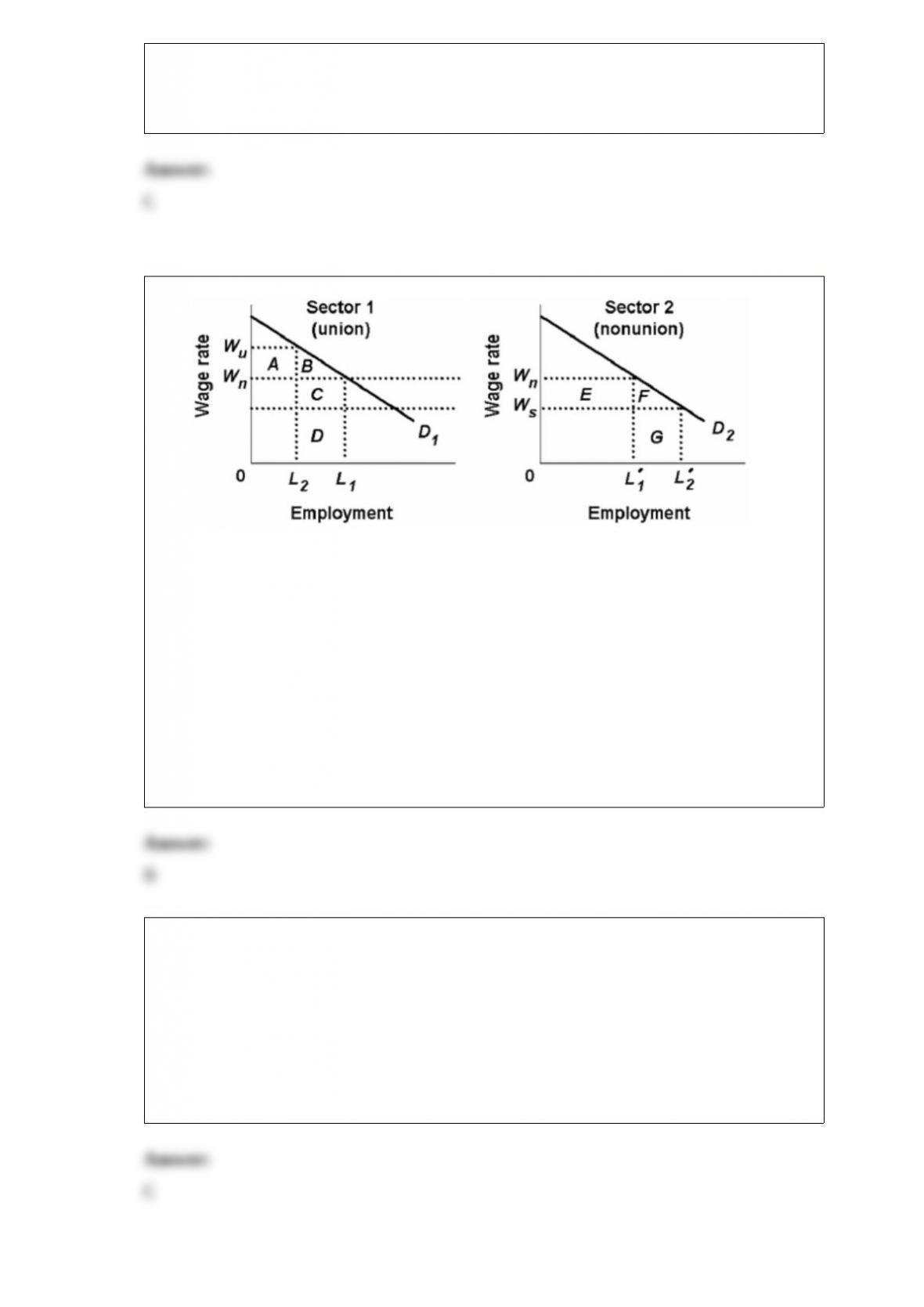
24) The following table contains hypothetical data for the 2010 U.S. balance of
payments. Answer the next question(s) on the basis of this information. All figures are
in billions of dollars.
Refer to the above data. Item (5) indicates:
A.that the United States’ current account was in surplus.
B.the size of the net inflow of foreign investment to the United States that occurred in
2010.
C.the net amount Americans received as interest and dividends on existing U.S.
investments abroad.
D.the net amount Americans paid as interest and dividends on existing foreign
investments in the United States.
25)
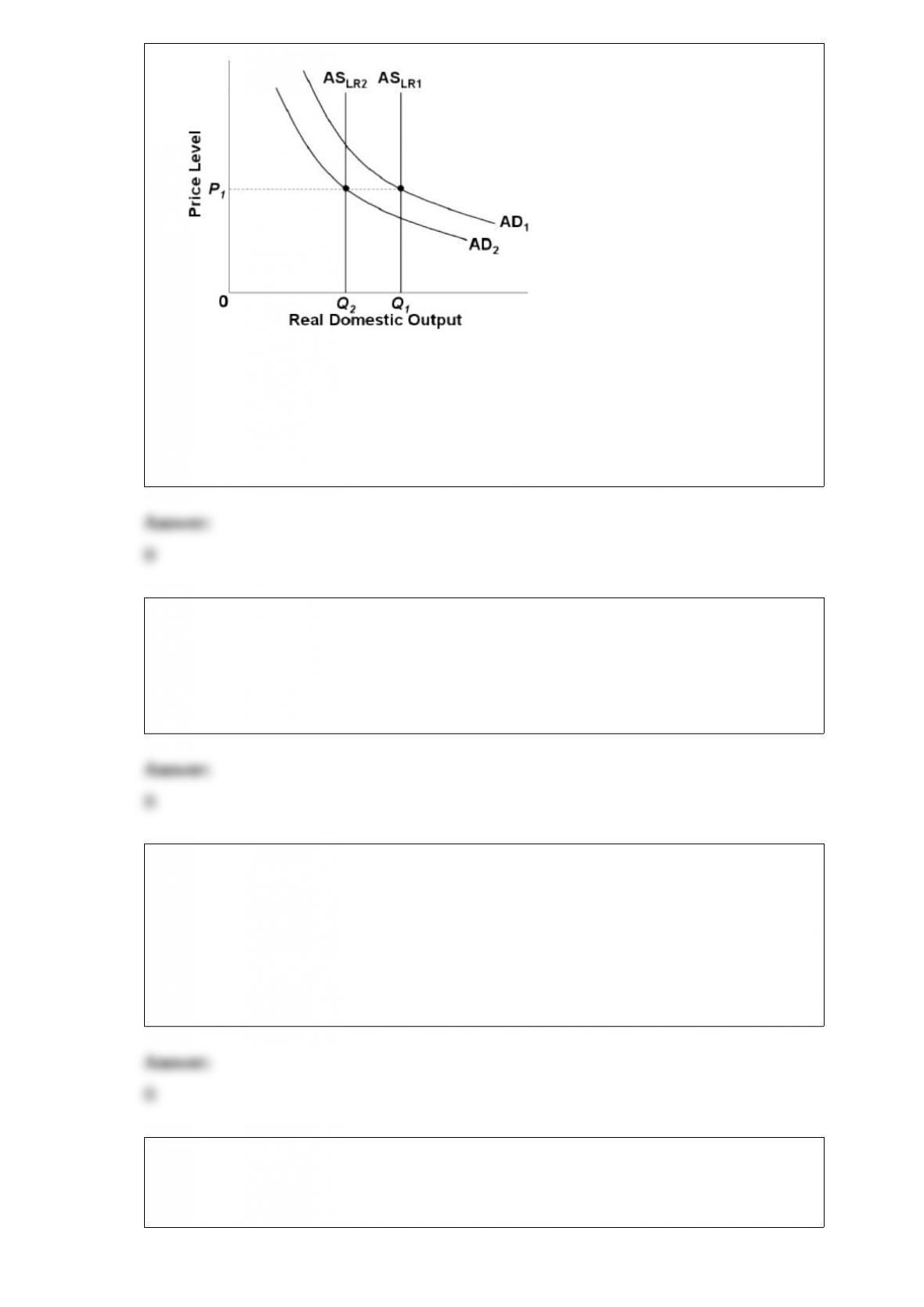
Assumptions: These two graphs show two sectors of the labor market for a particular
kind of labor. Relevant product markets are competitive. The two labor demand curves
are identical and initially the quantities of labor employed in the two sectors are L1and
L’1and the wage rate in each sector is Wn.
Refer to the above diagrams and assumptions. This analysis suggests that a union wage
advantage of Wuminus Ws causes a net efficiency:
A.loss equal to E – A.
B.loss equal to C.
C.gain equal to C.
D.gain equal to B.
26) (Last Word) According to economists Ayres and Levitt, Lojack and other car
retrieval systems that rely on hidden radio transmitters create a significant:
A.negative externality because they cause numerous false alarms.
B.negative externality in the form of radio signals that are disruptive to cell phone
communications.
C.positive externality because they help police find and break-up “chop-shops.”
D.moral hazard problem because people who own them tend to park their cars in riskier
locations than they would otherwise.
27)
Refer to the above diagram. A decline of aggregate supply from ASLR1 to ASLR2,
followed by a decline of aggregate demand from AD1 to AD2, would best describe the:
A.direct relationship between aggregate supply and aggregate demand.
B.real-business-cycle view of recession.
C.monetarist view of recession.
D.mainstream, Keynesian-based, view of recession.
28) The demand for a resource depends primarily on:
A.the supply of that resource.
B.the demand for the product or service that it helps produce.
C.the price of that input.
D.the elasticity of supply of substitute inputs.
29) Suppose a court rules that the ABC Corporation is in violation of the antitrust laws
because it produces 70 percent of the output of its industry. This decision is consistent
with the:
A.U.S. Steel case.
B.Alcoa case.
C.behavioralist approach to antitrust.
D.legal cartel theory of regulation.
30) (Advanced analysis) Answer the next question(s) on the basis of the following
information for a private closed economy.

where S is saving, Ig is gross investment, i is the real interest rate, and Y is GDP.
Refer to the above information. In equilibrium the level of saving will be:
A.$10.
B.$15.
C.$20.
D.$30.
31) Consider the following situations. Explain how each will affect the earning ability
of those discussed.
(a)Lucy has always been more goal-oriented than her brother Frank. For example,
during high school Lucy wouldnt hesitate to pull an all-nighter to make sure she was
prepared for a test, while Frank would only study until he got bored and decided to go
out with his friends.
(b)Roger works as a dentist, while his friend Hugh is a policeman.
(c)Sarah and Jackie are roommates together in college and both are hoping to get into
law school after graduation. Sarahs dad is a businessman and Jackies dad is a prominent
lawyer.
32) Why do monopolistically competitive firms spend funds for product differentiation
and advertising when this practice only adds to the firms costs?

33) What are the major components of the capital and financial account?
34) Offer a defense of economic growth.
35) What is the value added by all the firms AE from the production of a product as
described below? What did each firm add separately in value and what does it total?

36) How can the degree of income inequality be shown by a Lorenz curve?
37) How is marginal revenue product reflected in winner-take-all markets such as in the
music industry?
38) What is the difference between social insurance and public assistance in income
maintenance programs? What are examples of each type of government program?

39) Why might a government intervene in the foreign exchange markets to try to
increase or decrease the value of its currency?
40) What resource problem is created by positive externalities and what methods are
suggested for dealing with this problem?