
Which of the following is NOT an example of a way in which microeconomic analysis
can help in designing environmental policy?
A) Determining the optimal level of vehicle fuel efficiency standards
B) Designing laws to provide incentives for firms to implement clean technologies in
new vehicles
C) Lobbying consumers and firms to reduce consumption of energy
D) Examining the tradeoffs between ecological benefits of environmental legislation
and its impacts on consumers’ standard of living
The pricing technique known as tying
A) permits a firm to meter demand.
B) permits a firm to practice price discrimination.
C) enables a firm to extend its monopoly power to new markets.
D) all of the above
The demand for books is: Qd = 120 – P
The supply of books is: Qs = 5P
If P = $15, which of the following is true?
A) Quantity supplied is greater than quantity demanded.
B) Quantity supplied is less than quantity demanded.
C) Quantity supplied equals quantity demanded.
D) There is a surplus.
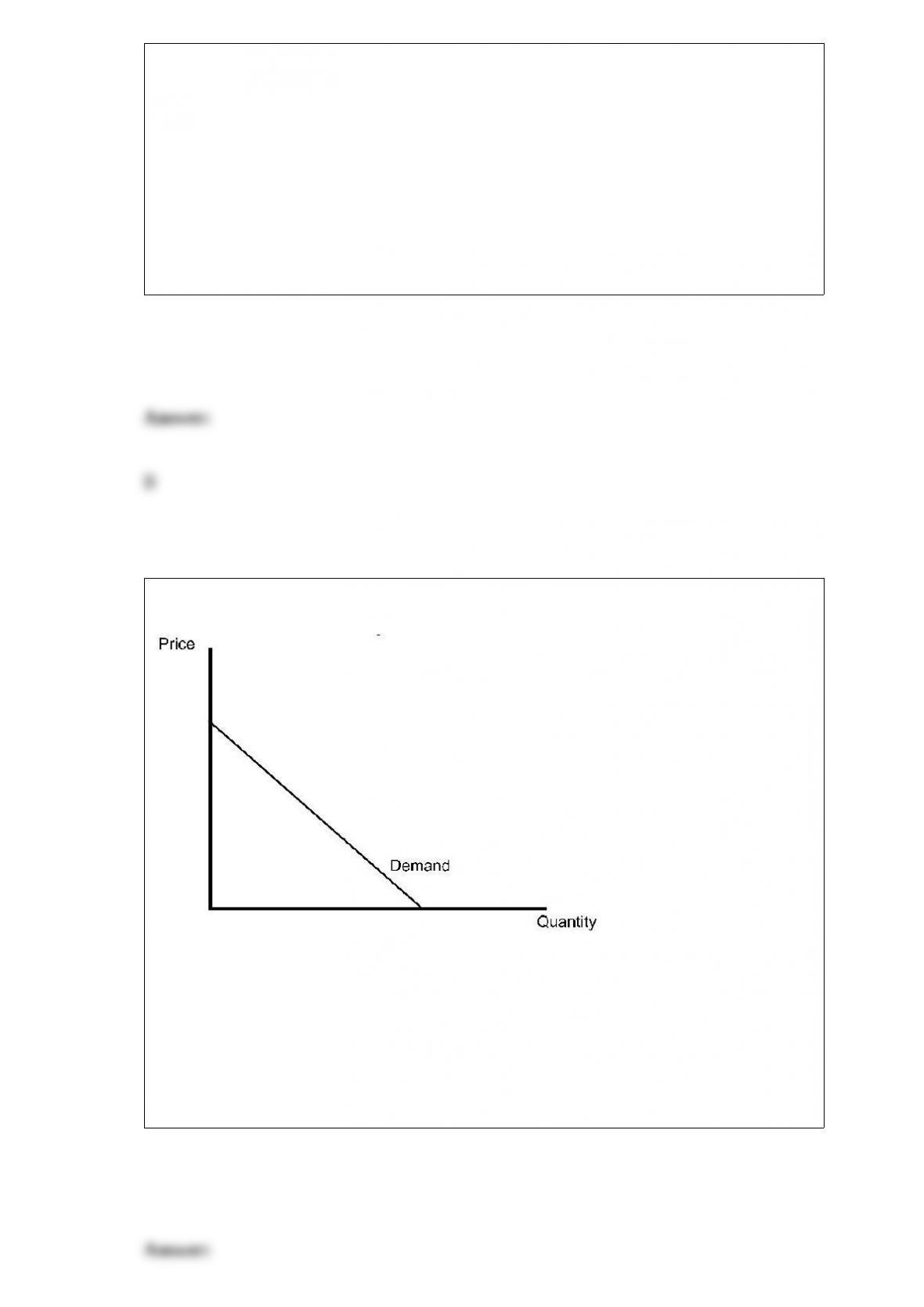
Which of the following statements about the diagram below is true?
A) Demand is infinitely elastic.
B) Demand is completely inelastic.
C) Demand becomes more inelastic as price declines.
D) Demand becomes more elastic as price declines.

In the arena of asymmetric information, standardization (for example, menus at
McDonald’s restaurants) is a substitute for
A) quality.
B) government regulation.
C) reputation of individual sellers.
D) firms’ distinguishing among buyers.
E) firms’ segregation of buyers.
You have been offered the opportunity to purchase a bond that will pay $100 in interest
at the end of each of the next three years, and a $1000 repayment of principal at the end
of the third year. The current interest rate is 12%.
a. Calculate the selling price of the bond. (You may assume that 12% accurately reflects
the risk of the bond.)
b. What would happen to the selling price of the bond if interest rates should fall?

Scenario 10.1:
Barbara is a producer in a monopoly industry. Her demand curve, total revenue curve,
marginal revenue curve and total cost curve are given as follows:
Q = 160 – 4P TR = 40Q – 0.25Q2MR = 40 – 0.5Q TC = 4Q MC = 4
Refer to Scenario 10.1. How much output will Barbara produce?
A) 0
B) 22
C) 56
D) 72
E) none of the above
If a consumer is always indifferent between an additional one grapefruit or an
additional two oranges, then when oranges are on the horizontal axis the indifference
curves:
A) will be straight lines with a slope of -1/2.
B) will be straight lines with a slope of -1.
C) will be straight lines with a slope of +1/2.

D) will be right angles whose corners occur on a ray from the origin with a slope of +2.
E) none of the above
The marginal cost of a monopolist is constant and is $10. The marginal revenue curve is
given as follows:
MR = 100 – 2Q
The profit maximizing price is
A) $70.
B) $65.
C) $60.
D) $55.
E) $50.
Suppose a competitive market is in equilibrium at price P’ and quantity Q’. If the
demand curve becomes less elastic, but the same price-quantity equilibrium is
maintained, what happens to consumer and producer surplus?
A) Both PS and CS increase

B) CS increases and PS decreases
C) CS increases and PS remains the same
D) Both CS and PS decrease
A consumer maximizes satisfaction at the point where his valuation of good X,
measured as the amount of good Y he would willingly give up to obtain an additional
unit of X, equals:
A) the magnitude of the slope of the indifference curve through that point.
B) one over the magnitude of the slope of the indifference curve through that point.
C) Px/Py
D) Py/Px
When asymmetric information problems drive high quality products from a market, we
refer to this situation as:
A) adverse selection.
B) moral hazard.
C) a lemons problem.

D) A and C are correct.
E) B and C are correct.
One way to remove the excess labor supply problem from a minimum wage policy is to
have the government hire all unemployed workers at the minimum wage. What is the
key drawback of this version of a minimum wage policy?
A) The deadweight loss may increase substantially.
B) The cost to the government may be very large.
C) Consumer surplus losses increase further.
D) A and B are correct.
E) B and C are correct..
Scenario 5.7:
As president and CEO of MegaWorld industries, Natasha must decide on some very
risky alternative investments. Consider the following:
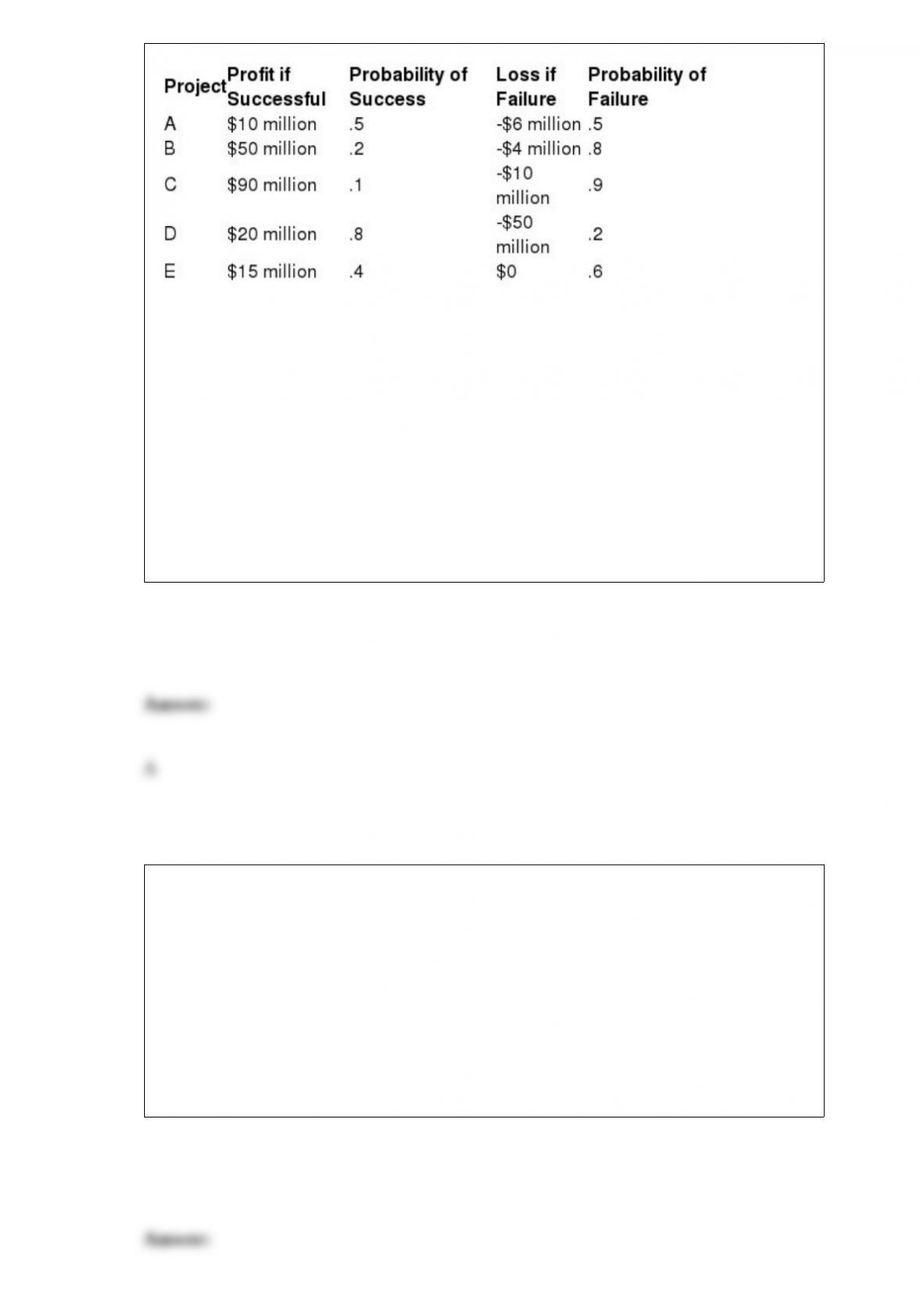
Refer to Scenario 5.7. As a risk-neutral executive, Natasha
A) is indifferent between projects D and E.
B) prefers project E to project D, but do not necessarily consider E the best.
C) prefers project E to all other projects.
D) seeks the highest “profit if successful” of all the projects.
E) seeks the project with the most even odds.
The firms in a market have decided not to compete with one another and have agreed to
limit output and raise price.
A) This practice is known as concentrating and is legal in the United States and Canada.
B) This practice is known as collusion and is illegal in the United States.
C) In this way firms take advantage of economies of scale.
D) This is an effective barrier to entry, but is illegal in the United States.

Which of the following statements is not true?
A) If tea and coffee are perfect substitutes in your consumption, then you will only
consume the good with the lowest price.
B) If tea and coffee are perfect substitutes in your consumption, then you will consume
some quantity of both goods if the prices of tea and coffee are equal.
C) You view coffee and donuts as perfect complements, and the corners of your
indifference curves follow the 45-degree line. As long as your income and the prices of
coffee and donuts are positive, you will not choose a corner solution.
D) You view coffee and donuts as perfect complements, and the corners of your
indifference curves follow the 45-degree line. You will consume coffee and donuts at
some point along the 45-degree line where your MRS equals the price ratio for the two
goods.
At the profit-maximizing level of output, what is relationship between the total revenue
(TR) and total cost (TC) curves?
A) They must intersect, with TC cutting TR from below.
B) They must intersect, with TC cutting TR from above.
C) They must be tangent to each other.
D) They cannot be tangent to each other.
E) They must have the same slope.

Because of the kind of externalities that tend to be generated from general R&D
resources bought by firms, the equilibrium price of R&D
A) is above the optimal level, and quantity is below the optimal level.
B) is below the optimal level, and quantity is above the optimal level.
C) and quantity of R&D are both above the optimal level.
D) and quantity of R&D are both below the optimal level.
E) must fall in order for the market to reach equilibrium.
When government intervenes in a competitive market by imposing an effective price
ceiling, we would expect the quantity supplied to ________ and the quantity demanded
to ________.
A) fall; rise
B) fall; fall
C) rise; rise
D) rise; fall

Because of the relationship between an asset’s real rate of return and its risk, one would
expect to find all of the following, except one. Which one?
A) Corporate stocks have higher rates of return than U.S. Treasury bonds.
B) Corporate stocks have higher rates of return than U.S. Treasury bills.
C) Corporate stocks have higher rates of return than corporate bonds.
D) Stocks of smaller companies have higher expected rates of return than stocks of
larger companies.
E) Mutual funds including stocks of companies in politically volatile developing
countries do not have as high a rate of return as mutual funds restricted to stocks of
companies in developed economies.
A perpetuity for sale at $100,000 that promises a yearly payment of $5,000 has an
effective yield of
A) 2%.
B) 5%.
C) 20%.
D) 50%.
E) 2,000%.

Which of the following is true at the output level where P=MC?
A) The monopolist is maximizing profit.
B) The monopolist is not maximizing profit and should increase output.
C) The monopolist is not maximizing profit and should decrease output.
D) The monopolist is earning a positive profit.
Consider the following information:
The probability of a fire in a factory without a fire prevention program is 0.01. The
probability of a fire in a factory with a fire protection program is 0.001. If a fire
occurred, the value of the loss would be $300,000. A fire prevention program would
cost $80 to run.
If the fire protection program were in place, the company could insure the warehouse
for a premium equal to
A) the loss from the fire, $300,000.
B) the expected loss from the fire, $300.
C) the expected loss from the fire, $3,000.
D) the cost of the fire protection program, $80.
E) $0.

You view tea and scones as perfect complements, and you prefer to consumer one cup
of tea with one scone. Also, your indifference curves are plotted with tea on the vertical
axis. If you presently have two cups of tea and one scone, what this the marginal rate of
substitution (MRS) at this point?
A) +1
B) -1
C) Zero
D) Infinity
DVDs can be produced at a constant marginal cost of $5 per disk, and Roaring Lion
Studios is releasing the DVDs for its last two major films. The DVD for Rambeau 17 is
priced at $20 per disk, and the DVD for Schreck 10 is priced at $30 per disk. What are
the price elasticities of demand for these two movies?
A) Both equal -1.2.
B) -0.75 and -5/6, respectively
C) -1.33 and -1.2, respectively
D) -1.33 and -2, respectively

Scenario 4.4:
The demand curve for the new computer game, Rock and Roll Trivia, is given as
follows:
Q = 200 – 5P – .1Pc – .5Pd + .2A – I
where P is the price of the game
Pc is the price of a computer
Pd is the price of a diskette
A is the level of advertising
Q is the level of incomeSee the information in Scenario 4.4. Suppose P = 10, Pc = 100,
Pd = 2, A = 5, and I = 50. How many games will be sold?
A) -100
B) 0
C) 50
D) 90
E) none of the above
Scenario 13.9
Consider the following game:

Two firms are situated next to a lake, and it costs each firm $1,500 per period to use
filters that avoid polluting the lake. However, each firm must use the lake’s water in
production, so it is also costly to have a polluted lake. The cost to each firm of dealing
with water from a polluted lake is $1,000 times the number of polluting firms.
Refer to Scenario 13.9. The equilibrium of this game, if played only once, is that
A) both firms pollute.
B) only Lago pollutes.
C) only Nessie pollutes.
D) neither firm pollutes.
E) the firms choose a mixed strategy.
One of the factors contributing to the fact that labor productivity is higher in the U.S.
than in the People’s Republic of China is
A) China’s larger stock of capital.
B) the higher capital/labor ratio in China.
C) the higher capital/labor ratio in the U.S.
D) China’s smaller stock of fossil fuels.
E) the fact that much labor in the U.S. is in management.

The real interest rate is
A) the nominal rate plus the rate of inflation.
B) the nominal rate minus the rate of inflation.
C) the nominal rate divided by the rate of inflation.
D) the nominal rate multiplied by the rate of inflation.
E) the nominal rate.
Jane lives in a dormitory that offers soft drinks and chips for sale in vending machines.
Her utility function is U = 3SC (where S is the number of soft drinks per week and C
the number of bags of chips per week), so her marginal utility of S is 3C and her
marginal utility of C is 3S. Soft drinks are priced at $0.50 each, chips $0.25 per bag.
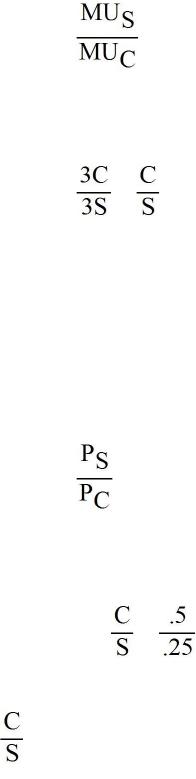
a. Write an expression for Jane’s marginal rate of substitution between soft drinks and
chips.
b. Use the expression generated in part (a) to determine Jane’s optimal mix of soft
drinks and chips.
c. If Jane has $5.00 per week to spend on chips and soft drinks, how many of each
should she purchase per week?

In which of these situations would the Coase theorem be MOST likely to work?
A) A thousand firms use a lake, there are no other users, all their costs could be reduced
somewhat by polluting, but all would have lower water intake costs if the lake were
clean.
B) A group of nine firms use a lake, there are no other users, all their costs could be
reduced somewhat by polluting, but all would have lower water intake costs if the lake
were clean.
C) Worldwide deep sea fishing rights need to be negotiated among thousands of
fishermen from different countries.
D) One hundred and fifty nations need to come to an accord about CFC generation to
combat ozone depletion.
E) A group of chemical firms high upstream on the Mississippi River have emissions
that affect not only communities downstream along the river, but around the Gulf of
Mexico as well.

When the income-consumption curve has a positive slope throughout its entire length,
we can conclude that
A) both goods are inferior.
B) both goods are normal.
C) the good on the vertical (y) axis is inferior.
D) the good on the horizontal (x) axis is inferior.