
In the real world we don’t observe countries completely specializing in the production
of goods for which they have a comparative advantage. One reasons for this is
A) comparative advantage works better in theory than in practice.
B) some countries have more resources than other countries.
C) tastes for many traded goods are similar in many countries because of globalization.
D) production of most goods involves increasing opportunity costs.
In 2013, ________ of Goodyear’s sales were outside North America.
A) only 11 percent
B) more than 60 percent
C) less than half
D) 95 percent
An external cost is created when you
A) graduate from college.
B) buy flowers for your mother on Mother’s Day.

C) litter on the side of the road.
D) buy a sandwich for lunch.
Marge buys 5 CDs and 7 DVDs. The marginal utility of the 5th CD and the marginal
utility of the 7th DVD are both equal to 30 utils. Can we say that this is the optimal
combination of CDs and DVDs for Marge?
A) No. We need to know her preferences for CDs and DVDs.
B) Yes.
C) No. We need to know the prices of the CDs and DVDs.
D) No. If this was the optimal combination, the marginal utility per dollar of the 5th CD
and the 7th DVD would be equal.
In the long run, a firm in a perfectly competitive industry will supply output only if its
total revenue covers its
A) explicit plus its implicit costs.
B) fixed costs.
C) implicit costs.
D) explicit costs.

Suppose an excise tax of $1 is imposed on every case of beer sold and sellers are
responsible for paying this tax. How would the imposition of the tax be illustrated in a
graph?
A) The supply curve for cases of beer would shift to the right by $1.
B) The supply curve for cases of beer would shift to the left by more than $1.
C) The supply curve for cases of beer would shift to the left by less than $1.
D) The supply curve for cases of beer would shift to the left by $1.
What is adverse selection?
A) It refers to the private, self-interested actions people that people pursue, which when
taken collectively leads to a loss in economic surplus.
B) It refers to the actions people take after they have entered into a transaction that
make the other party to the transaction worse off.
C) It refers to the situation in which one party to a transaction takes advantage of
knowing more than the other party to the transaction.
D) It refers to the actions people take before they enter into a transaction so as to
mislead the other party to the transaction.
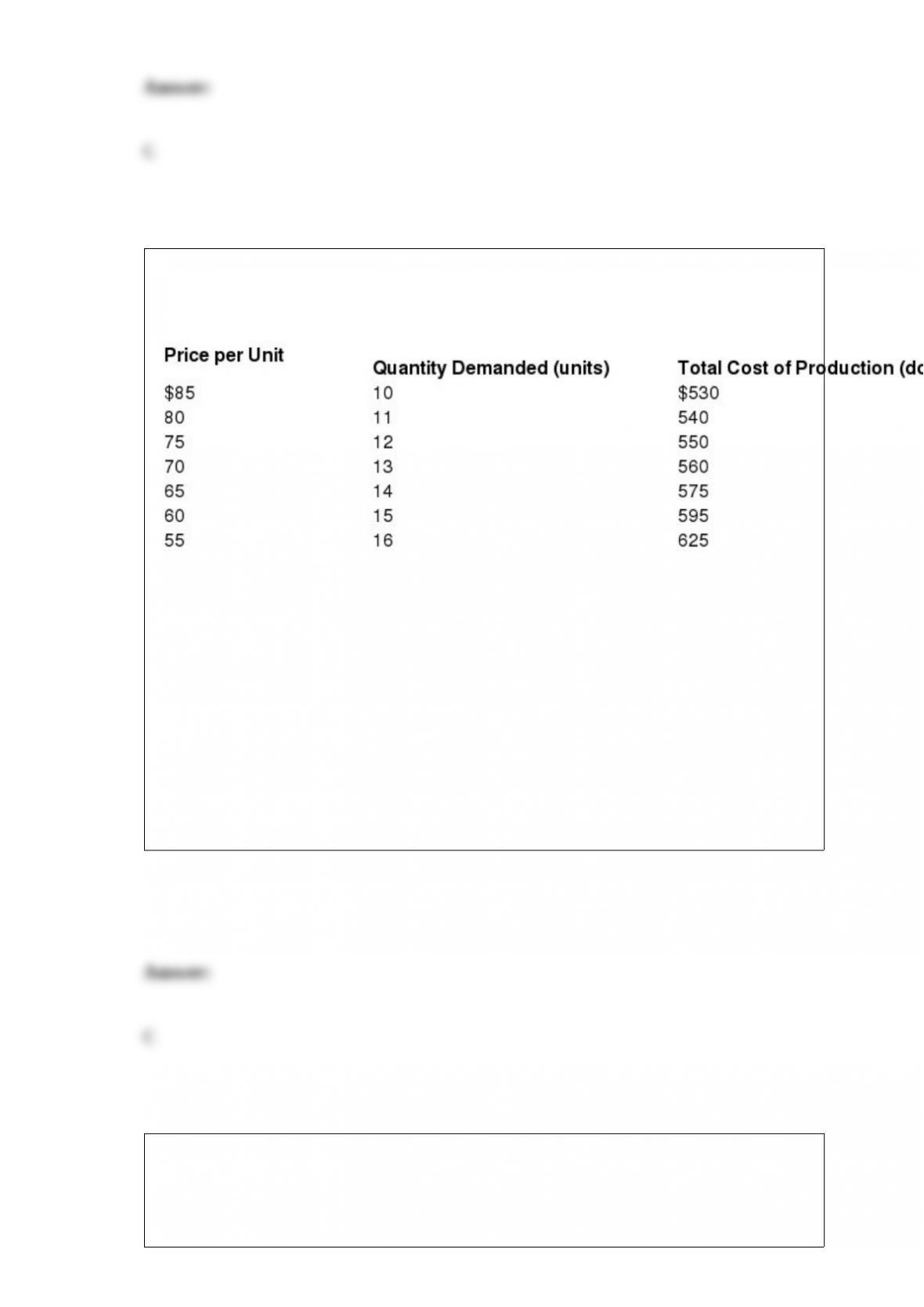
Table 15-1
A monopoly producer of foreign language translation software faces a demand and cost
structure as given in Table 15-1.
Refer to Table 15-1. What is the marginal revenue from the sale of the 12th unit?
A) $75
B) $50
C) $20
D) -$5
U.S. taxpayers spend many hours during the year maintaining records for tax purposes
and preparing their income tax returns. This administrative cost
A) is part of the deadweight loss of taxation.
B) is equal to the value of consumer surplus associated with the income tax system.
C) can be claimed as a deduction on income tax returns.
D) is larger for individuals in the lowest income quintile than for individuals in the
highest income quintile.
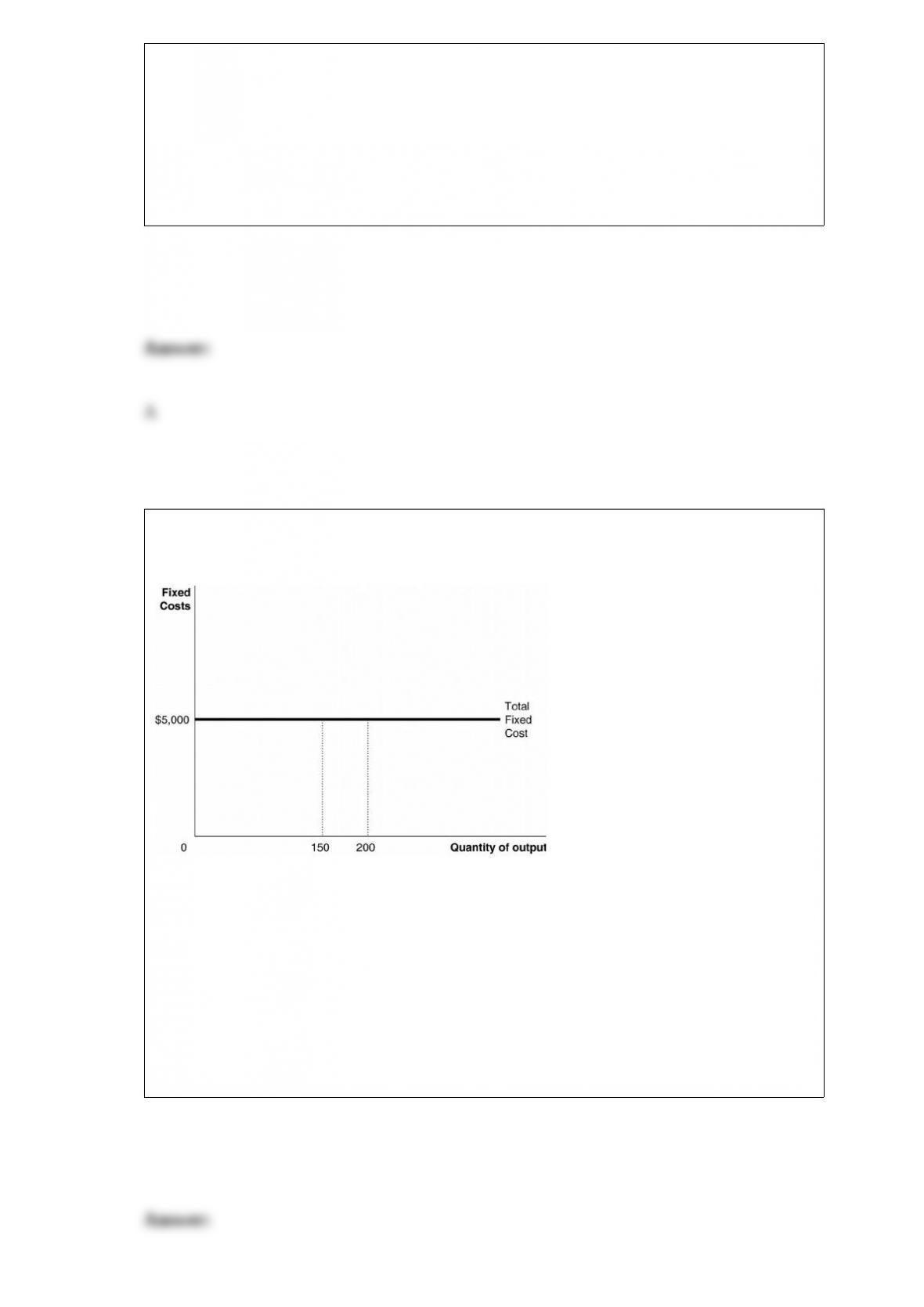
Figure 11-4
Refer to Figure 11-4. What happens to the average fixed cost of production when the
firm increases output from 150 to 200?
A) It remains constant.
B) It rises.
C) It falls.
D) It could rise or fall depending on what happens to total cost.

One reason why, in the last four decades, the number of new auto makers in the world
has been very small compared to the past is that
A) the automobile cannot be improved upon in any way by new producers.
B) new auto makers cannot obtain necessary inputs to produce new cars.
C) governments restrict who can produce automobiles.
D) new producers cannot match the economies of scale of existing auto makers.
Erin and Deidre, two residents of Ithaca, New York, are planning a trip to Boston. Erin,
the sales manager for a large retailer, has to attend a business meeting. Deidre, a college
student on vacation, is planning a leisurely trip to visit friends and relatives. Which of
the following statements is true?
A) An airline that price discriminates will charge Erin a higher price.
B) An airline that price discriminates will charge Deidre a higher price.
C) Since there is no difference in the cost of producing air travel, airlines will not
charge different prices to Erin and Deidre.
D) An airline cannot price discriminate because buyers can resell their tickets through
the Internet.

A perfectly competitive firm produces 3,000 units of a good at a total cost of $36,000.
The fixed cost of production is $20,000. The price of each good is $10. Should the firm
continue to produce in the short run?
A) No, it should shut down because it is making a loss.
B) Yes, it should continue to produce because its price exceeds its average fixed cost.
C) Yes, it should continue to produce because it is minimizing its loss.
D) There is insufficient information to answer the question.
Adverse selection occurs in the market for used cars because used car buyers
A) have more information than used car sellers.
B) have less information than used car sellers.
C) have less incentive to maintain the value of their cars than new car buyers.
D) tend to have more accidents than new car buyers.
Table 4-2
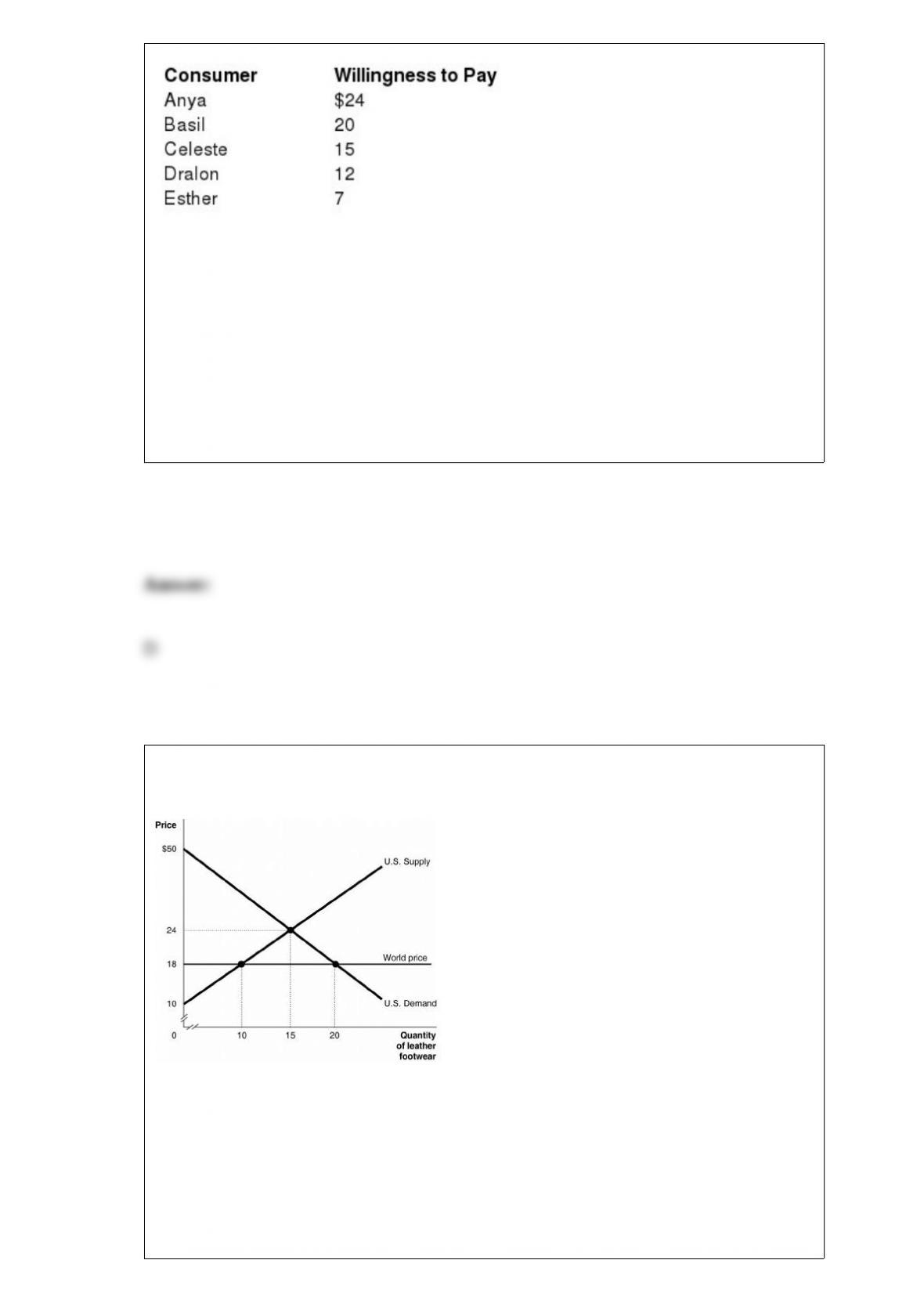
Refer to Table 4-2. The table above lists the highest prices five consumers are willing to
pay for a theater ticket. If the price of one ticket is $25
A) everyone will buy a ticket.
B) consumer surplus will be maximized.
C) Anya’s consumer surplus is $1.
D) no one will buy a ticket.
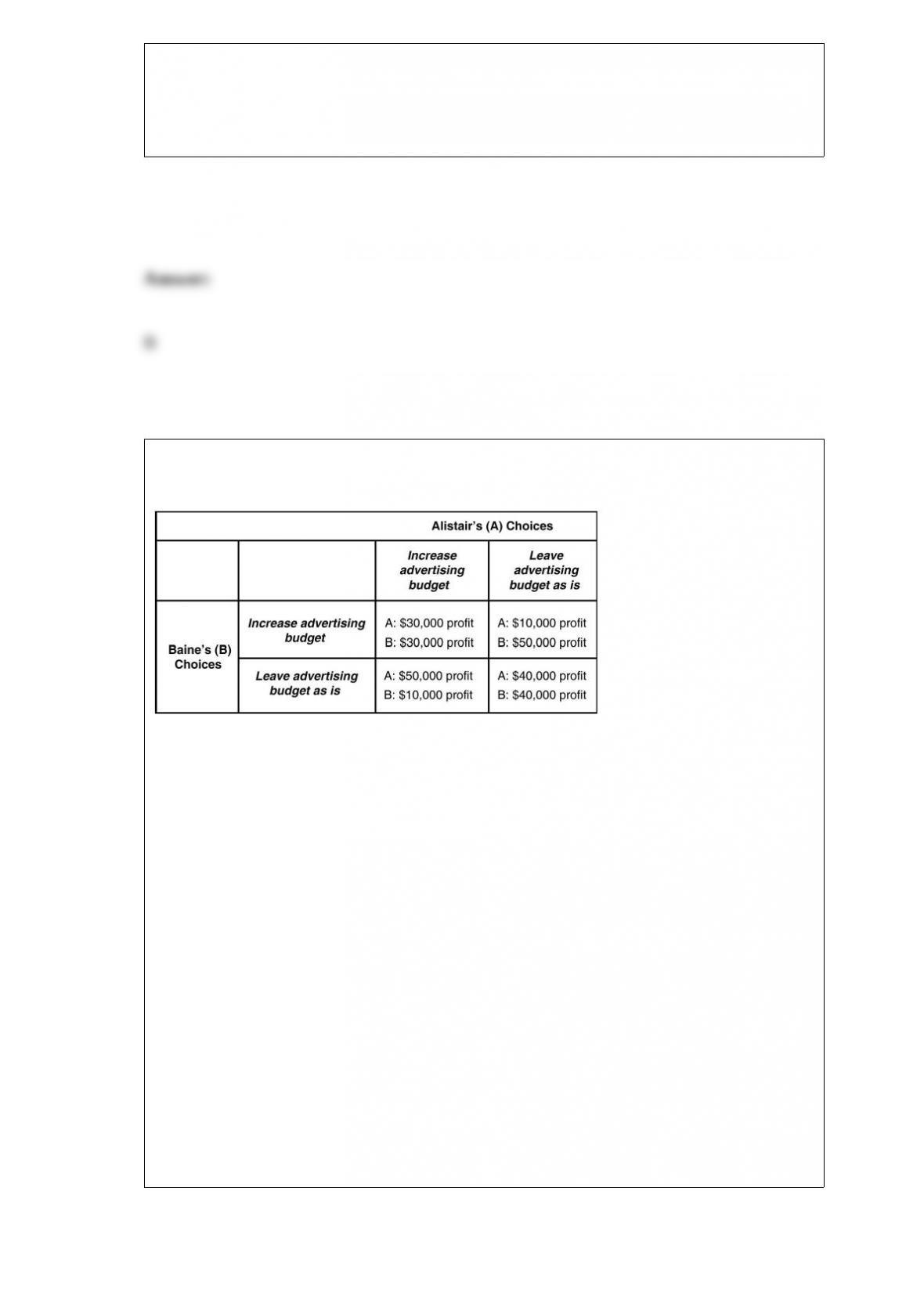
Figure 9-1
Figure 9-1 shows the U.S. demand and supply for leather footwear.
Refer to Figure 9-1. Suppose the government allows imports of leather footwear into
the United States. What will the market price be?
A) $10
B) $18
C) $24
D) >$24
Table 14-4
Alistair Luggage and Baine Baggage are the only firms selling luggage in the upscale
town of Montecito. Each firm must decide on whether to increase its advertising
spending to compete for customers. If one firm increases its advertising budget but the
other does not, then the firm with the higher advertising budget will increase its profit.
Table 14-4 shows the payoff matrix for this advertising game.
Refer to Table 14-4. How are the firms in this advertising game caught in a prisoner’s
dilemma?
A) They are not in a prisoner’s dilemma because there is one clear strategy for each.
B) They would be more profitable if they refrained from advertising but each fears that
if it does not advertise, it will lose customers.
C) Since each firm is uncertain about the other’s behavior, each will adopt a
wait-and-see attitude which results in no increase in market share and no new
customers.
D) Only the first mover is caught in a prisoner’s dilemma because the second has a
chance to observe and respond.
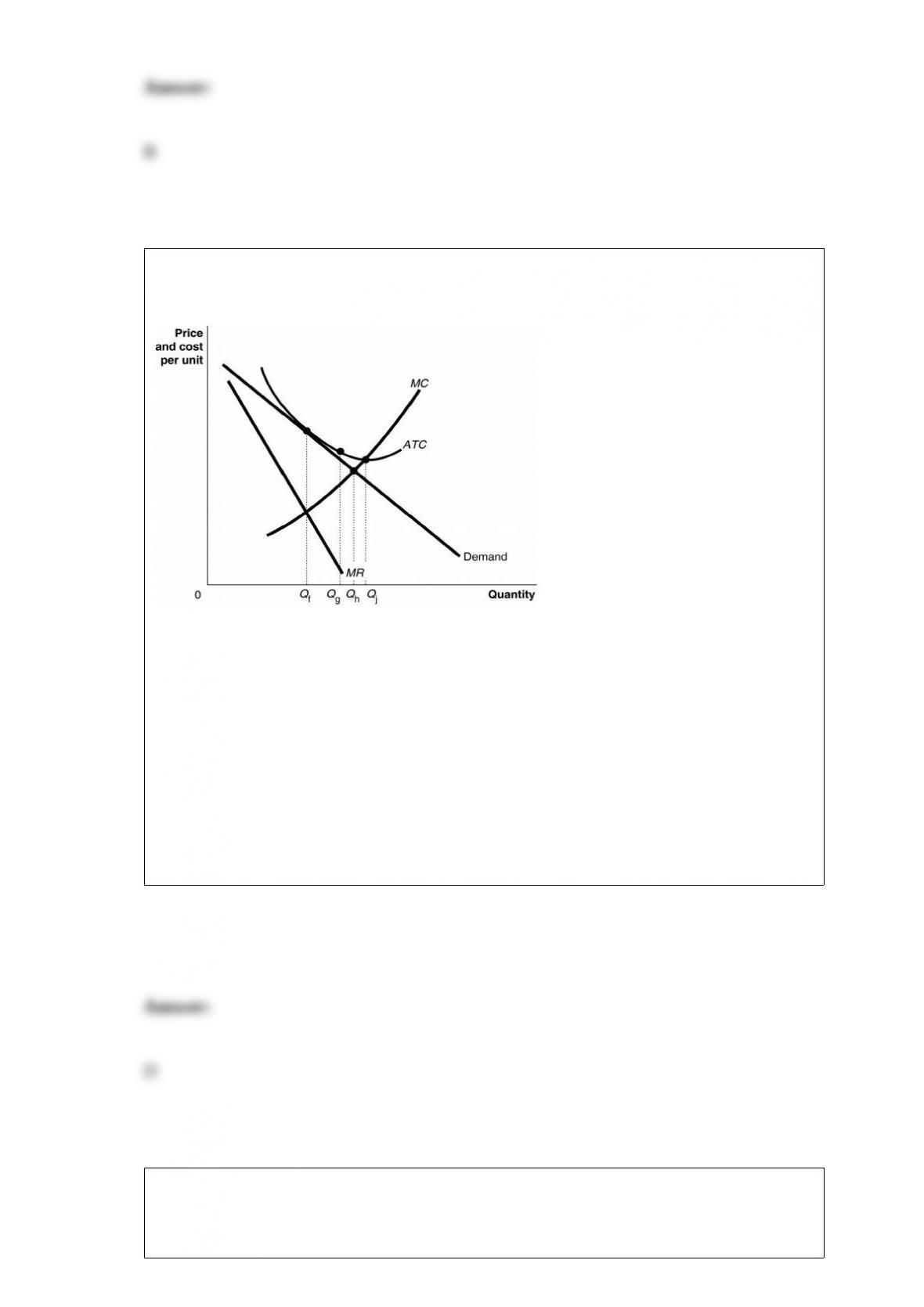
Figure 13-17
Refer to Figure 13-17. Suppose the firm is currently producing Qf units. What happens
if it increases its output to Qgunits?
A) Its average cost of production will fall and its profit will rise.
B) It will be taking advantage of economies of scale and will be able to lower the price
of its product.
C) It will move from a zero profit situation to a profit situation
D) It will move from a zero profit situation to a loss situation
When a firm faces a downward-sloping demand curve, marginal revenue
A) must exceed price because the price effect outweighs the output effect.

B) is less than price because a firm must lower its price to sell more.
C) equals price because the firm sells a standardized product.
D) must exceed price because the output effect outweighs the price effect.
Households
A) have no influence on the circular flow in a market economy.
B) purchase resources in the factor market.
C) sell goods in the product market.
D) sell resources in the factor market.
A firm that has the ability to control to some degree the price of the product it sells
A) is also able to dictate the quantity purchased.
B) faces a demand curve that is inelastic throughout the range of market demand.
C) is a price maker.
D) faces a perfectly inelastic demand curve.

Pollution is an example of a
A) public good.
B) positive externality.
C) private cost.
D) negative externality
As the value of the Gini coefficient approaches zero
A) income distribution becomes less unequal.
B) income distribution becomes more unequal.
C) the percentage of the population under the poverty line increases.
D) the percentage of the population under the poverty line decreases.
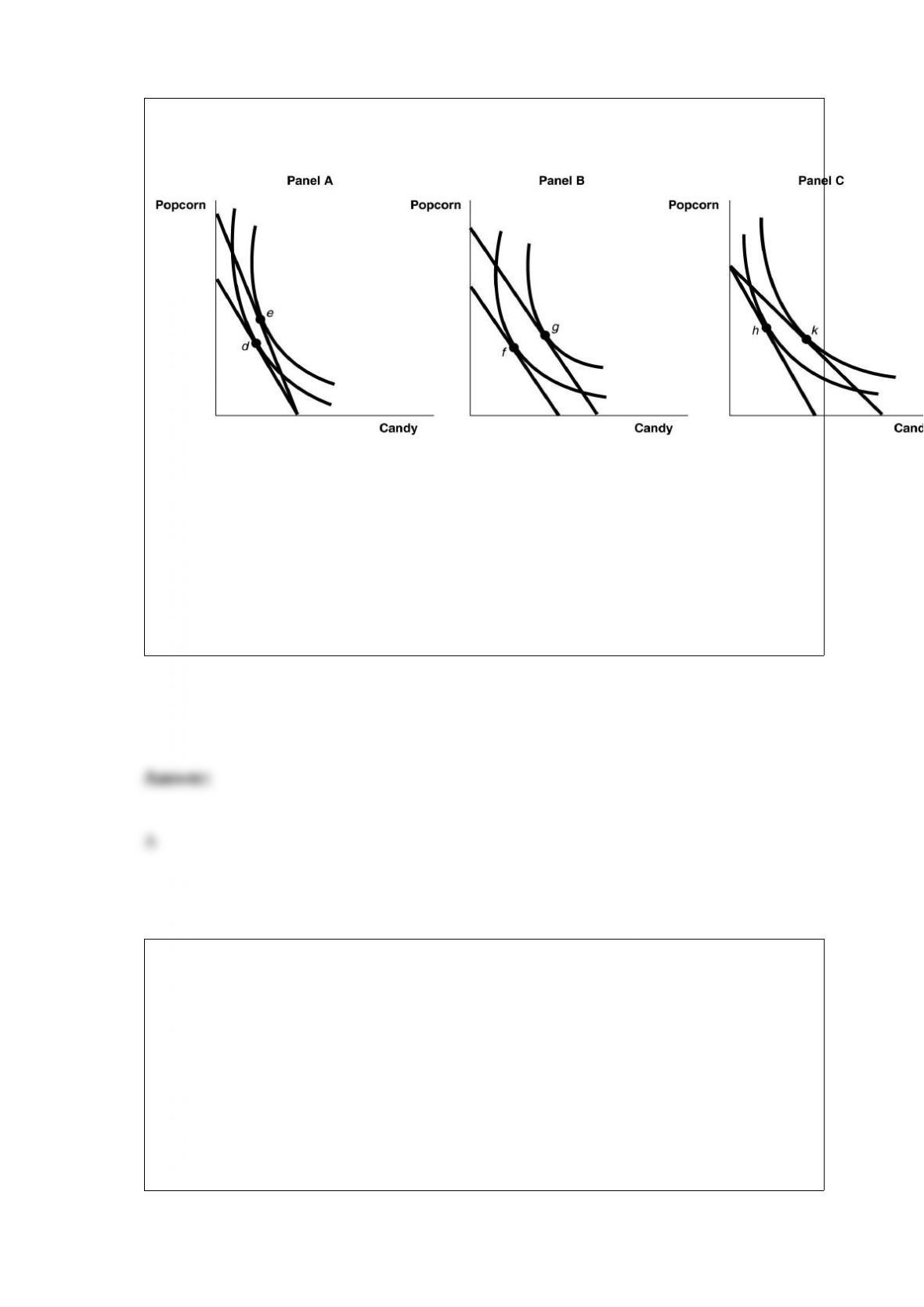
Figure 10-6
Refer to Figure 10-6. A change in the price of popcorn only is shown in
A) Panel A.
B) Panel B.
C) Panel C.
D) none of the above panels.
If the painting firms in a city sign a contract outlining a pricing plan, they are involved
in
A) price competition.
B) a legal form of business contract in the United States.
C) collusion.
D) price regulation.
Explain whether each of the following is a fixed cost or a variable cost for Damian
Dandridge’s tattoo parlor.
a. The payment he makes to buy tattoo ink.
b. The wages he pays his employees.
c. The $500-per-month payment he makes to advertise his shop on highway billboards.
d. The lease payment he makes to the landlord who owns the building where his shop is
located.
e. The payment he makes on his liability insurance policy.
Which of the following statements best describes the economic short run?
A) It is a period of one year or less.
B) It is a period during which firms are free to vary all of their inputs.
C) It is a period during which at least one of the firm’s inputs is fixed.
D) It is a period during which fixed inputs become variable inputs because of
depreciation.

To have a monopoly in an industry there must be
A) barriers to entry so high that no other firms can enter the industry.
B) a patent or copyright giving the firm exclusive rights to sell a product for 20 years.
C) an inelastic demand for the industry’s product.
D) a public franchise, making the monopoly the exclusive legal provider of a good or
service.
The population of a(n) ________ market is mostly rural and is characterized by poor
infrastructure with little credit or collateral.
A) emerging
B) traditional
C) developed
D) virtual

A study conducted by economists at the University of Chicago found that when
Southwest Airlines begins flying a new route, ticket prices on other airlines for that
route ________, indicating that airlines ________.
A) stay relatively unchanged; may begin practicing implicit price collusion when
Southwest enters a market
B) drop by an average of 29 percent; may have been practicing implicit price collusion
before Southwest’s entry into the market
C) rise by an average of 65 percent; know they can practice implicit price collusion
once Southwest announces it is entering a market.
D) first drop and then rise back to their original levels; temporarily stop practicing
implicit price collusion until Southwest becomes established, then return to their
collusive pricing strategies
The Bay Area subway system, BART, offers senior citizens discounted fares for BART
rides. This suggests that BART authorities believe that senior citizens have a ________
demand for subway rides.
A) more income elastic
B) less income elastic
C) more price elastic
D) less price elastic