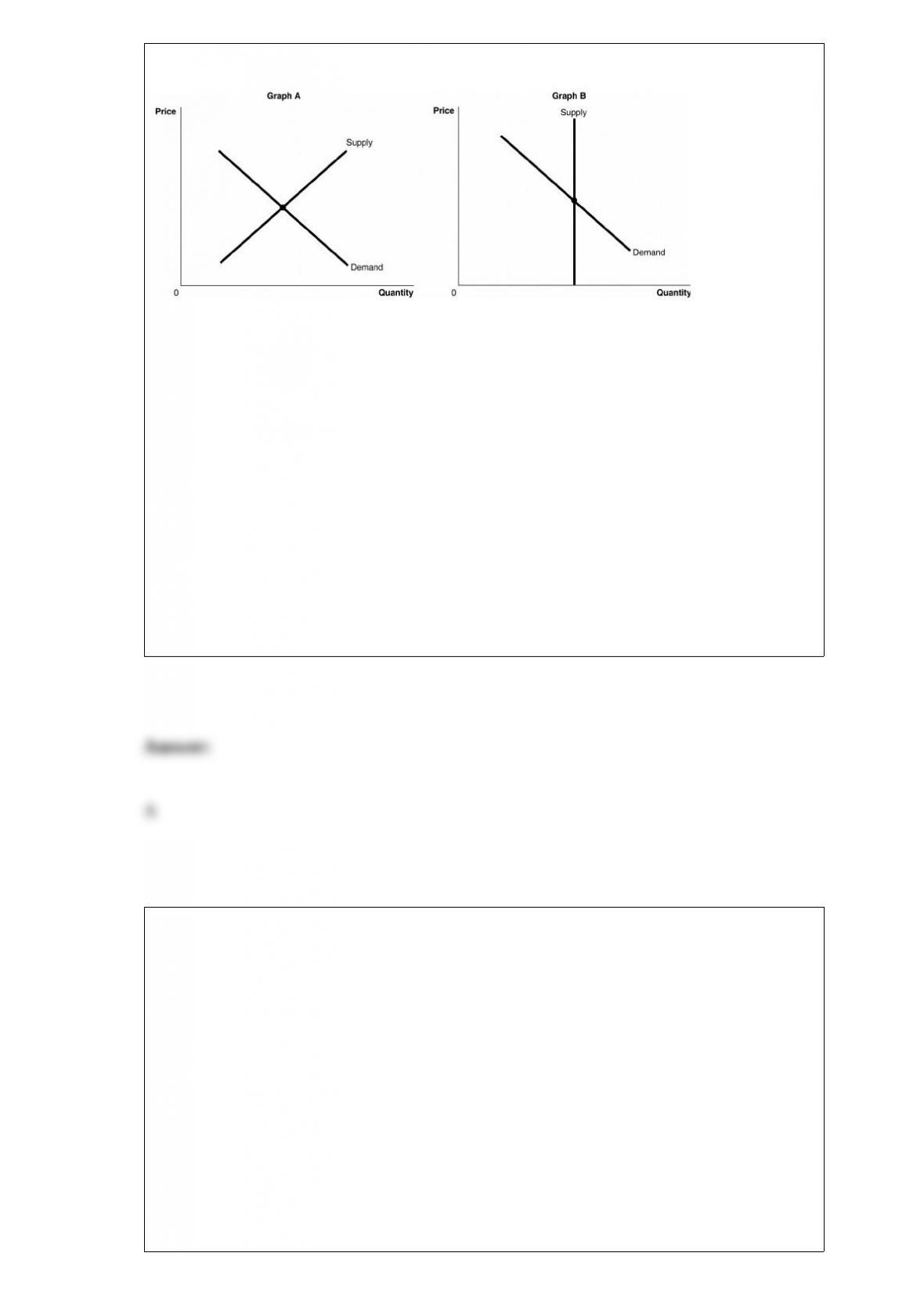
Figure 3-3
Refer to Figure 3-3. The figure above shows the supply and demand curves for two
markets: the market for original Michelangelo sculptures and the market for Ray Ban
sunglasses. Which graph most likely represents which market?
A) Graph B represents the market for original Michelangelo sculptures and Graph A
represents the market for Ray Ban sunglasses.
B) Graph A represents the market for original Michelangelo sculptures and Graph B
represents the market for Ray Ban sunglasses.
C) Graph A represents both the market for original Michelangelo sculptures and Ray
Ban sunglasses.
D) Graph B represents both the market for original Michelangelo sculptures and Ray
Ban sunglasses.
How were countries whose industries competed with Chinese industry affected by a
yuan that was pegged to the dollar?
A) Because the yuan was undervalued at the pegged exchange rate, the level of Chinese
exports remained higher than they would have been if the exchange rate was allowed to
float freely.
B) Because the yuan was overvalued at the pegged exchange rate, competing firms
from other countries feared that abandoning the peg would lead to an increase in
Chinese exports.
C) Competitors feared that the declining value of the dollar would continue to make
Chinese goods more expensive.
D) Because China’s population is so large relative to other countries, the pegged
exchange rate made the goods of foreign competing firms much less expensive than
domestic Chinese goods.
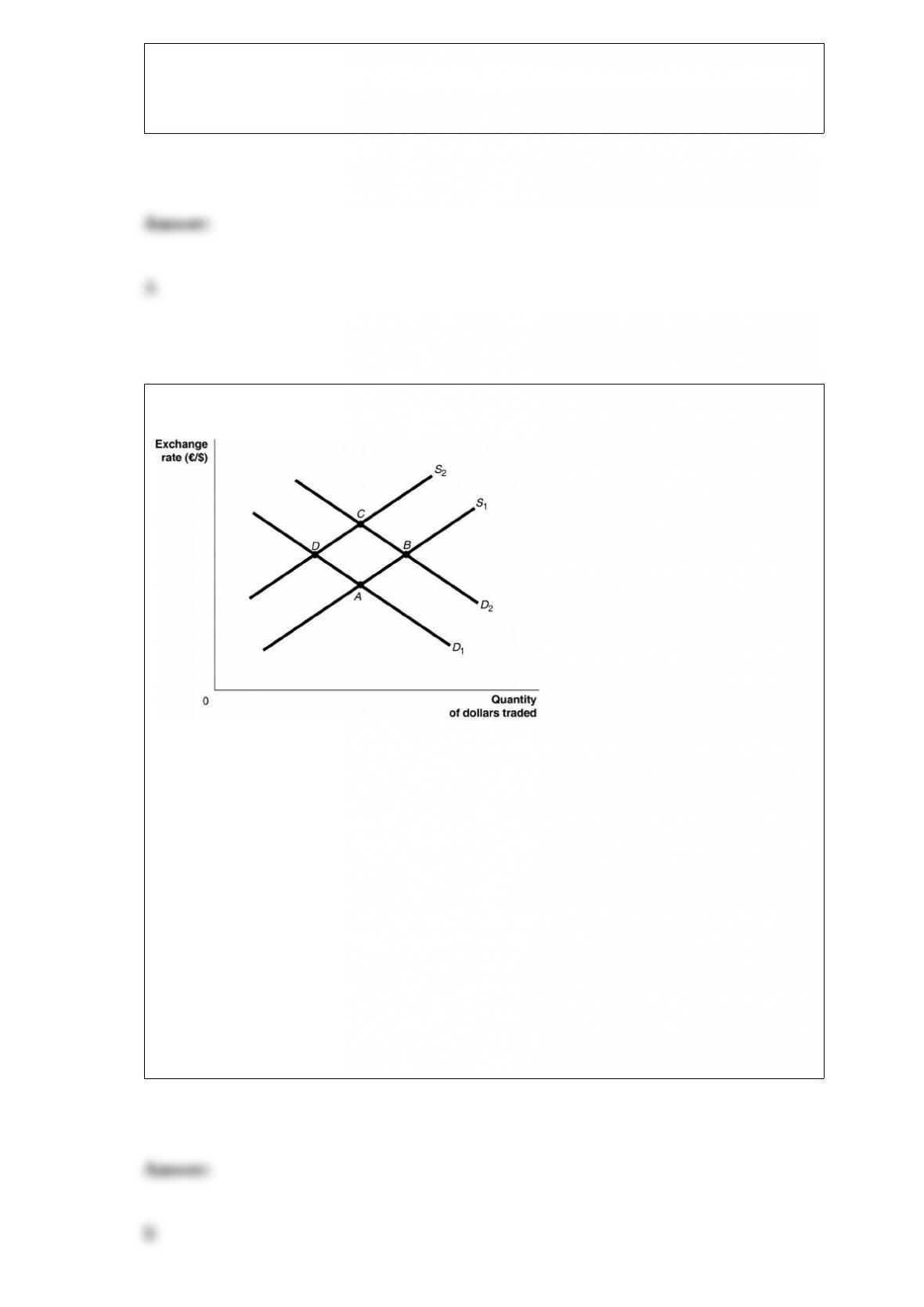
Figure 18-1
Refer to Figure 18-1. Suppose that the U.S. government deficit decreases, causing
interest rates in the United States to fall relative to those in the European Union.
Assuming all else remains constant, how would this be represented?
A) Supply would decrease, demand would decrease and the economy moves from B to
C to D.
B) Supply would increase, demand would decrease and the economy moves from C to
B to A.
C) Supply would decrease, demand would increase and the economy moves from A to
D to C.
D) Supply would increase, demand would increase and the economy moves from D to
A to B.

Suppose the Fed decreases the money supply. In response households and firms will
________ short term assets and this will drive ________ interest rates.
A) buy; up
B) buy; down
C) sell; up
D) sell; down
If the ________ cost of production for two goods is different between two countries
then mutually beneficial trade is possible.
A) marginal
B) explicit
C) opportunity
D) implicit
The ability to exercise control over one’s own resources within the confines of the law
refers to
A) the free market.

B) one’s property rights.
C) entrepreneurship.
D) having an absolute advantage.
During the German hyperinflation of the 1920s, the large increases in the money supply
were generated by the German government
A) significantly lowering the required reserve ratio to enable German businesses to
obtain loans.
B) significantly raising the required reserve ratio to reduce business loans.
C) printing large quantities of German marks.
D) selling large quantities of government bonds to the central bank, the Reichsbank.
Figure 2-7
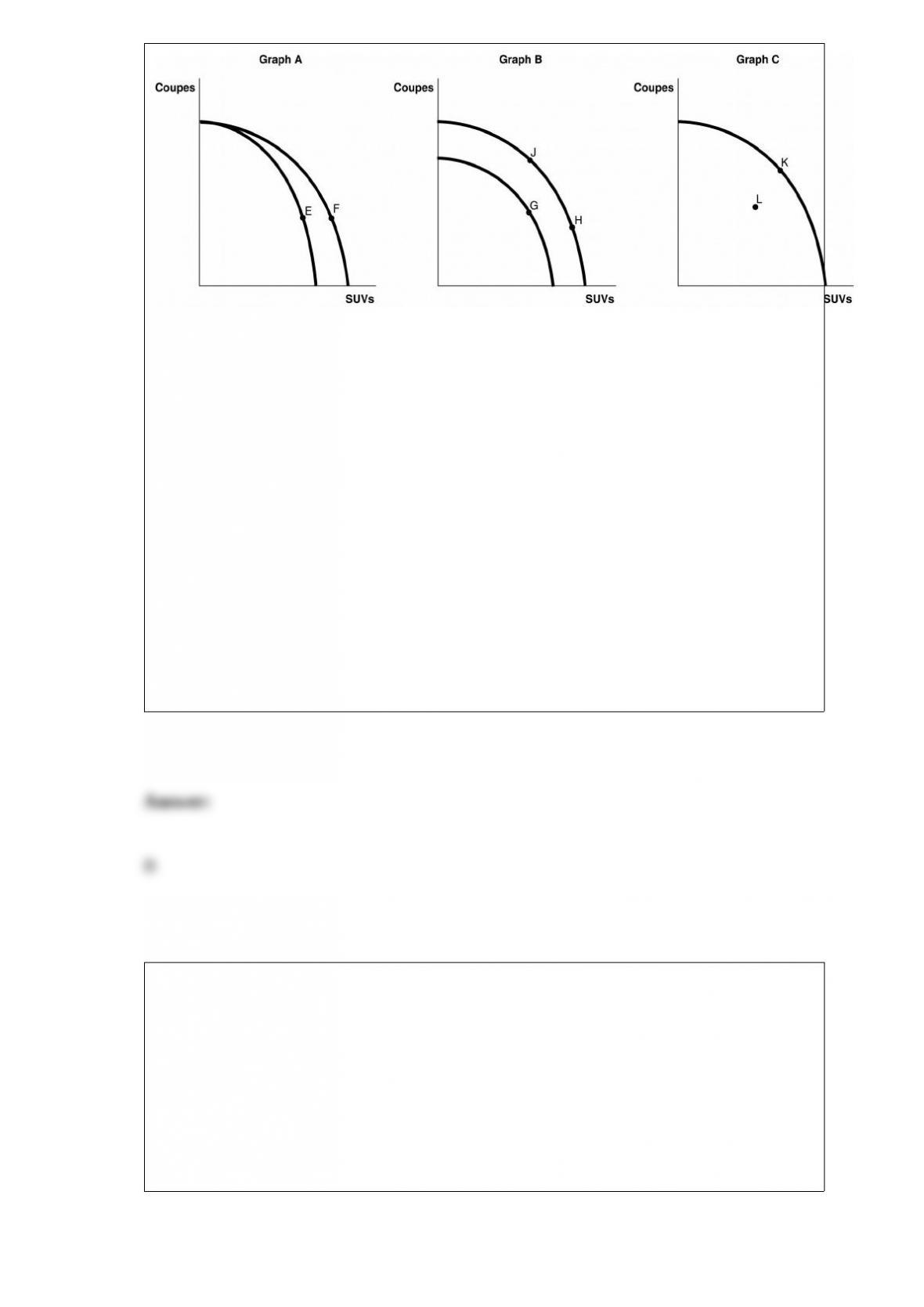
Mercedes Benz produces a full line of luxury automobiles, including coupes, sedans,
and SUVs, at a variety of manufacturing plants across the globe. Assume Mercedes
Benz produces both coupes and SUVs at its Tuscaloosa, Alabama factory. Figure 2-7
shows changes to its production possibilities frontier in response to new developments
and different strategic production decisions at this factory.
Refer to Figure 2-7. Suppose worker productivity increases so that the total number of
vehicles produced increases as the company adds more machinery, workers and changes
the layout of the factory. This is best represented by the
A) movement from E to F in Graph A.
B) movement from G to H in Graph B.
C) movement from K to L in Graph C.
D) movement from J to H in Graph B.
The stated interest rate on a loan is the
A) real interest rate.
B) nominal interest rate.
C) actual inflation rate.
D) expected inflation rate.

Firms free ride on the research and development of other firms when they
A) buy a firm’s newly developed product, and then give it away to consumers.
B) use knowledge other firms have developed without paying for that knowledge.
C) license a new technology from a firm that developed the new technology.
D) choose a level of research and development that is inefficiently high.
Caroline is an artist. She purchases canvas, paints, brushes, and accessories for $75. She
sells one of her original paintings to an art gallery for $1,500, even though an art lover
would pay $4,500 for that painting. How much value does Caroline add?
A) $75
B) $1,425
C) $1,500
D) $4,425
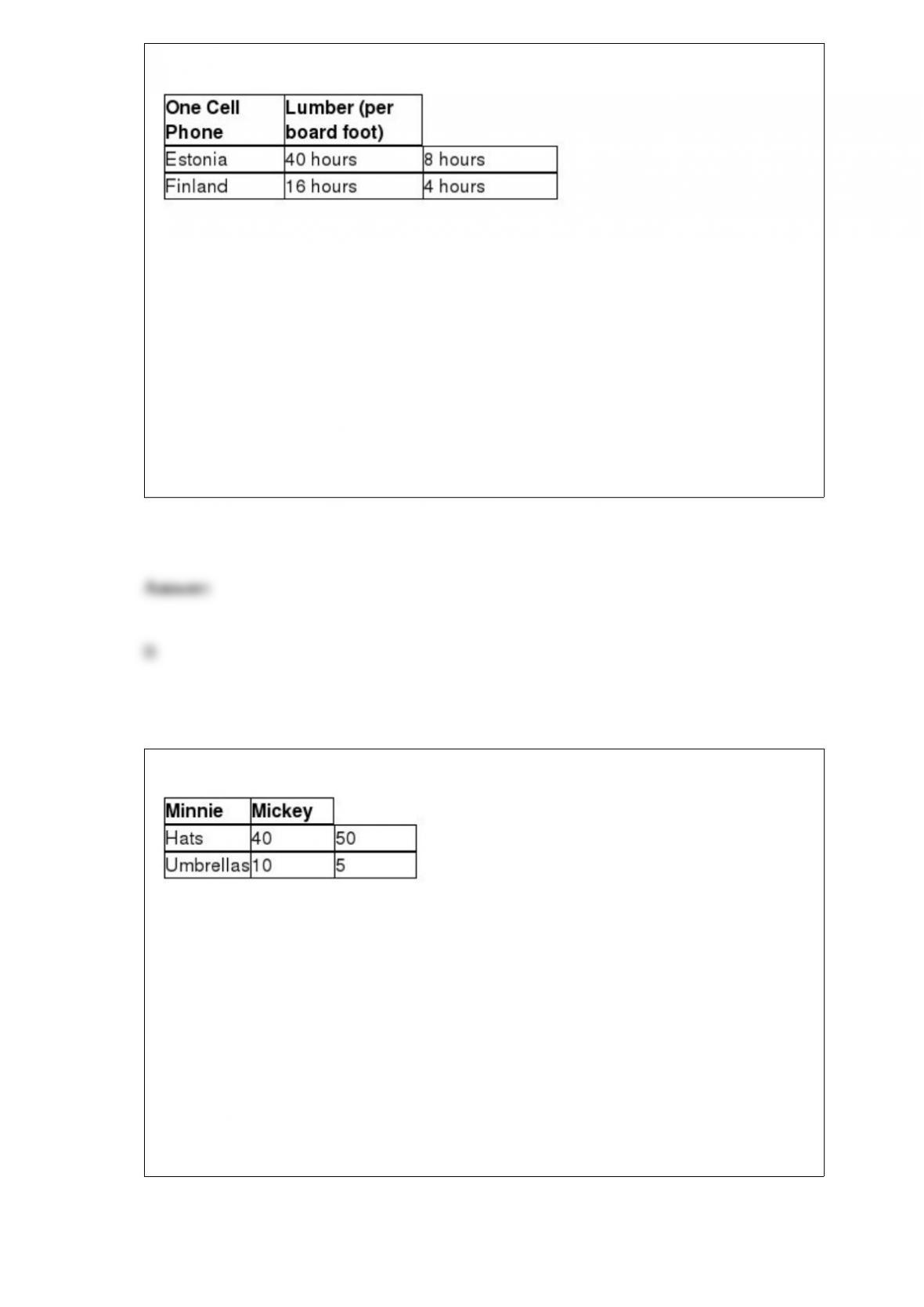
Table 2-5
Table 2-5 shows the number of labor hours required to produce a cell phone and a board
foot of lumber in Estonia and Finland.
Refer to Table 2-5. Estonia has a comparative advantage in the production of
A) both products.
B) lumber.
C) cell phones.
D) neither product.
Table 2-7
Table 2-7 shows the output per week of two people, Minnie and Mickey. They can
either devote their time to making hats or making umbrellas.
Refer to Table 2-7. What is Minnie’s opportunity cost of making an umbrella?
A) 1/10 of a hat
B) 1/4 of a hat
C) 4 hats
D) 40 hats
An expansionary monetary policy in the United States should
A) decrease the foreign currency price of U.S. exports.
B) cause the dollar to appreciate.
C) decrease the dollar price of imports.
D) decrease net exports.
Table 4-5
Table 4-5 above contains information about the wheat market. Answer the following
questions based on this table.
Refer to Table 4-5. An agricultural price floor is a price that the government guarantees
farmers will receive for a particular crop. Suppose the federal government sets a price
floor for wheat at $21 per bushel.
a. What is the amount of shortage or surplus in the wheat market as result of the price
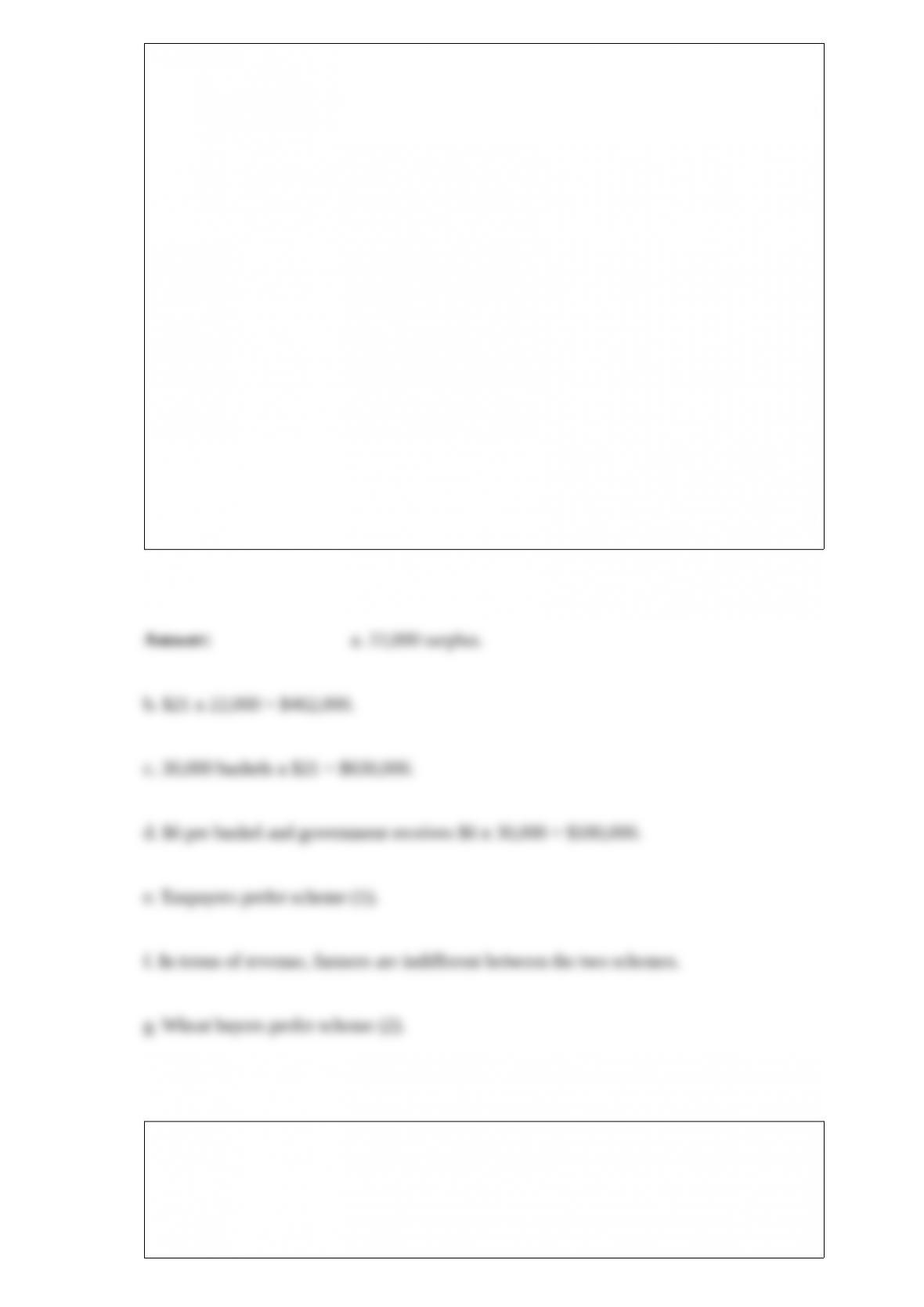
floor?
b. If the government agrees to purchase any surplus output at $21, how much will it
cost the government?
c. If the government buys all of the farmers’ output at the floor price, how many bushels
of wheat will it have to purchase and how much will it cost the government?
d. Suppose the government buys up all of the farmers’ output at the floor price and then
sells the output to consumers at whatever price it can get. Under this scheme, what is
the price at which the government will be able to sell off all of the output it had
purchased from farmers? What is the revenue received from the government’s sale?
e. In this problem we have considered two government schemes: (1) a price floor is
established and the government purchases any excess output and (2) the government
buys all the farmers’ output at the floor price and resells at whatever price it can get.
Which scheme will taxpayers prefer?
f. Consider again the two schemes. Which scheme will the farmers prefer?
g. Consider again the two schemes. Which scheme will wheat buyers prefer?
Hovnanain Enterprises, a residential home builder based in New Jersey, did well during
the mid-2000s but did not do so well in during and immediately after the recession of
2007-2009. The reason for this is
A) the Fed kept low interest rates in the mid-2000s but raised interest rates in 2007 to
help fight inflation.
B) the Fed kept low interest rates in the mid-2000s but by 2007 the housing bubble had
burst.
C) the Fed raised interest rates in the mid-2000s but lowered interest rates in 2007 to
revive the housing market.
D) the Fed raised interest rates in the mid-2000s and raised interest rates in 2007 to help
fight inflation.
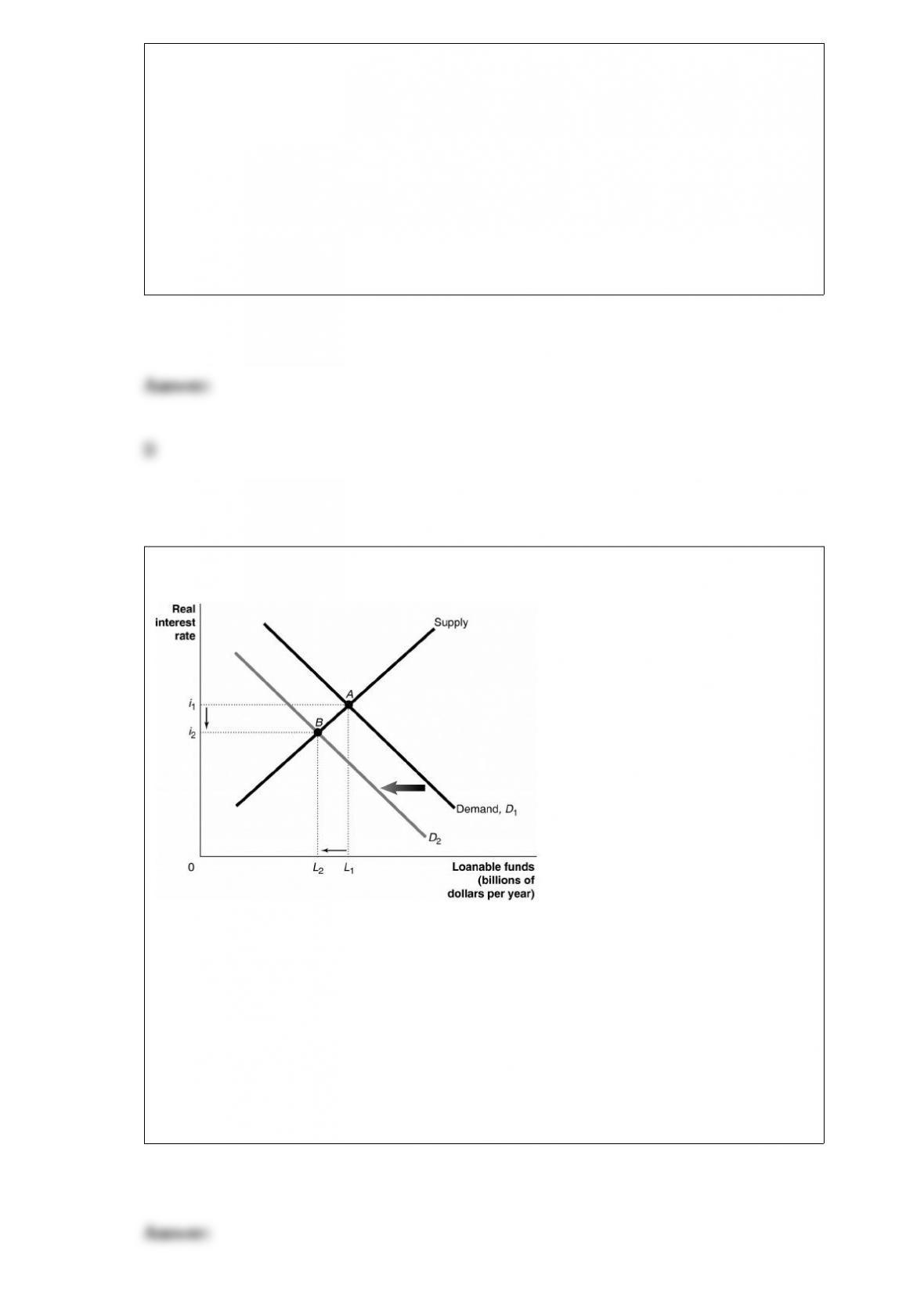
Figure 10-2
Refer to Figure 10-2. Which of the following is consistent with the graph depicted
above?
A) An expected expansion increases the profitability of new investment.
B) The government runs a budget surplus.
C) There is a shift from an income tax to a consumption tax.
D) New government regulations decrease the profitability of new investment.

Typically, a bank’s largest asset is its
A) reserves.
B) holdings of securities.
C) deposits of its customers.
D) loans.
It is necessary for all economic systems to provide people with goods and services and
also restrict them from getting as much of these goods and services as they wish,
because failure to do this could ________ the efficiency of the system by producing
some goods and services that are ________.
A) reduce; not as highly valued as others
B) increase; not as highly valued as others
C) reduce; valued more than others
D) increase; valued more than others
Depreciation is
A) the value of worn-out equipment, machinery, and buildings.
B) the value of the decrease in business inventory stocks.
C) the value of the addition to the capital stock.
D) the decline in the value of the stock market, net of dividends.