
The Difference between the ________ and the ________ from the sale of a product is
called producer surplus.
A) lowest price a firm would have been willing to accept; price it actually receives
B) highest price a firm would have been willing to accept; lowest price it was willing to
accept
C) cost to produce a product; price a firm actually receives
D) cost to produce a product; profit received
Sequential games are often used to analyze which two types of business strategies?
A) whether to invest in research and development and whether to offer employees an
early retirement package
B) deciding to merge with another firm and deciding how much to spend on an
advertising campaign
C) deciding to end production of an unprofitable product and deciding to shut down
temporarily
D) deterring entry by another firm and bargaining between firms
Your grandfather tells you that he earned $7,000/year in his first job in 1961. You earn
$35,000/year in your first job in 2013. You know that average prices have risen steadily
since 1961. You earn
A) 5 times as much as your grandfather in terms of real income.
B) more than 5 times as much as your grandfather in terms of real income.
C) less than 5 times as much as your grandfather in terms of real income.
D) less than 5 times as much as your grandfather in terms of nominal income.
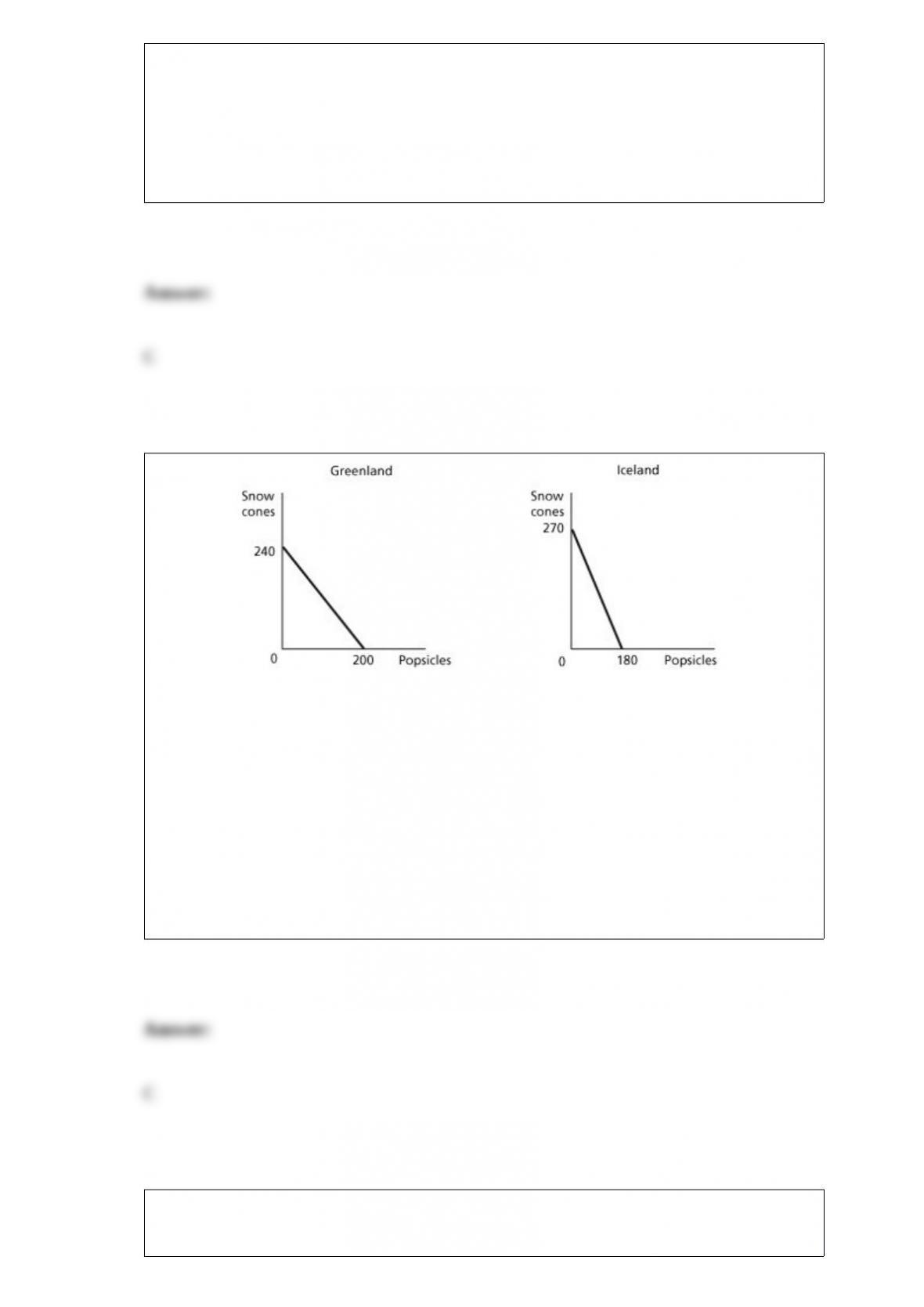
Figure 2-9 Figure 2-9
shows the production possibilities frontiers for Greenland and Iceland. Each country
produces two goods, snow cones and popsicles. What is the opportunity cost of
producing 1 popsicle in Greenland?
A) 2/3 of a snow cone
B) 5/6 of a snow cone
C) 1 1/5 snow cones
D) 240 snow cones
Price discrimination is possible in which of the following market structures?

a. perfect competition
b. monopoly
c. oligopoly
d. monopolistic competition
A) a, b, c, and d
B) c and d only
C) b and c only
D) b, c, and d only
During which of the following periods was growth in GDP per capita the strongest?
A) prior to 500 A.D.
B) 500 A.D. to 1800 A.D.
C) 1800-1900 A.D.
D) 1900-2000 A.D.
Which of the following is not an explanation for the revival in the growth of
productivity starting in the mid-1990s?
A) Information and communication innovations are increasingly geared toward
improving business processes and not consumer products.
B) Faster computers have sped up data processing.
C) Internet use has increased the efficiency of how firms buy and sell to each other and
to consumers.
D) Cell phones and wireless Internet access have increased worker flexibility.
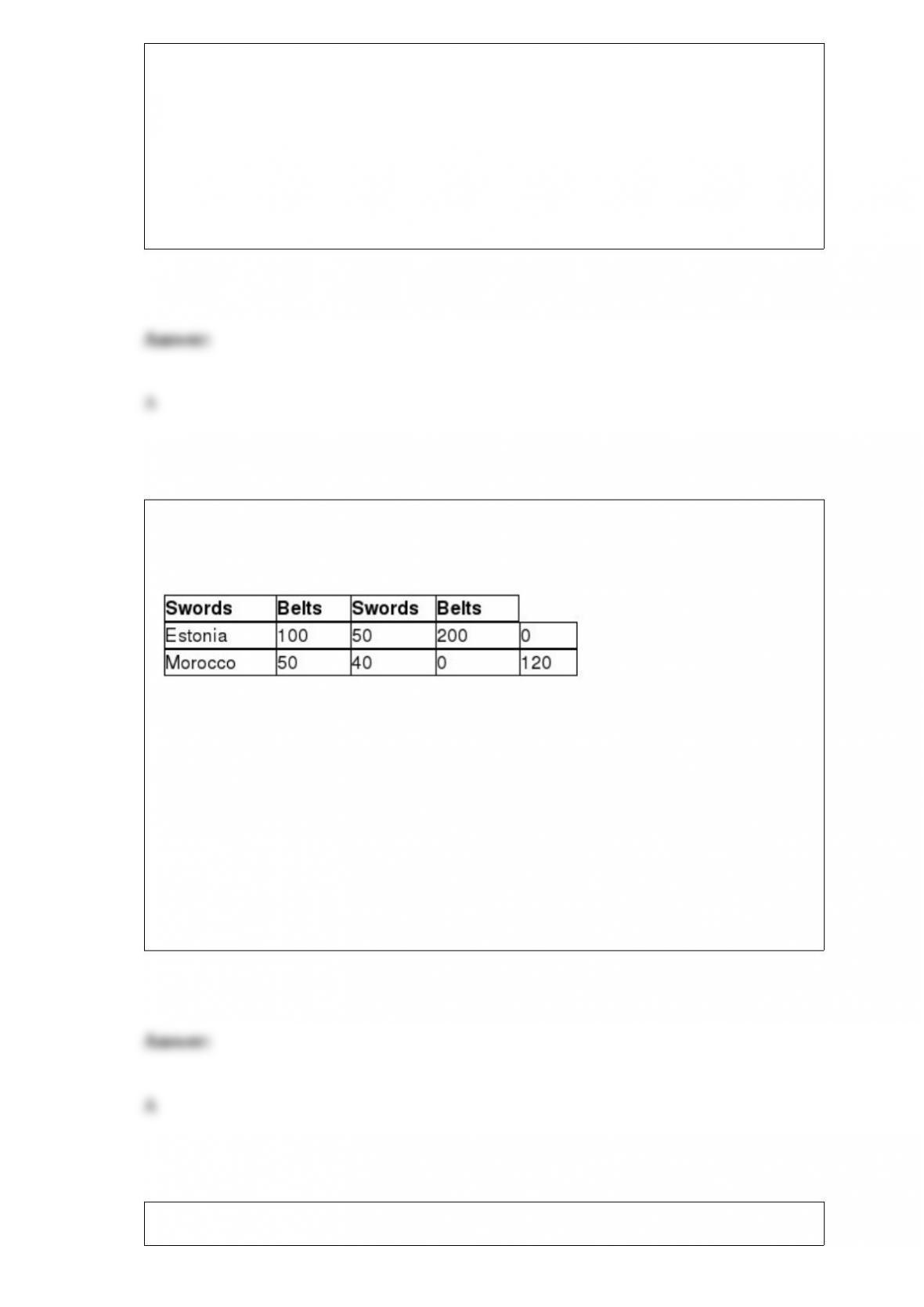
Table 7-6 Production and
Consumption Production
Without Trade With Trade
Estonia and Morocco can produce both swords and belts. Table 7-6 shows the
production and consumption quantities without trade, and the production numbers with
trade. Prior to trade, what was the opportunity cost to produce 1 sword in Estonia?
A) 1/2 of a belt
B) 4/5 of a belt
C) 1.25 belts
D) 2 belts
An example of a supplier that used its bargaining power to charge high prices to its

customers is
A) Wal-Mart, which required many of its suppliers to alter their distribution systems to
accommodate Wal-Mart’s need to control the flow of goods to its stores.
B) the firms that supply paper napkins to McDonald’s restaurants.
C) the Technicolor Company, the sole producer of cameras and film that movie studios
needed to produce color movies in the 1930s and 1940s.
D) the publishers of the Encyclopedia Britannica.
As a percentage of GDP, federal expenditures ________ from 1950 to the early 1990s,
________ from 1992 to 2001, and have ________ since 2001.
A) rose; fell; risen
B) fell; fell; risen
C) rose; rose; fallen
D) fell; rose; fallen
A personal exemption refers to
A) the tax rate that applies to a particular tax bracket.
B) the tax bracket that represents basic living expenses.
C) an amount representing basic living expenses that can be subtracted from income.

D) a dispensation that allows certain qualifying individuals not to pay federal taxes.
Assume that the hourly price for the services of tarot card readers has risen and sales of
these services have also risen. One can conclude that
A) the law of demand has been violated.
B) the number of tarot card readers has increased.
C) the demand for tarot card readers has increased.
D) tarot card readers are deliberately charging high prices because they provide services
for superstitious clients.
Calculate the government purchases multiplier if the marginal propensity to consume
equals 0.8, the tax rate is 0.1, and the marginal propensity to import equals 0.2.
A) 2.1
B) 1.9
C) 1.7
D) 1.4

Suppose your expenses for this term are as follows: tuition: $10,000, room and board:
$6,000, books and other educational supplies: $1,000. Further, during the term, you can
only work part-time and earn $8,000 instead of your full-time salary of $20,000. What
is the opportunity cost of going to college this term, assuming that your room and board
expenses would be the same even if you did not go to college?
A) $11,000
B) $17,000
C) $23,000
D) $29,000
Countries gain from specializing in producing goods in which they have ________ and
trading for goods in which other countries have ________.
A) a comparative advantage; an absolute advantage
B) an absolute advantage; an absolute advantage
C) a comparative advantage; a comparative advantage
D) an absolute advantage; a comparative advantage

For each pound of salami that Hungary produces, it gives up the opportunity to make 10
bottles of beer. Slovakia can produce 1 pound of salami for every 8 bottles of beer it
produces. Which of the following is true about the comparative advantage between the
two countries?
A) Hungary has the comparative advantage in salami.
B) Hungary has the comparative advantage in beer.
C) Slovakia has the comparative advantage in salami and beer.
D) Slovakia has the comparative advantage in beer.
Legalizing all forms of illegal activities
A) reduces GDP and the size of the underground economy.
B) reduces GDP and increases the size of the underground economy.
C) increases GDP and reduces the size of the underground economy.
D) increases GDP and increases the size of the underground economy.
Limits on the flow of foreign exchange and financial investment across countries are
called
A) capital controls.

B) fixed exchange rates.
C) credit constraints.
D) currency restrictions.
National saving equals
A) income – taxes – consumption.
B) taxes – government spending.
C) income – consumption – government spending.
D) private saving + public saving – net foreign investment.
Figure 17-6
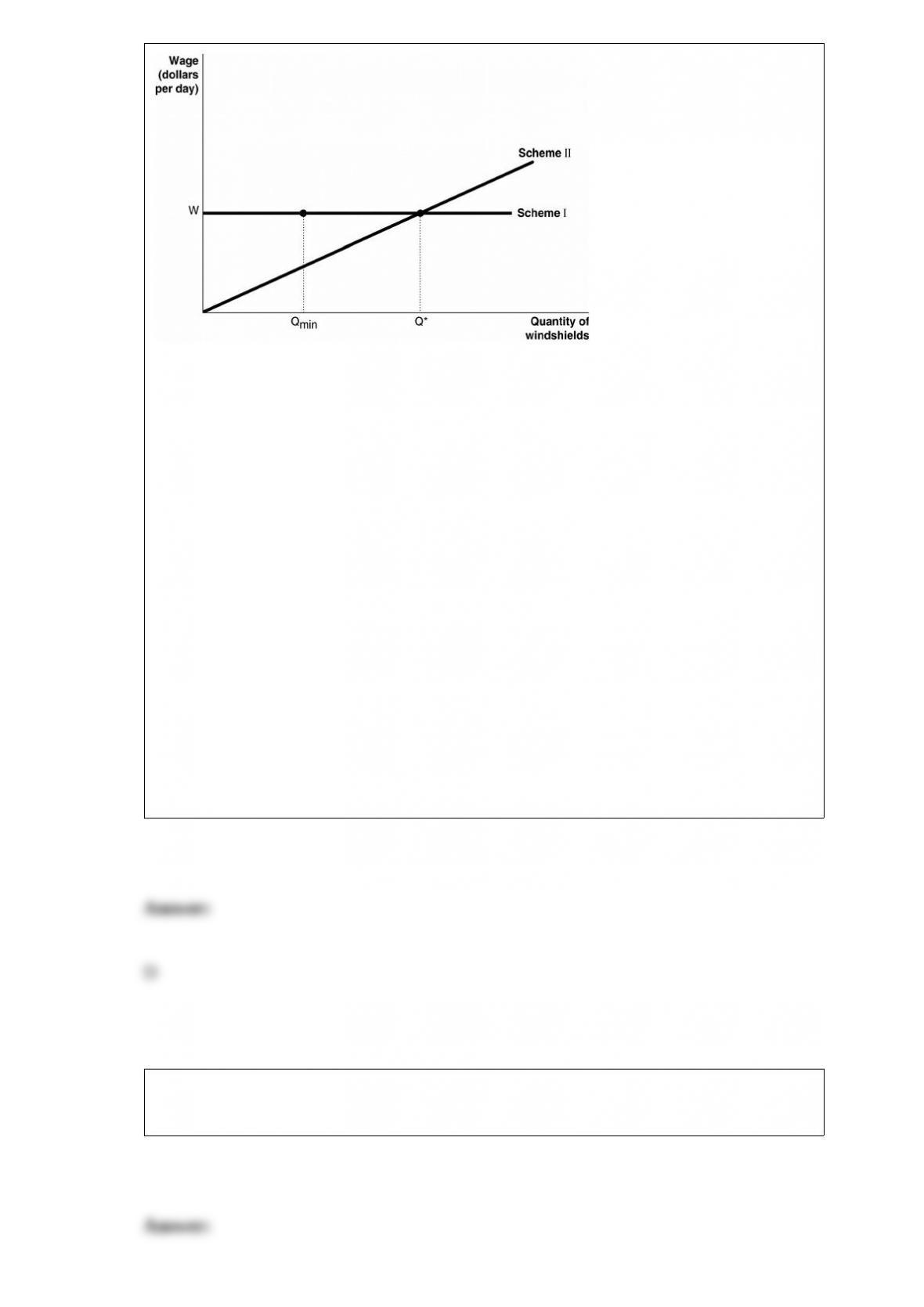
Figure 17-6 shows two
different compensation schemes for the Safelite Glass Corporation, an installer of auto
glass windshields. Under Scheme I, the firm pays a consistent wage of $80 per day
based on an 8-hour workday. Qmin represents the cut-off point under the hourly-wage
system: if a worker installed fewer than Qmin windshields, the worker got fired. Scheme
II represents a piece-rate scheme with an earnings floor: no worker would get less than
$80 per day (for an 8-hour workday) and would have to produce at least Qmin. For any
output level beyond Q* the worker earned an additional $20 for each unit produced.
Which of the following statements about Scheme II is false?
A) It is likely to draw highly productive workers who see the opportunity to increase
their wages.
B) It could discourage less productive workers and induce them to leave the firm.
C) It allows workers to increase their daily wage without penalizing those who are
content with their daily wage.
D) It is more risky for senior employees.
What are some of the reasons used to explain improvements in health, education,
democracy, and political stability in many low-income countries?
Explain the economic concept of price elasticity of supply. How is price elasticity of
supply calculated?
What did economists Robert Jensen and Nolan Miller determine must be true for a good
to be a Giffen good, where the income effect is larger than its substitution effect?
What is minimum efficient scale? What is likely to happen in the long run to firms that
do not reach minimum efficient scale?
Why will there be less crowding out of private spending by government spending the
less sensitive consumption, investment, and net exports are to changes in interest rates?