
Which of the following is a necessary condition for price discrimination to be
profitable?
a. All consumers must have an identical demand for the product.
b. Groups of consumers with different demand elasticities must be easily
distinguishable.
c. The market demand for the product must be highly elastic.
d. It must be possible for buyers to resell the product at a low cost.
Which of the following would most likely cause a nation’s currency to depreciate?
a. an increase in the nation’s domestic inflation rate
b. an increase in inflation of the nation’s trading partners
c. a decrease in the nation’s domestic inflation rate
d. an increase in domestic real interest rates
Which of the following is most important if a country is going to grow rapidly and
achieve a high level of per capita income?
a. an abundance of natural resources

b. a warm moist climate
c. a small population relative to the geographic size of the country
d. institutions and policies that encourage people to engage in productive activities
Why will the long-run market supply curve for most products slope upward to the
right?
a. The firms producing the product will be unable to expand the size of their plant and
equipment in the long run.
b. Economies of scale are present in most industries.
c. Most products are produced under conditions of constant cost.
d. Resource prices will rise and push costs upward as the output of the industry
expands.
Ceteris paribus, a decrease in the demand for automobiles will
a. increase the price of automobiles.
b. increase the quantity supplied of automobiles.
c. decrease the demand for automobile workers.
d. increase the demand for automobile workers.

Which of the following is the primary source of changes in output within the
framework of Keynesian analysis?
a. changes in the price level
b. changes in aggregate demand
c. changes in interest rates
d. changes in wage rates
Which of the following provides the most accurate description of monetary policy?
a. the deliberate control of the money supply to achieve macroeconomic goals
b. the use of the government’s regulatory powers to improve economic efficiency
c. the government provision of goods to improve economic efficiency
d. the use of government taxation and expenditures to achieve macroeconomic goals

Most of the income of Americans comes from
a. transfer payments.
b. individuals selling their labor services.
c. the ownership of bonds and corporate stocks.
d. the ownership of small businesses.
The upward-sloping portion of a long-run average total cost curve is the result of
a. economies of scale.
b. diseconomies of scale.
c. diminishing returns.
d. the existence of fixed resources.
If unskilled labor is relatively plentiful and cheap in many foreign countries, then as the
United States expands its trade with these foreign countries, the domestic demand for
a. unskilled labor will rise and skilled labor will fall.
b. skilled labor will rise and unskilled labor will fall.
c. both skilled and unskilled labor will rise proportionately.
d. both skilled and unskilled labor will be unaffected, assuming no barriers to free trade.

Suppose the economy is in long-run equilibrium at the level of potential output. What
will be the long-run effect of an expansionary monetary policy?
a. a higher price level
b. a higher level of real output
c. both a higher price level and a higher level of real output
d. a lower price level
e. a lower level of real output
The Austrian view of the business cycle stresses that
a. expansionary monetary policy will stimulate aggregate demand and thereby promote
lengthy economic expansions.
b. the velocity of money is constant and therefore an increase in the quantity of money
will lead only to a proportional increase in the general level of prices.
c. expansionary monetary policy will lead to higher interest rates that will retard
investment and throw the economy into a recession.
d. the interest rate is one of the most important prices and manipulation of the interest
rate by monetary policy-makers is a major source of economic instability.
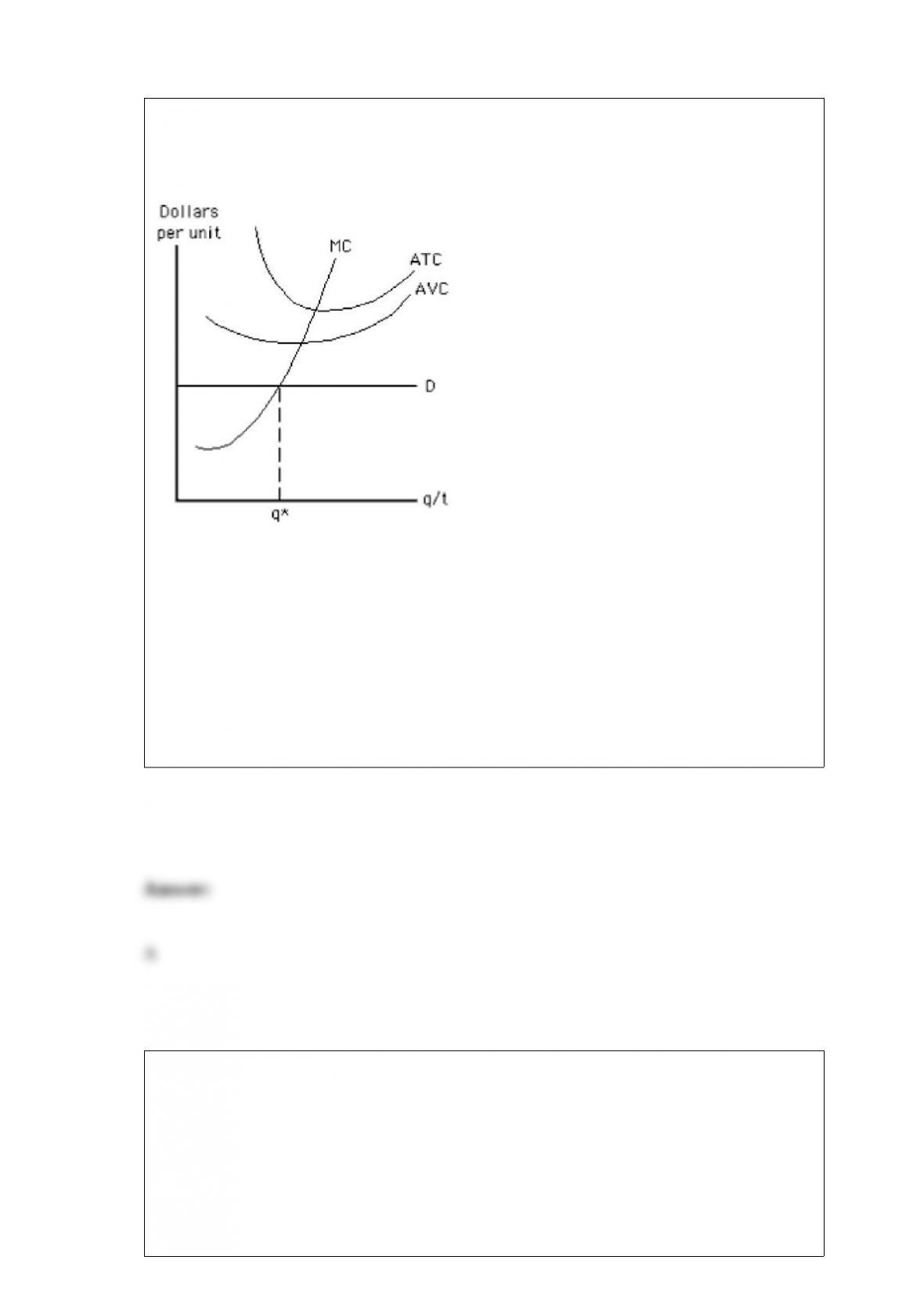
Figure 9-17
Which of the following statements about the competitive price-taker firm represented in
Figure 9-17 is false?
a. Short-run losses are minimized at output level q* because MR = MC there.
b. The firm should shut down in the short run.
c. If the firm shuts down in the short run, it will suffer a loss equal to the amount of its
fixed cost.
d. If the firm operates in the short run, it will suffer a loss greater than the amount of its
fixed cost.
e. If the firm operates in the short run, it will suffer a loss equal to the amount of its
fixed cost plus the uncovered portion of its variable cost.
When Iceland can generate a product using fewer labor hours and resources than the
United States, an economist would say that Iceland had
a. a comparative advantage in production of the product.
b. an absolute advantage in production of the product.
c. a higher opportunity cost of producing the product.
d. no incentive to import the product, regardless of the cost-price conditions for other
products.

Entrepreneurship is characterized by
a. the ability to visualize and undertake economically beneficial projects.
b. originality and innovation.
c. leadership and discovery.
d. all of the above.
The integration of expectations into macroeconomic analysis indicates that
a. fiscal policy is more potent than monetary policy.
b. monetary policy is more potent than fiscal policy.
c. once people come to expect a given rate of inflation, the inflation will neither
stimulate real output nor reduce unemployment.
d. higher rates of inflation will lead to lower rates of unemployment in the long run but
not in the short run.
All but one of the following are elements of the economic way of thinking. Which one
is not part of the economic way of thinking?
a. Incentives matter.
b. The value of goods can be determined objectively.
c. Economic thinking is marginal thinking.
d. Information is scarce.
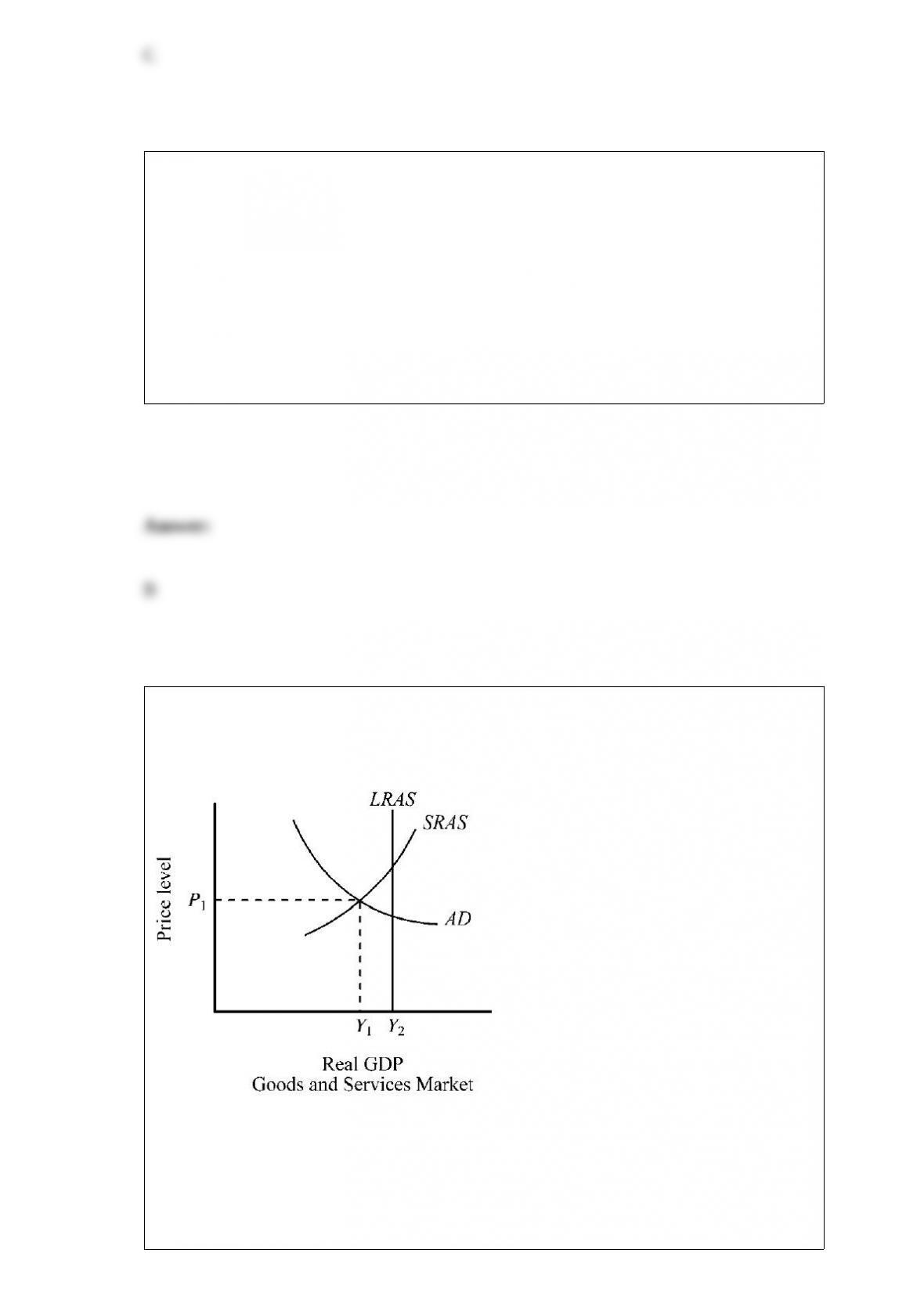
Use the figure below to answer the following question(s).
Figure 12-3
Refer to Figure 12-3. If an economy is currently operating at Y1, which of the following
would a new classical economist be most likely to favor?
a. higher taxes and reductions in expenditures in order to shift the budget toward a
surplus
b. lower taxes and increase in expenditures in order to shift the budget toward a deficit
c. a balanced budget
d. no government action and reliance on the self-corrective mechanism
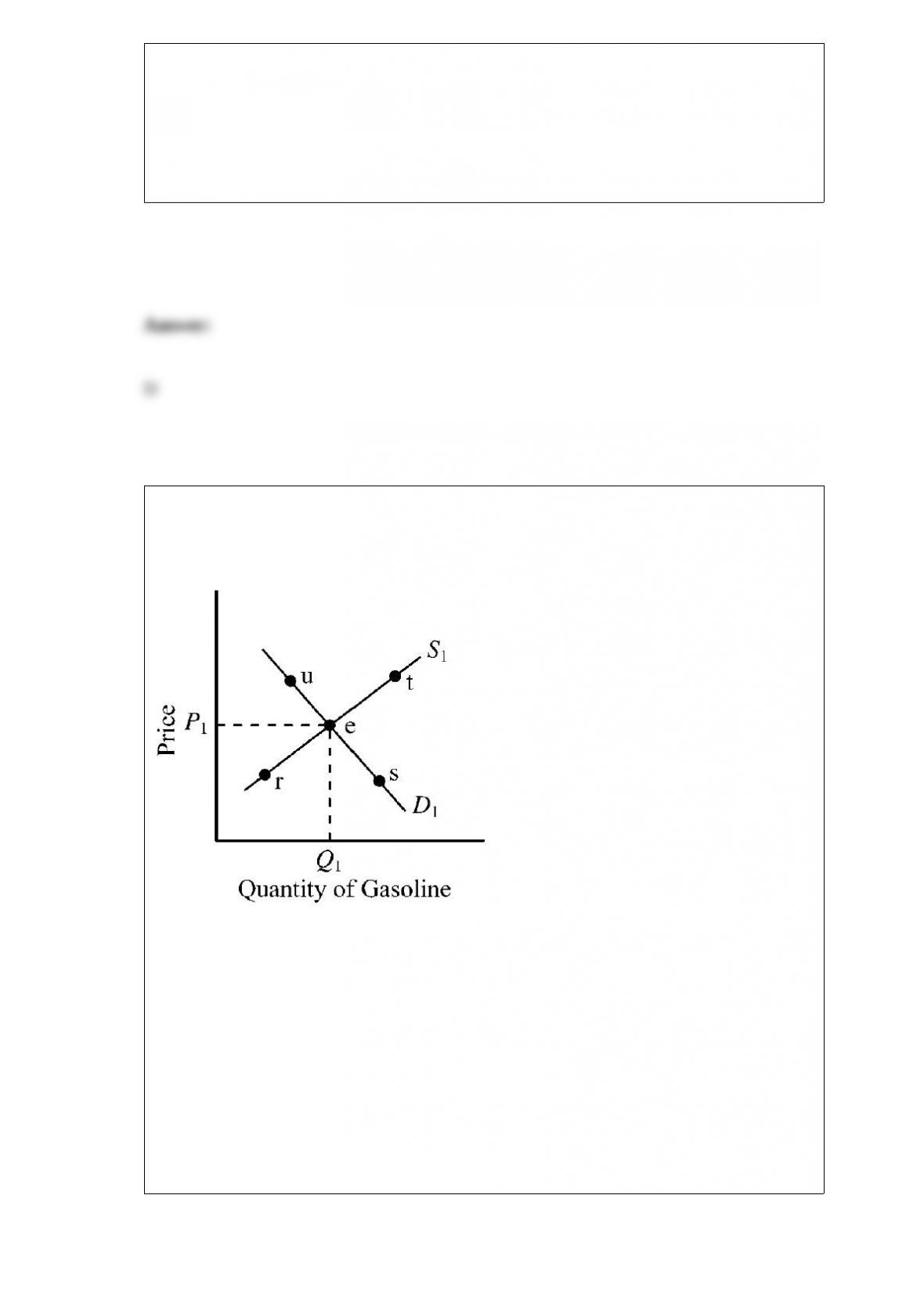
Use the figure below to answer the following question(s).
Figure 3-14
Refer to Figure 3-14. The gasoline market was initially in equilibrium at point e. Other
things constant, a decrease in the price of crude oil, an important ingredient used to
produce gasoline, would likely move the equilibrium in this market toward point
a. r.
b. s.
c. t.
d. u.

An item purchased often by the same buyer is known as a
a. frequent transaction good.
b. repeat-purchase item.
c. free rider good.
d. public good.
If the U.S. dollar appreciates in the foreign exchange market,
a. American goods will become more expensive for foreign buyers and foreign goods
will be cheaper for Americans.
b. American goods will become less expensive for foreign buyers and foreign goods
will be more expensive for Americans.
c. American goods will become more expensive for foreign buyers and foreign goods
will be more expensive for Americans.
d. American goods will become cheaper for foreign buyers and foreign goods will be
cheaper for Americans.
e. neither the price of U.S. exports nor the price of U.S. imports will change.

Other things equal, when the supply of workers is scarce, one would predict that market
wages would be
a. relatively high.
b. relatively low.
c. determined solely by factors that affect demand.
d. determined outside the domain of economic theory.
Liam is willing to cut lawns for a minimum of $200 a week. He is, however, paid $250
for the same service by a lawn maintenance company. This is an example of
a. consumer surplus.
b. employment discrimination.
c. producer surplus.
d. the derivation of accounting profit.
Which of the following resulted from the Smoot-Hawley trade bill of 1930?

a. The stock market began a steady recovery from the crash of October 1929.
b. Many countries responded by imposing higher tariffs on American products, and the
volume of international trade fell sharply.
c. Imports decreased, while exports increased, resulting in an overall increase in GDP
and tariff revenues.
d. The unemployment rate, which had been rising, began to steadily decline as jobs
were protected by the trade restrictions.
Democracy tends to best promote economic freedom when there is
a. checks on the power of both the executive and legislative majorities.
b. constitutional protection of private property rights.
c. political decentralization.
d. all of the above.
The money rate of interest will be less than the real rate of interest when decision
makers anticipate
a. stable prices in the future.
b. falling prices in the future.
c. inflation in the future.

d. that the money rate of interest will decline.
Why didn’t the Fed’s quantitative easing policies exert a stronger impact on aggregate
demand and lead to a more rapid recovery during 2010-2012?
a. The low interest rates accompanying the policy failed to increase stock prices.
b. Even though the Fed made additional reserves available to the banking system, the
policy did not result in lower interest rates.
c. The velocity of money increased, partially offsetting the impact of the Fed’s low
interest rate policy.
d. The earnings of senior citizens and others from money market accounts, saving
deposits, and other forms of savings fell, reducing their incentive to spend and thereby
increasing aggregate demand.
For effective price discrimination to occur, a seller must
a. be a pure monopolist.
b. have large economies of scale and control over a key natural resource.
c. face a horizontal demand curve for its product.
d. be able to prevent consumers from reselling the product to other consumers.
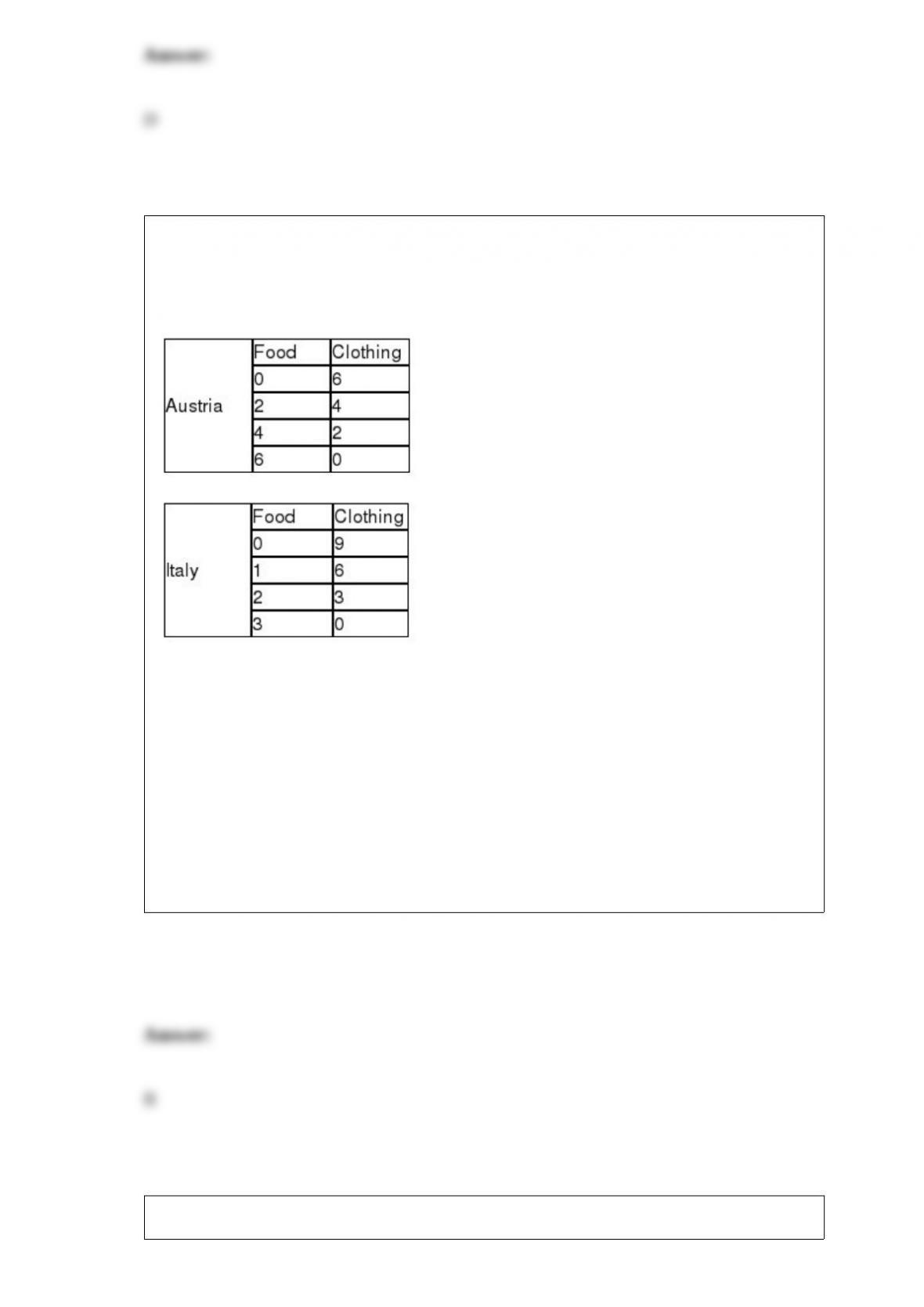
Use the production possibilities data below for Austria and Italy to answer the following
question(s).
Table 2-1
Refer to Table 2-1. Which of the following would be a mutually agreeable rate of
exchange?
a. 1 Food = 1 Clothing
b. 1 Food = 2 Clothing
c. 1 Food = 3 Clothing
d. No exchange rate would be mutually agreeable.
Dairy farmers hold an annual Capitol Hill ice cream social that provides free ice cream
for congressional staffers during which time representatives from the industry discuss
issues with, and provide information to, congressional staff. This is an example of
a. logrolling.
b. rent seeking.
c. pork-barrel legislation.
d. the shortsightedness effect.
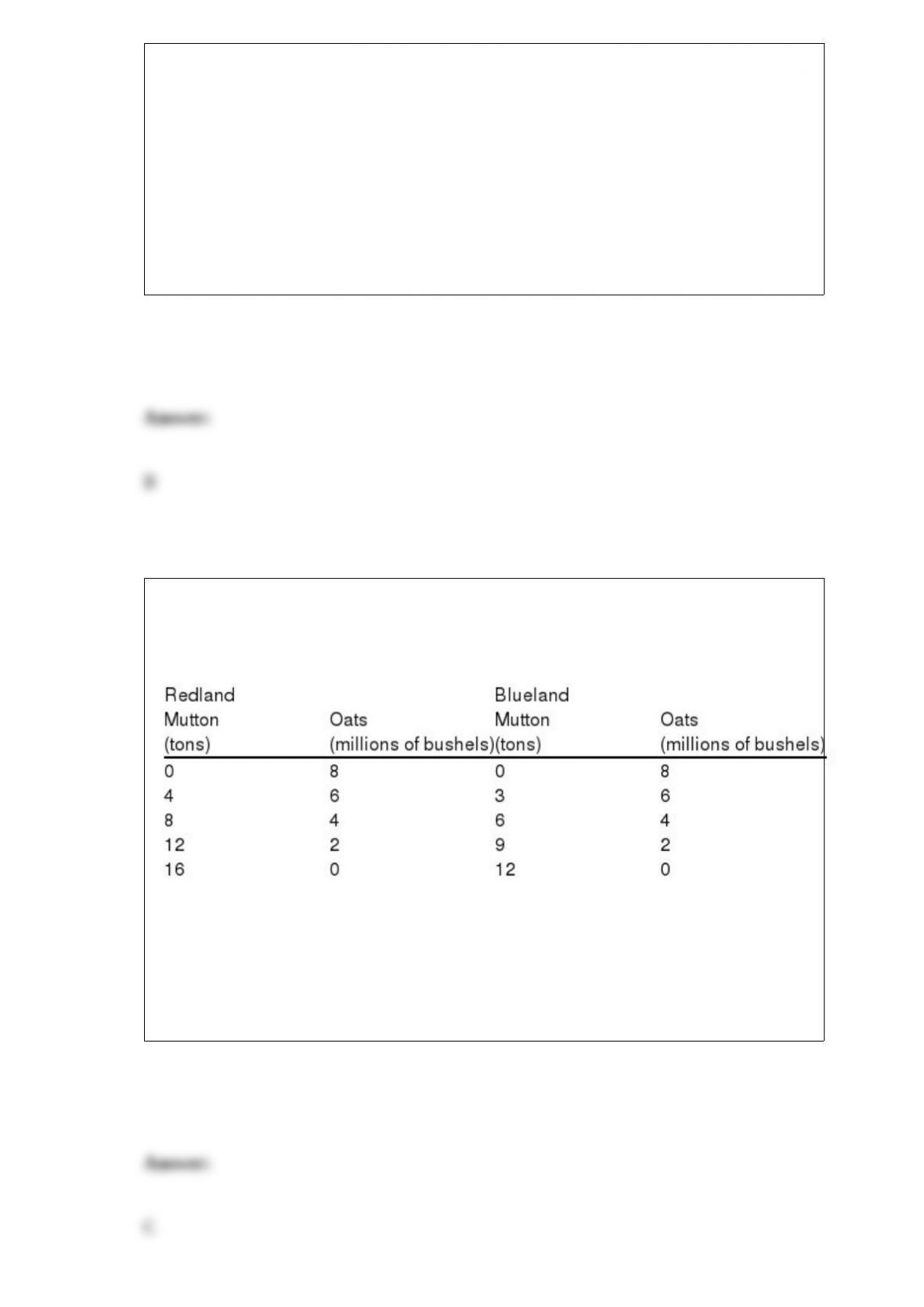
Use the table below to answer the following question. The table outlines the production
possibilities for two hypothetical countries.
Which of the following statements is true?
a. Redland has a comparative advantage in producing oats.
b. Redland enjoys a comparative advantage in producing both products and could not
gain from exchange.
c. Redland should specialize in producing mutton and should trade for oats.
d. In this example, Blueland has nothing to gain through trade with Redland.

If carpentry positions A and B required identical skill levels, other things constant,
which one of the following would most likely increase the wage rate of position A
relative to position B?
a. The work place of position A is in the intense heat of the sun, whereas the work place
of B is air-conditioned.
b. Position A is a safe office job; position B requires the employee to operate a
dangerous saw.
c. Position A offers steady employment, whereas employees holding position B are
often laid off.
d. Position A offers more sick leave and more paid holidays.
Suppose Congress raises taxes and the monetary authorities slow the annual money
supply growth from 10 percent to 5 percent. If decision makers accurately anticipate the
impact of these policy changes on prices,
a. unemployment will rise.
b. unemployment will fall.
c. there will be no effect on unemployment.
d. unemployment will fall if the change in monetary policy dominates, but
unemployment will rise if the change in fiscal policy dominates.

With time, an appreciation in the value of the nation’s currency in the foreign exchange
market would cause
a. the nation’s imports to increase and exports to decline.
b. the nation’s exports to increase and imports to decline.
c. both imports and exports to decline.
d. both imports and exports to rise.