
If the LRATC curve is falling, then
a. the law of diminishing marginal returns is operating.
b. economies of scale are present.
c. constant returns to scale are present.
d. diseconomies of scale are present.
Points inside (below) the production possibilities frontier (PPF) are
a. unattainable.
b. attainable, but productive inefficient.
c. preferable to points that lie on the PPF.
d. attainable and productive efficient.
Exhibit 2-1

The movement from point A to point B is a movement from
a. a productive efficient point to a productive inefficient point.
b. a point with more guns and less butter to a point with more butter and even more
guns.
c. a productive efficient point to another productive efficient point.
d. a productive inefficient point to a productive efficient point.
“Collective bargaining” refers to
a. negotiations between labor unions and management about wage rates and other
issues.
b. negotiations among labor unions over jurisdictional control.
c. negotiations between labor, management, and government over the drafting of labor
laws.
d. b and c
e. none of the above

A quota on imported avocadoes ______________ the price of avocadoes,
_____________ consumers’ surplus for avocado buyers, _______________ producers’
surplus of avocado growersand __________________ tariff revenue. Because the loss
to _____________ is more than the gain to ___________________, there is a net loss
to society.
a. raises; increases; decreases; generates; producers; consumers and government
b. lowers; increases; decreases; does not generate; producers; consumers
c. raises; increases; decreases; does not generate;consumers; producers and importers
d. raises; decreases; increases; generates; consumers; producers and government
Suppose the economy goes from a point on its production possibilities frontier (PPF) to
a point directly to the left of it. Assuming that the PPF has not shifted, this could be due
to
a. a gain of resources.
b. a loss of resources.
c. technological improvement in the production of both goods.
d. a new law that interferes with productive efficiency.

The supply of factor X is perfectly inelastic and it receives a price of $100. It follows
that
a. the entire $100 is pure economic rent.
b. part of the $100 is pure economic rent.
c. factor X does not receive any economic rent.
d. any payment above the price of $100 is economic rent.
e. none of the above
Which of the following is consistent with the law of demand?
a. People substitute higher-priced goods for higher-quality goods.
b. People substitute some higher-priced goods for other higher-priced goods.
c. People substitute lower-priced goods for higher-priced goods.
d. People substitute some lower-priced goods for other lower-priced goods.
Exhibit 3-16
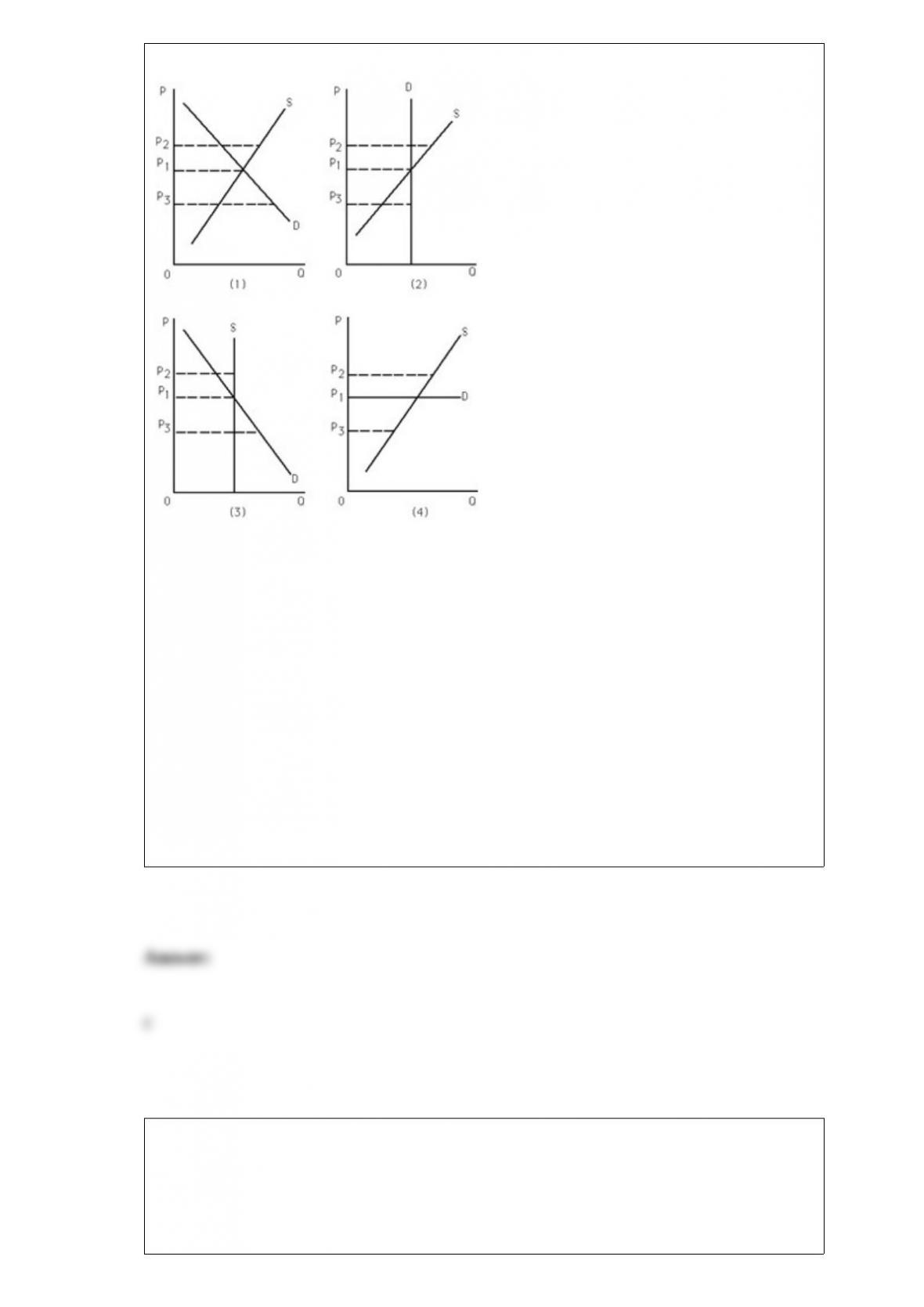
If there are empty seats for a basketball game at the price P*, the situation is best
depicted on graph
a. (1), with P* = P1.
b. (2), with P* = P3.
c. (3), with P* = P2.
d. (3), with P* = P3.
e. (4), with P* = P1.
One reads the following in a newspaper: “Today the president and Congress agreed to
impose new restrictive quotas on Japanese cars coming into the country.” As a result, an
economist would predict that the
a. supply of cars in the country will remain the same and the (average) price of cars will

fall.
b. supply of cars in the country will fall and the (average) price of cars will rise.
c. supply of cars in the country will rise and the (average) price of cars will fall.
d. demand for cars in the country will fall and the (average) price of cars will rise.
e. demand for cars in the country will rise and the (average) price of cars will rise.
If the interest rate increases, then
a. households will decrease their level of saving.
b. the supply of loanable funds will fall because it now costs more to borrow funds and
people who were supplying the funds will realize that fewer people will be willing to
borrow their funds.
c. households will consume less and save more.
d. government will consume more because it now costs more to borrow funds to buy
goods.
e. a, b, and d
The economist who said, “I am distressed by the sight of poverty. I am benefited by its
alleviation; but I am benefited equally whether I or someone else pays for its
alleviation; the benefits of other people’s charity therefore partly accrues to me” was
a. John Kenneth Galbraith.

b. John Rawls.
c. Milton Friedman.
d. Adam Smith.
e. David Ricardo.
In economics, capital is defined as a financial asset such as stocks and bonds.
a. True
b. False