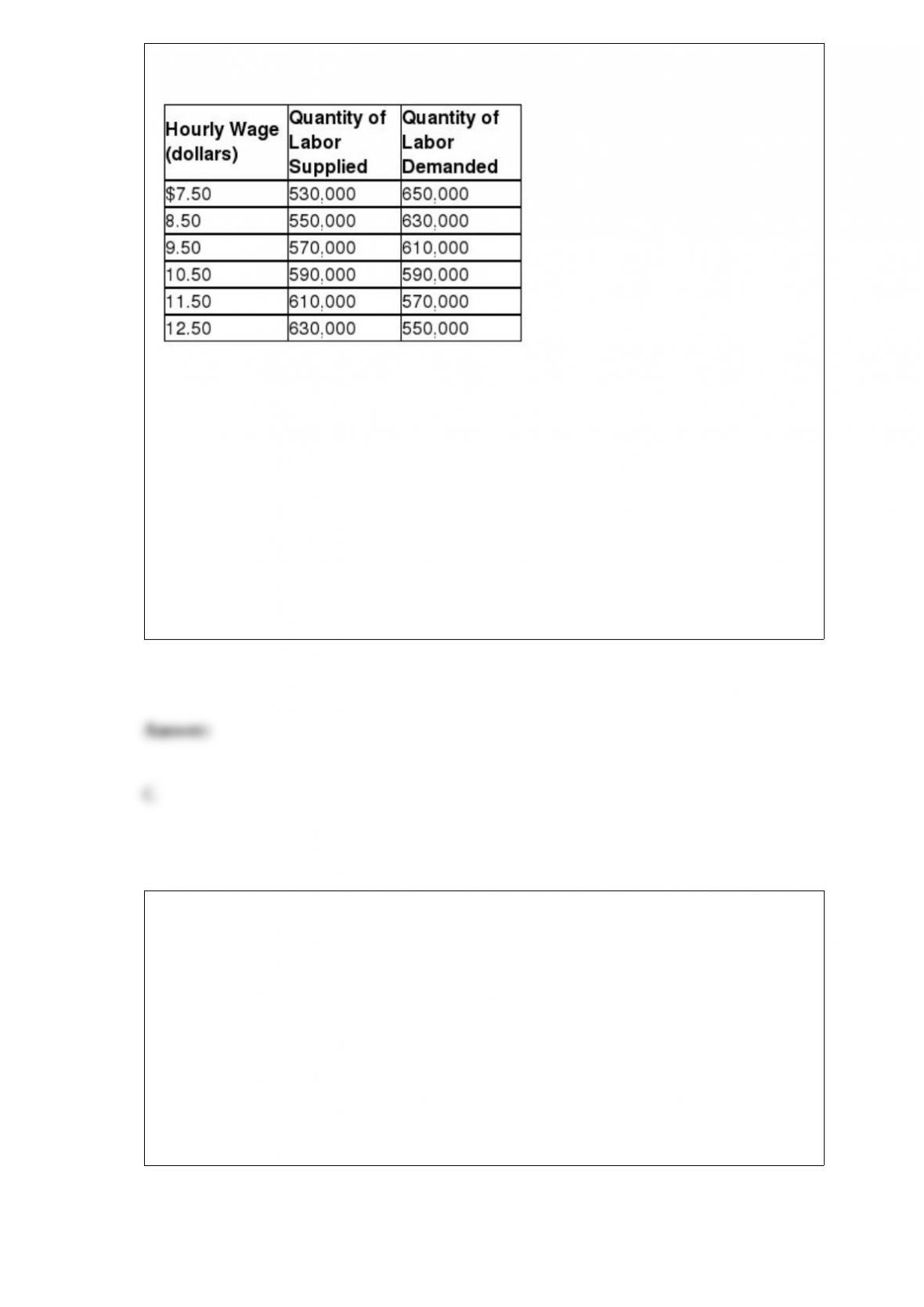
Table 4-4
Table 4-4 shows the demand and supply schedules for labor market in the city of Pixley.
Suppose that the quantity of labor supplied increases by 40,000 at each wage level.
What are the new free market equilibrium hourly wage and the new equilibrium
quantity of labor?
A) W = $8.50; Q = 550,000
B) W = $12.50; Q = 630,000
C) W = $9.50; Q = 610,000
D) W = $11.50; Q = 610,000
For the recessions in the United States since the 1950s,
A) inflation has been nonexistent.
B) the inflation rate rises on average by about 2.5 percentage points 12 months after a
recession begins.
C) the inflation rate falls on average by about 2.5 percentage points 12 months after a
recession begins.
D) deflation occurs.
During which of the following periods was growth in GDP per capita the strongest?
A) prior to 500 A.D.
B) 500 A.D. to 1800 A.D.
C) 1800-1900 A.D.
D) 1900-2000 A.D.
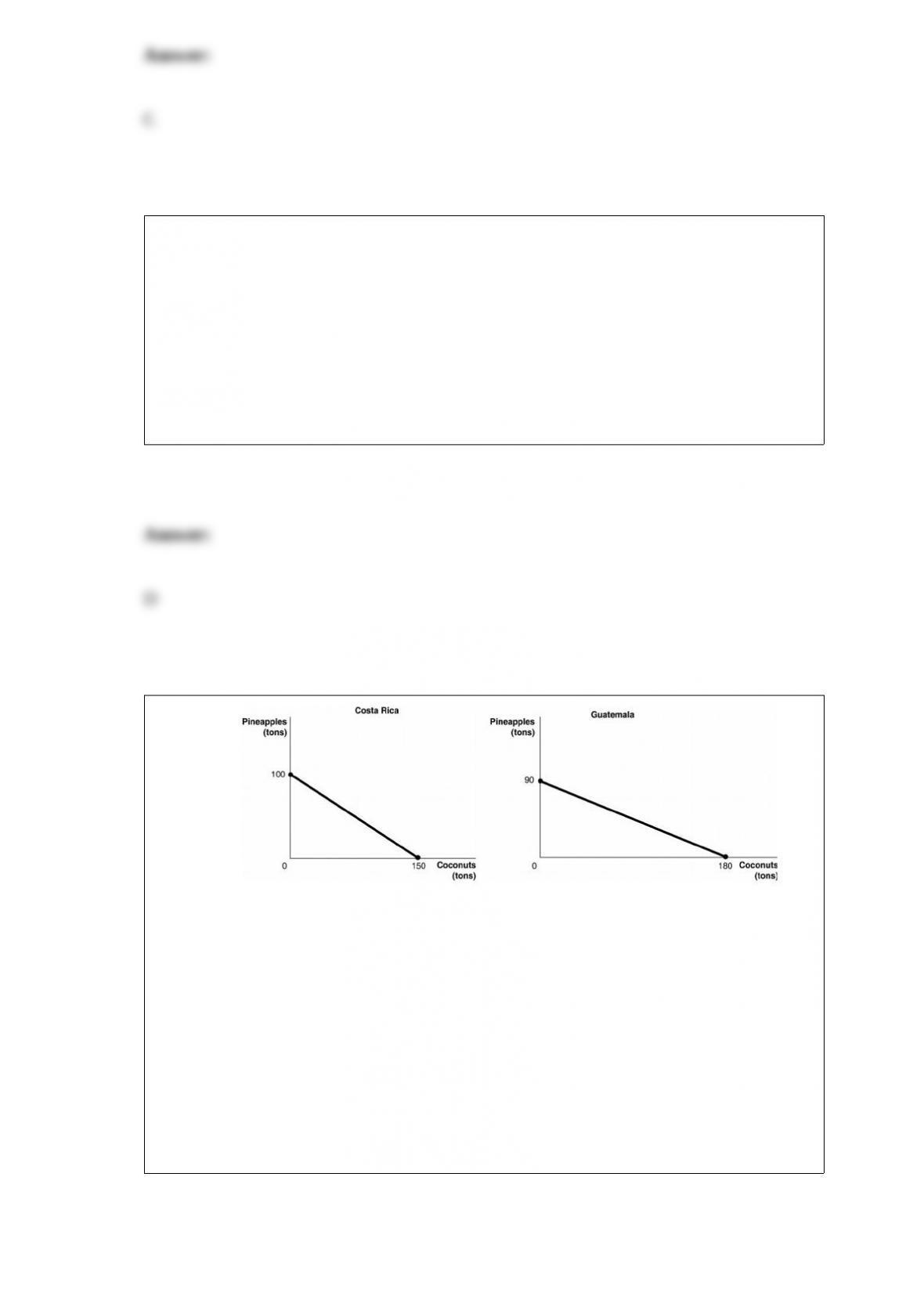
Figure 2-8
Figure 2-8 shows the production possibilities frontiers for Costa Rica and Guatemala.
Each country produces two goods, pineapples and coconuts.
What is the opportunity cost of producing 1 ton of coconuts in Guatemala?
A) 1/2 of a ton of pineapples
B) 1 1/3 tons of pineapples
C) 2 tons of pineapples
D) 90 tons of pineapples

Kenneth Chay and Michael Greenstone examined the impact of reductions in air
pollution since the passage of the Clean Air Act of 1970. Which of the following
statements summarizes their findings?
A) The marginal benefit of reductions in air pollution was less than the marginal cost.
B) The marginal cost of reducing emissions of sulfur dioxide has increased over time as
the marginal benefit of the reductions has increased.
C) The benefits of reducing the six main air pollutants in the two years following the
Act greatly exceeded the costs.
D) In the two years following passage of the Act, fewer infants died than would have
died if the Act had not been passed.
During recessions, government expenditure automatically
A) falls because of programs such as unemployment insurance and Medicaid.
B) rises because of programs such as unemployment insurance and Medicaid.
C) falls because of the progressive income tax system.
D) rises because of the progressive income tax system.

Suppose a negative externality exists in a market. If transactions costs are low and
parties are willing to bargain then, according to the Coase theorem,
A) an efficient solution can be reached only if property rights are assigned to the
victims of the pollution.
B) an efficient solution can be reached only if property rights are assigned to the
polluters.
C) an efficient solution can be reached regardless of the initial assignment of property
rights.
D) government intervention is critical to reach an efficient solution.
Which of the following is a problem inherent in centrally planned economies?
A) Households and firms make poor decisions in choosing how resources are allocated.
B) There is too little production of low-cost, high-quality goods and services.
C) Production managers are more concerned with satisfying consumer wants than with
satisfying government’s orders.
D) Exports tend to exceed imports.
Which of the following would cause a decrease in the supply of peanut butter?
A) a decrease in the price of jelly (assuming that peanut butter and jelly are
complements)

B) a decrease in the price of peanut butter
C) an increase the price of peanuts
D) an increase in the technology used to produce peanut butter
Although advertising raises the price of a monopolistic competitor’s product, it does
confer a benefit to consumers. Which of the following is a benefit to consumers?
A) Advertising acts as a barrier to entry.
B) Advertising engenders brand loyalty.
C) Advertising could provide consumers with useful information about new products
and enable them to comparison shop.
D) Advertised products tend to be of higher quality so consumers feel special when they
consume advertised products.
Mr. Peabody chooses to invest in companies that produce goods and services at the
lowest possible cost. Mr. Peabody is investing in companies that are
A) allocatively efficient.
B) productively efficient.
C) guaranteed to make a profit.
D) all of the above

Which of the following would be the best measure of the cost of living?
A) real GDP
B) real GDP per person
C) GDP deflator
D) consumer price index
If policy makers implement an expansionary fiscal policy but do not take into account
the potential for crowding out, the new equilibrium level of GDP is likely to
A) be at potential GDP.
B) be above potential GDP.
C) be below potential GDP.
D) There is insufficient information given here to draw a conclusion.
A decrease in U.S. federal government budget deficits that lowers U.S. interest rates
relative to the rest of the world should
A) lower the trade balance.
B) decrease net exports.
C) cause the dollar to appreciate.
D) lead to a current account surplus.
E) increase foreign portfolio investment.
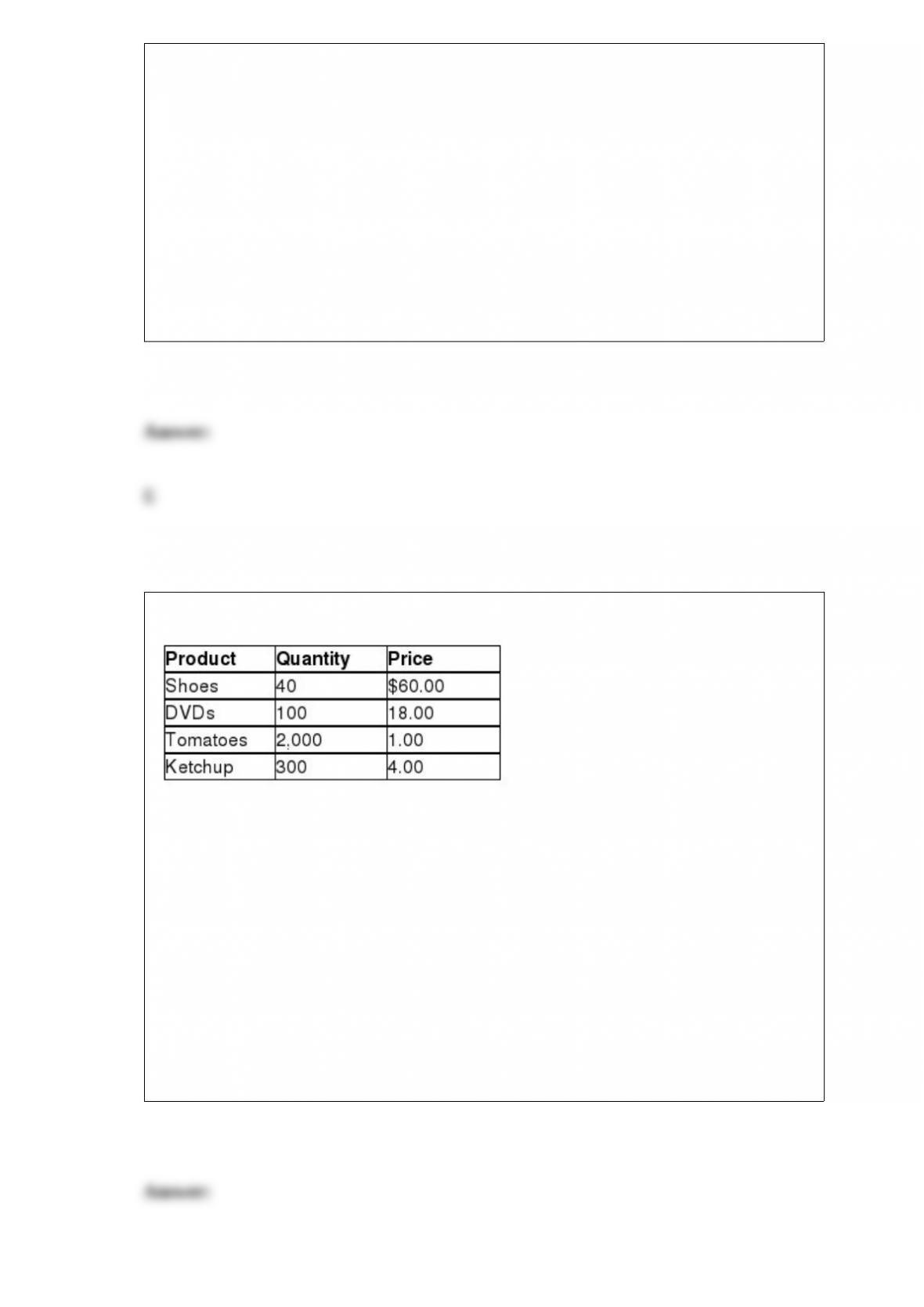
Table 19-2
Suppose that a simple economy produces only four goods and services: shoes, DVDs,
tomatoes, and ketchup. Assume one half of the tomatoes are used in making the ketchup
and the other half of the tomatoes are purchased by households. Using the information
in the above table, nominal GDP for this simple economy equals
A) $7,400.
B) $6,400.
C) $5,800.
D) 2,440 units.
Average total cost is
A) total cost divided by the quantity of output produced.
B) total explicit costs divided by the quantity of output produced.
C) variable cost divided by the quantity of output produced.
D) the change in fixed plus variable cost divided by the quantity of output produced.