
The marginal product of labor for Acme, Inc. is 15. The average product of labor is 25,
and the price of labor is $10. Assuming that Acme, Inc. is a competitor in its output and
input markets, the marginal revenue product of labor:
A) is $10.
B) is $150.
C) is $250.
D) is $375.
E) cannot be determined with the information provided.
Nash equilibria are stable because
A) they involve dominant strategies.
B) they involve constant-sum games.
C) they occur in noncooperative games.
D) once the strategies are chosen, no players have an incentive to negotiate jointly to
change them.
E) once the strategies are chosen, no player has an incentive to deviate unilaterally from
them.

Scenario 17.5
Consider the following information:
Income to the firm from workers who sell door-to-door
Bad Luck Good Luck
Low Effort (e = 0) $5,000 $7,000
High Effort (e = 1) $7,000 $13,000
Cost of effort: c = $2500e
Probabilities: Bad luck = .75; Good luck = .25
Under which of the following payment schemes would workers have an incentive to
exert high effort?
A) A guaranteed wage equal to $0
B) A guaranteed wage equal to $5000
C) A guaranteed wage equal to $10,000
D) A wage equal to the income earned, minus $4000
E) A wage equal to $0 if revenue is $5000, $2000 if revenue is $7000, and $8000 if
revenue is $13,000
What would best explain why a generally risk-averse person would bet $100 during a
night of blackjack in Las Vegas?
A) Risk aversion relates to income choices only, not expenditure choices.
B) Risk averse people may gamble under some circumstances.
C) The economics of gambling and the economics of income risk are two different

things.
D) Risk-averse people attach high subjective probabilities to favorable outcomes, even
when objective probabilities are known.
The aggregate demand for good X is Q = 20 – P. If the price rises from P = $4 to P = $5,
what is the change in consumer surplus?
A) $4.50
B) $5.50
C) $15.50
D) $16
The demand for books is: Qd = 120 – P
The supply of books is: Qs = 5P
What is the equilibrium price of books?
A) 5
B) 10

C) 15
D) 20
E) none of the above
Donald derives utility from only two goods, carrots (Qc) and donuts (Qd). His utility
function is as follows:
U(Qc,Qd) = (Qc)(Qd)
The marginal utility that Donald receives from carrots (MUc) and donuts (MUd) are
given as follows:
MUc = Qd
MUd = Qc
Donald has an income (I) of $120 and the price of carrots (Pc) and donuts (Pd) are both
$1.
a. What is Donald’s budget line?
b. What is Donald’s income-consumption curve?
c. What quantities of Qc and Qd will maximize Donald’s utility?
d. Holding Donald’s income and Pd constant at $120 and $1 respectively, what is
Donald’s demand curve for carrots?
e. Suppose that a tax of $1 per unit is levied on donuts. How will this alter Donald’s
utility maximizing market basket of goods?
f. Suppose that, instead of the per unit tax in (e), a lump sum tax of the same dollar
amount is levied on Donald. What is Donald’s utility maximizing market basket?
g. The taxes in (e) and (f) both collect exactly the same amount of revenue for the
government, which of the two taxes would Donald prefer? Show your answer
numerically and explain why Donald prefers the per unit tax over the lump sum tax, or
vice versa, or why he is indifferent between the two taxes.

Since last year, the price of gold has risen from $1100 to $1420. What annual inflation
rate would leave the real price of gold unchanged over the last twelve months?
A) Approximately 29%
B) 40%
C) Approximately 71%
D) 320%
E) none of the above
A tennis pro charges $15 per hour for tennis lessons for children and $30 per hour for
tennis lessons for adults. The tennis pro is practicing
A) first-degree price discrimination.
B) second-degree price discrimination.
C) third-degree price discrimination.
D) fourth-degree price discrimination.
E) fifth-degree price discrimination.
Assume that beer is an inferior good. If the price of beer falls, then the substitution
effect results in the person buying ________ of the good and the income effect results
in the person buying ________ of the good.
A) more, more
B) more, less
C) less, more
D) less, less
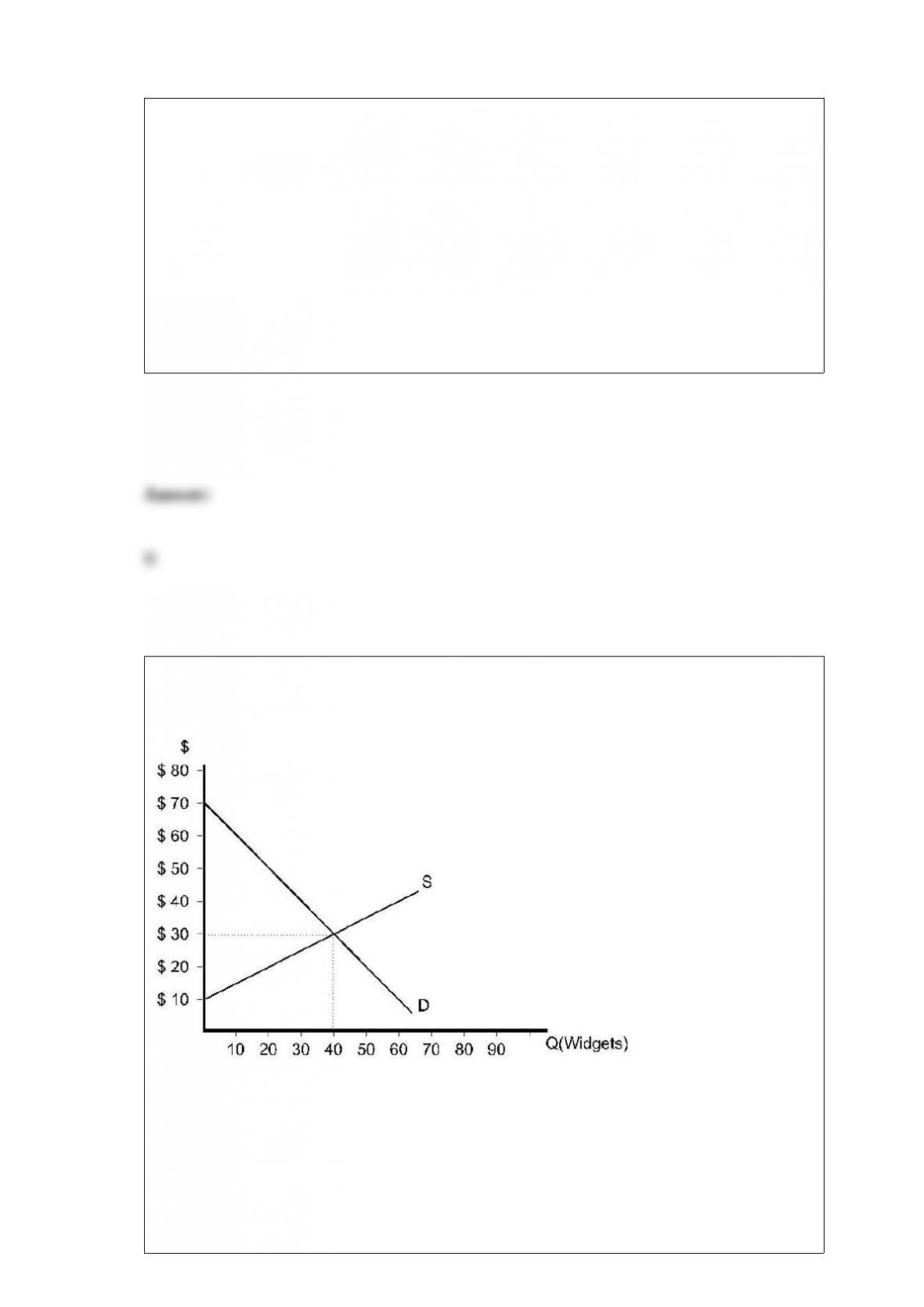
Figure 9.1
Refer to Figure 9.1. If the market is in equilibrium, the consumer surplus earned by the
buyer of the 1st unit is ________.
A) $5.00
B) $15.00

C) $22.50
D) $40.00
In 1994, the Walt Disney Corporation ran a special promotion on tickets to Disneyland.
Residents of southern California who lived near the amusement park were offered
admission at the special price of $22. Other visitors to Disneyland were charged about
$30. This practice is an example of:
A) collusion.
B) price discrimination.
C) two-part tariff.
D) bundling.
E) tying.
Scenario 10.5:
A firm produces garden hoses in California and in Ohio. The marginal cost of producing
garden hoses in the two states and the marginal revenue from producing garden hoses
are given in the following table:
California Ohio

Qc MCc Qo MCo Qc + o MR
1 2 1 3 1 24
2 3 2 4 2 20
3 5 3 6 3 16
4 9 4 8 4 12
5 16 5 12 5 8
6 24 6 17 6 4
Refer to Scenario 10.5. How many garden hoses should be produced in California in
order to maximize profits?
A) 1
B) 2
C) 3
D) 4
E) 5
The problem of production in multi-plant firms with asymmetric information can be
solved by paying the manager
A) a piece rate, some constant amount per unit of output produced.
B) a larger amount for each unit than was paid for the previous unit, to reflect
increasing marginal cost.
C) a smaller amount for each unit than was paid for the previous unit, to reflect
decreasing marginal revenue.
D) an annual bonus that increases with each unit of output up to capacity, and decreases

with each unit of output past capacity.
E) an annual bonus that is calculated decreases with each unit of output up to capacity,
and increases with each unit of output past capacity.
The principle of revealed preference would say that if Xavier chooses market basket A
over market basket B then:
A) if A is more expensive than B, then Xavier must prefer A over B.
B) if A is more expensive than B, then Xavier must prefer B over A.
C) if A is less expensive than B, then Xavier must prefer A over B.
D) if A is less expensive than B, then Xavier must prefer B over A.
Melon Computer Company manufacturers its computer components in Singapore and
assembles the computers intended for sale in North America in its plant in Arizona. If
the U.S. reduces the corporate income tax rate next year, what is the likely outcome for
Melon Computer Company?
A) Reduce the transfer price for computer components and increase downstream profits
B) Reduce the transfer price for computer components and decrease downstream profits
C) Increase the transfer price for computer components and increase downstream
profits

D) Increase the transfer price for computer components and decrease downstream
profits
When the average product is decreasing, marginal product
A) equals average product.
B) is increasing.
C) exceeds average product.
D) is decreasing.
E) is less than average product.
The marginal revenue product can be expressed as the
A) additional revenue received from selling one more unit of product.
B) increment to revenue received from one additional unit of input hired.
C) marginal physical product of an input times the average revenue received from the
sale of the product.
D) average physical product of the input times the marginal revenue received from the
sale of the final product.

Suppose the income-consumption curve for goods X and Y is upward sloping. If the
price of good Y increases and the income-consumption curve rotates in clockwise
fashion, then we know that:
A) X and Y are complements.
B) X and Y are both inferior goods.
C) X and Y are substitutes .
D) Y is an inferior good.
Is it possible for an investor to allocate more than 100% of their assets to the stock
market?
A) No, this is not theoretically plausible.
B) No, federal law prohibits this kind of investment.
C) Yes, investors can borrow money to buy stocks on margin.
D) none of the above

Which of the following is NOT an example of ways in which microeconomic analysis
can help Toyota Motor Corporation its in corporate decision making?
A) Forecasting demand for new automobiles
B) Determining how many automobiles to produce in order to maximize profits
C) Predicting how competitors will react to the firm’s pricing strategy
D) Forecasting the effect of Toyota’s hiring patterns on the U.S. unemployment rate
E) Forecasting the effect of an oil price increase on demand for hybrid autos
Suppose a firm has unavoidable fixed costs of $500,000 per year, and it decides to shut
down. What is the firm’s producer surplus?
A) PS is positive in this case, but we cannot determine the value based on the given
information
B) PS is negative in this case, but we cannot determine the value based on the given
information
C) PS = -$500,000
D) PS = 0

This market situation is much like a pure monopoly except that its member firms tend
to cheat on agreed upon price and output strategies. What is it?
A) Duopoly
B) Cartel
C) Market sharing monopoly
D) Natural monopoly
The substitution effect of a price change for product X is the change in consumption of
X associated with a change in
A) the price of X, with the level of utility held constant.
B) the price of X, with the level of real income not considered.
C) the price of X, with the prices of other goods changing by the same percentage as
that for product X.
D) income, with prices of other goods held constant.
If a firm had a fixed proportions technology, then the pollution produced by this firm

A) cannot be reduced.
B) can be reduced only by lowering the level of output (holding technology constant).
C) can be reduced by changing how the output is produced within the bounds of the
existing technology.
D) can be reduced only by increasing the number of firms in the industry.
E) can be reduced only by changing the technology.
Under which of the following scenarios is it most likely that monopoly power will be
exhibited by firms?
A) When there are few firms in the market and the demand curve faced by each firm is
relatively inelastic.
B) When there are many firms in the market and the demand curve faced by each firm
is relatively inelastic.
C) When there are few firms in the market and the demand curve faced by each firm is
relatively elastic.
D) When there are many firms in the market and the demand curve faced by each firm
is relatively elastic.
Suppose you only consume rice and bananas. Can both of these goods be Giffen goods
in your consumption?
A) Yes, this is possible
B) No, at least one of the goods must be normal
C) No, they both can be inferior, but at least one of the goods cannot be a Giffen good
D) We need more information about the goods to answer this question
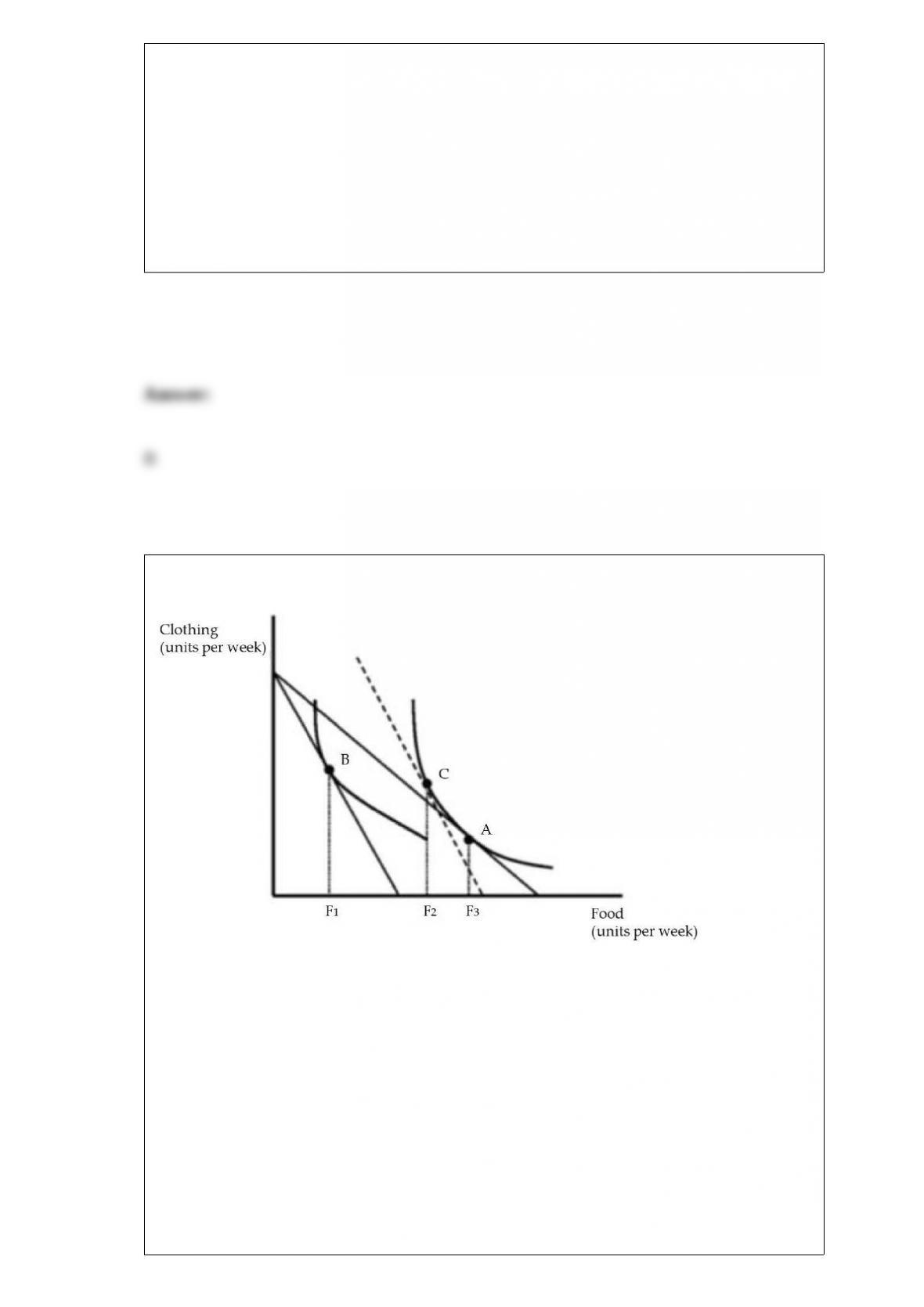
Figure 4.1
A consumer’s original utility maximizing market basket of goods is shown in Figure 4.1
as point A. Following a price change, the consumer’s utility maximizing market basket
changes is at point B.
Refer to Figure 4.1. The substitution effect of the price change in food on the quantity
of food purchased is:
A) the change from F3 to F1.
B) the change from F3 to F2.

C) the change from F2 to F1.
D) the change from F1 to F2.
E) none of the above
The social discount rate is an important component in net present value (NPV)
calculations for public policies related to stock externalities, but economists do not
agree on which value to use for this rate. Suppose a recent study reports that the NPV of
a proposed carbon tax intended to reduce carbon dioxide emissions is positive, but the
annual net benefits do not become positive until 2060. The authors of the study used a
social discount rate of 2%. What can we say about the findings of the study if the
research were repeated with a higher social discount rate?
A) NPV would decline, and the annual net benefits would become positive after 2060.
B) NPV would increase, and the annual net benefits would become positive before
2060.
C) NPV would decline, and the annual net benefits would not change.
D) The findings of the study would not change.
In a problem involving exchange, the contract curve shows
A) all exchanges that make both parties better off.

B) the one exchange that makes both parties better off.
C) all possible allocations of goods between both parties.
D) all possible efficient allocations between both parties.
A plastics factory emits water pollutants into a nearby river. The marginal private cost
of producing plastics and the marginal external cost of the pollutants are both constant
with respect to the quantity of plastics produced. If the demand for plastics is downward
sloping, what happens to the socially optimal level of output and market price if the
demand curve for plastics shifts rightward?
A) Optimal price and quantity increase
B) Optimal price increases, optimal quantity remains unchanged
C) Optimal price remains unchanged, optimal quantity increases
D) Optimal price and quantity remain unchanged
The production function for Cogswell Cogs is y(K, L) = . K represents the
number of robot hours used in the production process while L represents the number of
labor hours. The marginal productivity of a labor hour is MPL = Fill in the
empty columns in the table below. Use the information in the table to sketch Cogswell’s
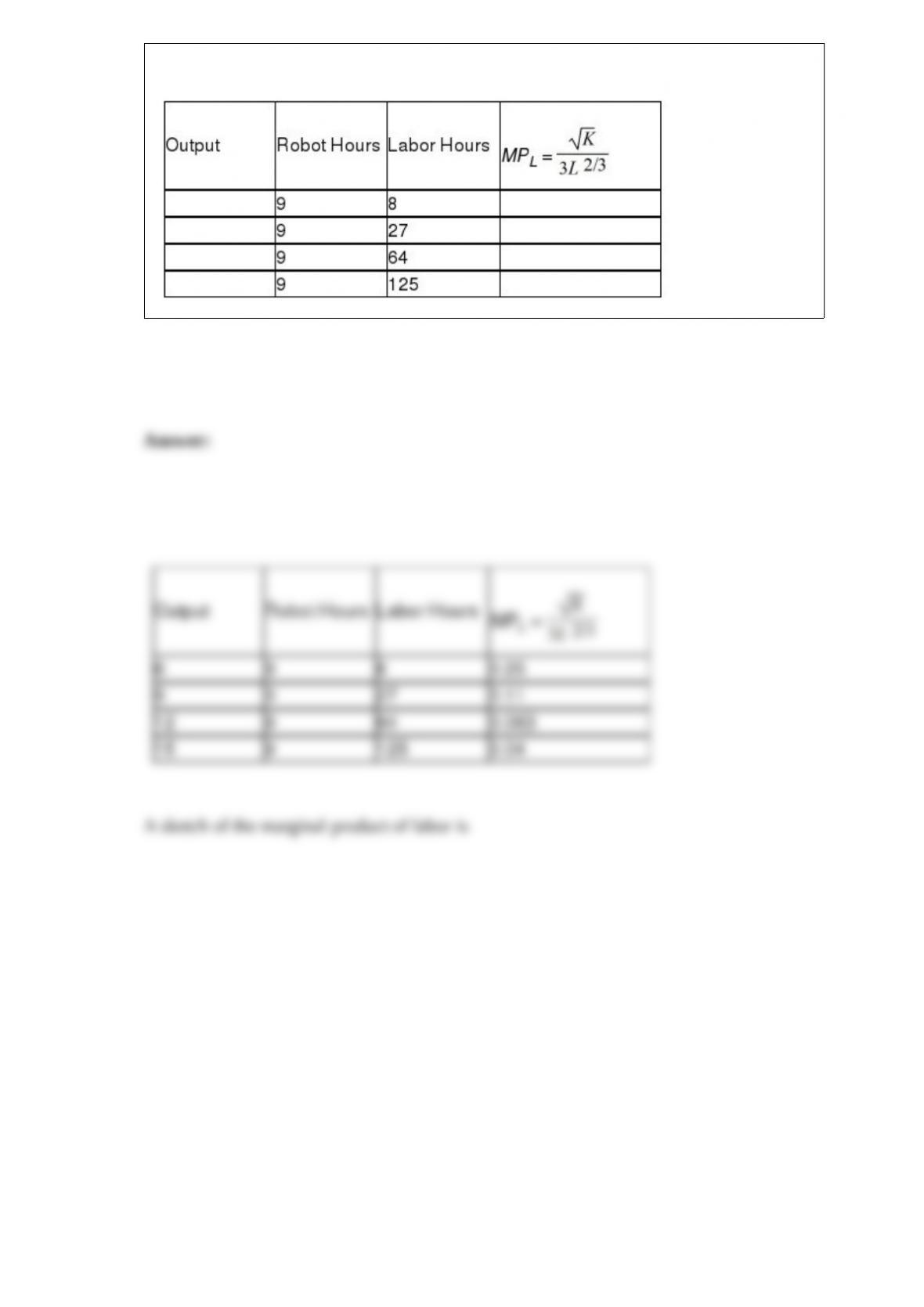
marginal product of labor curve while robot hours are fixed at 9.

In the town of Battle Springs, the market for fast food is dominated by Mr. Berger. The
other companies tend to follow Mr. Berger’s lead in setting price and style of burger.
The total demand for cheeseburgers in Battle Springs is:
P = $1.50 – $0.00015Q.
The marginal cost of producing and serving burgers at Mr. Berger is:
MCL = 0.25 + 0.0000417Q.
The competitive supply curve of burgers by all the other (competitor) firms is:
Pf = 0.50 + 0.000285Qf.
Compute the price that will be set in the market when Mr. Berger behaves as a
dominant firm and maximizes profit for itself. Also, compute the production rate by Mr.
Berger and the competitor firms.

Reginald enjoys hunting whitetail deer. He has a dilemma of deciding each morning
where to locate his hunting stand. Reginald would like to choose the location that gives
him the deer with the highest Pope and Young score in the smallest amount of time.
Reginald will also kill the first deer he sees that offers any Pope and Young score. His
utility is a function of the Pope and Young score (b), time in minutes spent hunting (t)
and wealth in dollars (w) and is given by
U(b, t, w) = – + w. If Reginald chooses stand A, he will kill a deer with Pope and
Young score of 120 in 300 minutes. If Reginald chooses stand B, he will kill a deer with
a Pope and Young score of 190 in 480 minutes. In dollars, how much would Reginald
be willing to give up to learn of the outcomes from each stand?
For each city across the U.S., economists construct a price index for a similar basket of
goods. In Los Angeles the index is 127.3 and the index for Dallas is 94.8. If you have
been offered $137,000 for a job in Los Angeles and $117,000 for a similar job in Dallas,
which job affords you the highest purchasing power of the bundle of goods in the price
index? Use the Los Angeles value as the base.