Given the equations for C, I, G, and NX below, what is the marginal propensity to
consume? C = 2,000 + 0.9Y
I = 2,500
G = 3,000
NX = 400 A) -0.1
B) 0.1
C) 0.9
D) 2000
Which of the following is not an option for a perfectly competitive firm that suffers
short-run losses?
A) shutting down
B) reducing production
C) reducing the use of variable factors
D) raising price
Which of the following is included in both the U.S. GDP and U.S. GNP?
A) the value of all cars produced by General Motors in the United States
B) the value of all cars produced by Ford in Mexico
C) the value of all cars produced by Toyota in the United States
D) the value of all cars produced by Nissan in Japan and the United States
According to Marx, which of the following factors of production did not contribute
anything of value to production?
A) labor
B) capital
C) natural resources
D) entrepreneurship
An increase in government spending may expedite recovery from a recession in the
short run, but in the long run this policy may
A) reduce investment in new capital.
B) make domestic businesses less competitive in international markets as the dollar
appreciates in value.
C) raise interest rates and reduce consumer expenditures on automobiles and new
houses.
D) All of the above are correct.
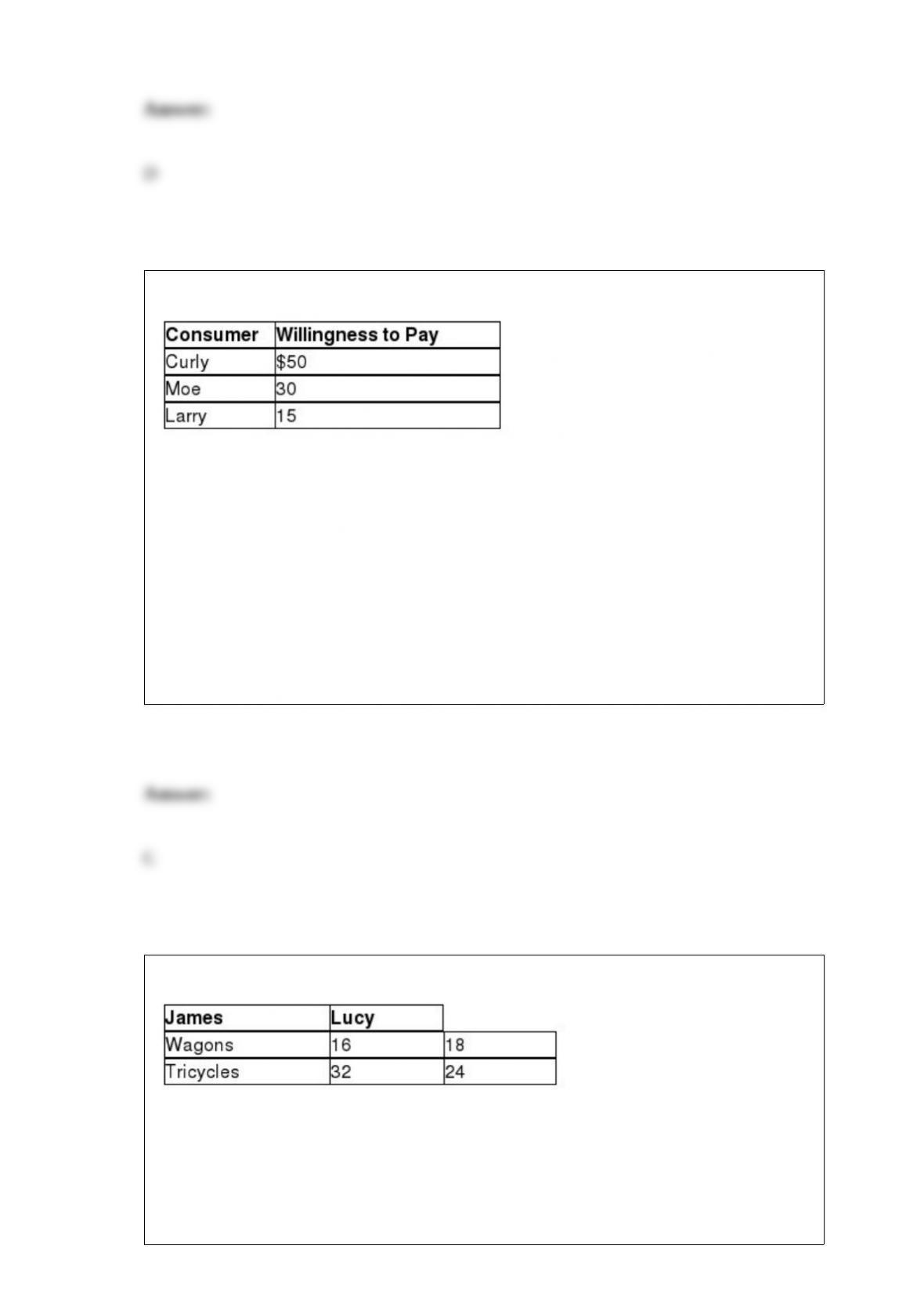
Table 4-4
The table above lists the highest prices three consumers, Curly, Moe, and Larry, are
willing to pay for a bottle of champagne. If the price of one of the bottles is $27 dollars,
total consumer surplus will be
A) $0.
B) $14.
C) $26.
D) $53.
Table 2-6
Table 2-6 shows the output per week of two people, James and Lucy. They can either
devote their time to making bracelets or making necklaces. What is James’s opportunity
cost of making a wagon?
A) 2 tricycles
B) 1/2 of a wagon
C) 1/2 of a tricycle
D) 3/4 of a wagon
Which of the following statements is true?
A) If a tax is imposed on a product sold by a monopolist, the monopolist will maximize
its profits by producing where marginal revenue equals marginal cost.
B) A monopolist will always charge the highest possible price.
C) If a tax is imposed on a product sold by a monopolist, the monopolist can increase
its price to pass along the entire tax to consumers.
D) Because a monopolist faces no competition, the demand for its product is perfectly
inelastic.
During the recession phase of the business cycle,
A) production is usually rising.
B) interest rates are usually falling.
C) unemployment is usually falling.
D) income is usually rising.
In the United States today, the Federal Reserve will give you ________ in exchange for
$1.
A) 1/35 of an ounce of gold
B) $1 worth of gold (based on the market price of an ounce of gold at the time you
redeem the gold)
C) 1 ounce of gold
D) no gold
a. What is the defining characteristic of a natural monopoly?
b. Should the government break up a natural monopoly into two or more firms to make
the industry more competitive?
c. Suppose the government wants to ensure that some of the benefits of declining
average total cost are passed on to consumers. To achieve this goal, it requires that the
natural monopoly set its price equal to marginal cost. Is this a feasible goal? Explain.
d. What is an alternative to marginal cost pricing that ensures that consumers reap some
of the benefits of declining average total cost?