1) the expenditures and income approaches to gdp are expected to yield identical results
because goods that are not sold in one year will be sold in some following year.
2) the marginal tax rate is the tax rate that applies to additional income.
3) indifference curves are linear and budget lines are convex to the origin.
4) terms of trade of 1x=5y will be acceptable to two countries that have domestic
opportunity costs of 1x=4y and 1x=1y, respectively.
5) Although state and local taxes are highly progressive, Federal taxation is
predominantly regressive.
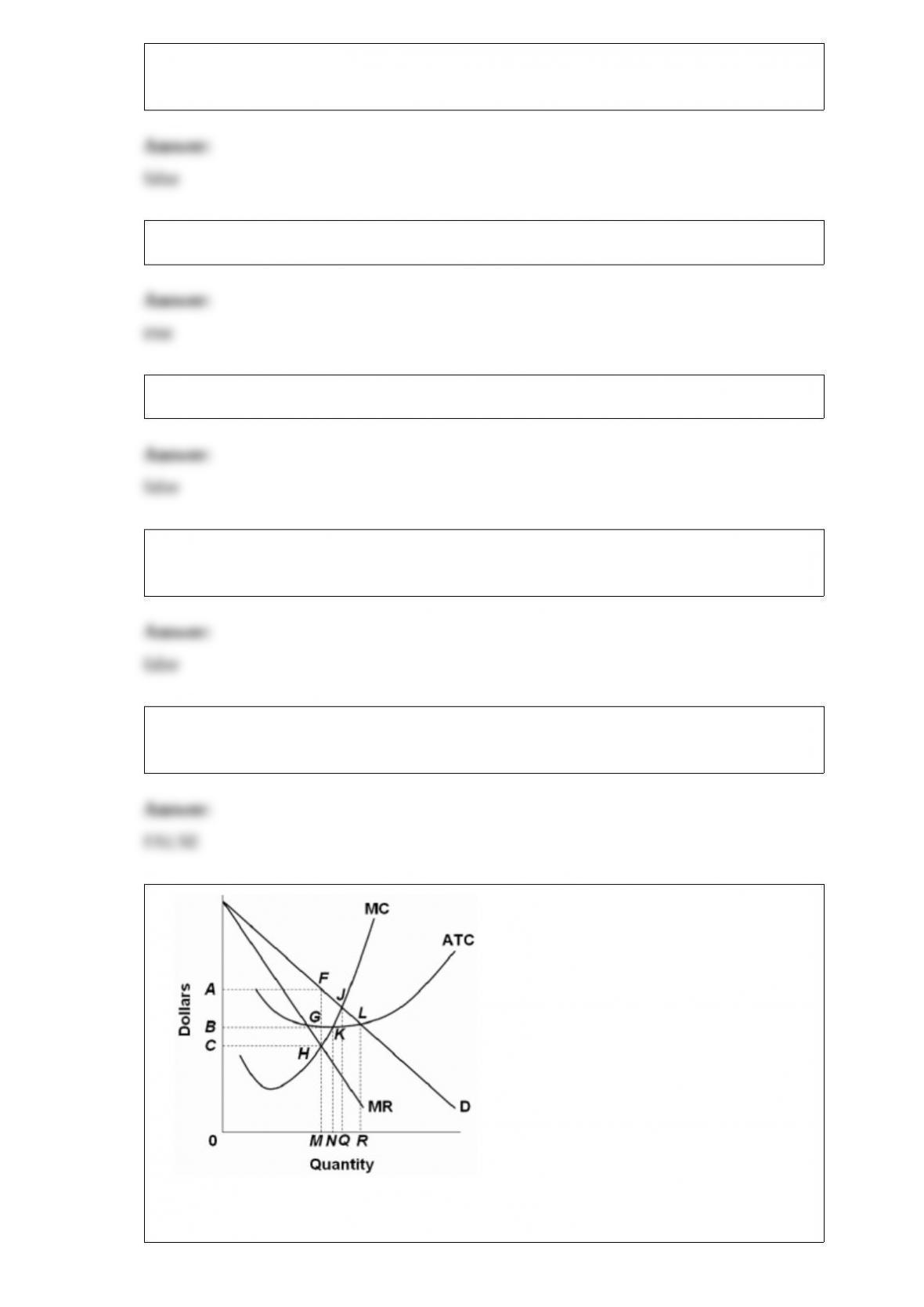
6)
refer to the above diagram for a nondiscriminating monopolist. at output q production
will be unprofitable.
7) During the Great Depression most nations lowered tariffs and abolished import
quotas to encourage the flow of trade.
8) The real-business cycle theorists see aggregate supply as the “active” factor in
causing business cycles and aggregate demand as a “passive” factor.
9) in descending order the three most important sources of federal tax revenue are the
personal income tax, payroll taxes, and corporate income taxes.
10) Approximately $450 billion of U.S. currency is circulating in foreign countries.
11) a pure monopolist should never produce in the:
a.elastic segment of its demand curve because it can increase total revenue and reduce
total cost by lowering price.
b.inelastic segment of its demand curve because it can increase total revenue and reduce
total cost by increasing price.
c.inelastic segment of its demand curve because it can always increase total revenue by
more than it increases total cost by reducing price.
d.segment of its demand curve where the price elasticity coefficient is greater than one.
12) Suppose the transportation industry has been regulated for many years. Government
now proposes to deregulate the industry, only to find that firms in the industry oppose
this action. This is consistent with the:
A.public interest theory of regulation.
B.theory of natural monopolies.
C.legal cartel theory of regulation.
D.Alcoa and U.S. Steel court decisions.
13) because of higher corn prices, firms producing corn-based products have
experienced:
a.an upward shift in their mc, avc, and atc curves.
b.an upward shift in their afc, avc, and atc curves.
c.a downward shift in their mc, afc, and avc curves.
d.greater economies of scale
14) An efficiency wage is:
A.a below-market wage.
B.an above-market wage.
C.a “wage” that contains a profit-sharing component.
D.a wage that is free to rise or fall from day to day, depending on labor supply and
demand.
15) According to monetarists, a change in the money supply changes:
A.the velocity of money which in turn changes the nominal GDP.
B.investment spending which in turn changes the nominal GDP.
C.the interest rate which in turn changes the nominal GDP.
D.aggregate demand which in turn changes the nominal GDP.
16) What percentage of the average firm’s costs are accounted for by wages and
salaries?
A.40
B.60
C.75
D.85
17) the main determinant of elasticity of supply is the:
a.number of close substitutes for the product available to consumers.
b.amount of time the producer has to adjust inputs in response to a price change.
c.urgency of consumer wants for the product.
d.number of uses for the product.
18) The Federal funds rate is:
A.higher than both the prime interest rate and the discount rate.
B.lower than both the prime interest rate and the discount rate.
C.higher than the prime interest rate but lower than the discount rate.
D.lower than the prime interest rate but higher than the discount rate.
19) the following table applies to a purely competitive industry composed of 100
identical firms.
refer to the above table. if each of the 100 firms in the industry is maximizing its profit
and earning only a normal profit, each must have a total cost of:
a.$18,000.
b.$20,000.
c.$22,000.
d.$24,000.
20) the separation of ownership and control in a corporation means that:
a.hired managers play a larger role in determining company policy than do a
corporation’s legal owners.
b.the ownership of corporations is becoming increasingly concentrated in the hands of a
few common stockholders.
c.a firm’s board of directors has no power over hired managers.
d.stockholders have lost their voting privileges.
21) The median-voter model implies that a political office seeker will:
A.adopt more extreme views when seeking his or her party’s nomination than when
running against the other party’s opponent.
B.adopt less extreme views when seeking his or her party’s nomination than when
running against the other party’s opponent.
C.favor extensive government spending because demand curves for public goods are
added vertically rather than horizontally.
D.favor the private resolution of externality problems rather than governmental
intervention.
22) Suppose a single firm has the marginal revenue product schedule for a particular
type of labor given in the following table.
(a)Assume there are 150 firms with the same marginal-revenue-product schedules for
this particular type of labor. Compute the total or market demand for this labor by
completing column 1 in the table below.
(b)What will be the equilibrium wage rate and how many workers will be hired?
(c)What will be the marginal labor cost and wage rate for the individual firm? How
many workers will the firm employ?
(d)How would the imposition of a $9 minimum wage rate change the total amount of
labor hired in this market?
23) Explain how changes in relative income affect the value of a nations currency.
24) Is there a trade-off between wage increases for union members and employment?
Explain.
25) How does the trading of pollution rights work in the Clean Air Act of 1990?
26) Describe how the Federal Reserve handled the monetary policy from 19902008.
What type of economic events did it face and how did it use monetary policy to address
them?
27) How have firms and organizations devised ways to overcome information problems
without government intervention? Give three examples.
28) Pure competition or pure monopoly industries will tend to be one-price industries.
Monopolistic competition, however, is a multiprice industry. Explain.
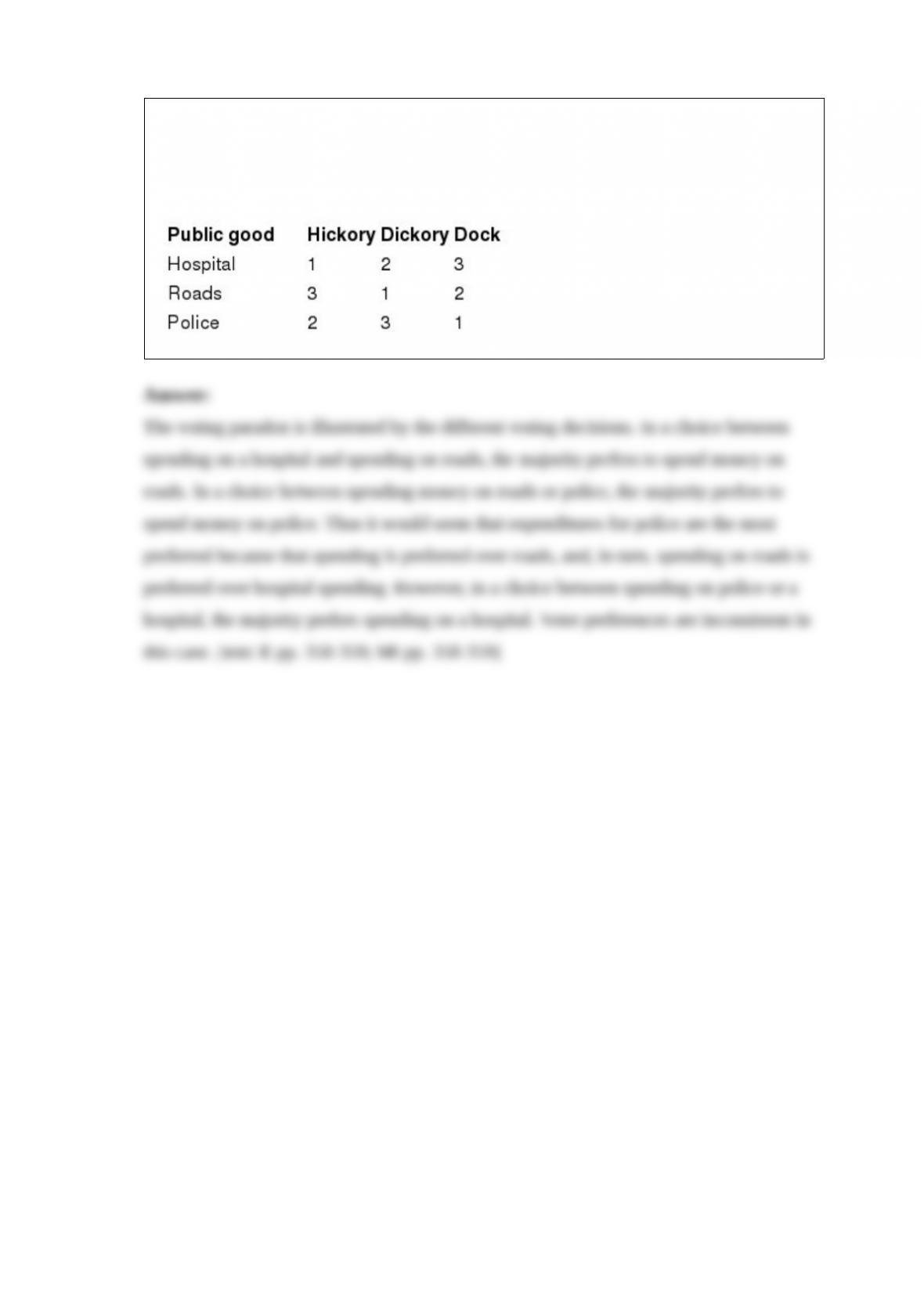
29) Explain the paradox of voting that is illustrated in the table below in choices
between the same expenditure on three different public goods. The numbers under each
name indicate the voting preferences (first, second, or third choice) of each of the three
citizens in the society.