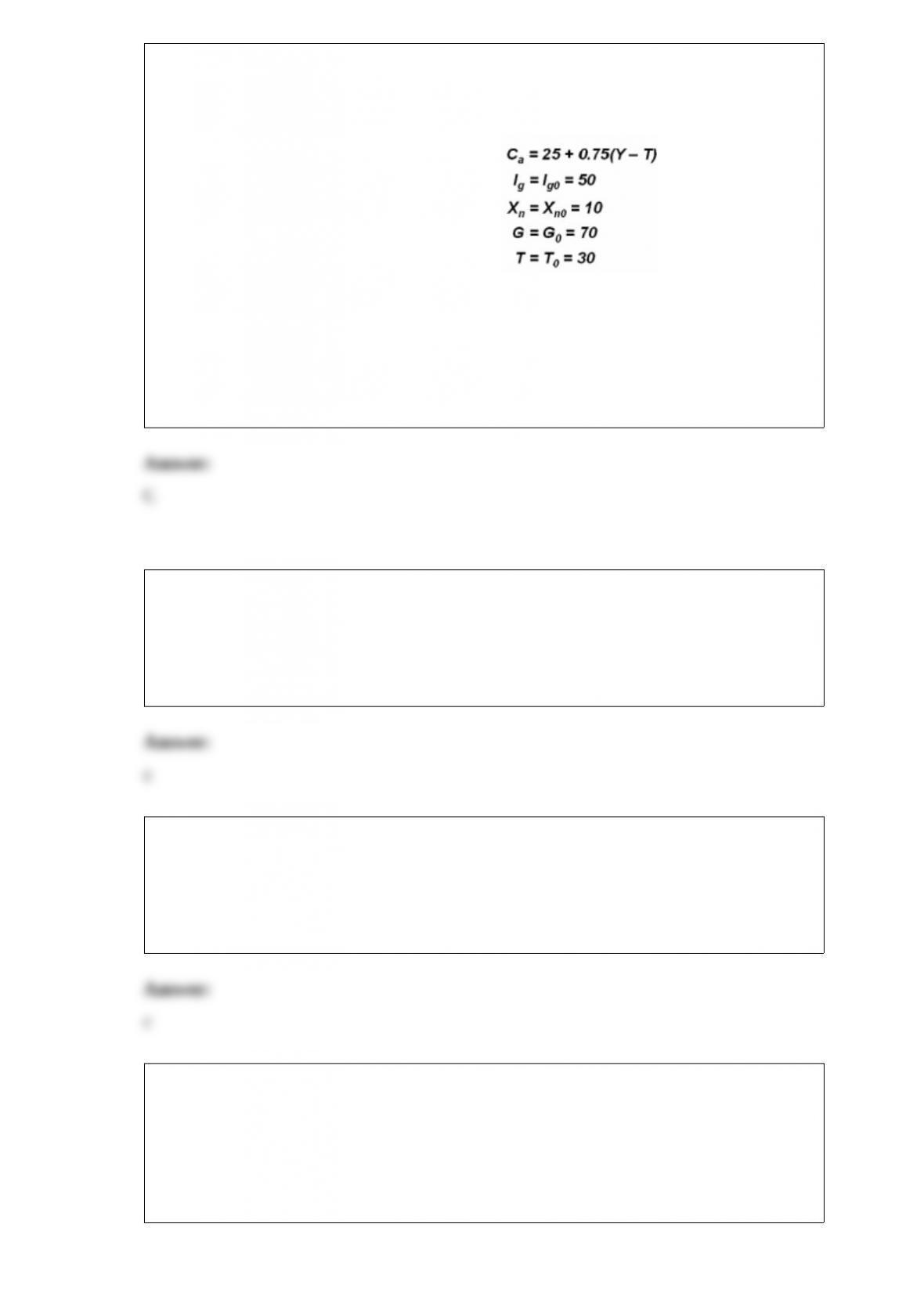
1) (Advanced analysis) Answer the next question(s) on the basis of the following
information for a mixed open economy. The letters Y, Ca, Ig, Xn, G, and T stand for
GDP, consumption, gross investment, net exports, government purchases, and net taxes
respectively. Figures are in billions of dollars.
Refer to the above information. If government desired to raise the equilibrium GDP to
$650, it could:
A.raise G by $45 and reduce T by $10.
B.raise G by $40 and reduce T by $30.
C.raise G by $30 or reduce T by $40.
D.raise both G and T by $40.
2) the slope of a line parallel to the vertical axis is:
a.zero.
b.one.
c.infinite.
d.one-half.
3) microeconomics:
a.is the basis for the “after this, therefore because of this” fallacy.
b.is not concerned with details, but only with the overall big picture of the economy.
c.is concerned with individual economic units and specific markets.
d.describes the aggregate flows of output and income.
4) suppose that a person’s nominal income rises by 5 percent and the price level rises
from 125 to 130. the person’s real income will:
a.fall by about 1 percent.
b.remain constant.
c.rise by about 4 percent.
d.rise by about 1 percent.
5)
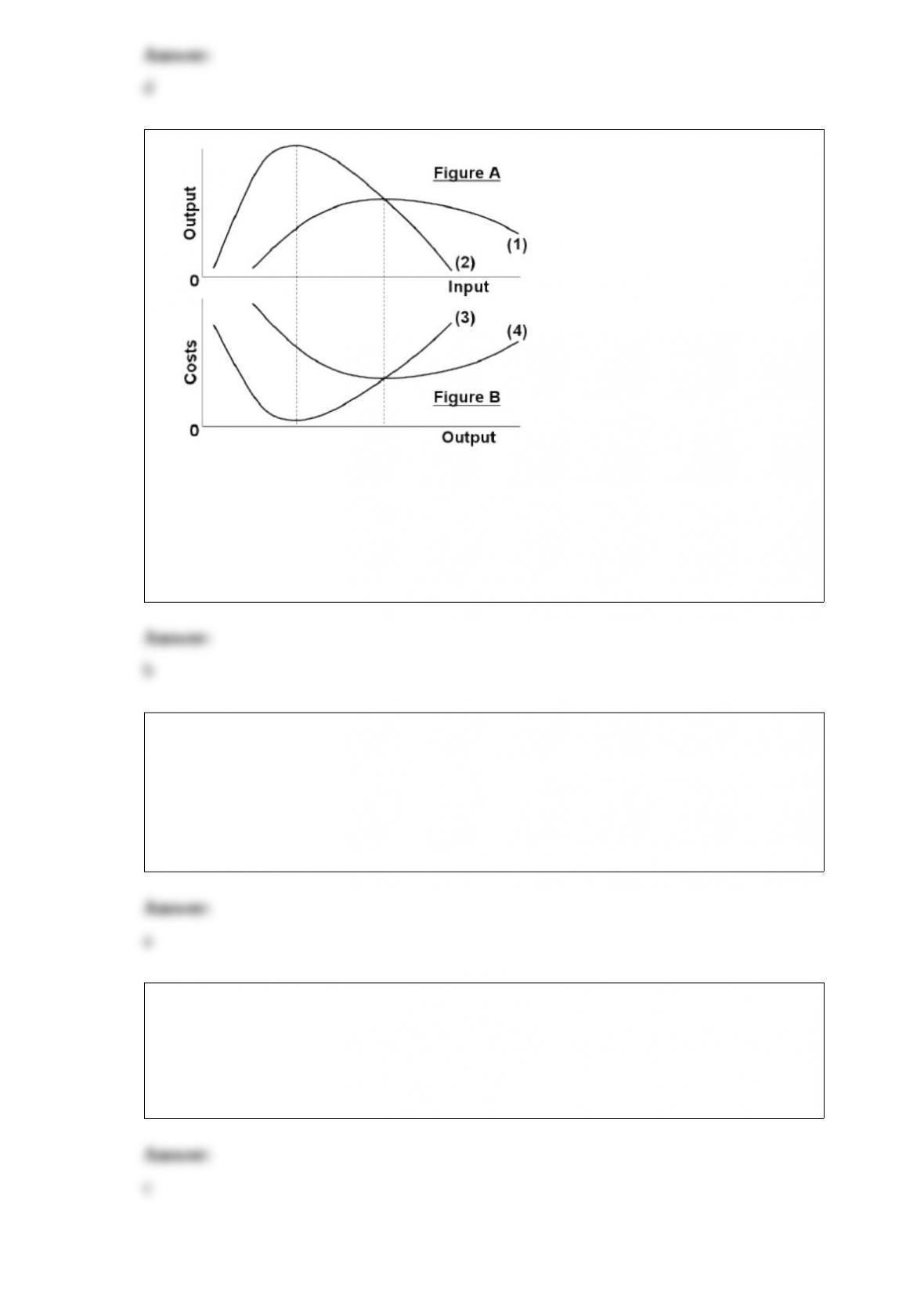
refer to the above short-run production and cost data. the curves of figures a and b
suggest that:
a.marginal product and marginal cost reach their maximum points at the same output.
b.marginal cost reaches a minimum where marginal product is at its maximum.
c.marginal cost and marginal product reach their minimum points at the same output.
d.avc cuts mc at the latter’s minimum point.
6) when economists say that people act rationally in their self interest, they mean that
individuals:
a.look for and pursue opportunities to increase their utility.
b.generally disregard the interests of others.
c.are mainly creatures of habit.
d.are unpredictable.
7) the stabilization function of government involves government’s efforts to:
a.alter the output of specific goods when external costs or benefits are present.
b.reduce the after-tax incomes of the rich and increase the after-tax incomes of the poor.
c.deal with the problems of substantial unemployment and rapid inflation.
d.provide the socially desired output of public goods.
8) consumption of fixed capital (depreciation) can be determined by:
a.adding taxes on production and imports to ndp.
b.subtracting ndp from gdp.
c.subtracting net investment from gdp.
d.adding net investment to gross investment.
9) proponents of economic growth make all of the following arguments except:
a.growth is the basic means of improving living standards.
b.it is easier to reduce poverty when the economy is growing than when it is not.
c.there is a direct relationship between a growing real gdp and rising pollution.
d.growth provides an economic environment favorable to education and
self-fulfillment.
10) In 2007, the public debt was about:
A.$9 trillion.
B.$7.9 trillion.
C.$470 billion.
D.$184 billion.
11) The velocity of money is equal to:
A.1/MPS.
B.1/reserve ratio.
C.M/GDP.
D.none of these.
12) The sale of government bonds by the Federal Reserve Banks to commercial banks
will:
A.increase aggregate supply.
B.decrease aggregate supply.
C.increase aggregate demand.
D. decrease aggregate demand.

13) the following is cost information for the creamy crisp donut company:
entrepreneur’s potential earnings as a salaried worker = $50,000
annual lease on building = $22,000
annual revenue from operations = $380,000
payments to workers = $120,000
utilities (electricity, water, disposal) costs = $8,000
value of entrepreneur’s talent in the next best entrepreneurial activity = $80,000
entrepreneur’s forgone interest on personal funds used to finance the business = $6,000
refer to the above data. if, other things equal, creamy crisp’s revenue fell to $286,000:
a.its implicit costs, including a normal profit, would exceed its explicit costs.
b.it would earn a normal profit but not an economic profit.
c.it would suffer an economic loss.
d.its accounting profit would fall to zero.
14) (Last Word) In 2001, Microsoft was found guilty of violating:
A.Section 7 of the Clayton Act.
B.Sections 1 and 2 of the Sherman Act.
C.the Federal Trade Commission Act.
D.Section 20 of the Wagner Act.
15) search unemployment and wait unemployment are types of:
a.frictional unemployment.
b.structural unemployment.
c.deficient-demand unemployment.
d.cyclical unemployment.