
Since the Federal Reserve sets the required reserve ratio to less than one, one dollar of
reserves can support ________ of checkable deposits.
a. exactly one dollar
b. less than one dollar
c. more than one dollar
d. exactly twice the amount
Answer:
High interest rates might cause a corporation to ________ building a new plant that
would provide more jobs.
A. complete
B. consider
C. postpone
D. contemplate
Answer:
FIRREA increased the core-capital leverage requirement for thrift institutions from 3%
to

A. 8%.
B. 5%.
C. 10%.
D. 25%
Answer:
When bad drivers line up to purchase collision insurance, automobile insurers are
subject to the
A. moral hazard problem.
B. adverse selection problem.
C. assigned risk problem.
D. ill queue problem.
Answer:
In the Keynesian model the quantity of money demanded is ________ related to income
and ________ related to the interest rate.
A. positively; positively

B. positively; negatively
C. negatively; negatively
D. negatively; positively
Answer:
In the simple model of multiple deposit creation in which banks do not hold excess
reserves, the increase in checkable deposits equals the product of the change in reserves
and the
A. reciprocal of the excess reserve ratio.
B. simple deposit expansion multiplier.
C. reciprocal of the simple deposit multiplier.
D. discount rate.
Answer:
The rational expectations hypothesis implies that when macroeconomic policy changes
A. the economy will become highly unstable.
B. the way expectations are formed will change.

C. people will be slow to catch on to the change.
D. people will make systematic mistakes.
Answer:
The Japanese banking system went through a cycle of ________ in the 1990s similar to
the one that occurred in the U.S. in the 1980s.
A. regulatory forbearance
B. policy antagonism
C. regulatory ignorance
D. policy renewal
Answer:
Everything else held constant, aggregate demand increases when
A. net exports decrease.
B. taxes increase.
C. planned investment spending increases.

D. the money supply decreases.
Answer:
________ is used to make purchases while ________ is the total collection of pieces of
property that serve to store value.
A. Money; income
B. Wealth; income
C. Income; money
D. Money; wealth
Answer:
Which of the following is an advantage to money targeting?
A. There is an immediate signal on the achievement of the target.
B. It does not rely on a stable money-inflation relationship.
C. It implies lack of transparency.
D. It implies smaller output fluctuations.

Answer:
To prevent bank runs and the consequent bank failures, the United States established the
________ in 1934 to provide deposit insurance.
A. FDIC
B. SEC
C. Federal Reserve
D. ATM
Answer:
Approaches to establishing central bank credibility include
A. continued success at keeping inflation under control.
B. central bank independence.
C. appointment of a more conservative central banker.
D. all of the above.
Answer:

An instrument developed to help investors and institutions hedge interest-rate risk is
A. a debit card.
B. a credit card.
C. a financial derivative.
D. a junk bond.
Answer:
A person remodeling her house could obtain a loan from a
A. sales finance company.
B. consumer finance company.
C. business finance company.
D. public finance company.
Answer:

Everything else held constant, an increase in the time deposit ratio will result in
________ in the M1 money multiplier and ________ in the M2 money multiplier.
a. an increase; an increase
b. no change; an increase
c. a decrease; a decrease
d. no change; a decrease
Answer:
Under a fixed exchange rate regime, if a country’s central bank runs out of international
reserves, it cannot keep its currency from
A) depreciating.
B) appreciating.
C) deflating.
D) inflating.
Answer:
The share of checkable deposits in total bank liabilities has

A. expanded moderately over time.
B. expanded dramatically over time.
C. shrunk over time.
D. remained virtually unchanged since 1960.
Answer:
One advantage of using swaps to eliminate interest-rate risk is that swaps
A. are less costly than futures.
B. are less costly than rearranging balance sheets.
C. are more liquid than futures.
D. have better accounting treatment than options.
Answer:
The reduction of brokerage commissions for trading common stocks that occurred in
1975 caused the demand for bonds to ________ and the demand curve to shift to the
________.
A. fall; right

B. fall, left
C. rise; right
D. rise; left
Answer:
Which policy measure increased the SEC budget to supervise securities markets?
A. Sarbanes-Oxley Act of 2002
B. Global Legal Settlement of 2002
C. Gramm-Leach-Bliley Act of 1999
D. Riegle-Neal Act of 1994
Answer:
The United States chooses to have ________ and ________ and therefore, cannot have
a fixed exchange rate at the same time.
A) capital control; an independent monetary policy
B) free capital mobility; an independent monetary policy
C) free capital mobility; no control of monetary policy

D) capital control; no control of monetary policy
Answer:
The equation of exchange is
A. M × P = V × Y.
B. M + V = P + Y.
C. M + Y = V + P.
D. M × V = P × Y.
Answer:
Suppose the economy is producing at the natural rate of output. An increase in
consumer and business confidence will cause ________ in real GDP in the short run
and ________ in inflation in the short run, everything else held constant.
A. an increase; an increase
B. a decrease; a decrease
C. no change; an increase
D. no change; a decrease

Answer:
A consol paying $20 annually when the interest rate is 5 percent has a price of
A. $100.
B. $200.
C. $400.
D. $800.
Answer:
The chartering process is similar to ________ potential borrowers and the restriction of
risk assets by regulators is similar to ________ in private financial markets.
A. screening; restrictive covenants
B. screening; branching restrictions
C. identifying; branching restrictions
D. identifying; credit rationing
Answer:

Which of the following are investment intermediaries?
A. life insurance companies
B. mutual funds
C. pension funds
D. state and local government retirement funds
Answer:
The fixed exchange rate regime established at a meeting in New Hampshire in 1944 has
been known as the
A) General Agreement on Tariffs and Trade.
B) Bretton Woods system.
C) International Settlement Fund.
D) Balance of Payments Compliance Accord.
Answer:

An advantage to American banks from operating foreign branches is that Eurodollar
deposits in offshore branches are
A) not subject to reserve requirements.
B) insured by the FDIC.
C) subject to extensive regulatory supervision.
D) all demand deposits that pay no interest.
Answer:
To convert a nominal GDP to a real GDP, you would use
A. the PCE deflator.
B. the CPI measure.
C. the GDP deflator.
D. the PPI measure.
Answer:
An increase in productivity in a country will cause its currency to ________ because it

can produce goods at a ________ price, everything else held constant.
A. depreciate; lower
B. appreciate; lower
C. depreciate; higher
D. appreciate; higher
Answer:
Describe what the liquidity trap is. Explain how it can be problematic for monetary
policymakers.
Answer:
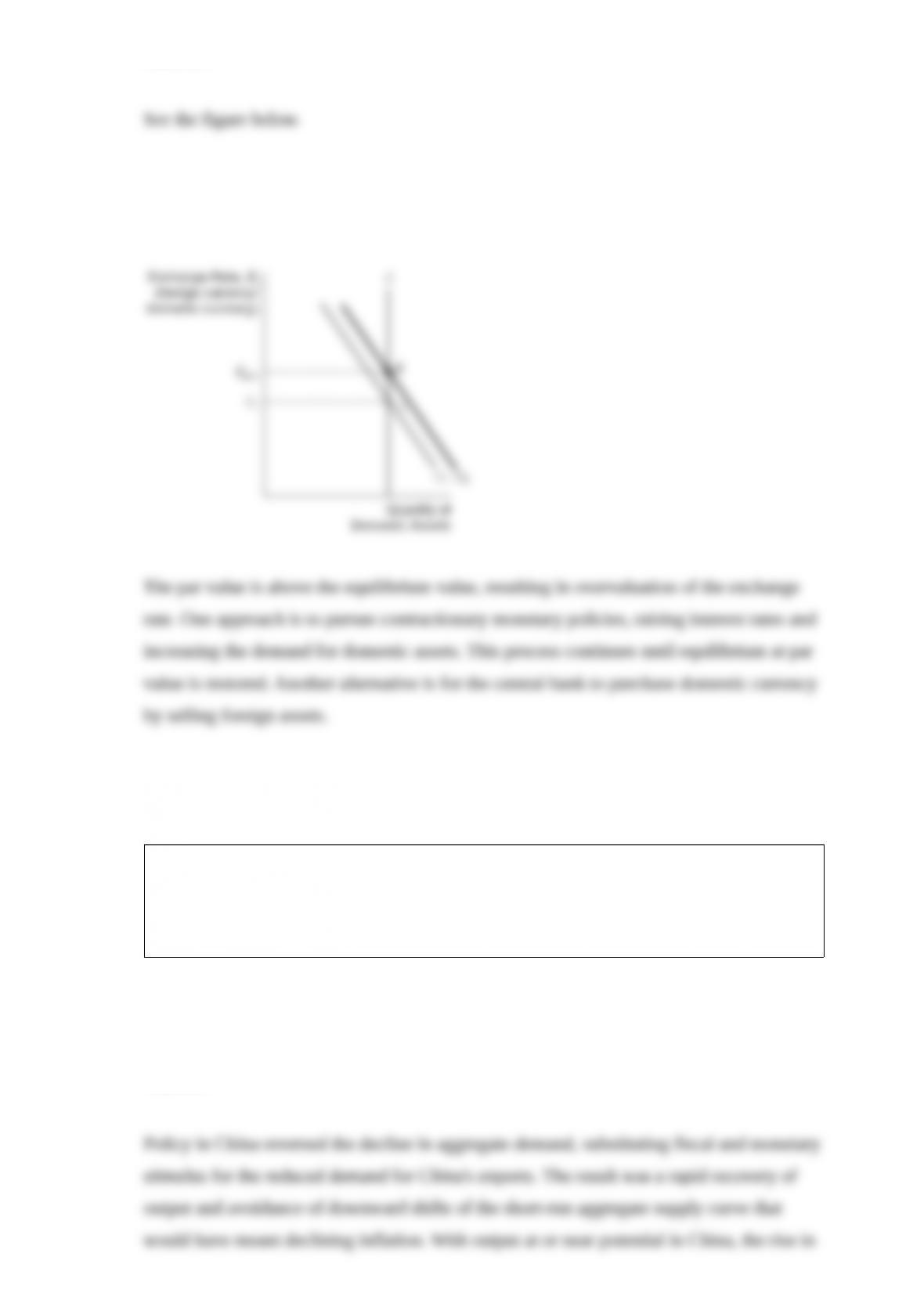
Explain and demonstrate graphically the situation of an overvalued exchange rate in a
fixed exchange rate system. What alternative policies are available to eliminate the
overvaluation of the exchange rate?
Answer:
As of 2009, China’s economy had recovered from the global recession that began in
2008. Use aggregate demand and aggregate supply analysis to explain why, and to
explain the likely consequences for China of an increase in the growth rate of the global
economy.
Answer:

What is the theory of bureaucratic behavior and how can it be used to explain the
behavior of the Federal Reserve?
Answer:
Explain the complete formula for the M1 money supply, and explain how changes in
required reserves, excess reserves, the currency ratio, the nonborrowed base, and
borrowed reserves affect the money supply.
Answer:
The spread between the interest rates on Baa corporate bonds and U.S. government
bonds is very large during the Great Depression years 1930-1933. Explain this
difference using the bond supply and demand analysis.
Answer:
Explain the law of one price and the theory of purchasing power parity. Why doesn’t
purchasing power parity explain all exchange rate movements in the short run? What
factors determine long-run exchange rates?
Answer:
Why does the Federal Reserve Bank of New York play a special role within the Federal
Reserve System?
Answer:
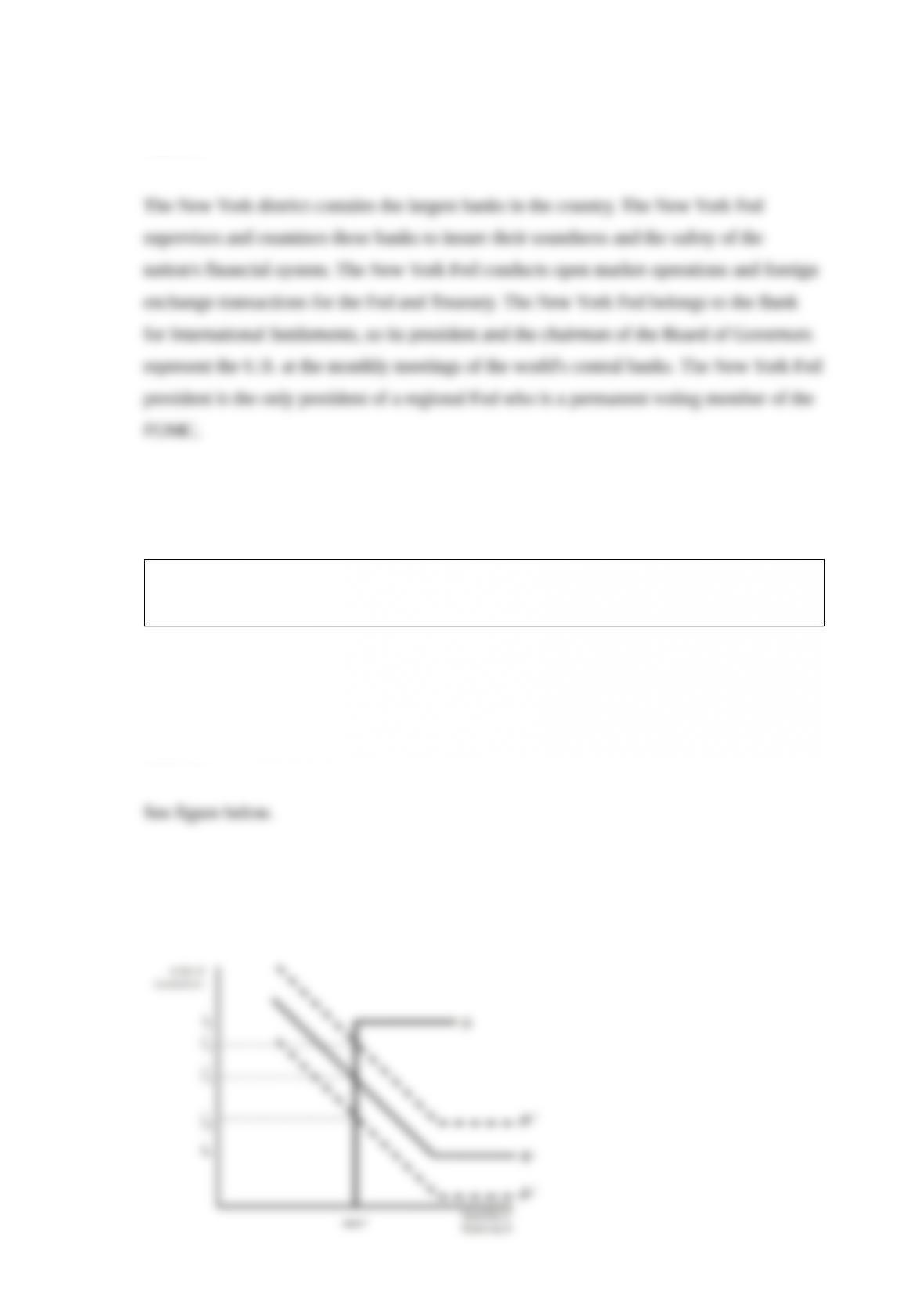
Explain and demonstrate graphically how targeting nonborrowed reserves can result in
federal funds rate instability.
Answer:

What financial innovations helped banks to get around the bank branching restrictions
of the McFadden Act?
Answer:
Why does the free-rider problem occur in the debt market?
Answer:
Explain the type of conflicts of interest that can arise from the development of universal
banking.
Answer:
Because there is an imbalance of information in a lending situation, we must deal with
the problems of adverse selection and moral hazard. Define these terms and explain
how financial intermediaries can reduce these problems.
Answer:

Discuss three channels by which monetary policy affects stock prices and aggregate
spending.
Answer:
Make the case for and against an independent Federal Reserve.
Answer:

What is a stock? How do stocks affect the economy?
Answer:
In the Baumol-Tobin model, given that total costs for an individual equals + ,
where T0 = monthly income, b = brokerage costs, and C = amount raised from each
bond transaction, derive the so-called square root rule.
Answer:

Explain what inflation targeting is. What are the advantages and disadvantages of this
type of monetary policy strategy?
Answer:

Explain through the component parts of aggregate demand why the aggregate demand
curve slopes down with respect to the inflation rate. Be sure to discuss two channels
through which changes in inflation rates affect demand.
Answer:
How does a mutual fund lower transactions costs through economies of scale?
Answer: