
Two interpretations of the IS“LM model are that the model explains:
A) the determination of income in the short run when prices are fixed, or what shifts the
aggregate demand curve.
B) the short-run quantity theory of income, or the short-run Fisher effect.
C) the determination of investment and saving, or what shifts the liquidity preference
schedule.
D) changes in government spending and taxes, or the determination of the supply of
real money balances.
The Taylor rule can be written as FF rate = p + 2.0 + 0.5 (p ” 2.0) + 0.5(GDP gap),
where FF rate is the nominal federal funds rate, p is the inflation rate, and the GDP gap
is the percentage deviation of real GDP from its natural level. If inflation is 2 percent
and the GDP gap is “2 percent, then according to the Taylor rule, the Fed should set the
nominal federal funds rate at _____ percent.
A) 2
B) 3
C) 4
D) 5

In the IS”LM model, a decrease in output would be the result of a(n):
A) decrease in taxes.
B) increase in the money supply.
C) increase in money demand.
D) increase in government purchases.
According to the monetary policy rule, the central bank sets the nominal interest rate so
that the real interest rate increases when inflation ____ its target, or output ____ its
natural level.
A) rises above; rises above
B) rises above; falls below
C) falls below; falls below
D) falls below; rises above
Research indicates that greater central-bank independence is correlated with:
A) higher average growth rates of real GDP.
B) lower rates of unemployment.

C) lower and more stable rates of inflation.
D) less volatility of real GDP.
Wage rigidity:
A) forces labor demand to equal labor supply.
B) is caused by sectoral shifts.
C) prevents labor demand and labor supply from reaching the equilibrium level.
D) increases the rate of job finding.
All of the following actions increase government purchases of goods and services
except the:
A) federal government’s sending a Social Security check to Betty Jones.
B) federal governments sending a paycheck to the president of the United States.
C) federal government’s buying a Patriot missile.
D) city of Boston’s buying a library book.

When there is structural unemployment, the real wage is:
A) rigid at a level below the market-clearing level.
B) rigid at the market-clearing level.
C) rigid at a level above the market-clearing level.
D) flexible.
National income differs from net national product by an amount called:
A) depreciation.
B) indirect business taxes.
C) statistical discrepancy.
D) net foreign factor income payments.
In the Solow model with technological progress, by increasing the efficiency of labor at
rate g:
A) the real wage and the real rental price of capital both grow at rate g.
B) the real wage grows at rate g but the real rental price of capital is constant.
C) the real wage is constant but the real rental price of capital grows at rate g.
D) both the real wage and the real rental price of capital are constant.
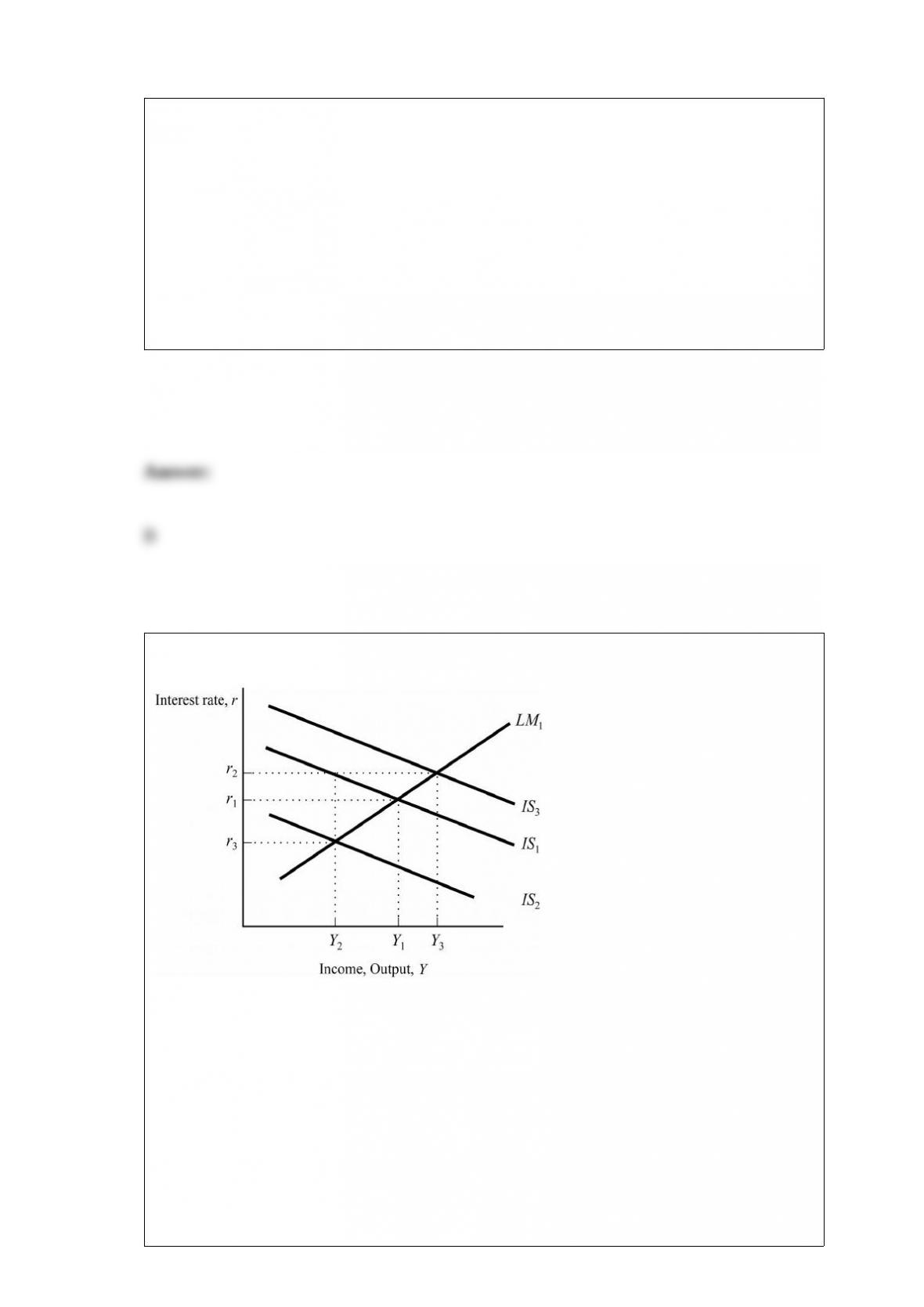
Exhibit: IS”LM Fiscal Policy
(Exhibit: IS“LM Fiscal Policy) Based on the graph, starting from equilibrium at interest
rate r1 and income Y1, a tax cut would generate the new equilibrium combination of
interest rate and income:
A) r2, Y2
B) r3, Y2
C) r2, Y3

D) r3, Y3
Assume that the production function is Cobb”Douglas with parameter a = 0.3. If factors
are paid their marginal products, capital and labor, respectively, receive the shares of
income:
A) 0.3 and 0.3.
B) 0.7 and 0.7.
C) 0.3 and 0.7.
D) 0.7 and 0.3.
In the short run an adverse supply shock causes:
A) both prices and output to rise.
B) prices to rise and output to fall.
C) prices to fall and output to rise.
D) both prices and output to fall.

If y = k1/2, the country saves 10 percent of its output each year, and the steady-state
level of capital per worker is 4, then the steady-state levels of output per worker and
consumption per worker are:
A) 2 and 1.6, respectively.
B) 2 and 1.8, respectively.
C) 4 and 3.2, respectively.
D) 4 and 3.6, respectively.
All of the following events are consistent with the spending hypothesis as contributing
to the Great Depression except:
A) the decline in investment spending on housing because of a decline in immigration
in the 1930s.
B) the decline in consumption spending caused by the stock market crash of
C) fiscal policy to reduce the budget deficit by raising taxes in 1932.
D) the 25-percent reduction in the money supply between 1929 and 1933.

If an economy with no population growth or technological change has a steady-state
MPK of 0.125, a depreciation rate of 0.1, and a saving rate of 0.225, then the
steady-state capital stock:
A) is greater than the Golden Rule level.
B) is less than the Golden Rule level.
C) equals the Golden Rule level.
D) could be either above or below the Golden Rule level.
A competitive firm chooses the:
A) price at which to sell the product produced.
B) wage to pay labor.
C) quantity of labor and capital to employ.
D) rental price to pay capital.
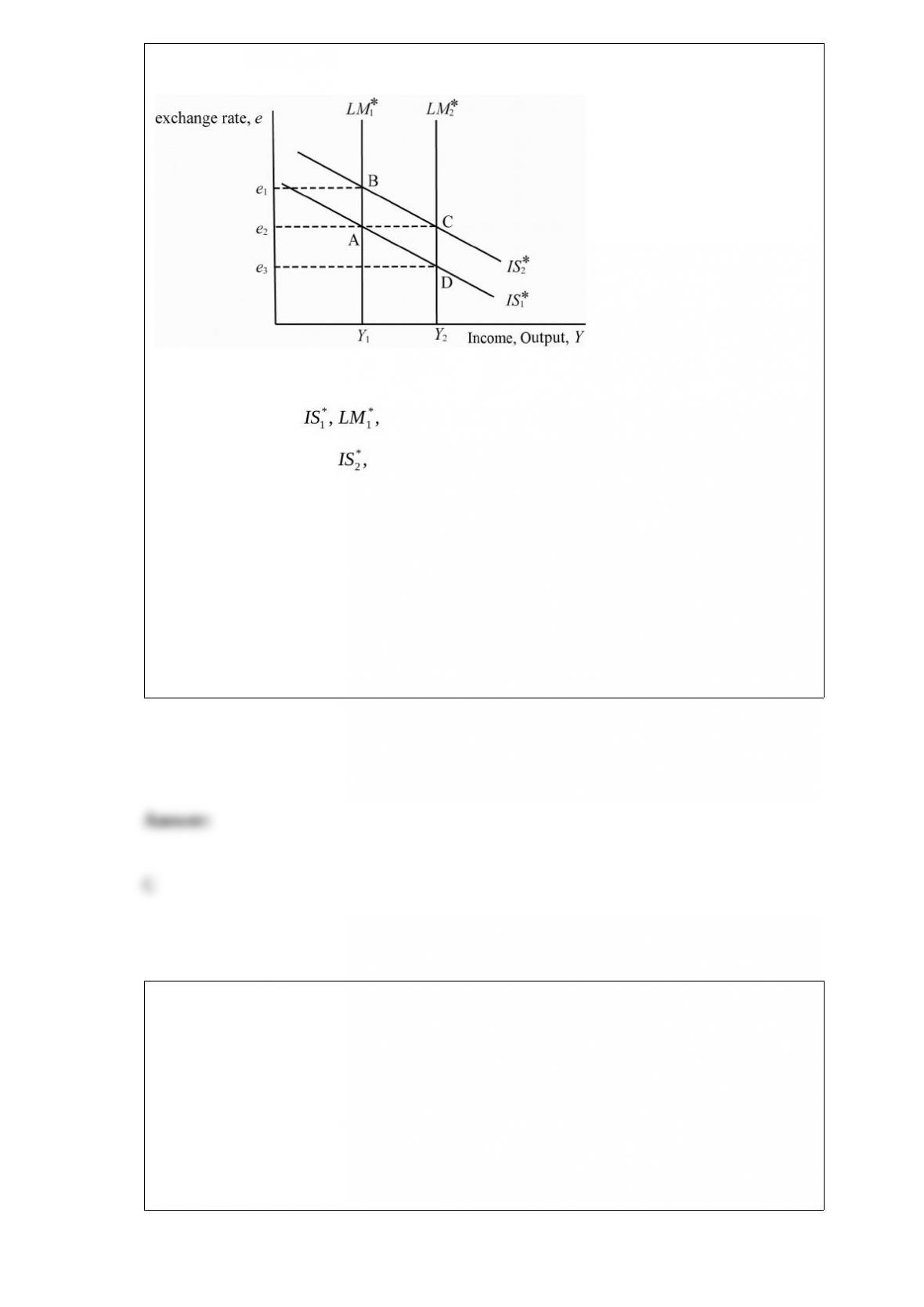
Exhibit: IS*”LM*
(Exhibit: IS*”LM*) A small open economy with a fixed exchange rate e2 is initially at
equilibrium A with and equilibrium output Y1. If there is an increase in
government spending to the new equilibrium will be at ____, holding everything
else constant.
A) A
B) B
C) C
D) D
Disposable personal income is defined as income after the payment of all:
A) taxes.
B) interest.
C) loans.
D) social insurance contributions.

A change in income in the IS“LM model resulting from a change in the price level is
represented by a ______ aggregate demand curve, while a change in income in the
IS“LM model for a given price level is represented by a ______ aggregate demand
curve.
A) movement along the; shift in the
B) shift in the; movement along the
C) vertical; horizontal
D) horizontal; vertical
Along an aggregate supply curve, if the level of output is less than the natural level of
output, then the price level is:
A) greater than the expected price level.
B) less than the expected price level.
C) equal to the natural price level.
D) stuck at the existing price level.

The money supply consists of:
A) currency plus reserves.
B) currency plus the monetary base.
C) currency plus demand deposits.
D) the monetary base plus demand deposits.
In principle, the GDP accounts shouldbut do nothave an imputation for:
A) housing services enjoyed by homeowners.
B) rental services of automobiles driven by owners.
C) meals cooked in restaurants.
D) housing services enjoyed by renters.
In the Keynesian-cross model, fiscal policy has a multiplied effect on income because
fiscal policy:

A) increases the amount of money in the economy.
B) changes income, which changes consumption, which further changes income.
C) is government spending and, therefore, more powerful than private spending.
D) changes the interest rate.
If the average price of goods and services in the economy equals $10 and the quantity
of money in the economy equals $200,000, then real balances in the economy equal:
A) 10.
B) 20,000.
C) 200,000.
D) 2,000,000.
In a large open economy, if political instability abroad lowers the net capital outflow
function, then the real interest rate:
A) rises, while the real exchange rate rises and net exports fall.
B) rises, while the real exchange rate falls and net exports rise.

C) falls, while the real exchange rate rises and net exports rise.
D) falls, while the real exchange rate rises and net exports fall.
The lags involved in implementing monetary and fiscal policy are:
A) short and predictable.
B) long and predictable.
C) short and variable.
D) long and variable.
In the specification of adaptive expectation used in the dynamic model of aggregate
demand and aggregate supply, people at time t ” 1 forecast the inflation rate in time
period t will be:
A) pt ” 2
B) pt ” 1
C) pt
D) pt + 1

The adoption of an investment tax credit in a small open economy is likely to lead to:
A) no change in either domestic investment or domestic saving in the small open
economy.
B) an increase in both domestic investment and domestic saving in the small open
economy.
C) an increase in domestic saving but no change in domestic investment in the small
open economy.
D) an increase in domestic investment but no change in domestic saving in the small
open economy.
Empirical studies of Franco Modigliani’s life-cycle hypothesis show that:
A) most elderly individuals try to exhaust all their savings by the time they die.
B) the elderly do not seem to run down their wealth in old age, as a simple version of
the theory would predict.
C) elderly individuals generally do not want to leave bequests for their children.
D) precautionary saving is not an important saving motive for the elderly.

If expected inflation equals 3 percent and monetary policymakers push the nominal
interest rate to 1 percent, the real interest rate equals ______ percent.
A) 4
B) 1
C) 0
D) “2
The lag between the time that the money supply is increased and the time that
investment expenditures increase is an example of a:
A) fiscal inside lag.
B) fiscal outside lag.
C) monetary inside lag.
D) monetary outside lag.

The relationship between the quantity of output demanded and the aggregate price level
is called:
A) aggregate demand.
B) aggregate supply.
C) aggregate output.
D) aggregate consumption.