
The table below shows a pizzeria’s fixed cost and variable cost at different levels of
output. Pizza’s sell for $20 each.
When the pizzeria makes 50 pizzas a day, its average total cost is ______.
A. $5
B. $10
C. $15
D. $20
Mike and Tom debone chicken breasts for Ted’s Chicken Co. Mike is new and can only
debone 30 chicken breasts per hour, while Tom’s experience allows him to debone 60
chicken breasts per hour. Both Mike and Tom work 40 hours per week. Their average
hourly productivity as a team is ______ chicken breasts.
A. 30
B. 45
C. 60
D. 90
The central bank of the United States is:

A. Bank of America.
B. Bank of the United States.
C. the U.S. Treasury.
D. the Federal Reserve System.
Industrial production, total sales, nonfarm employment, and after-tax household income
are examples of ______ indicators of economic activity.
A. coincident
B. preceding
C. lagged
D. real
Sam owns a candy factory and hires workers in a competitive labor market to pack
cases of candy. The company’s weekly output of cases of candy varies with the number
of workers hired, as shown in the following table:

If each case sells for $5 more than the cost of the materials used in producing it, and the
competitive market wage is $625/week, then how many workers should Sam hire each
week?
A. 5
B. 4
C. 3
D. 2
The following table shows the relationship between the speed of a computer’s CPU and
its benefits and costs. Assume that all other features of the computer are the same (that
is, CPU speed is the only source of variation), and only the CPU speeds listed below are
available for purchase.
The marginal cost of upgrading from a 2.5GHz to 3.0GHz computer is:
A. $400.
B. $300.
C. $200.
D. $100.

A recession in Japan ______ the demand for exports from East Asian countries resulting
in a reduction in autonomous expenditures in these East Asian countries and a(n)
______ output gap in the East Asian countries.
A. reduces; expansionary
B. increases; expansionary
C. reduces; recessionary
D. increases; recessionary
The table below shows how total donations, average donations, total labor costs and
average labor costs vary depending on the number of employees State U hires for its
fundraising activities.
The President of State U decides to hire fundraising employees as long as their average
benefit exceeds their average cost. This results in ______ employees being hired and a
net benefit (total donations minus total labor costs) of ______.
A. 5; $17,080
B. 5; $67,080
C. 4; $60,000
D. 4; $22,000

The time between when the fed funds rate is cut and when investment spending
increases is an example of:
A. Okun’s law.
B. the outside lag of macroeconomic policy.
C. anchoring inflationary expectations.
D. the inside lag of macroeconomic policy.
Evidence from work hours and marginal tax rates in different countries suggests that:
A. higher marginal tax rates encourage more work hours.
B. lower marginal tax rates encourage more work hours.
C. marginal tax rates are not related to work hours.
D. higher average tax rates encourage more work hours.

When the Federal Reserve lends reserves to commercial banks, this is an example of:
A. a change in reserve requirements.
B. an open-market sale.
C. an open-market purchase.
D. discount window lending.
When plotting marginal and average cost curves, the ______ cost curve always crosses
the ______ cost curve at its ______.
A. average fixed; marginal; minimum
B. marginal; average total; minimum
C. marginal; average variable; maximum
D. average variable; marginal; maximum
Suppose Erie Textiles can dispose of its waste “for free” by dumping it into a nearby

river. While the firm benefits from dumping waste into the river, the waste reduces fish
and bird reproduction. This causes damage to local fishermen and bird watchers. At a
cost, Erie Textiles can filter out the toxins, in which case local fishermen and bird
watchers will not suffer any damage. The relevant gains and losses (in thousands of
dollars) for the three parties are listed below.
Suppose that Erie Textiles can only negotiate with one of the affected groups. Will Erie
operate with a filter?
A. Yes, if they negotiate with the Bird Watchers, but not if they negotiate with the
Fishermen.
B. No, regardless of which group they negotiate with.
C. Yes, if they negotiate with the Fishermen, but not if they negotiate with the Bird
Watchers.
D. Yes, regardless of which group they negotiate with.
In a country with 200 million people aged 16 years and older, 120 million are in the
labor force, and 114 million are employed, what is the participation rate?
A. 40 percent
B. 57 percent
C. 60 percent
D. 95 percent

If the government needs to raise revenue to pay for a public good, the ideal tax structure
would tax
A. all citizens by the same amount.
B. all citizens in proportion to their willingness to pay for the public good.
C. all citizens by the same proportion of their income.
D. only citizens who state that they will use the public good.
Ben and Ashley are identical in every way except for one: Ashley has a master’s degree
and Ben does not. You would expect Ashley to be paid:
A. the same amount as Ben.
B. more than Ben and more than her VMP.
C. less than Ben.
D. more than Ben.

If the price elasticity of demand for chicken is 2, then a 20% decrease in the price of
chicken will lead to a:
A. 10% decrease in the quantity demanded of chicken.
B. 10% increase in the quantity demanded of chicken.
C. 40% decrease in the quantity demanded of chicken.
D. 40% increase in the quantity demanded of chicken.
Suppose that there are two types of houses for sale: those with solid foundations and
those with cracked foundations. In all other respects, the two types of houses are
identical. Houses with solid foundations are worth $200,000, while those with cracked
foundations are worth $200,000 minus the $20,000 to fix the crack, or $180,000. Sellers
know which type of house they have, but buyers cannot detect whether the foundation
has a crack. Suppose that 80 percent of the houses for sale have a solid foundation and
20 percent of the houses for sale have a cracked foundation. If buyers are risk-neutral
and know the that 80 percent of the houses for sale have a solid foundation while 20
percent have a cracked foundation, then the owners of houses with a solid foundation
will find that:
A. potential buyers are offering more than $200,000.
B. potential buyers are offering $200,000.
C. potential buyers are offering $180,000.
D. it is not worthwhile to sell their houses.
The inputs used to produce cupcakes (e.g., flour, sugar, butter, and labor) are also used
to produce cookies, cakes, muffins, pies and many other goods. This suggests that:
A. the supply curve for cupcakes is downward sloping.
B. the elasticity of supply of cupcakes is relatively high.
C. the elasticity of supply of cupcakes is relatively low.
D. cupcakes are a normal good.
Betty and Wilma are the only two cashiers employed at a retail store. Each of them
works the same 40 hours per week. By manually entering the price of each product
purchased into the cash register, Betty can check out 20 customers and Wilma can
check out 30 customers per hour. The store owner replaces the old cash registers with
new ones that automatically scan product prices into the register. With the new cash
registers, Betty and Wilma can each check out 60 customers per hour. Their average
labor productivity as a team before the new cash registers were introduced was ______
customers per hour and ______ customers per hour after the new machines were
installed.
A. 25; 60
B. 50; 120

C. 50; 60
D. 1,000; 2,400
If the demand for a good decreases as income decreases, it is a(n):
A. complementary good.
B. normal good.
C. inferior good.
D. substitute good.
The owner of a pizza shop observes that when she raises the price of a large pizza, her
total revenue decreases, and when she lowers the price of a large pizza, her total
revenue increases. This suggests that:
A. pizza lovers act irrationally.
B. the demand for her large pizzas is elastic with respect to price.
C. there are few good substitutes for a large pizza.
D. the demand for her large pizzas is inelastic with respect to price.

Suppose Joe has a two-year old Honda Civic that’s in excellent condition and that he
would be willing to sell for $13,000. Lauren, who is risk-neutral, is considering whether
to buy Joe’s car. She’s willing to pay $14,000 for a two-year Honda Civic that’s in
excellent condition and only $10,000 for one that’s not in excellent condition. Lauren
cannot tell whether Joe’s car is in excellent condition. She believes that only 20 percent
of two-year old Hondas for sale in the market are in excellent condition and that the
other 80 percent are not in excellent condition. If Joe offers a warranty in which he
makes a legally binding commitment to pay for any major repairs the car needs in the
next 18 months, then this ______ serve a credible signal because ______.
A. will; it is more costly for people with low-quality cars to offer such a warranty
B. will; people who own cars that are in excellent condition are usually honest
C. will not; it is less costly for people with low-quality cars to offer such a warranty
D. will not; people who sell used cars are rarely honest
If a firm functions in an oligopoly, it is:
A. one of a small number of firms that produce goods that are either close or perfect
substitutes.

B. the only firm that produces a good with no close substitutes.
C. one of a large number of firms that produce goods that are either close or perfect
substitutes.
D. one of a large number of firms that produce a good with no close substitute.
Refer to the figure below. The total utility of consuming 4 pizzas a week is:
A. 15
B. 22.5
C. 75
D. 90
Tracy and Amy are playing a game in which Tracy has the first move at X in the
decision tree shown below. Once Tracy has chosen either the top or bottom branch at X,
Amy, who can see what Tracy has chosen, must choose the top or bottom branch at Y or
Z. Both players know the payoffs at the end of each branch.

If before Tracy chose, Amy could make a credible commitment to choose either the top
or bottom branch when her turn came, then we would expect Tracy to get a payoff of
______ and Amy to get a payoff of ______.
A. 25; 225
B. 300; 200
C. 75; 150
D. 125; 125
For a given inflation rate, if increasing threats to domestic security cause the
government to increase military spending, then the ______ shifts _____.
A. aggregate demand curve; right
B. aggregate demand curve; left
C. aggregate supply curve; left
D. aggregate supply curve; right

A country’s nominal exchange rate, e, is defined as the number of units of:
A. domestic goods relative to the number of units of foreign goods.
B. foreign goods relative to the number of units of domestic goods.
C. the foreign currency that one unit of the domestic currency will buy.
D. the domestic currency that one unit of the foreign currency will buy.
This graph shows the marginal cost and marginal benefit associated with roadside litter
clean up. Assume that the marginal benefit curve and marginal cost curve each have
their usual slope.
From the graph, one can infer that:
A. the marginal benefit of picking up the 10th bag of litter exceed the marginal cost.
B. the marginal cost of picking up the 10th bag of litter exceed the marginal benefit.
C. the marginal benefit of picking up the 20th bag of litter exceed the marginal cost.
D. the total benefit of having 30 bags removed is zero.

When a firm builds a new factory, this is an example of an investment in:
A. human capital.
B. physical capital.
C. the market.
D. research and development.
Inflation reduces economic efficiency because it does each of the following except:
A. Distort incentives through interaction with the tax laws.
B. Obscure information transmitted by prices.
C. Induce people to minimize cash holdings.
D. Change relative prices.
The price of gold is $300 per ounce in New York and 2,550 pesos per ounce in Mexico
City. If the law of one price holds for gold, the nominal exchange rate is ______ pesos
per U.S. dollar.
A. 0.118
B. 1.18
C. 8.5
D. 85.5
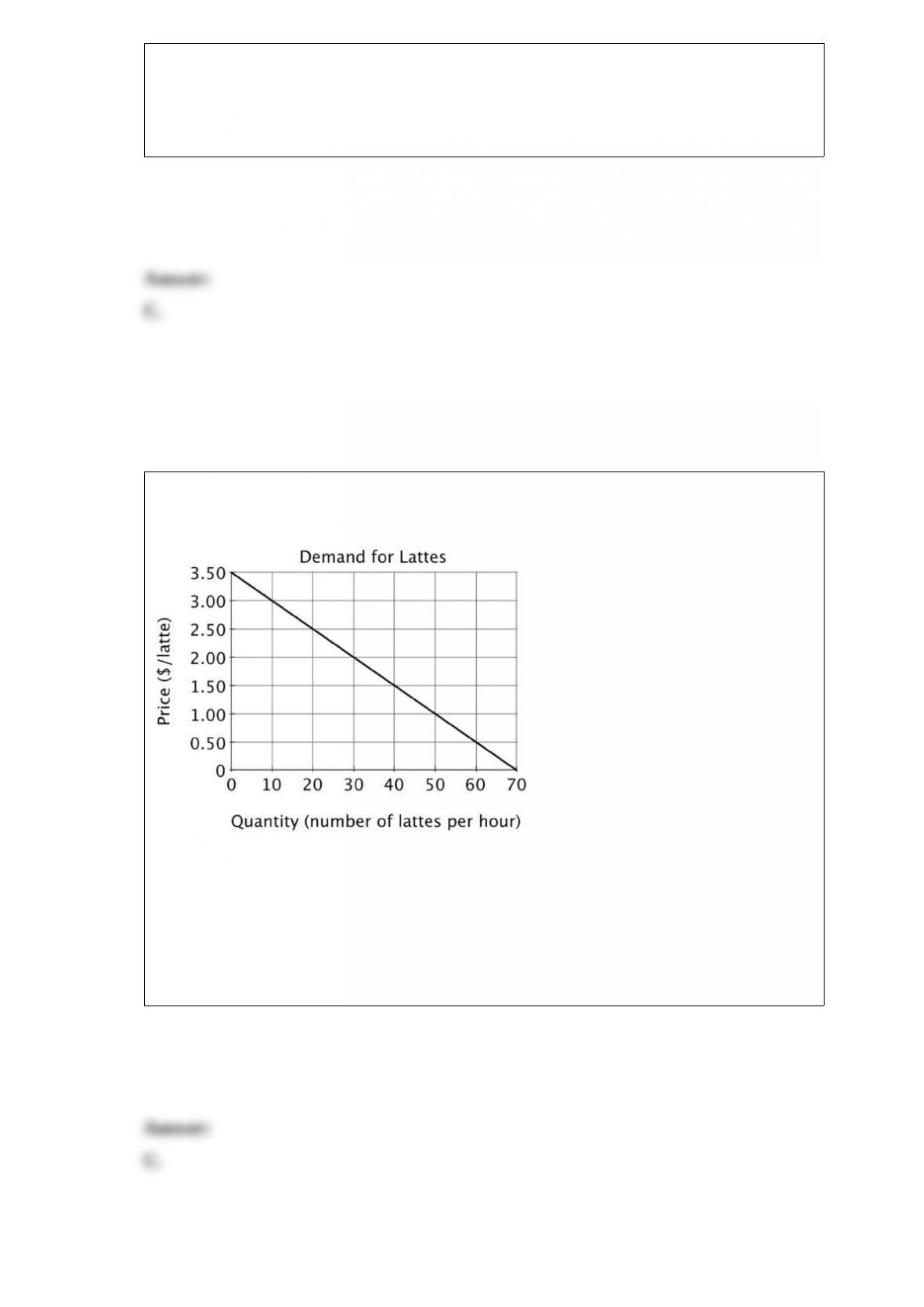
Refer to the figure below. At a price of $2, the total expenditure on lattes each hour
equals:
A. $30.
B. $40.
C. $60.
D. $80.
Individual supply curves generally slope ______ because ______.
A. downward; sellers become more efficient with practice
B. upward; profits increase with quantity
C. downward; inputs are cheaper when purchased in high volume
D. upward; of increasing opportunity costs