
A Big Mac costs $4.00 in the United States and 9.00 reals in Brazil. If the exchange rate
is 2 reals per dollar, purchasing power parity predicts that
A) the dollar is undervalued.
B) the dollar is overvalued.
C) the real is undervalued.
D) both B and C are correct.
Article Summary. Although growing at only half the average rate following the
seven previous recessions, consumer spending has increased 9 percent since the
end of the 2007-2009 recession, and consumer confidence has been on the rise as
household finances, the job market, and the housing market continue to improve.
The Federal Reserve projects a 3% – 3.5% growth rate for the economy in 2014,
up from the recent average of 2%. Debt payments have fallen to an average of
15.69% of after-tax income for households, the lowest level in 30 years, and lower
debt payments leave households with more to spend on consumer goods.
Source: Neil Shah, “Pocketbooks Begin to Open As Household Wealth Grows,”
Wall Street Journal, June 25, 2013.
The increase in consumer spending discussed in the article summary was due in part to
lower debt payments which have resulted in an increase in disposable income. The
increase in consumption resulting from the increase in disposable income caused a(n)
________ the aggregate expenditure curve.
A) movement up along
B) movement down along
C) downward shift of
D) upward shift of
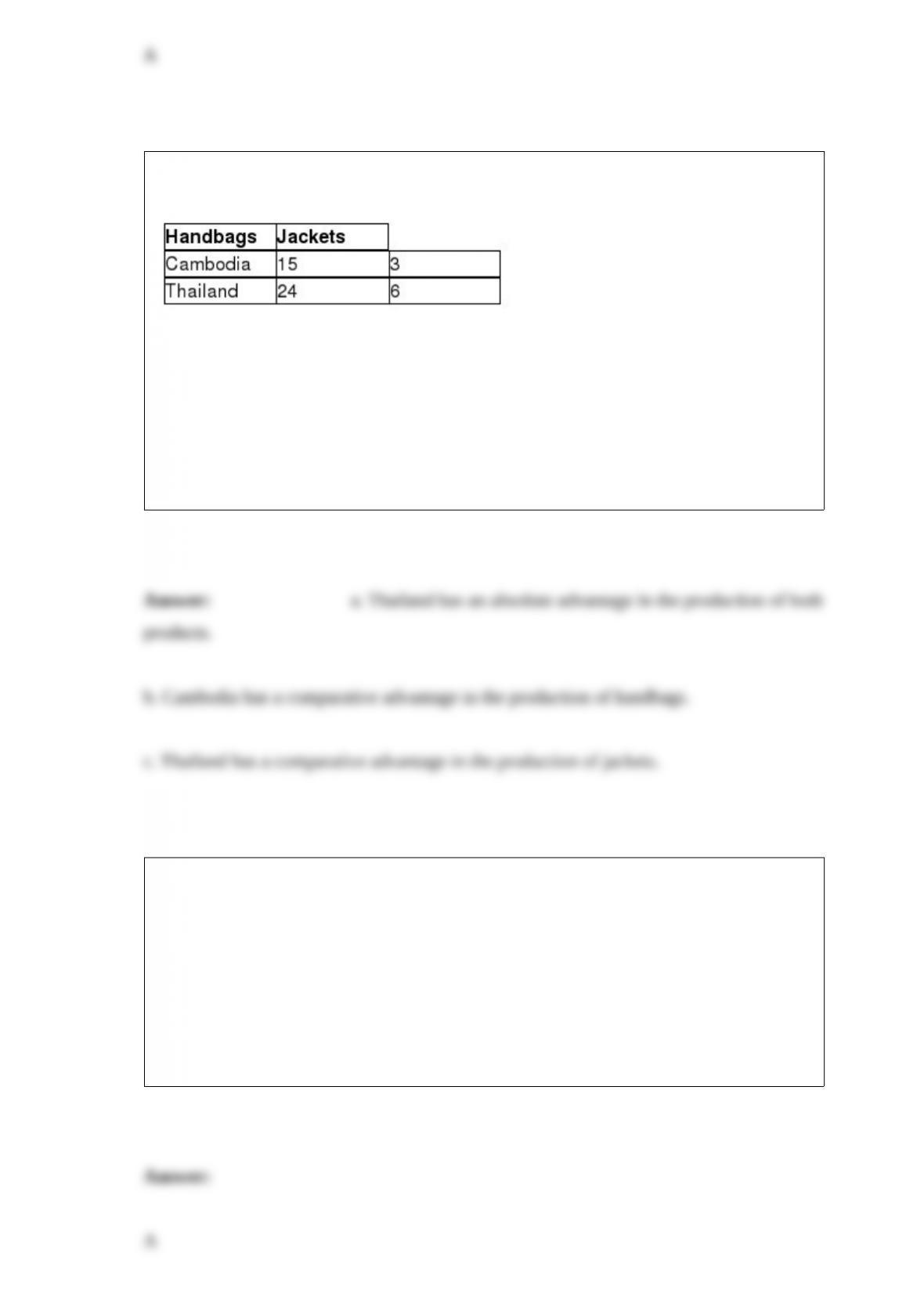
Table 9-4
Output Per Hour of Work
Table 9-4 shows the output per hour of work for handbags and jackets in Cambodia and
in Thailand.
a.Which country has an absolute advantage in the production of handbags and jackets?
b. Which country has a comparative advantage in the production of handbags?
c. Which country has a comparative advantage in the production of jackets?
A good measure of the standard of living is
A) real GDP per capita.
B) nominal GDP per capita.
C) total real GDP.
D) total nominal GDP.

The De Beers Company blocked competition
A) in the diamond market by controlling the output of most of the world’s diamond
mines.
B) by controlling the supply of most of the world’s high-quality bauxite, the mineral
used to produce aluminum.
C) in the market for fresh and frozen cranberries because it controls about 80 percent of
the cranberry crop.
D) because it has lower costs of producing than other department stores due to
economies of scale.
Improvements in inventory control represent a positive technological change because
they allow firms to produce the same output with fewer inputs. In recent years, many
firms have adopted an inventory system in which firms accept shipments from suppliers
as close as possible to the time they will be needed. Wal-Mart has been a pioneer in
using inventory control systems to this in its stores. This type of inventory system is
called a ________ inventory system.
A) first-in-first-out
B) cash-and-carry
C) just-in-time
D) buy-now-pay-later

Figure 2-1
________ is (are) inefficient in that not all resources are being used.
A) Point A
B) Point B
C) Point C
D) Points A and C
An increase in the demand for orthodontic services leads to
A) an increase in the supply of orthodontists.
B) lower prices for orthodontic care.
C) an increase in the demand for orthodontists.
D) a rise in the rates of dental insurance.

The political process is more likely to serve the interests of individuals whose
preferences are in the middle, rather than individuals with preferences that are much to
the left or right of the political center. This statement is best explained by which of the
following?
A) logrolling
B) the voting paradox
C) the Arrow impossibility theorem
D) the median voter theorem
When foreign investors in Thailand began to realize that Thailand could not maintain its
peg to the dollar indefinitely, they began to ________ in Thailand and exchange
________. This change in investment by foreigners is termed capital flight.
A) purchase more investments; dollars for baht to purchase these investments
B) sell off their investments; the baht they received for dollars
C) sell off their investments; the dollars they received for baht
D) purchase more investments; baht for dollars to purchase these investments
Avner is maximizing total utility by buying sports magazines and protein supplements.
For him to buy more sports magazines

A) the price of protein supplements. has to fall.
B) the price of sports magazines has to fall.
C) the price of sports magazines has to rise.
D) Since Avner is maximizing his utility, nothing can change the consumption of sports
magazines.
A market comprised of only two firms is called a
A) competitive market.
B) duopoly.
C) monopoly.
D) monopolistically competitive market.
The United States has developed a comparative advantage in digital computers,
airliners and many prescription drugs. The source of its comparative advantage in these
products is
A) a favorable climate.
B) technology.
C) abundant supplies of natural resources.

D) a strong central government.
In order to avoid the imposition of other types of trade barriers, foreign producers will
sometimes agree to limit their exports to a country. What are these types of agreements
called?
A) involuntary export restraints
B) voluntary export restraints
C) implicit quotas
D) sanctions
Natural monopolies in the United States are generally regulated by
A) the Federal Trade Commission.
B) the Department of Justice.
C) local or state regulatory commissions.
D) the Department of Commerce.

The period of expansion ends with a ________ and the period of recession ends with a
________.
A) business cycle peak; business cycle trough
B) business cycle trough; business cycle peak
C) business cycle peak; business cycle peak
D) business cycle trough; business cycle trough
Which of the following is a characteristic of an oligopolistic market structure?
A) There are few dominant sellers.
B) Each firm sells a unique product.
C) It is easy for new firms to enter the industry.
D) Each firm need not react to the actions of rivals.
Collusion
A) is rampant in perfect competition as all firms charge the same price.
B) reduces market concentration in an industry.

C) among firms is difficult to maintain because it eliminates long run economic profit.
D) is more difficult when there are many firms producing differentiated products in an
industry.
A fractional reserve banking system is one in which banks hold less than 100 percent of
________ in reserves.
A) loans
B) deposits
C) securities
D) shareholder equity
The labor force participation rate equals the
A) (number of employed divided by the labor force) 100.
B) (labor force divided by the number of people not in the labor force) 100.
C) (labor force divided by working-age population) 100.
D) (labor force divided by the total population) 100.