
Phillips found a
a. positive relation between unemployment and inflation in the United Kingdom.
b. positive relation between unemployment and inflation in the United States.
c. negative relation between unemployment and inflation in the United States.
d. negative relation between unemployment and inflation in the United Kingdom.
Jeff decides that he would pay as much as $3,000 for a new laptop computer. He buys
the computer and realizes consumer surplus of $700. How much did Jeff pay for his
computer?
a. $700
b. $2,300
c. $3,000
d. $3,700
Figure 5-8
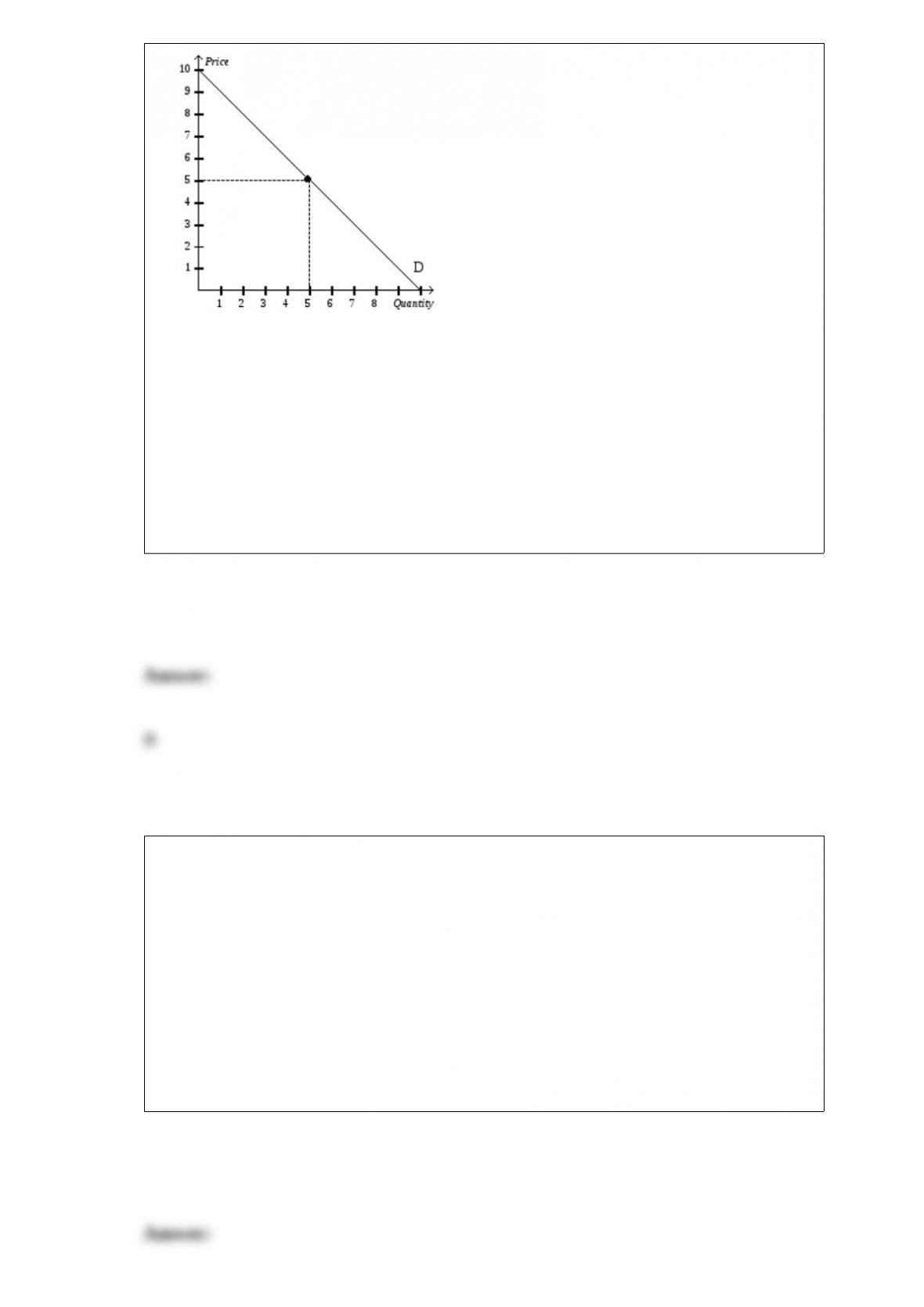
Refer to Figure 5-8. For prices below $5, demand is price
a. elastic, and raising price will increase total revenue.
b. inelastic, and raising price will increase total revenue.
c. elastic, and lowering price will increase total revenue.
d. inelastic, and lowering price will increase total revenue.
In June 2009 the BLS reported an adult population of 234.9 million, unemployment of
12.4 million, and employment of 141.6 million. Based on these numbers the labor-force
participation rate was
a. 154/234.9.
b. 141.6/234.9.
c. 141.6/154.
d. None of the above are correct.

Suppose an economy produces only cranberries and maple syrup. In 2010, 50 units of
cranberries are sold at $20 per unit and 100 units of maple syrup are sold at $8 per unit.
In 2009, the base year, the price of cranberries was $10 per unit and the price of maple
syrup was $15 per unit. For 2010,
a. nominal GDP is $1800, real GDP is $2000, and the GDP deflator is 90.
b. nominal GDP is $1800, real GDP is $2000, and the GDP deflator is 111.1.
c. nominal GDP is $2000, real GDP is $1800, and the GDP deflator is 90.
d. nominal GDP is $2000, real GDP is $1800, and the GDP deflator is 111.1.
Your younger sister needs $50 to buy a new bike. She has opened a lemonade stand to
make the money she needs. Your mother is paying for all of the ingredients. She
currently is charging 25 cents per cup, but she wants to adjust her price to earn the $50
faster. If you know that the demand for lemonade is elastic, what is your advice to her?
a. Leave the price at 25 cents and be patient.
b. Raise the price to increase total revenue.
c. Lower the price to increase total revenue.
d. There isn’t enough information given to answer this question.

If a firm sells a total of 100 shares of stock, then
a. each share represents 1 percent of the firm’s indebtedness.
b. each share represents ownership of 1 percent of the firm.
c. the firm is engaging in term finance.
d. All of the above are correct.
Scenario 8-2
Tom mows Stephanie’s lawn for $25. Tom’s opportunity cost of mowing Stephanie’s
lawn is $20, and Stephanie’s willingness to pay Tom to mow her lawn is $28.
Refer to Scenario 8-2. If Stephanie hires Tom to mow her lawn, Stephanie’s consumer
surplus is
a. $3.
b. $5.
c. $8.
d. $25.
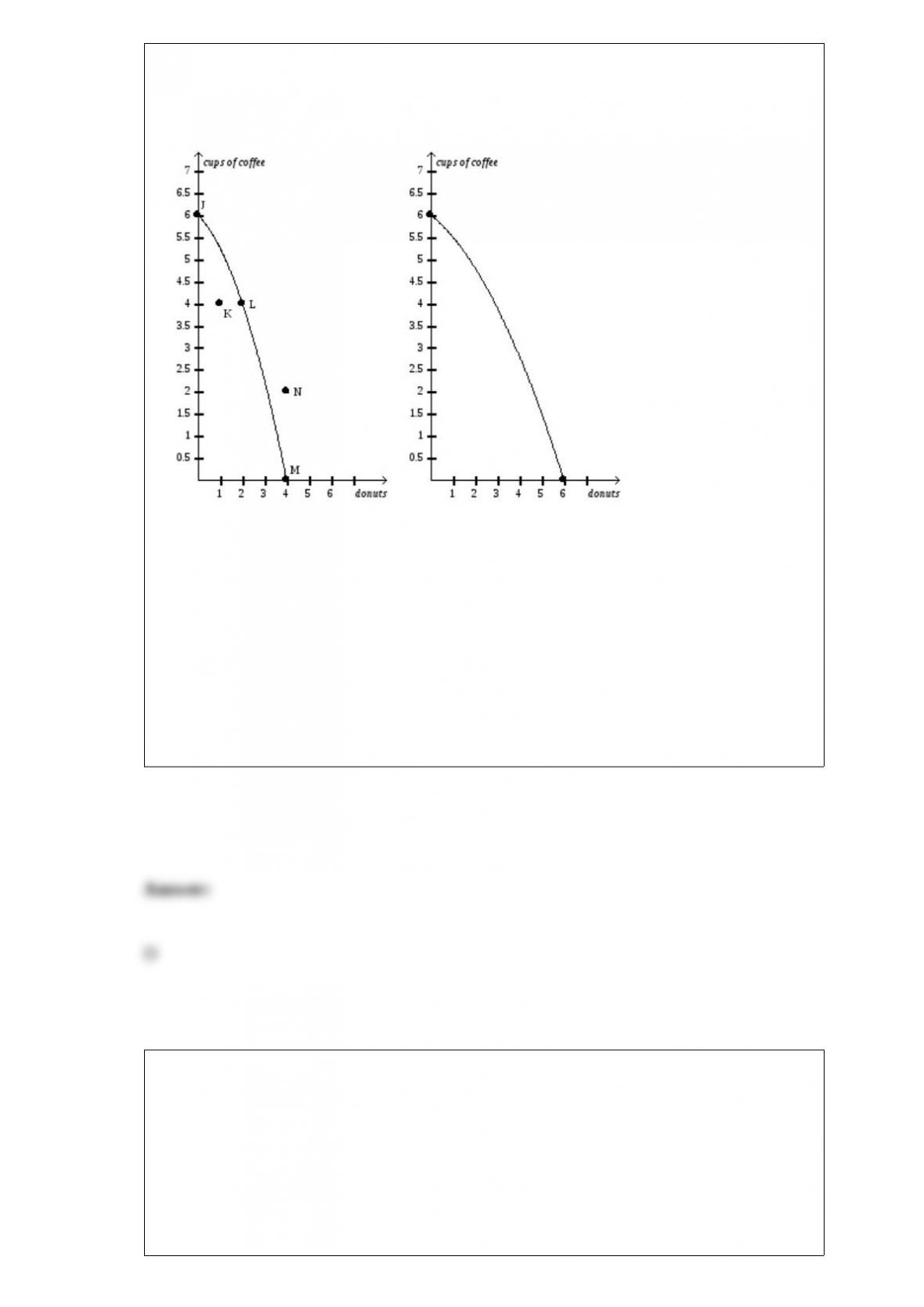
Figure 2-8
Panel (a) Panel (b)
Refer to Figure 2-8, Panel (a) and Panel (b). Which of the following is not a result of
the shift of the economy’s production possibilities frontier from Panel (a) to Panel (b)?
a. the tradeoff between the production of donuts and coffee changes
b. the opportunity cost of a cup of coffee is higher at all levels of coffee production
c. production of 4 donuts and 2 cups of coffee becomes possible
d. production of 1 donut and 4 cups of coffee becomes efficient
The New York Federal Reserve Bank
a. president always gets to vote at the FOMC meetings.
b. conducts open market transactions.
c. is one of 12 regional Federal Reserve Banks.

d. All of the above are correct.
Total surplus measures the
a. loss to buyers from paying higher prices plus the benefit to sellers from receiving
lower prices.
b. buyers’ willingnesses to pay less the sellers’ costs.
c. fairness of the distribution of resources in society.
d. value to the government of goods and services sold in society.
The discount rate is the interest rate that
a. banks charge one another for loans.
b. banks charge the Fed for loans.
c. the Fed charges banks for loans.
d. the Fed charges Congress for loans.
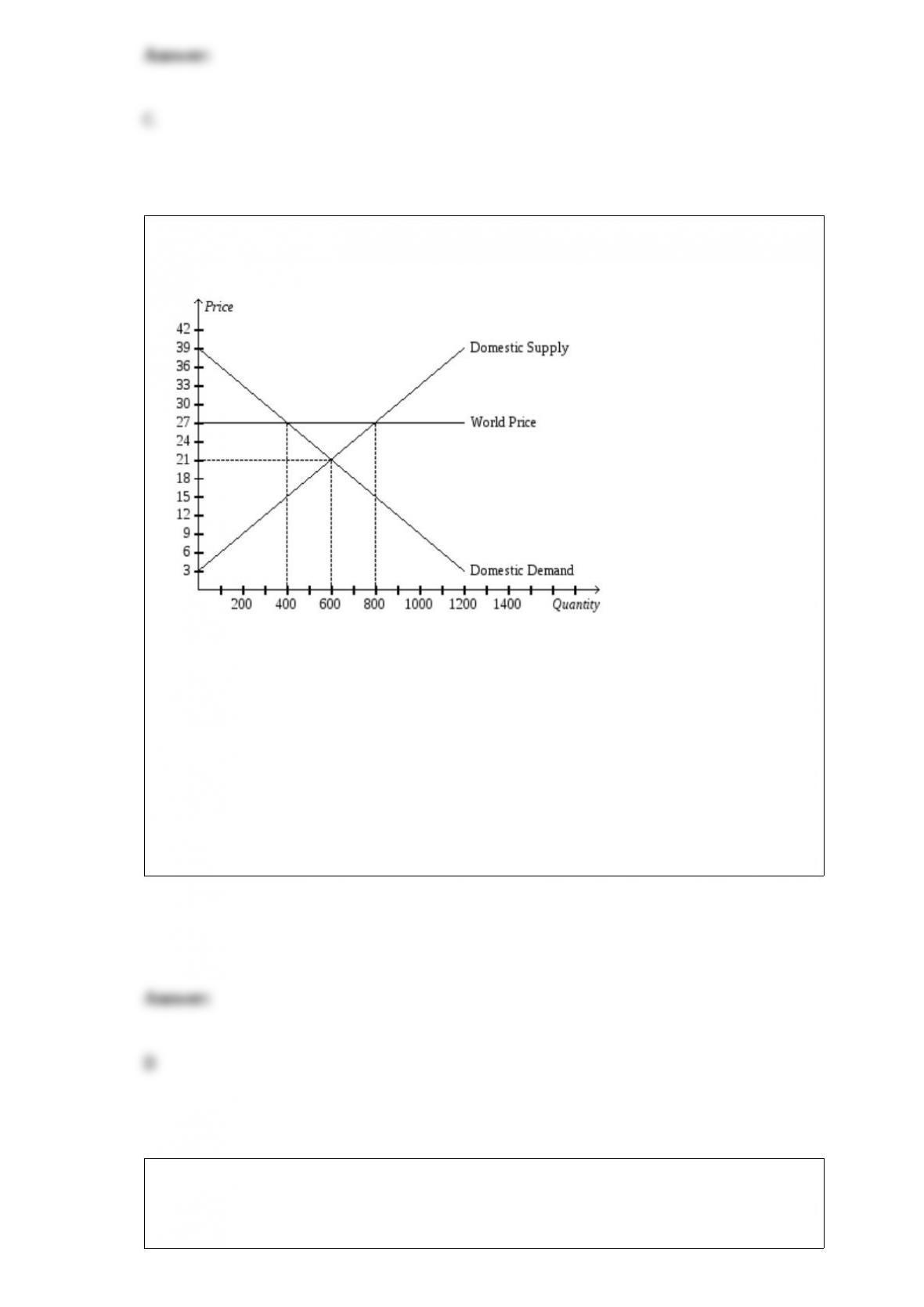
Figure 9-12
Refer to Figure 9-12. With trade, domestic production and domestic consumption,
respectively, are
a. 600 and 400.
b. 800 and 400.
c. 400 and 600.
d. 400 and 800.
Production is efficient if the economy is producing at a point
a. on the production possibilities frontier.

b. outside the production possibilities frontier.
c. on or inside the production possibilities frontier.
d. inside the production possibilities frontier.
If a country raises its budget deficit then
a. both its supply of and demand for loanable funds shift.
b. its supply of but not its demand for loanable funds shifts.
c. its demand for but not its supply of loanable funds shifts.
d. neither its supply nor its demand for loanable funds shift.
What is the present value of a payment of $1,000 two years from now if the interest rate
is 6%?
a. $2,000/1.06
b. $1000/(1.06)2
c. $1000/(1 + 0.062)
d. None of the above are correct.
If there is a shortage of farm laborers, we would expect
a. the wage of farm laborers to increase.
b. the wage of farm laborers to decrease.
c. the price of farm commodities to decrease.
d. a decrease in the demand for substitutes for farm labor.
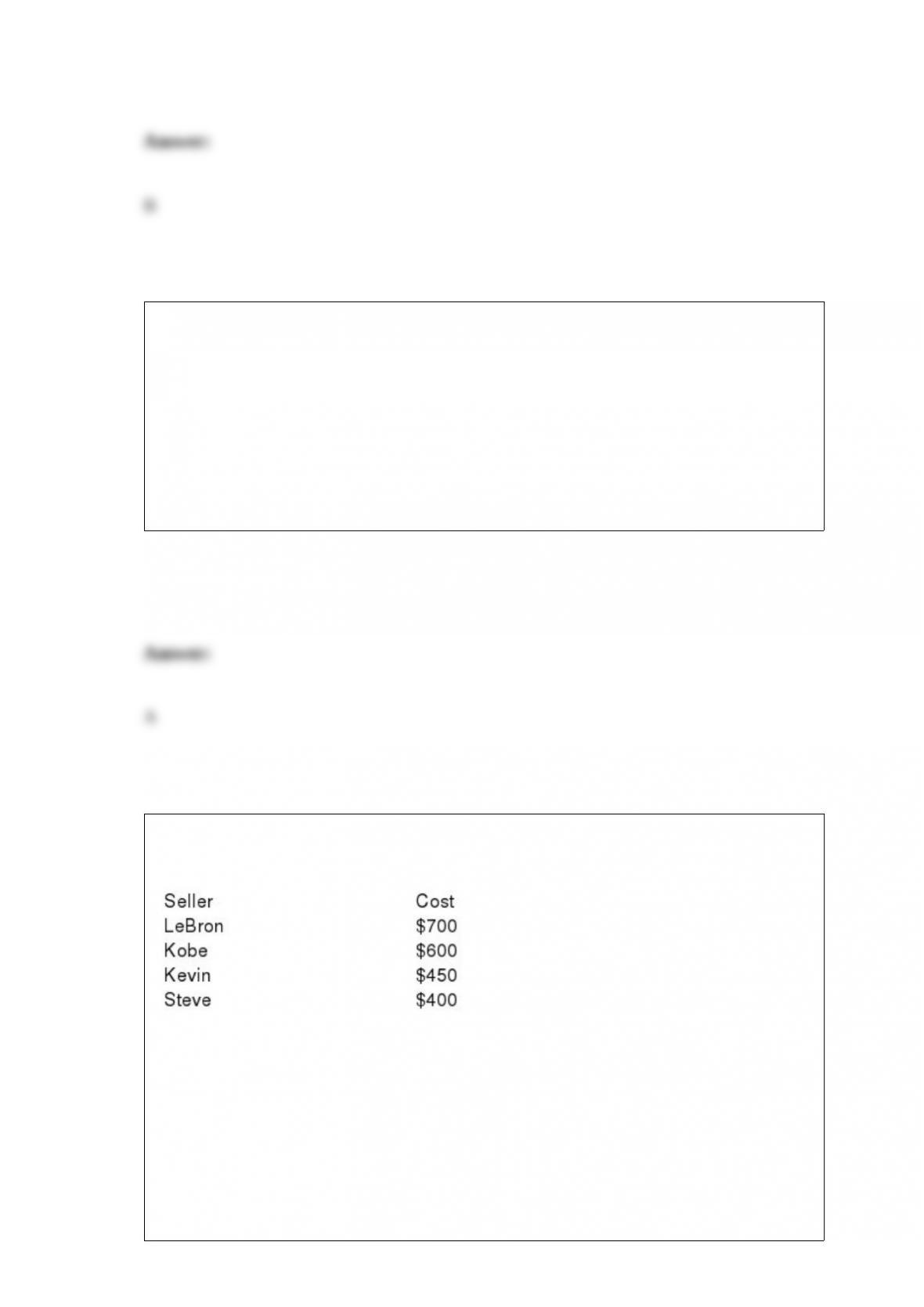
Table 7-10
Refer to Table 7-10. You and your best friend want to hire a professional photographer
to take pictures of your two families. The table shows the costs of the four potential
sellers in the local photography market. You and your friend agree to offer $500 for
each session. Who accepts the offer, and what is the total producer surplus in the
market?
a. LeBron and Kobe; $500
b. Kevin and Steve; $500

c. LeBron and Kobe; $300
d. Kevin and Steve; $150
Trade among nations is ultimately based on
a. absolute advantage.
b. strategic advantage.
c. comparative advantage.
d. technical advantage.
Which of the following claims concerning the importance of effects that explain the
slope of the U.S. aggregate-demand curve is correct?
a. The exchange-rate effect is relatively small because exports and imports are a small
part of real GDP.
b. The interest-rate effect is relatively small because investment spending is not very
responsive to interest rate changes.
c. The wealth effect is relatively large because money holdings are a significant portion
of most households’ wealth.

d. None of the above is correct.
During some year a country had exports of $50 billion, imports of $35 billion, and
purchased $30 billion of foreign assets. What was the value of domestic assets
purchased by foreigners?
a. $35 billion
b. $20 billion
c. $15 billion
d. $5 billion
International studies of the relationship between GDP per person and quality of life
measures such as life expectancy and literacy rates show that larger GDP per person is
associated with
a. longer life expectancy and a lower percentage of the population that is literate.
b. longer life expectancy and a higher percentage of the population that is literate.
c. very nearly the same life expectancy and a lower percentage of the population that is
literate.
d. very nearly the same life expectancy and a higher percentage of the population that is
literate.
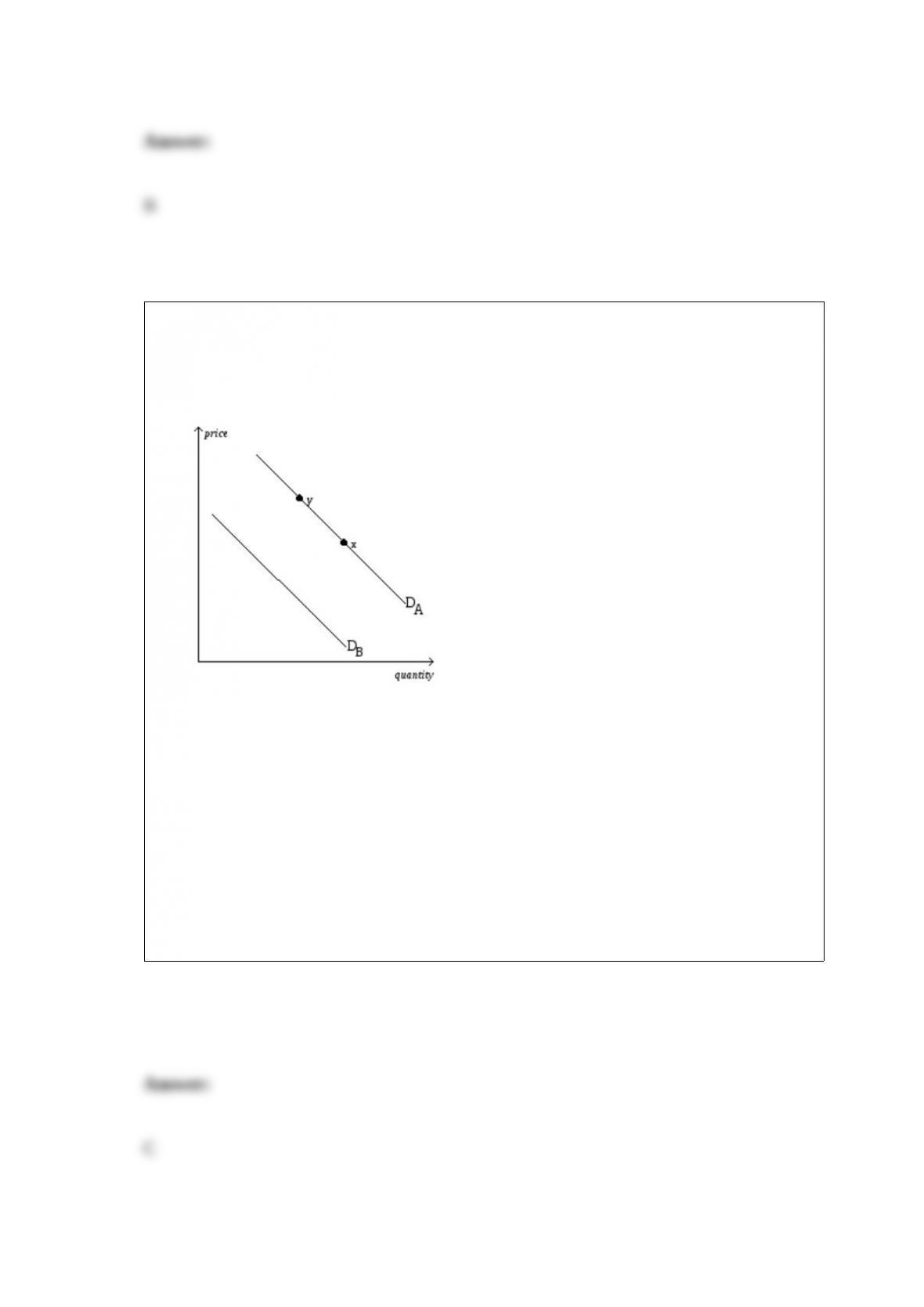
Figure 4-19
The diagram below pertains to the demand for turkey in the United States.
Refer to Figure 4-19. All else equal, the premature deaths of thousands of turkeys
would cause a move from
a. DA to DB.
b. DB to DA.
c. x to y.
d. y to x.

Assume an economy experienced a positive rate of inflation between 2003 and 2004
and again between 2004 and However, the inflation rate was higher between 2004 and
2005 than it was between 2003 and 2004. Which of the following scenarios is
consistent with this assumption?
a. The CPI was 100 in 2003, 110 in 2004, and 105 in 2005.
b. The CPI was 100 in 2003, 120 in 2004, and 135 in 2005.
c. The CPI was 100 in 2003, 105 in 2004, and 130 in 2005.
d. The CPI was 100 in 2003, 90 in 2004, and 88 in 2005.
Albert Einstein once made the following observation about science:
a. “The whole of science is nothing more than the refinement of everyday thinking.”
b. “The whole of science is nothing more than an interesting intellectual exercise.”
c. “In order to understand science, one must rely solely on abstraction.”
d. “In order to understand science, one must transcend everyday thinking.”
When a country allows trade and becomes an importer of bottled water, which of the
following is not a consequence?
a. The gains of domestic consumers of bottled water exceed the losses of domestic

producers of bottled water.
b. The losses of domestic producers of bottled water exceed the gains of domestic
consumers of bottled water.
c. The price paid by domestic consumers of bottled water decreases.
d. The price received by domestic producers of bottled water decreases.
A perfectly inelastic demand implies that buyers
a. decrease their purchases when the price rises.
b. purchase the same amount as before when the price rises or falls.
c. increase their purchases only slightly when the price falls.
d. respond substantially to an increase in price.
Table 16-7
Metropolis National Bank is currently holding 2% of its deposits as excess reserves.
Metropolis National Bank
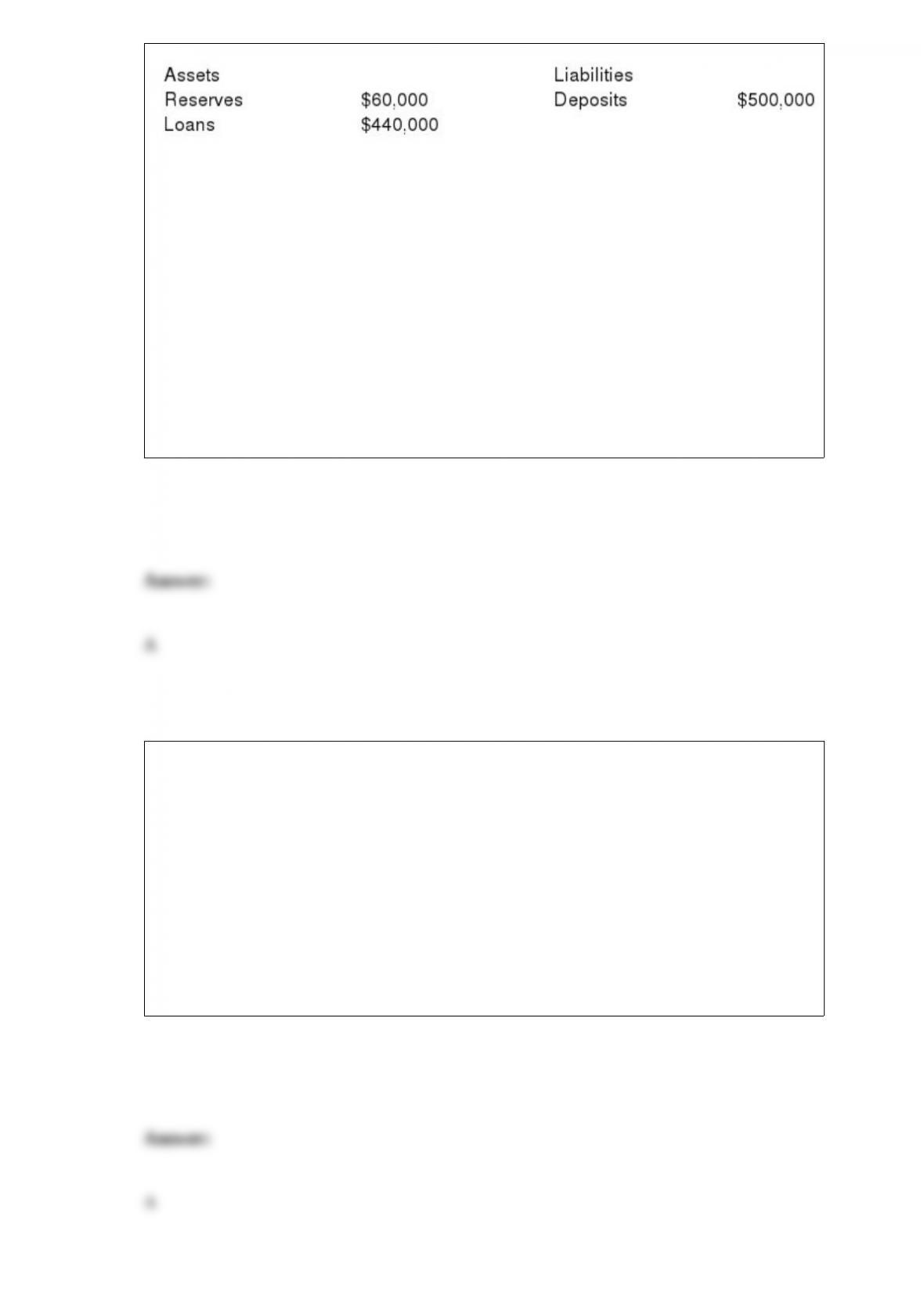
Refer to Balance Sheet of Metropolis National Bank. Metropolis National Bank is
currently holding 2% of deposits as excess reserves. Assume that no banks in the
economy want to hold excess reserves and that people only hold deposits and no
currency. How much does the money supply ultimately increase when Metropolis
National Bank lends out its excess reserves?
a. $100,000
b. $110,000
c. $120,000
d. None of the above are correct.
Roger determines that if Aim Corporation has high revenues, then Zest Corporation will
have low revenues, and that if Aim Corporation has low revenues, Zest Corporation will
have high revenues. He buys stock in both corporations.
a. He has reduced firm-specific risk but not market risk.
b. He has reduced market risk, but not firm-specific risk.
c. He had reduce both firm-specific risk and market risk.
d. He has reduced neither firm-specific risk nor market risk.
In which of the following cases can we be certain that a natural resource has become
scarcer?
a. both the demand for the resource and the supply of the resource have increased
b. both the demand for the resource and the supply of the resource have decreased
c. demand for the resource is unchanged and the supply of the resource has increased
d. the demand for the resource has decreased and the supply of the resource is
unchanged
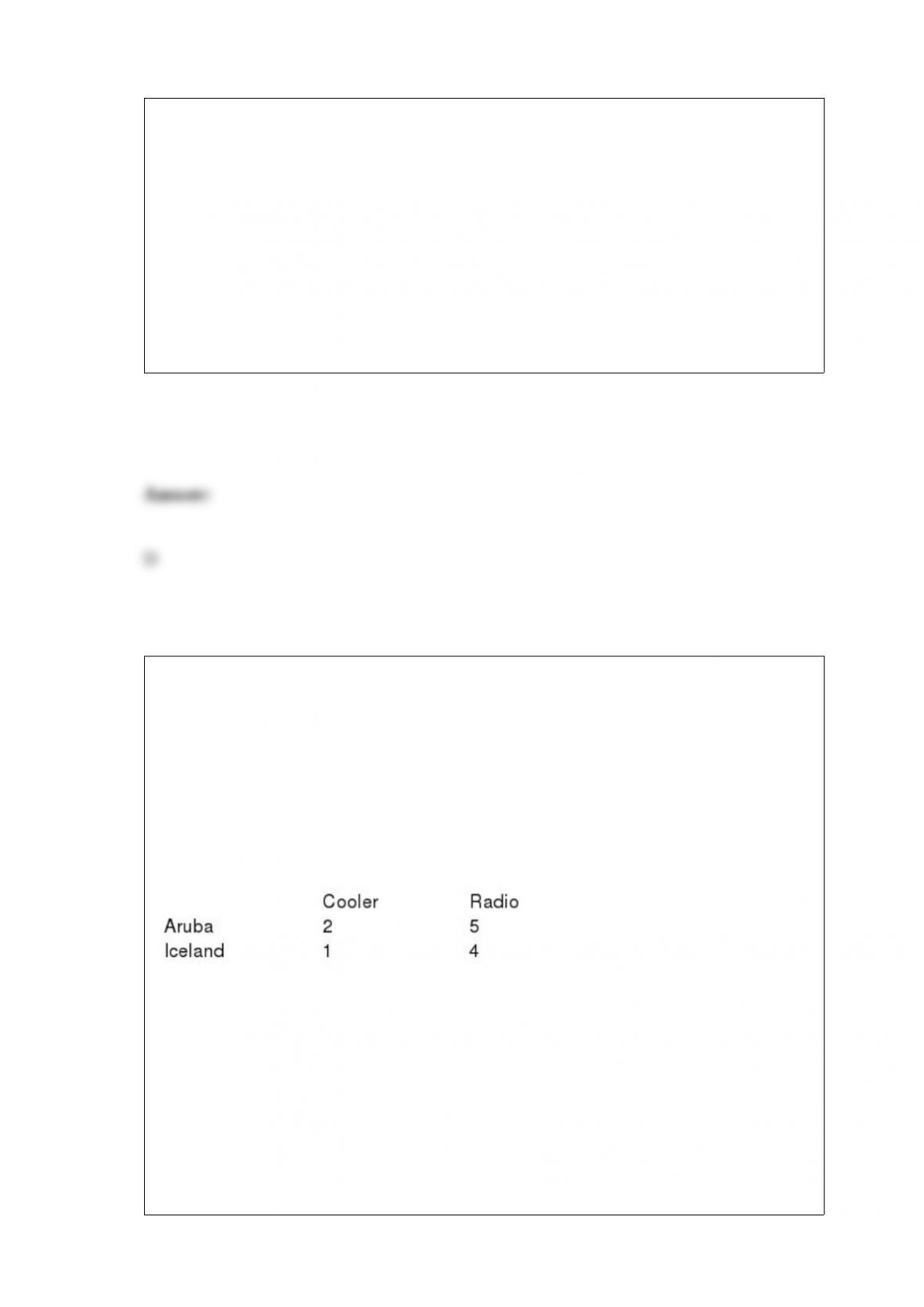
Table 3-2
Assume that Aruba and Iceland can switch between producing coolers and producing
radios at a constant rate.
Labor Hours
Needed to Make 1
Refer to Table 3-2. Aruba and Iceland would not be able to gain from trade if Iceland’s
opportunity cost of one radio changed to
a. 0 coolers.
b. 0.25 coolers.
c. 2.5 coolers.
d. Aruba and Iceland can always gain from trade regardless of their opportunity costs.

The quantity theory of money
a. is a fairly recent addition to economic theory.
b. can explain both moderate inflation and hyperinflation.
c. argues that inflation is caused by too little money in the economy.
d. All of the above are correct.