
Figure 5-4
Suppose there are several paper mills producing paper for a market. These mills,
located upstream from a fishing village, discharge a large amount of wastewater into the
river. The waste material affects the number of fish in the river, and the use of the river
for recreation and as a public water supply source. Figure 5-4 shows the paper market.
Use this Figure to answer the following question(s).
What does S2 represent?
A) the market supply curve that reflects social cost
B) the market supply curve that reflect private cost
C) the market supply curve that reflects external cost
D) the market supply curve that reflects social benefit
The Difference between a firm’s assets and liabilities is its
A) accounting profit.
B) economic profit.
C) net worth.
D) implicit costs.
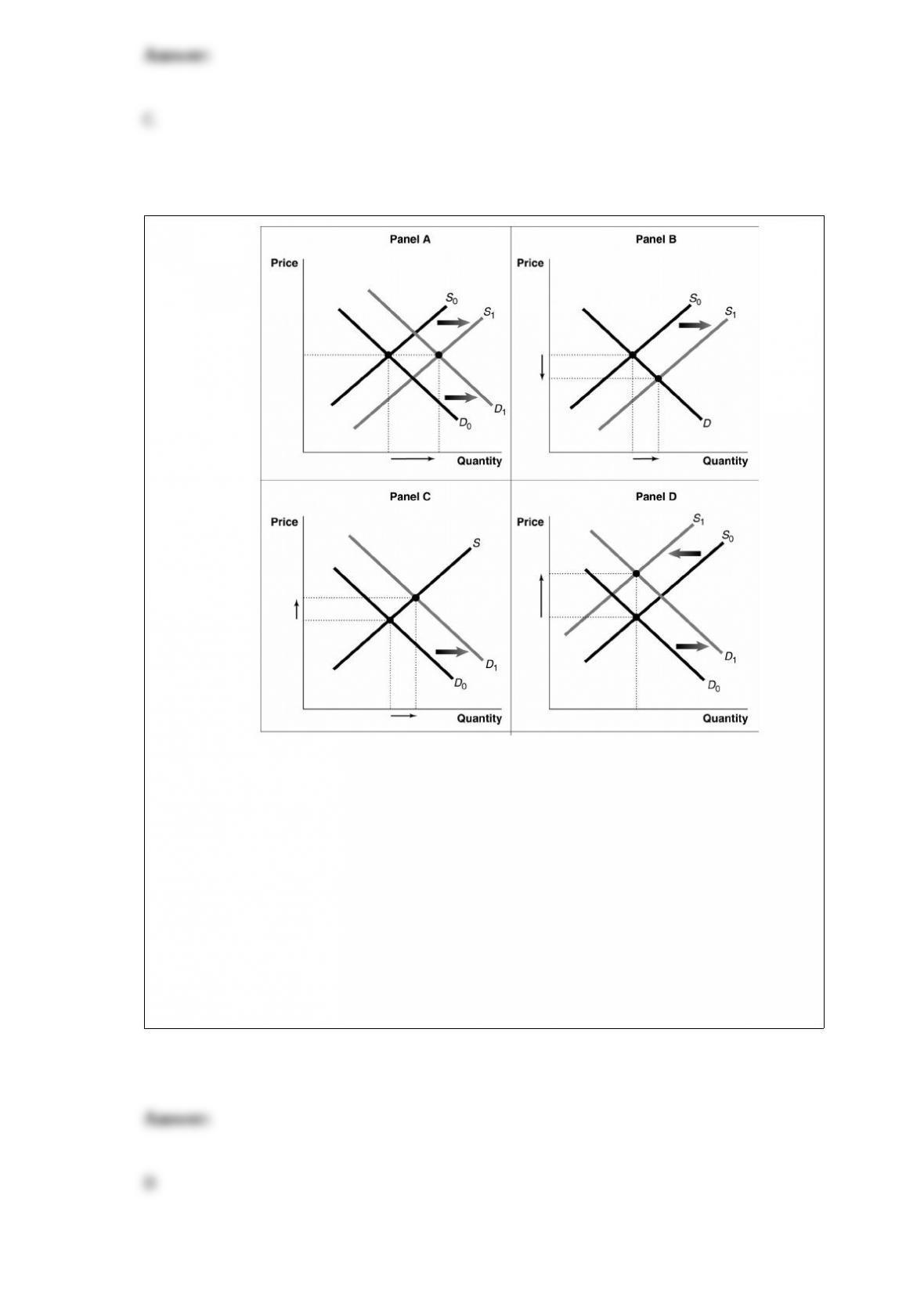
Figure 12-15
Suppose a typical firm in a perfectly competitive market is earning economic profits in
the short run. Which of the diagrams in the figure depicts what happens in the industry
as it transitions to a long-run equilibrium?
A) Panel A
B) Panel B
C) Panel C
D) Panel D

A Big Mac costs $4.00 in the United States and 9.00 reals in Brazil. If the exchange rate
is 2 reals per dollar, purchasing power parity predicts that
A) the dollar is undervalued.
B) the dollar is overvalued.
C) the real is undervalued.
D) both B and C are correct.
In economics, the difference between a firm’s revenues and its costs is referred to as
A) physical capital.
B) profit.
C) capital gains.
D) factor payments.
The Industrial Revolution
A) marked the beginning of significant economic growth in the world.
B) started in France around the year 1750.
C) produced goods exclusively using human or animal power.
D) had no impact on standards of living in the world.
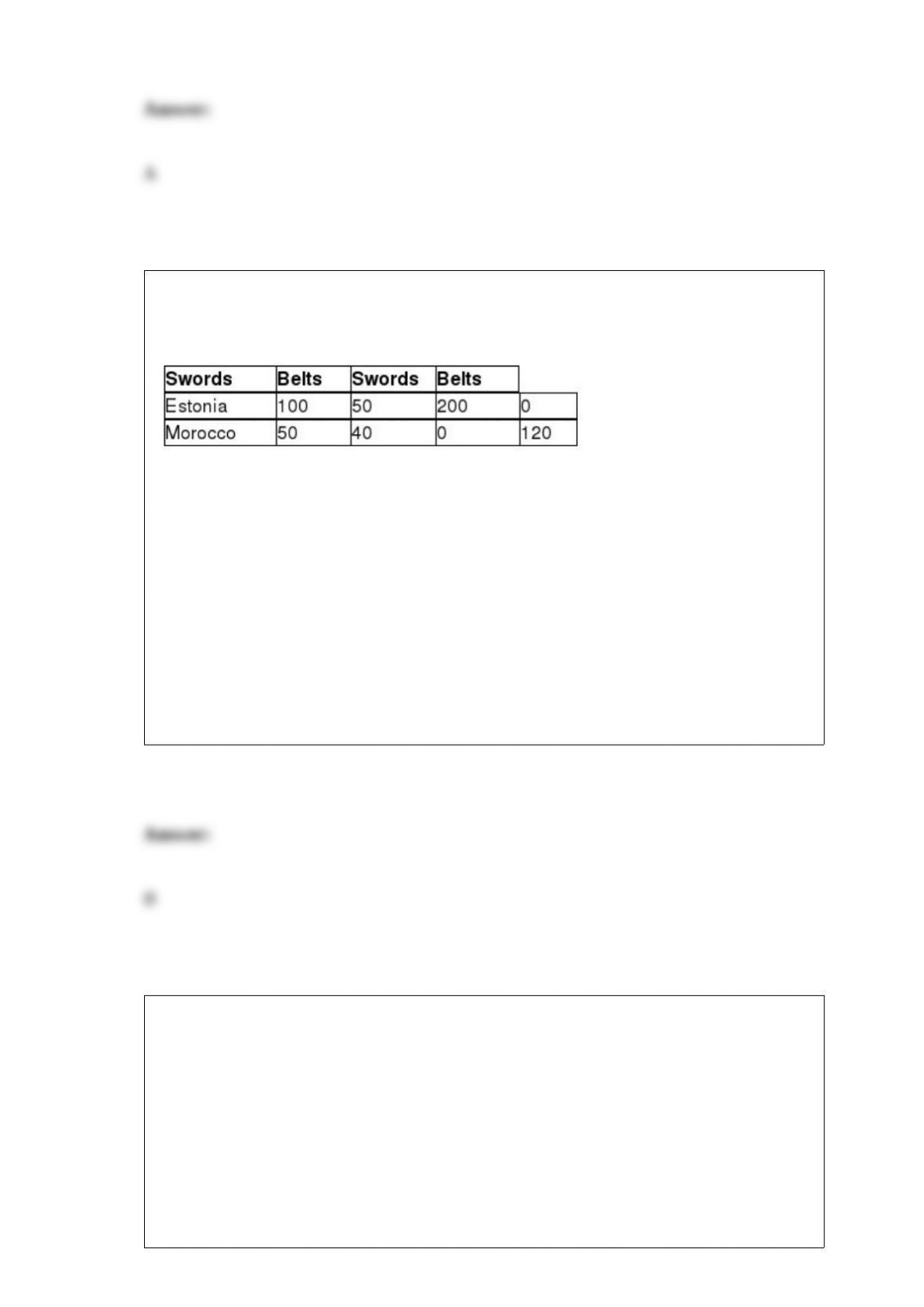
Table 7-6 Production and
Consumption Production
Without Trade With Trade
Estonia and Morocco can produce both swords and belts. Table 7-6 shows the
production and consumption quantities without trade, and the production numbers with
trade. If the actual terms of trade are 1 belt for 1.5 swords and 70 belts are traded, how
many swords will Morocco consume?
A) 50
B) 95
C) 105
D) 200
Allison’s Auto Art is a company that applies pinstripes to vehicles. Allison’s cost for a
basic 1-color pinstriping job is $35, and she charges $95 for this service. For a total
price of $175, Allison will apply a fancier 3-color pinstripe application to an
automobile, a service that adds an additional $40 to the total cost of the package. What
is the marginal cost of moving up from the 1-color application to the 3-color
application?
A) $35
B) $40
C) $80
D) $175
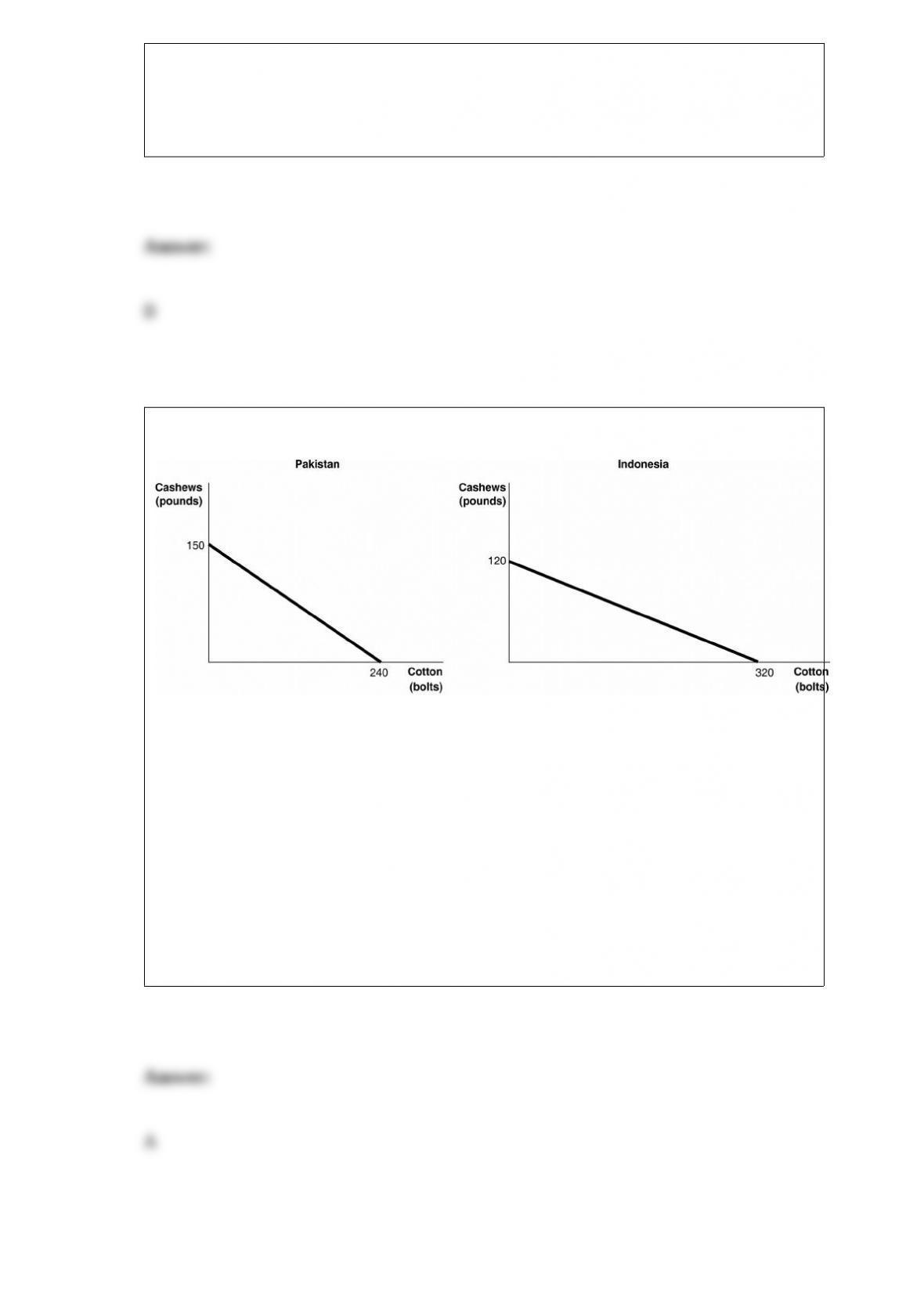
Figure 2-12
Figure 2-12 shows the production possibilities frontiers for Pakistan and Indonesia.
Each country produces two goods, cotton and cashews.
What is the opportunity cost of producing 1 bolt of cotton in Indonesia?
A) 3/8 of a pound of cashews
B) 5/8 of a pound of cashews
C) 2 2/3 pounds of cashews
D) 120 pounds of cashews
As the economy nears the end of an expansion, interest rates usually ________ and
wages raise more ________ than prices.
A) rise; rapidly
B) rise; slowly
C) fall; rapidly
D) fall; slowly
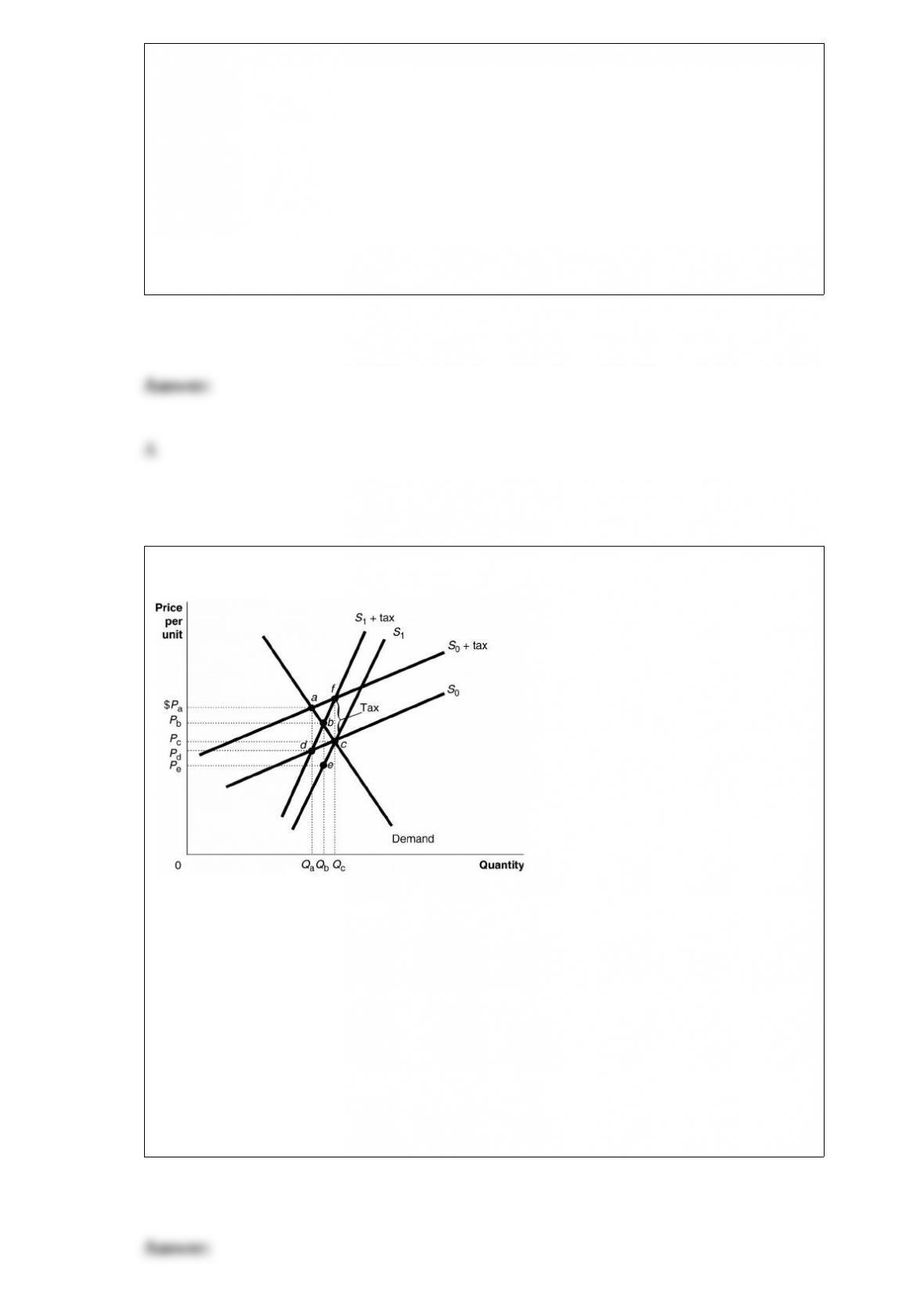
Figure 18-2
Figure 18-2 shows a demand curve
and two sets of supply curves, one set more elastic than the other. If the government
imposes an excise tax of $1.00 on every unit sold, what is the size of the deadweight
loss, if there is any?
A) the area adcif the supply curve is S0 and the area bec if the supply curve is S1.
B) the area afcdif the supply curve is S0 and the area bfce if the supply curve is S1.
C) the area becf under either supply curve.
D) There is no deadweight loss; revenue raised is used to fund government projects.

One important difference between the political process and the market process is that
A) the political process results in collective actions in which not everyone is required to
participate, while in the market process individuals are obliged to participate.
B) the political process results in collective actions in which everyone is obliged to
participate, while in the market process individuals are free to participate or not.
C) the political process results in collective actions that maximize economic surplus,
while the market process may lead to efficiency losses.
D) the political process results in collective actions in which everyone is made better
off, while the market process results in actions that favor some groups only.
If a corporation earns a profit, how do owners of the firm share in the profit?
A) through coupon payments on that firm’s bonds
B) through dividend payments on shares of that firm’s stock
C) by selling any bonds or stocks owned and realizing a capital gain
D) by raising the interest rate on bonds