
During the 1960s and 1970s, the U.S. trade balance was close to zero, but during the
1980s, the trade deficit ballooned to unprecedented levels due to:
A. an inability of U.S. companies to compete in the international market.
B. a decline in private saving that resulted from an upsurge in consumption.
C. a decline in national saving caused largely by rapidly rising government budget
deficits.
D. a worldwide recession that made it difficult for American companies to sell their
products abroad.
If the output gap equals 1.8 percent, then
A. cyclical unemployment equals the sum of structural and frictional unemployment.
B. there is an expansionary gap.
C. there is no cyclical unemployment.
D. potential GDP is less than actual GDP.
The recession of 2007-2009 happened in part because, after the housing bubble burst in
2006, the ensuing financial crisis:
A. made it difficult for government to finance deficit spending.

B. led to widespread inflation.
C. increased the level of uncertainty about the future.
D. shifted the PAE line upward.
Starting from long-run equilibrium, a large increase in government purchases will result
in a(n) ______ gap in the short-run and ____ inflation and ____ output in the long-run
A. expansionary; higher; potential
B. expansionary; lower; potential
C. expansionary; higher; higher
D. expansionary; higher; lower
Which one of the following policies mitigates the negative effects of moral hazard?
A. Mandatory car insurance for car owners
B. Lowering everyone’s insurance premium
C. Increasing everyone’s insurance premium
D. Insurance policies with large deductible provisions
If the marginal cost of reducing pollution is positive:
A. it should be reduced as much as technically feasible.
B. the marginal benefit is nearly zero.
C. the optimal amount of pollution is zero.
D. the optimal amount of pollution is greater than zero.
In an economy where planned aggregate spending is given by PAE = 5,500 + 0.6Y –
20,000r, the interest rate is currently 2 percent (0.02). If potential output equals 8,000,
the central bank must ______ the interest rate to close the ______ gap.
A. lower; expansionary
B. lower; recessionary
C. raise; recessionary
D. raise; expansionary
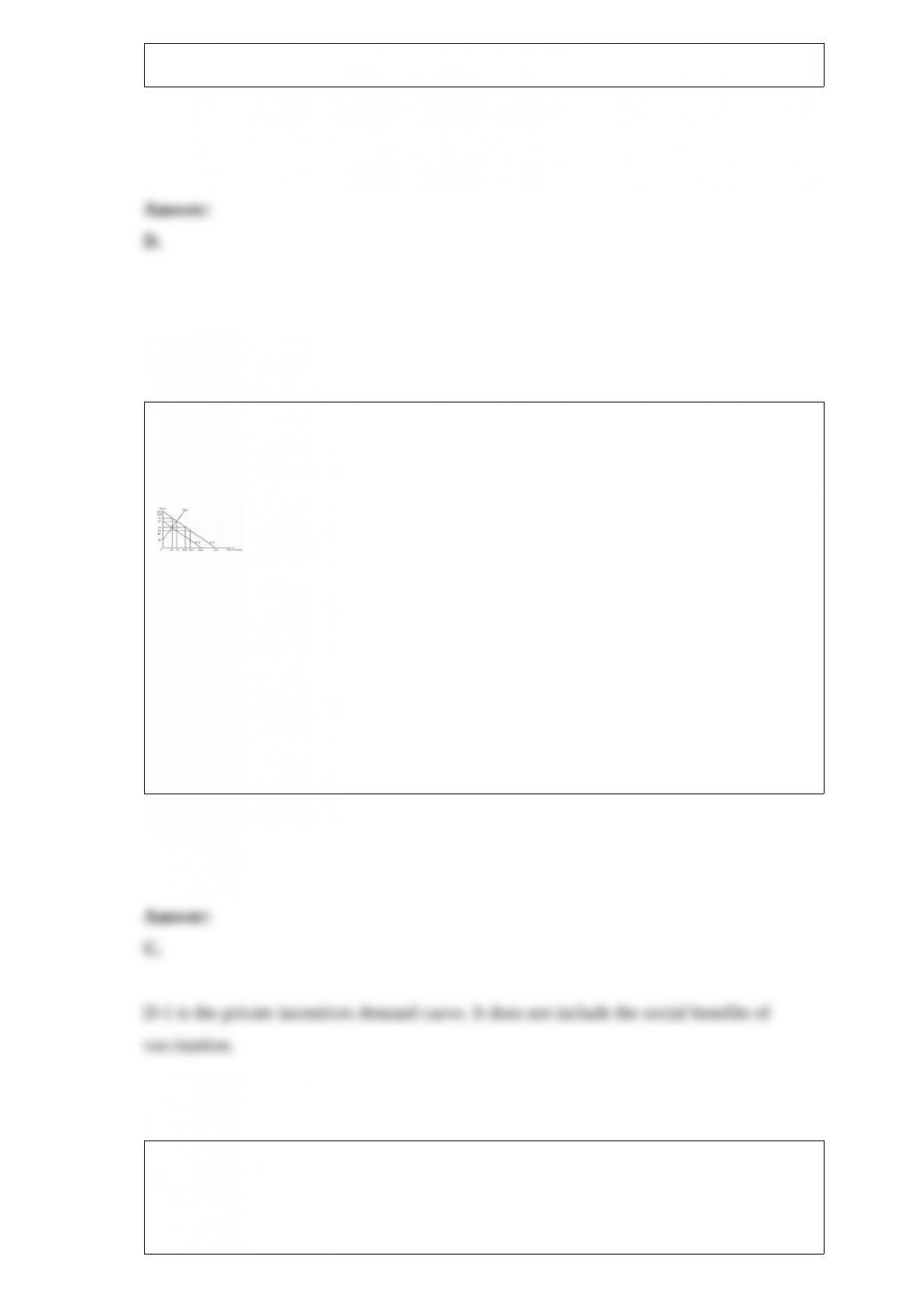
Suppose that a vaccine is developed for a highly contagious strain of flu. The likelihood
that anyone will get this flu decreases as more people receive the vaccine. One of the
demand curves in the diagram reflects private benefits and the other reflects social
benefits.
Refer to the figure above. Private incentives will lead to _____ people receiving the
vaccine at a cost of _____.
A. 75; $80
B. 75; $50
C. 50; $60
D. 50; $90
Charlie is getting a divorce. He selects a female lawyer at a large law firm because he
believes they are more aggressive in obtaining favorable settlements in divorce cases.
Charlie’s behavior is an example of _____ discrimination.
A. market

B. employer
C. employee
D. customer
In Macroland, a country that operates according to Okun’s law, potential GDP equals
$10 trillion, the actual rate of unemployment is 8 percent, and the natural
unemployment rate is 6 percent. What is real GDP in Macroland?
A. $9.6 trillion
B. $9.8 trillion
C. $10 trillion
D. $10.2 trillion
The fact that output gaps will not last indefinitely, but will be closed by rising or falling
prices is the economy’s:
A. short-run equilibrium property.
B. self-correcting property.
C. income-expenditure multiplier.
D. long-run equilibrium property.
Suppose a firm is collecting $100 in total revenues when it sells 10 units and it receives
$110 in total revenues when it sells 11 units. The firm is a(n):
A. pure monopolist.
B. oligopolist.
C. monopolistic competitor.
D. perfect competitor.
The benefits to specialization are enhanced when two trading partners have:
A. absolute advantages in producing the same goods.
B. similar consumption preferences.
C. very similar opportunity costs.
D. large comparative advantages in different goods.
The central bank of the United States is:
A. Bank of America.
B. Bank of the United States.
C. Bank One.
D. the Federal Reserve System.
Suppose you believe that plaid flannel shirts are an inferior good, and want to test this
with economic data. You expect to find that the income elasticity for plaid flannel shirts
is:
A. close to zero.
B. greater than zero, but less than one.
C. greater than one.
D. less than zero.
The most important, most convenient, and most flexible way in which the Federal
Reserve affects the supply of bank reserves is through:
A. conducting open-market operations.
B. changing the Federal Reserve discount rate.
C. changing bank reserve requirement ratios.
D. changing interest rates.
The following data give the dates of successive turning points in U.S. economic activity
and the corresponding levels of real GDP at the time:
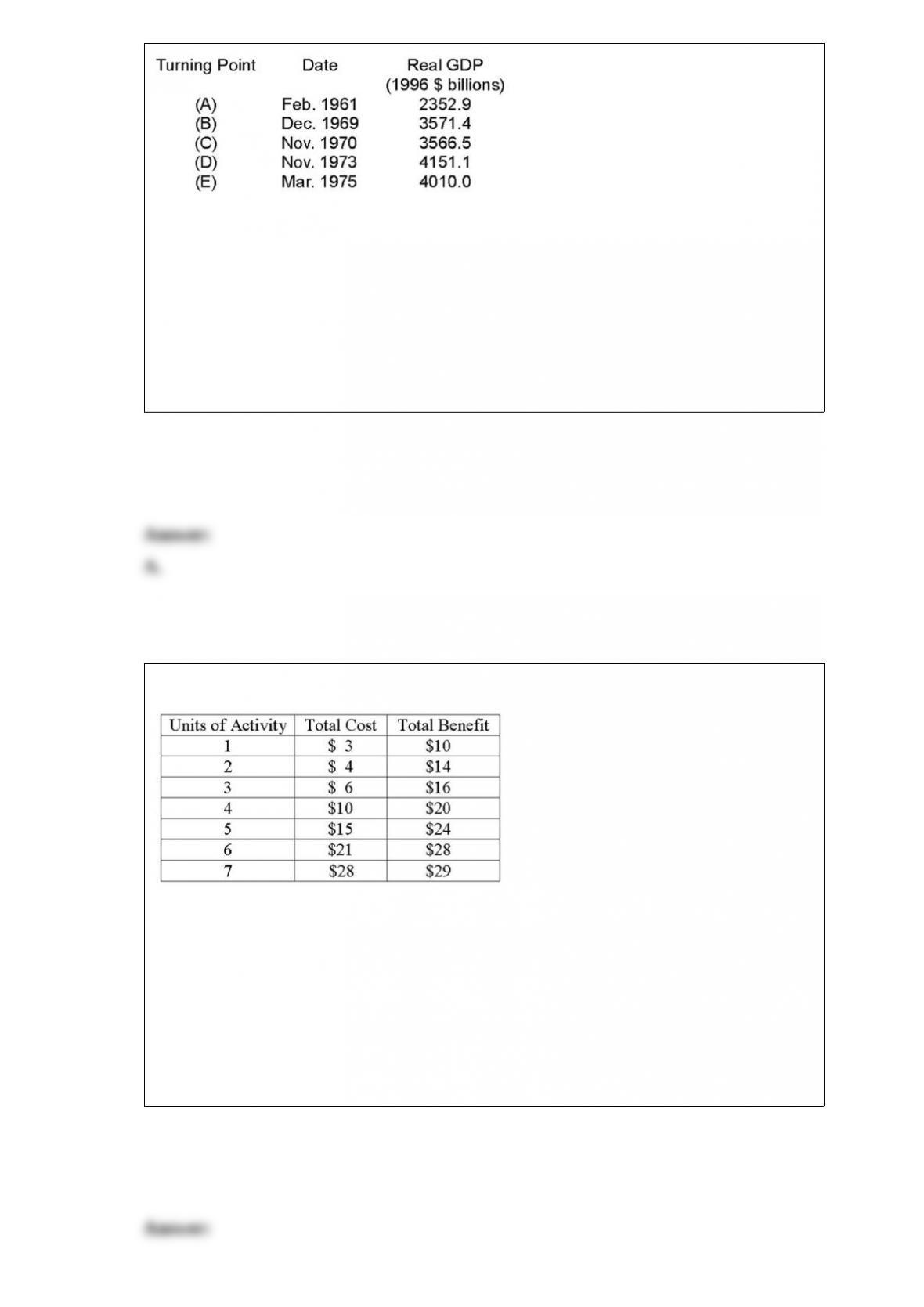
Which of the following periods was an expansion?
A. February 1961 through December 1969
B. December 1969 through November 1970
C. November 1970 through March 1975
D. December 1969 through November 1973
Refer to the table above. The average benefit of 4 units of activity is:
A. $4
B. $5
C. $6
D. $10
If a point on a production possibilities curve is attainable:
A. it must be efficient.
B. it might or might not be efficient.
C. it is efficient only if it does not exhaust all currently available resources.
D. it must completely exhaust all currently available resources.
Holding all else constant, a decrease in the real interest rate on Mexican assets will
______ the supply of dollars in the foreign exchange market and ______ the
equilibrium Mexican peso/U.S. dollar exchange rate.
A. increase; increase
B. increase; decrease
C. decrease; decrease
D. decrease; increase
Cost saving developmentse.g., a new production procedure that shortens a production
process by two stepsin a perfectly competitive industry will lead to:
A. entry by new firms.
B. economic profits by new firms.
C. economic profits for a few firms for a short time.
D. a leftward shift of the supply curve.
The following table shows the relationship between the speed of a computer’s CPU and
the benefits and costs. Assume that all other features of the computer are the same, i.e.,
CPU speed is the only source of variation.
The marginal benefit of upgrading from a 600 Mhz computer to a 700 Mhz computer is:
A. $1,500.
B. $500.
C. $50.
D. $5.

When the price of a good rises, the ratio of the marginal utility of that good divided by
its price _______ and as a result, consumers purchase _______ of that good.
A. rises; more
B. falls; more
C. rises; less
D. falls; less
In the basic Keynesian model, an increase in transfer payments:
A. reduces short-run equilibrium output.
B. increases short-run equilibrium output.
C. reduces potential output.
D. increases potential output.
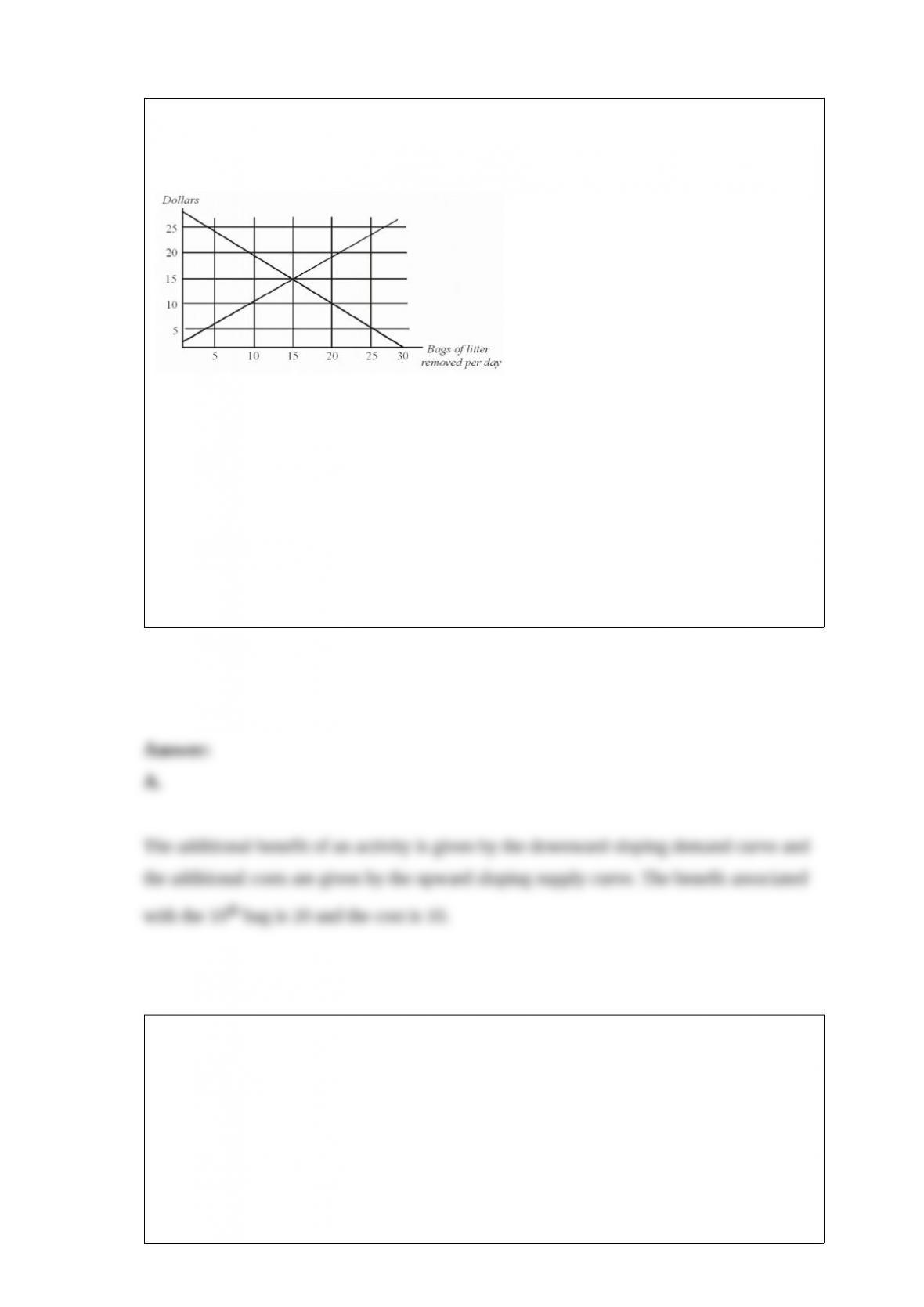
This graph shows the marginal costs and marginal benefits associated with roadside
litter clean up. Assume that the marginal cost and marginal benefit curves slope in the
usual directions.
Refer to the information given above. From the graph, one can infer that:
A. the benefits of picking up the 10th bag of litter exceed the costs.
B. the costs of picking up the 10th bag exceed the benefits.
C. the benefits of picking up the 20th bag exceed the costs.
D. the total benefit of having 30 bags removed is less than the total benefit of having 25
bags removed.
Government purchases include all of the following EXCEPT:
A. social security benefits paid by the federal government.
B. the construction of a new court house built by a county government.
C. the salary paid to an elementary school teacher employed by a local public school
district.
D. the purchase of new military hardware by the U.S. Army.

The duration of an expansion is from:
A. peak to trough.
B. trough to peak.
C. peak to peak.
D. trough to trough.
If the price of tables sold by All-Oak Table Co. increases from $400 to $500, then the:
A. supply of labor to All-Oak Table Co. increases.
B. supply of labor to All-Oak Table Co. decreases.
C. demand for labor by All-Oak Table Co. decreases.
D. demand for labor by All-Oak Table Co. increases.

Banks help savers find productive uses for their funds because banks have specialized
in:
A. gathering information about and evaluating potential borrowers.
B. obtaining preferential tax treatment for savers.
C. securing government guarantees for loans.
D. evaluating the riskiness of stocks.
The most important, most convenient, and most flexible way in which the Federal
Reserve affects the supply of bank reserves is through:
A. conducting open-market operations.
B. changing the Federal Reserve discount rate.
C. changing bank reserve requirement ratios.
D. changing interest rates.