1) Labor unions will raise the quantity of labor demanded.
a.True
b.False
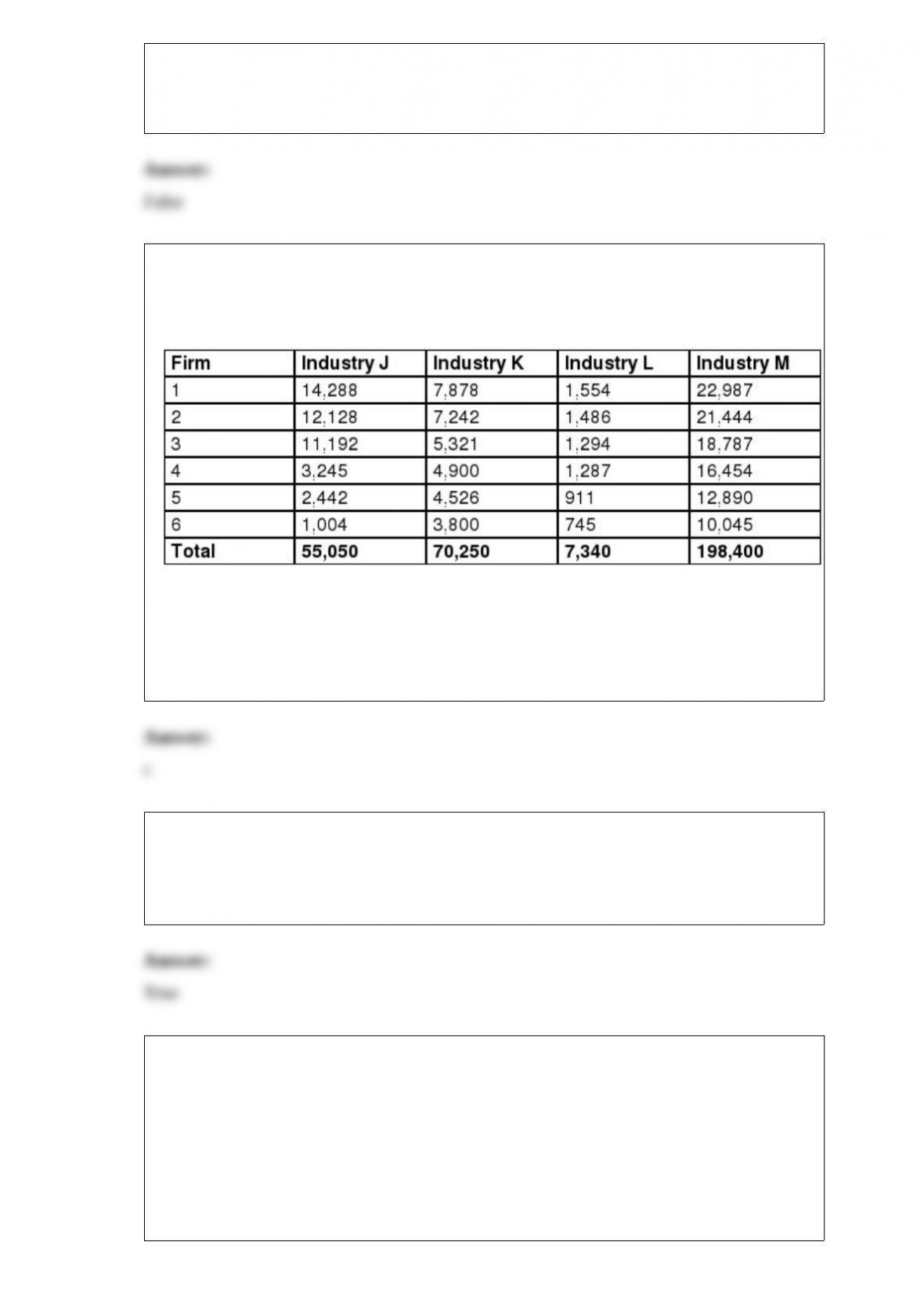
2) Table 16-2
The following table shows the total output produced by the top six firms as well as the
total industry output for each industry.
What is the concentration ratio for Industry M?
a.about 96%
b.about 52%
c.about 40%
d.about 22%
3) Some goods can be classified as either public goods or private goods depending on
the circumstances.
a.True
b.False
4) Two bottles of body wash sit side-by-side in a grocery store: Olay (a brand name)
sells for $6.00, while Up and Up (not a brand name) sells for $3.00. Even defenders of
brand names would have to admit that
a.no rational consumer would spend twice as much for Olay as she would for Up and
Up.
b.the side-by-side presence of these two body washes conveys no useful information to
consumers.
c.Olay has no incentive to maintain the quality of its product just because of the Olay
brand name.
d.None of the above is correct.
5) If a monopoly lowers its price, its
a.total revenue must increase.
b.total revenue must decrease.
c.marginal revenue must increase.
d.marginal revenue must decrease.
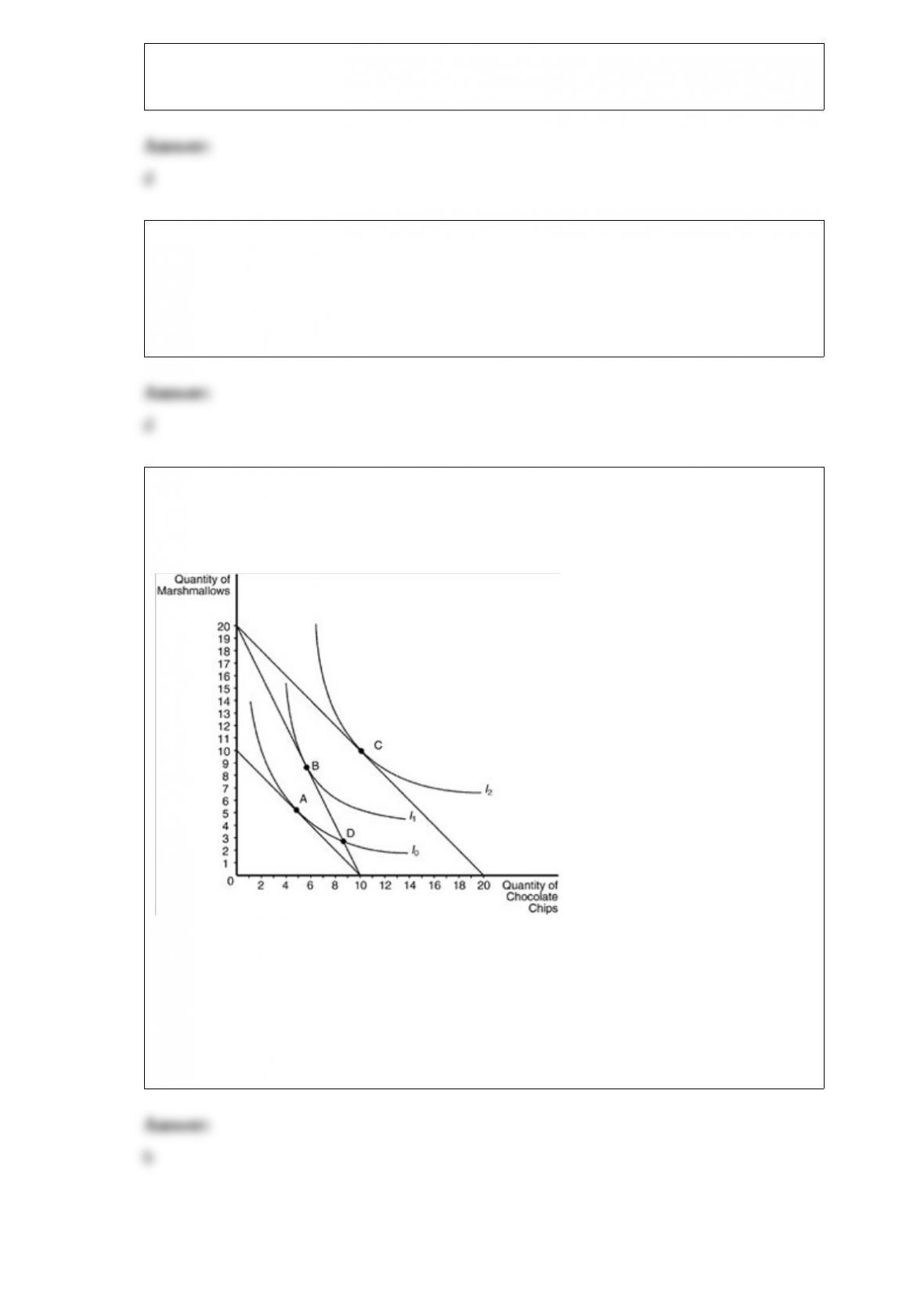
6) Figure 21-20
The following graph illustrates a representative consumer’s preferences for
marshmallows and chocolate chip cookies:
Refer to Figure 21-20. Assume that the consumer has an income of $100 and currently
optimizes at bundle A. When the price of marshmallows decreases to $5, which bundle
will the optimizing consumer choose?
a.A
b.B
c.C
d.D
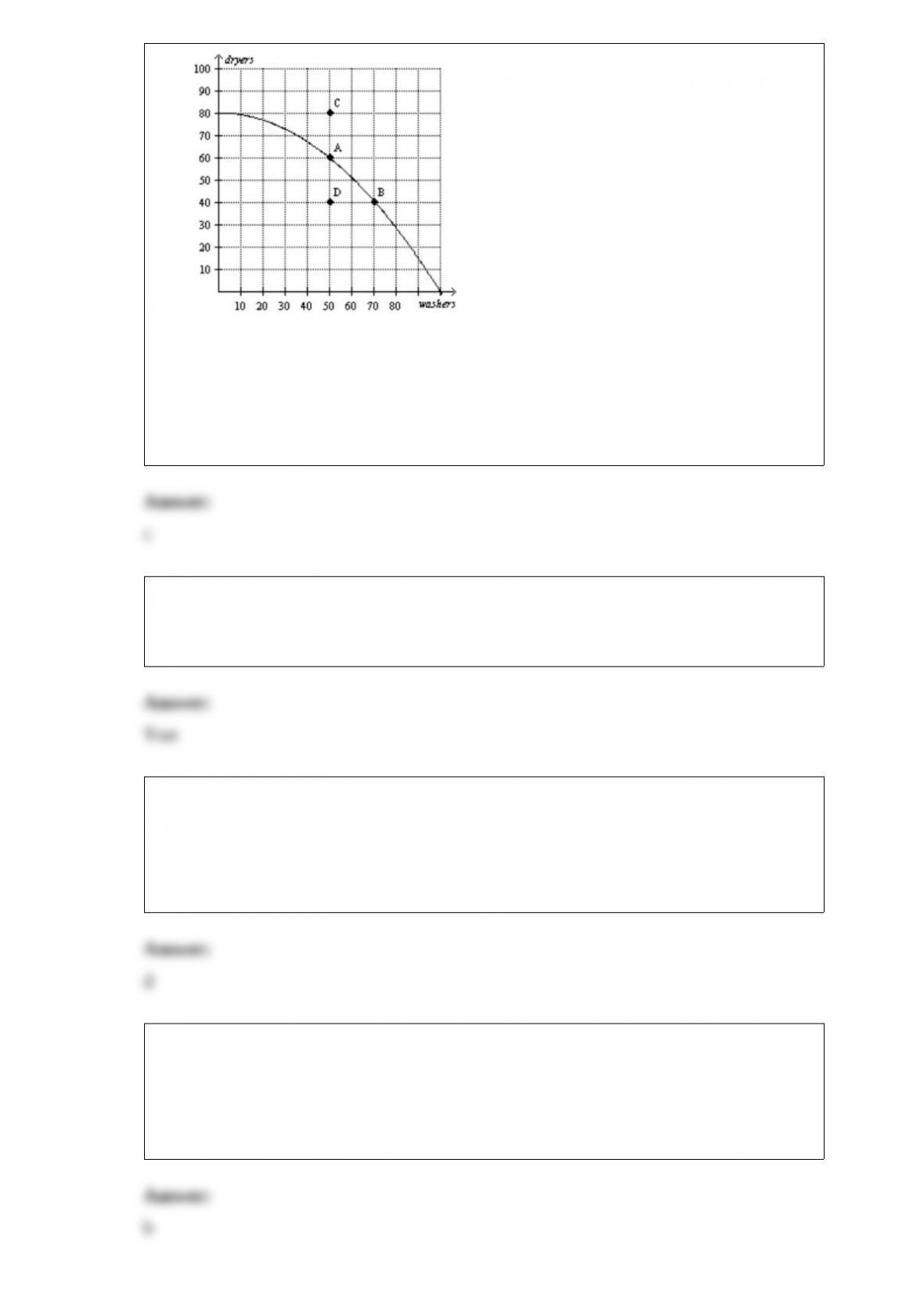
7)
It is not possible for this economy to produce at point
a.A.
b.B.
c.C.
d.D.
8) Land, labor, and capital are examples of factors of production.
a.True
b.False
9) When an industry is a natural monopoly,
a.it is characterized by constant returns to scale.
b.it is characterized by diseconomies of scale.
c.a larger number of firms may lead to a lower average cost.
d.a larger number of firms will lead to a higher average cost.
10) Effective minimum-wage laws will most likely
a.increase demand for labor.
b.create a surplus of labor.
c.increase incomes for all unskilled workers.
d.decrease incomes for all unskilled workers.

11) Suppose the price of good X falls. As a result, the quantity demanded for good X
increases for a particular consumer. For this consumer, the substitution effect induced
the consumer to purchase more X while the income effect induced the consumer to
purchase less X. We can infer that X is a(n)
a.normal good.
b.inferior good.
c.Giffen good.
d.luxury good.
12) Suppose that a competitive market is initially in equilibrium. Then demand
increases. If entering firms face the same costs as existing firms and sufficient resources
are available for entering firms,
a.the long-run market supply curve will be upward sloping.
b.the long-run market supply curve will be perfectly elastic.
c.in the long run firms will suffer economic losses, leading them to exit the industry.
d.the number of firms will decrease, and the market will become a monopoly.
13) In the market for widgets, the supply curve is the typical upward-sloping straight
line, and the demand curve is the typical downward-sloping straight line. The
equilibrium quantity in the market for widgets is 200 per month when there is no tax.
Then a tax of $5 per widget is imposed. The price paid by buyers increases by $2 and
the after-tax price received by sellers falls by $3. The government is able to raise $750
per month in revenue from the tax. The deadweight loss from the tax is
a.$250.
b.$125.
c.$75.
d.$50.
14) A positive economic statement such as Pollution taxes decrease the quantity of
pollution generated by firms
a.would likely be made by an economist acting as a policy advisor.
b.would require values and data to be evaluated.
c.would require data but not values to be evaluated.
d.could not be evaluated by economists acting as scientists.